
Gallium Arsenide Germanium Solar Cell (Gaas) Market Report 2026
Global Outlook – By Type ( Liquid Encapsulated Czochralski (LEC) Grown Gallium Arsenide (GaAs), VGF (Vertical Gradient Freeze) Grown Gallium Arsenide (GaAs)), By Channel ( Direct Sales, Other Distribution Channel), By Application ( Spacecraft Power Systems, High-Altitude Long-Endurance (HALE) Unmanned Aerial Vehicles, Concentrated Photovoltaic (CPV) Systems, Research And Development Or Experimental Solar Technologies, Military And Defense Solar Power Applications) – Market Size, Trends, Strategies, and Forecast to 2030
Gallium Arsenide Germanium Solar Cell (Gaas) Market Overview
• Gallium Arsenide Germanium Solar Cell (Gaas) market size has reached to $15.96 billion in 2025 • Expected to grow to $22.82 billion in 2030 at a compound annual growth rate (CAGR) of 7.3% • Growth Driver: Growing Demand For Electric Vehicle Is Driving The Growth Of The Gallium Arsenide Germanium Solar Cells Market • Market Trend: Advancements In Gallium Arsenide Germanium (Gaas) Space Solar Cell Technology • Asia-Pacific was the largest region in 2025 and North America is the fastest growing region.Market Gains By 2030 – Top Opportunities By Segment
Market Gain identifies the most promising market opportunities by highlighting the segments or products expected to generate the highest incremental revenue growth over the next five years.
What Is Covered Under Gallium Arsenide Germanium Solar Cell (Gaas) Market?
Gallium arsenide germanium solar cell (Gaas) is a type of high-efficiency solar cell that combines materials from the III-V semiconductor family. GaAs are known for their high electron mobility, direct bandgap, and excellent heat-resistant properties. These properties make it particularly suitable for high-efficiency solar cells and applications where high temperatures and radiation are present. The main types of gallium arsenide germanium solar cells (Gaas) are liquid encapsulated Czochralski (LEC) grown gallium arsenide (Gass), VGF (vertical gradient freeze) grown gallium arsenide (Gaas). Liquid encapsulated czochralski (LEC) grown gallium arsenide (GaAs) is a method of growing high-quality single crystals of gallium arsenide using the LEC process. The various channels include direct sales, and others that are used in various applications such as radio frequency electronics, light emitting diodes, photovoltaic devices, photonic devices, wireless communication, optoelectronic devices, and other applications.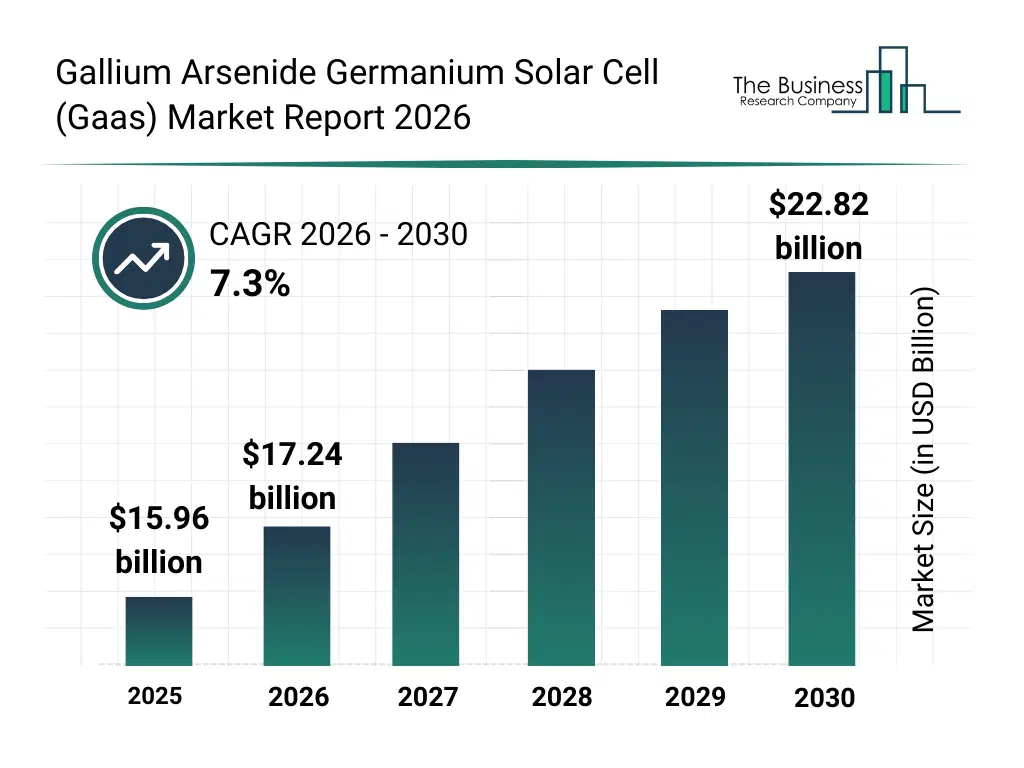
What Is The Gallium Arsenide Germanium Solar Cell (Gaas) Market Size 2026 And Growth Rate?
The gallium arsenide germanium solar cell (gaas) market size has grown strongly in recent years. It will grow from $15.96 billion in 2025 to $17.24 billion in 2026 at a compound annual growth rate (CAGR) of 8.0%. The growth in the historic period can be attributed to early adoption of gaas in space applications, demand for high efficiency solar cells, advancements in iii-v semiconductor fabrication, growth in satellite and aerospace programs, limitations of silicon solar efficiency.What Is The Gallium Arsenide Germanium Solar Cell (Gaas) Market Growth Forecast?
The gallium arsenide germanium solar cell (gaas) market size is expected to see strong growth in the next few years. It will grow to $22.82 billion in 2030 at a compound annual growth rate (CAGR) of 7.3%. The growth in the forecast period can be attributed to rising investments in space solar power, increasing demand for high performance photovoltaics, advancements in epitaxial growth techniques, growing use in wireless and optoelectronic systems, focus on high efficiency renewable energy solutions. Major trends in the forecast period include high-efficiency iii-v solar cell adoption, advanced semiconductor material integration, high-temperature and radiation-resistant solar solutions, expansion of space-grade photovoltaic technologies, increased use of compound semiconductors in energy systems.
Global Gallium Arsenide Germanium Solar Cell (Gaas) Market Segmentation
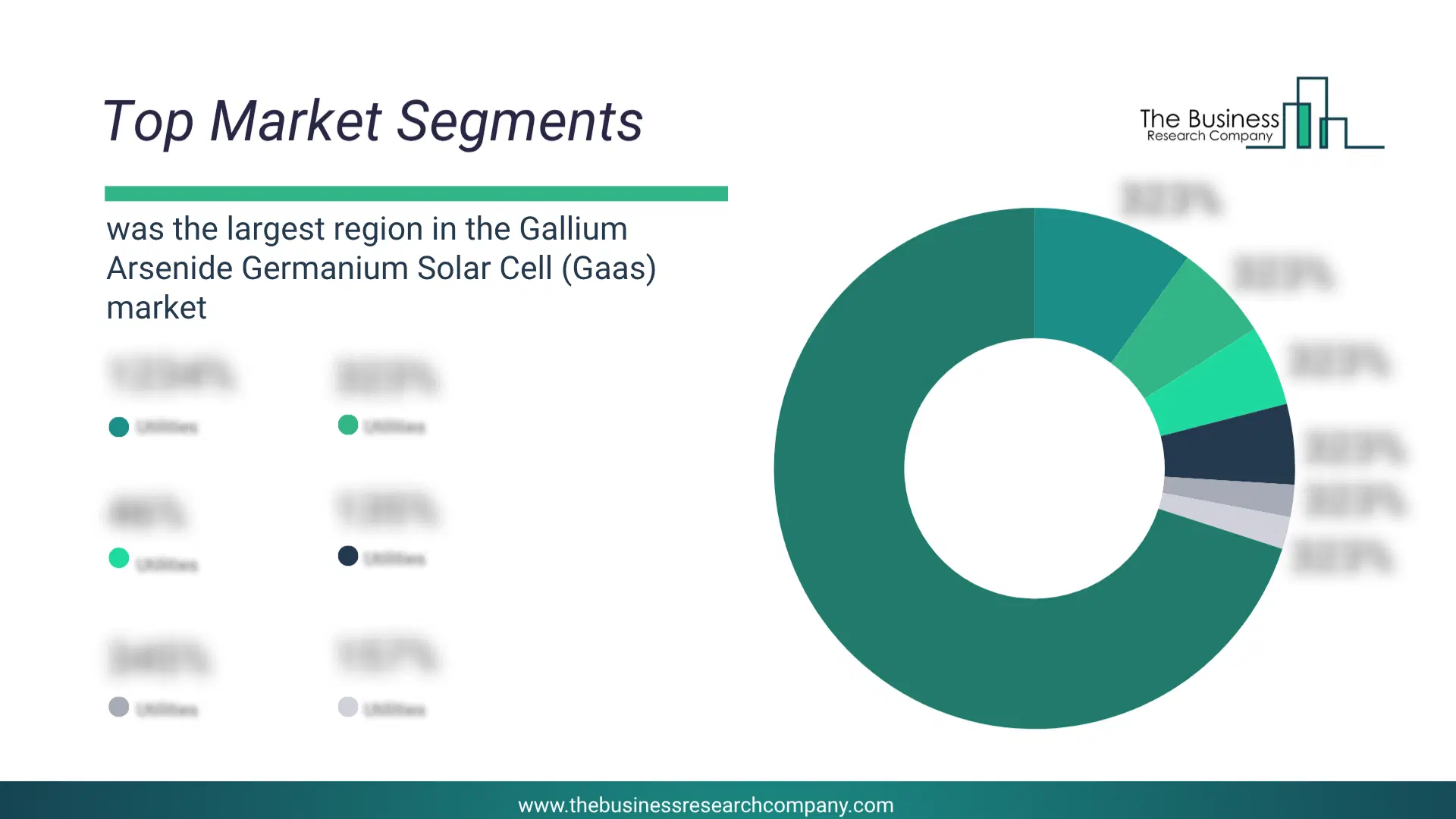
1) By Type: Liquid Encapsulated Czochralski (LEC) Grown Gallium Arsenide (GaAs), VGF (Vertical Gradient Freeze) Grown Gallium Arsenide (GaAs) 2) By Channel: Direct Sales, Other Distribution Channel 3) By Application: Spacecraft Power Systems, High-Altitude Long-Endurance (HALE) Unmanned Aerial Vehicles, Concentrated Photovoltaic (CPV) Systems, Research And Development Or Experimental Solar Technologies, Military And Defense Solar Power Applications Subsegments: 1) By Liquid Encapsulated Czochralski (LEC) Grown GaAs: Liquid Encapsulated Czochralski (LEC) Grown GaAs, Semi-Insulating LEC GaAs Wafers, Semi-Conducting LEC GaAs Wafers, N-Type LEC GaAs Substrates, P-Type LEC GaAs Substrates, Large-Diameter LEC GaAs Wafers (=4-inch) 2) By VGF (Vertical Gradient Freeze) Grown GaAs: High-Purity VGF GaAs Wafers, Low-Dislocation-Density VGF GaAs, N-Type VGF GaAs Substrates, P-Type VGF GaAs Substrates, Space-Grade VGF GaAs Wafers The top segments in the gallium arsenide germanium solar cell (gaas) market will be: • Liquid Encapsulated Czochralski (LEC) Grown Gallium Arsenide (GaAs) will reach $12.8 Billion by 2030. • VGF (Vertical Gradient Freeze) Grown Gallium Arsenide (GaAs) will reach $7.82 Billion by 2030.What Is The Driver Of The Gallium Arsenide Germanium Solar Cell (Gaas) Market?
The rise in popularity of renewable energy sources is expected to propel the growth of the gallium arsenide germanium solar cell (Gaas) market going forward. Renewable energy sources are energy sources that are naturally replenished on a human timescale and derived from natural processes that are continuously replenished. The increasing demand for renewable energy sources is driven by several factors, such as climate change and sustainability goals. Gallium arsenide solar cells are highly efficient and reliable, making them a valuable component in the increasing demand for renewable energy sources. Their unique properties make them particularly valuable for specialized applications, contributing to a more sustainable and resilient energy infrastructure. For instance, in January 2024, according to the International Energy Agency (IEA), a France-based intergovernmental organization, in 2023, the global addition of renewable energy capacity surged by 50%, reaching nearly 510 gigawatts more than in 2022. Therefore, the rise in popularity of renewable sources is driving the growth of the gallium arsenide germanium solar cell (Gaas) industry.What Is The Driver Of The Gallium Arsenide Germanium Solar Cell (Gaas) Market?
The growing adoption of the Internet of Things (IoT) is expected to propel the growth of the gallium arsenide germanium solar cell going forward. The Internet of Things (IoT) refers to the network of physical devices embedded with sensors, software, and other technologies to connect and exchange data with other devices and systems over the Internet. The growing adoption of the Internet of Things (IoT) is primarily driven by enhanced operational efficiency, cost reduction through predictive maintenance, and improved decision-making. GaAs solar cells perform well in low-light and indoor conditions, making them ideal for IoT devices in shaded, indoor, and variable lighting environments where traditional silicon-based cells may struggle. For instance, in April 2024, according to a report published by Ericsson, a Sweden-based telecommunications company, global IoT connections reached 15.7 billion connections in 2023 and are expected to increase by 16% to 38.8 billion connections by 2029. Therefore, the growing adoption of IoT drives the gallium arsenide germanium solar cell market.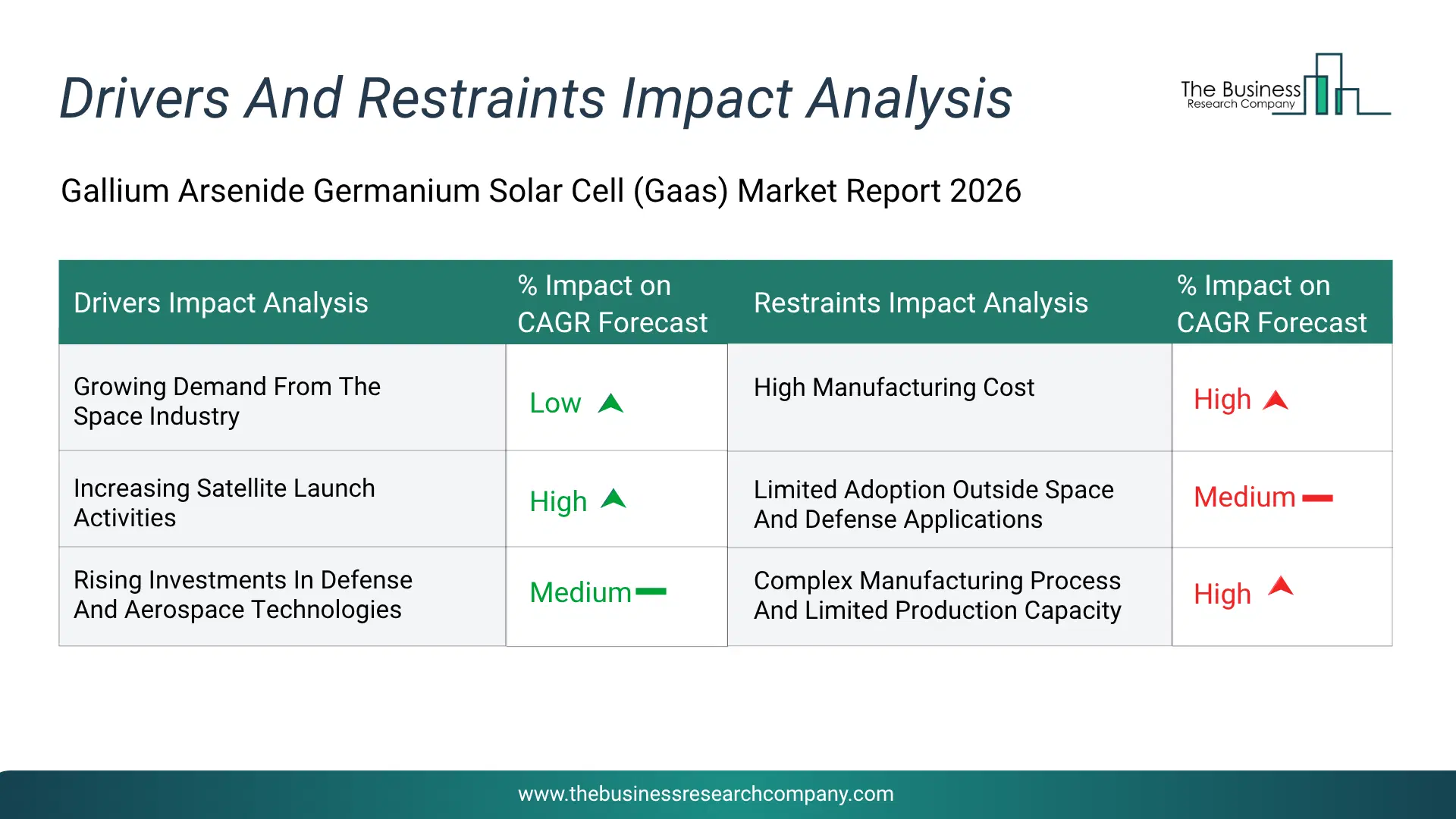
Infographic Chart Showing Key Market Drivers Analysis And Restraints For Gallium Arsenide Germanium Solar Cell (Gaas) Market
The chart presents an impact analysis of key drivers and restraints, quantifying their relative influence on the market's growth rate and helping assess the balance between growth enablers and limiting factors. This chart offers a high-level perspective; the full report contains more detailed insights.
How Will The Drivers Impact Growth In The Global Gallium Arsenide Germanium Solar Cell (Gaas) Market?
• Growing Demand From The Space Industry (Low) – During the forecast period, the growing demand from the space industry is expected to become a key growth driver for the gallium arsenide germanium solar cell (Gaas) market by 2030. Growing demand from the space industry acts as a major driver for the Gallium Arsenide Germanium (GaAs) solar cell market because satellites, space stations, and deep-space missions require solar cells that deliver very high efficiency while operating reliably in harsh environments. GaAs solar cells provide excellent radiation resistance, high power output, and stable performance under extreme temperatures, making them the preferred choice for space applications. Rising investments by government space agencies and private satellite operators continue to increase demand for advanced space-grade solar cells. • Increasing Satellite Launch Activities (High) – During the forecast period, the increasing satellite launch activities is expected to emerge as a major factor driving the expansion of the gallium arsenide germanium solar cell (Gaas) market by 2030. Increasing satellite launch activities act as a major driver for the Gallium Arsenide Germanium (GaAs) solar cell market because every satellite requires a dependable and lightweight power source for long-term operation. The rapid growth of low Earth orbit satellite constellations for broadband, defense, weather monitoring, and remote sensing is creating consistent demand for high-performance solar cells. GaAs technology offers higher energy conversion efficiency than conventional silicon cells, helping satellites generate more power within limited surface area. • Rising Investments In Defense And Aerospace Technologies (Medium) – During the forecast period, the rising investments in defense and aerospace technologies is expected to act as a key growth catalyst for the gallium arsenide germanium solar cell (Gaas) market by 2030. Rising investments in defense and aerospace technologies act as a major driver for the Gallium Arsenide Germanium (GaAs) solar cell market because modern defense satellites, military communication systems, and aerospace platforms require highly reliable power generation technologies. Governments across major economies continue increasing spending on national security, surveillance, and advanced space capabilities, creating sustained demand for space-qualified solar cells. GaAs solar cells offer the durability and long operational life required for critical defense missions.How Will The Restraints Impact Growth In The Global Gallium Arsenide Germanium Solar Cell (Gaas) Market?
• High Manufacturing Cost (Low) – During the forecast period, the high manufacturing cost acts as a major restraint for the Gallium Arsenide Germanium (GaAs) solar cell market because producing GaAs solar cells requires expensive raw materials, complex semiconductor fabrication processes, and highly specialized manufacturing equipment. These factors make GaAs solar cells significantly more expensive than conventional silicon solar cells. Many commercial users hesitate to adopt them due to the high upfront investment. As a result, adoption remains largely limited to premium applications such as space and defense, restricting wider market expansion. • Limited Adoption Outside Space And Defense Applications (High) – During the forecast period, the limited adoption outside space and defense applications acts as a major restraint for the Gallium Arsenide Germanium (GaAs) solar cell market because most commercial and residential solar projects prioritize lower-cost silicon-based technologies. Although GaAs solar cells offer superior efficiency, their high price makes them unsuitable for many large-scale terrestrial installations. Demand therefore remains concentrated in a few specialized industries. This narrow customer base slows overall market penetration and limits production scale. • Complex Manufacturing Process And Limited Production Capacity (Medium) – During the forecast period, the complex manufacturing process and limited production capacity act as restraints on the Gallium Arsenide Germanium (GaAs) Solar Cell market because producing high-efficiency GaAs cells requires advanced semiconductor fabrication techniques and specialized manufacturing expertise. The complexity of production limits scalability compared with conventional silicon solar technologies. Limited manufacturing capacity can increase lead times and restrict availability for large-scale applications. These challenges also reduce opportunities for cost reduction through mass production. As a result, production limitations continue to restrict wider adoption of GaAs solar cells.Key Players In The Global Gallium Arsenide Germanium Solar Cell (Gaas) Market
Major companies operating in the gallium arsenide germanium solar cell (gaas) market are Spectrolab, Inc., SolAero Technologies Corp., Azur Space Solar Power GmbH, Emcore Corporation, MicroLink Devices, Inc., Alta Devices, Inc., Solar Junction Corporation, AXT, Inc., Freiberger Compound Materials GmbH, Xiamen Powerway Advanced Material Co., Ltd., DOWA Electronics Materials Co., Ltd., Vital Materials Co., Ltd., Semiconductor Wafer, Inc., IQE plc, WIN Semiconductors Corp., China Crystal Technologies Co., Ltd., Umicore NV, Veeco Instruments Inc., Aixtron SE, Advanced Micro-Fabrication Equipment Inc. (AMEC), Sumitomo Electric Industries, Ltd., Sumika Electronic Materials, Inc., JDS Uniphase Corporation, Kopin Corporation, Anadigics, Inc.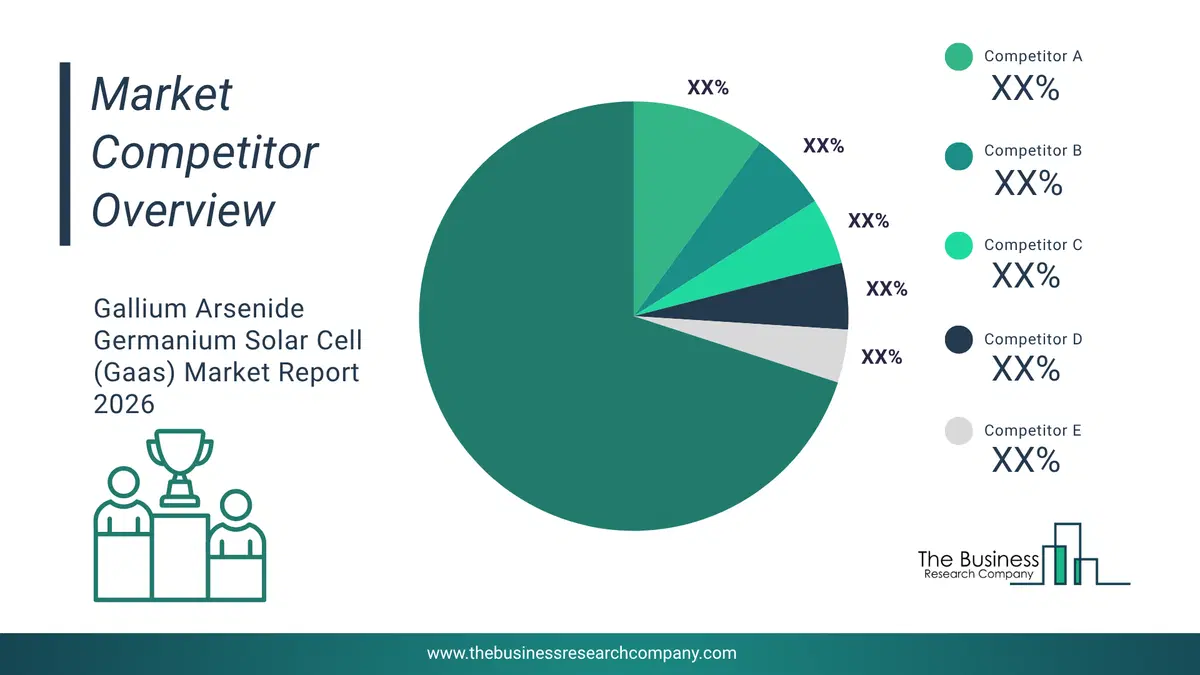
This chart is for illustrative purposes; the full report includes a detailed competitor analysis and comprehensive overview of the top 10 companies in the market.
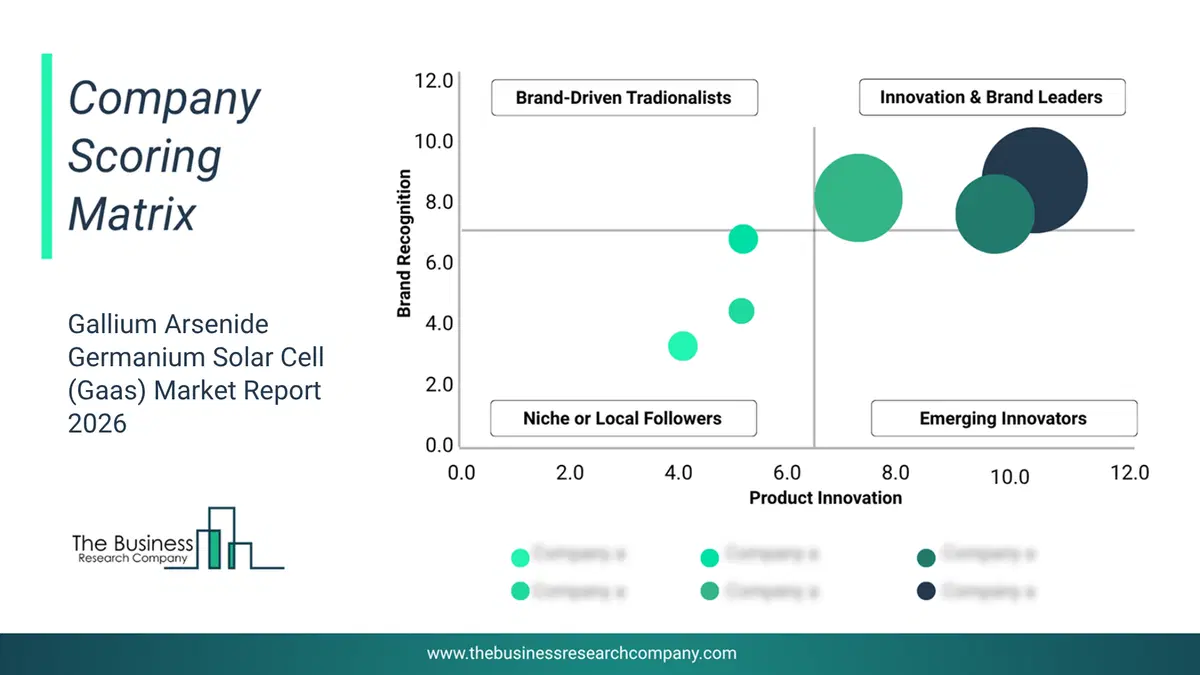
This chart maps companies by product innovation and brand strength, with bubble size indicating relative revenue, helping identify market leaders, challengers, and niche players. This is an illustrative chart; the full report provides a complete and accurate competitive analysis.
Global Gallium Arsenide Germanium Solar Cell (Gaas) Market Trends and Insights
Major companies operating in the gallium arsenide germanium solar cell (Gaas) market are developing innovative technology, such as space solar cell technology, to enhance energy efficiency and reliability for satellite and spacecraft applications. Space solar cell technology based on gallium arsenide and germanium (GaAs/Ge) utilizes semiconductor materials such as gallium arsenide (GaAs) and germanium (Ge) to convert sunlight into electricity. For instance, in March 2023, Rocket Lab USA Inc., a US-based aerospace and defense company, launched a new space solar cell called IMM-β. This new cell is currently the highest-efficiency space solar cell technology in high-volume production. The technology behind IMM-β solar cells involves the use of gallium arsenide germanium solar cells (GaAs) and other materials such as indium gallium phosphide (InGaP) to achieve high efficiencies. The IMM-β solar cells have an average beginning of life (BOL) efficiency of 33.3%, which is higher than the 32% efficiency of the IMM-α cell that is currently in production.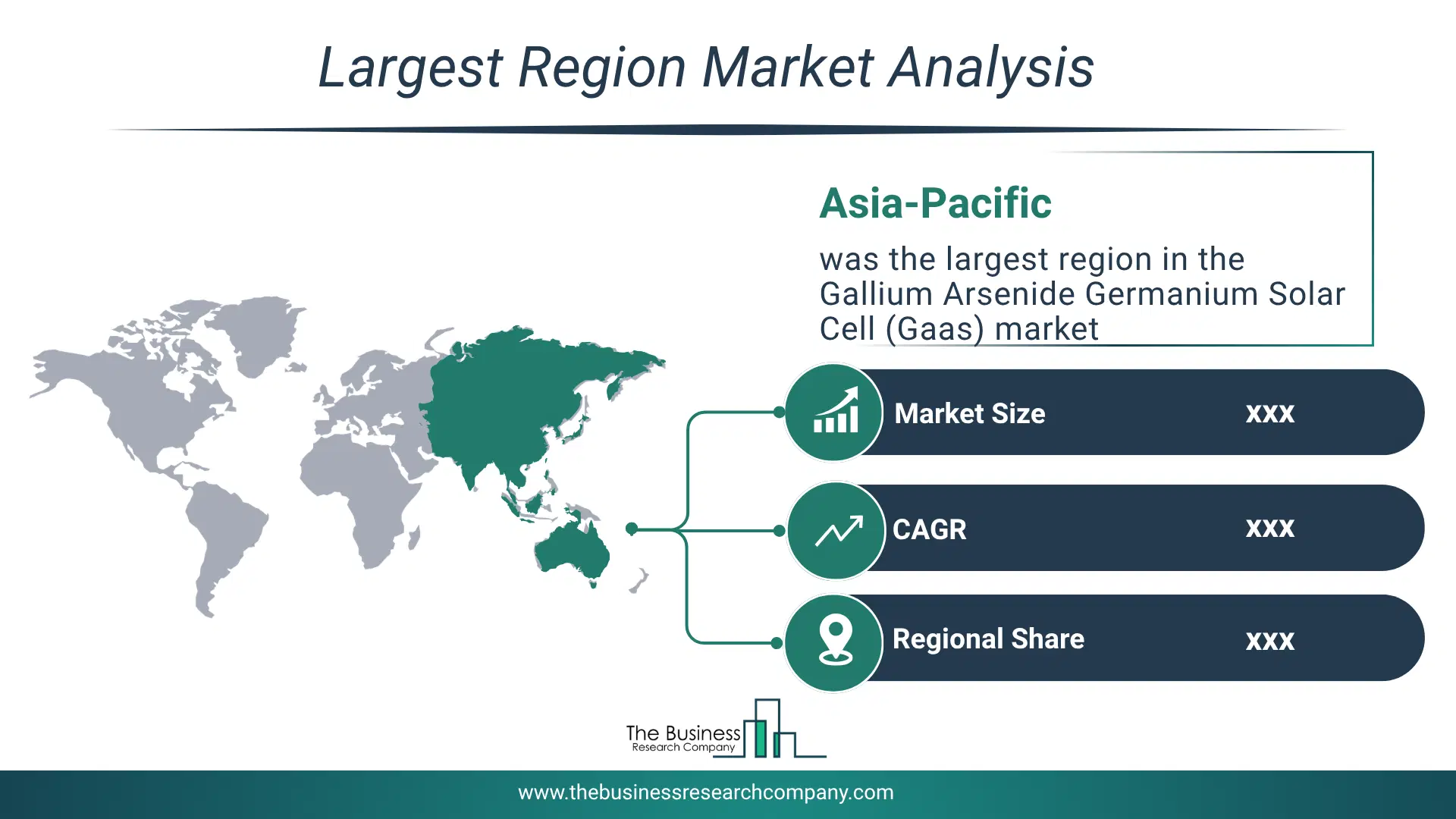
Regional Outlook
Asia-Pacific was the largest region in the gallium arsenide germanium solar cell (Gaas) market in 2025. North America is expected to be the fastest-growing region in the forecast period. The regions covered in this market report are Asia-Pacific, South East Asia, Western Europe, Eastern Europe, North America, South America, Middle East, Africa. The countries covered in this market report are Australia, Brazil, China, France, Germany, India, Indonesia, Japan, Taiwan, Russia, South Korea, UK, USA, Canada, Italy, Spain.What Defines the Gallium Arsenide Germanium Solar Cell (Gaas) Market?
The gallium arsenide germanium solar cell (Gaas) market consists of sales of space-specified solar cells and hybrid solar cells. Values in this market are ‘factory gate’ values, that is the value of goods sold by the manufacturers or creators of the goods, whether to other entities (including downstream manufacturers, wholesalers, distributors, and retailers) or directly to end customers. The value of goods in this market includes related services sold by the creators of the goods.How is Market Value Defined and Measured?
The market value is defined as the revenues that enterprises gain from the sale of goods and/or services within the specified market and geography through sales, grants, or donations in terms of the currency (in USD unless otherwise specified). The revenues for a specified geography are consumption values that are revenues generated by organizations in the specified geography within the market, irrespective of where they are produced. It does not include revenues from resales along the supply chain, either further along the supply chain or as part of other products.
This chart presents market attractiveness based on a quantitative evaluation of growth, competition, strategic alignment, and risk, offering a clear view of opportunity areas for decision-making. This chart is for illustrative purposes; the full report contains the complete analysis.

This chart highlights the Total Addressable Market (TAM) by estimating the maximum revenue opportunity using an assumption-driven approach, supporting strategic planning and opportunity sizing across markets. The chart is illustrative; the full report provides a more comprehensive analysis.
What Key Data and Analysis Are Included in the Gallium Arsenide Germanium Solar Cell (Gaas) Market Report 2026?
The gallium arsenide germanium solar cell (gaas) market research report is one of a series of new reports from The Business Research Company that provides market statistics, including industry global market size, regional shares, competitors with the market share, detailed market segments, market trends and opportunities, and any further data you may need to thrive in the gallium arsenide germanium solar cell (gaas) industry. The market research report delivers a complete perspective of everything you need, with an in-depth analysis of the current and future state of the industry.Gallium Arsenide Germanium Solar Cell (Gaas) Market Report 2026 Market Report Forecast Analysis
| Report Attribute | Details |
|---|---|
| Market Size Value In 2026 | $17.24 billion |
| Revenue Forecast In 2030 | $22.82 billion |
| Growth Rate | CAGR of 8.0% from 2026 to 2030 |
| Base Year For Estimation | 2025 |
| Actual Estimates/Historical Data | 2020-2025 |
| Forecast Period | 2026 - 2030 |
| Market Representation | Revenue in USD Billion and CAGR from 2026 to 2030 |
| Segments Covered | Type, Channel, Application |
| Regional Scope | Asia-Pacific, Western Europe, Eastern Europe, North America, South America, Middle East, Africa |
| Country Scope | The countries covered in the report are Australia, Brazil, China, France, Germany, India, ... |
| Key Companies Profiled | Spectrolab, Inc., SolAero Technologies Corp., Azur Space Solar Power GmbH, Emcore Corporation, MicroLink Devices, Inc., Alta Devices, Inc., Solar Junction Corporation, AXT, Inc., Freiberger Compound Materials GmbH, Xiamen Powerway Advanced Material Co., Ltd., DOWA Electronics Materials Co., Ltd., Vital Materials Co., Ltd., Semiconductor Wafer, Inc., IQE plc, WIN Semiconductors Corp., China Crystal Technologies Co., Ltd., Umicore NV, Veeco Instruments Inc., Aixtron SE, Advanced Micro-Fabrication Equipment Inc. (AMEC), Sumitomo Electric Industries, Ltd., Sumika Electronic Materials, Inc., JDS Uniphase Corporation, Kopin Corporation, Anadigics, Inc. |
| Customization Scope | Request for Customization |
| Pricing And Purchase Options | Explore Purchase Options |