
Gasoline Direct Injection (GDI) Device Market Report 2026
Global Outlook – By Product Type (Four-Cylinder GDI, Six-Cylinder GDI, Other Products), By Component (Fuel Injectors, Electronic Control Units, Sensors, Fuel Pumps), By Operating Mode (Stratified Mode, Homogenous Mode), By Application (Passenger Cars (PC), Commercial Vehicles (CV)) – Market Size, Trends, Strategies, and Forecast to 2030
Gasoline Direct Injection (GDI) Device Market Overview
• Gasoline Direct Injection (GDI) Device market size has reached to $9.57 billion in 2025 • Expected to grow to $17.12 billion in 2030 at a compound annual growth rate (CAGR) of 12.4% • Growth Driver: Surging Automobile Manufacturing And Sales Fuel Growth In Gasoline Direct Injection (GDI) Device Market • Market Trend: Strategic Partnerships Drive Efficient Product Distribution In Gasoline Direct Injection (GDI) Market • Europe was the largest region in 2025.What Is Covered Under Gasoline Direct Injection (GDI) Device Market?
Gasoline direct injection (GDI) device refers to a fuel injection system that directly injects gasoline into an engine's combustion chamber, allowing for precise control of the fuel-air mixture. It is used in modern gasoline engines to enhance performance and fuel efficiency while reducing emissions, offering benefits such as increased power output and improved engine responsiveness. The main products of gasoline direct injection (GDI) devices are four-cylinder GDI, six-cylinder GDI, and others. Four-cylinder GDI is a gasoline direct injection device that consists of four cylinders. Four cylinders GDI is used as it produces less friction and maintains more energy. The component includes fuel injectors, electronic control units, sensors, and fuel pumps that have operating modes such as stratified mode and homogenous mode. The gasoline direct injection (GDI) devices are used in passenger cars (PC) and commercial vehicles (CV).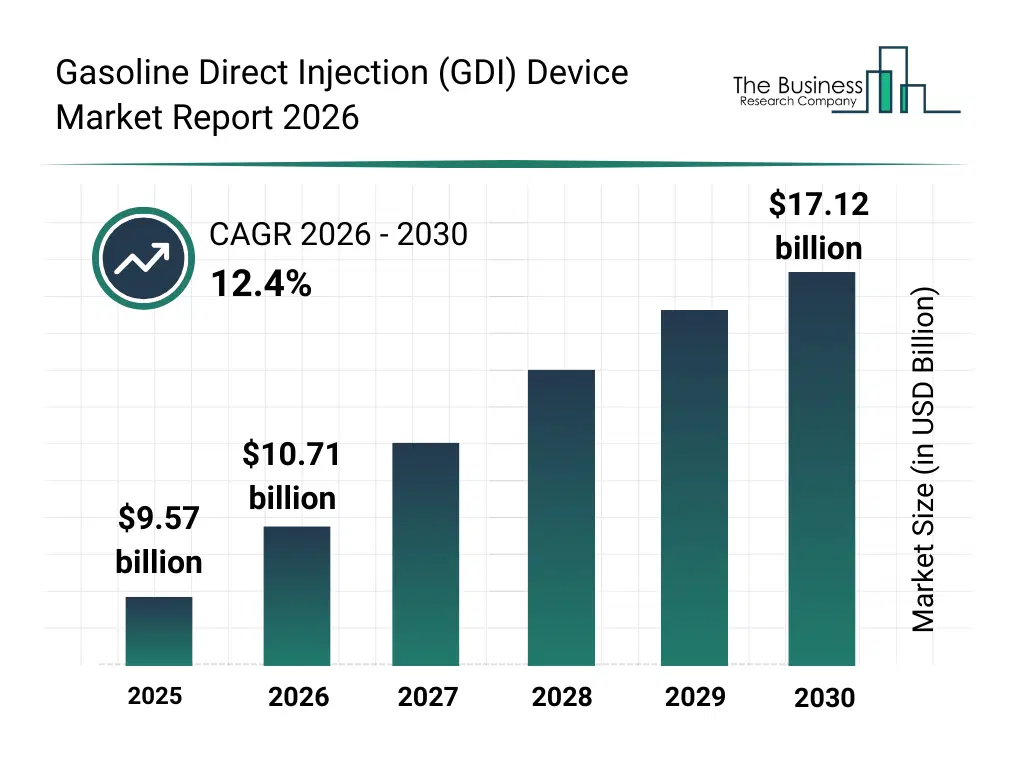
What Is The Gasoline Direct Injection (GDI) Device Market Size and Share 2026?
The gasoline direct injection (gdi) device market size has grown rapidly in recent years. It will grow from $9.57 billion in 2025 to $10.71 billion in 2026 at a compound annual growth rate (CAGR) of 11.9%. The growth in the historic period can be attributed to adoption of fuel-efficient engines, tightening emission regulations, growth in passenger car production, demand for improved engine performance, advancements in fuel injection technology.What Is The Gasoline Direct Injection (GDI) Device Market Growth Forecast?
The gasoline direct injection (gdi) device market size is expected to see rapid growth in the next few years. It will grow to $17.12 billion in 2030 at a compound annual growth rate (CAGR) of 12.4%. The growth in the forecast period can be attributed to hybrid powertrain adoption, stricter emission standards, demand for higher fuel economy, continued ice optimization, lightweight engine component development. Major trends in the forecast period include downsizing of gasoline engines, demand for high-pressure injectors, optimization for emission compliance, integration with turbocharged engines, material advancements for injectors.Tariff Impact On Gasoline Direct Injection (GDI) Device Market
Tariffs are materially affecting the gasoline direct injection device market by increasing the cost of imported fuel injectors, electronic control units, sensors, and high-pressure fuel pumps used in modern engines. Automotive manufacturers in Asia-Pacific and Europe are most impacted due to complex global supply chains and heavy reliance on cross-border component sourcing. These tariffs are increasing production costs and delaying technology upgrades in cost-sensitive vehicle segments. North America is also experiencing pricing pressure on advanced engine systems. At the same time, tariffs are accelerating supplier localization, encouraging in-house component development, and driving innovation in cost-optimized fuel injection architectures.
Global Gasoline Direct Injection (GDI) Device Market Segmentation
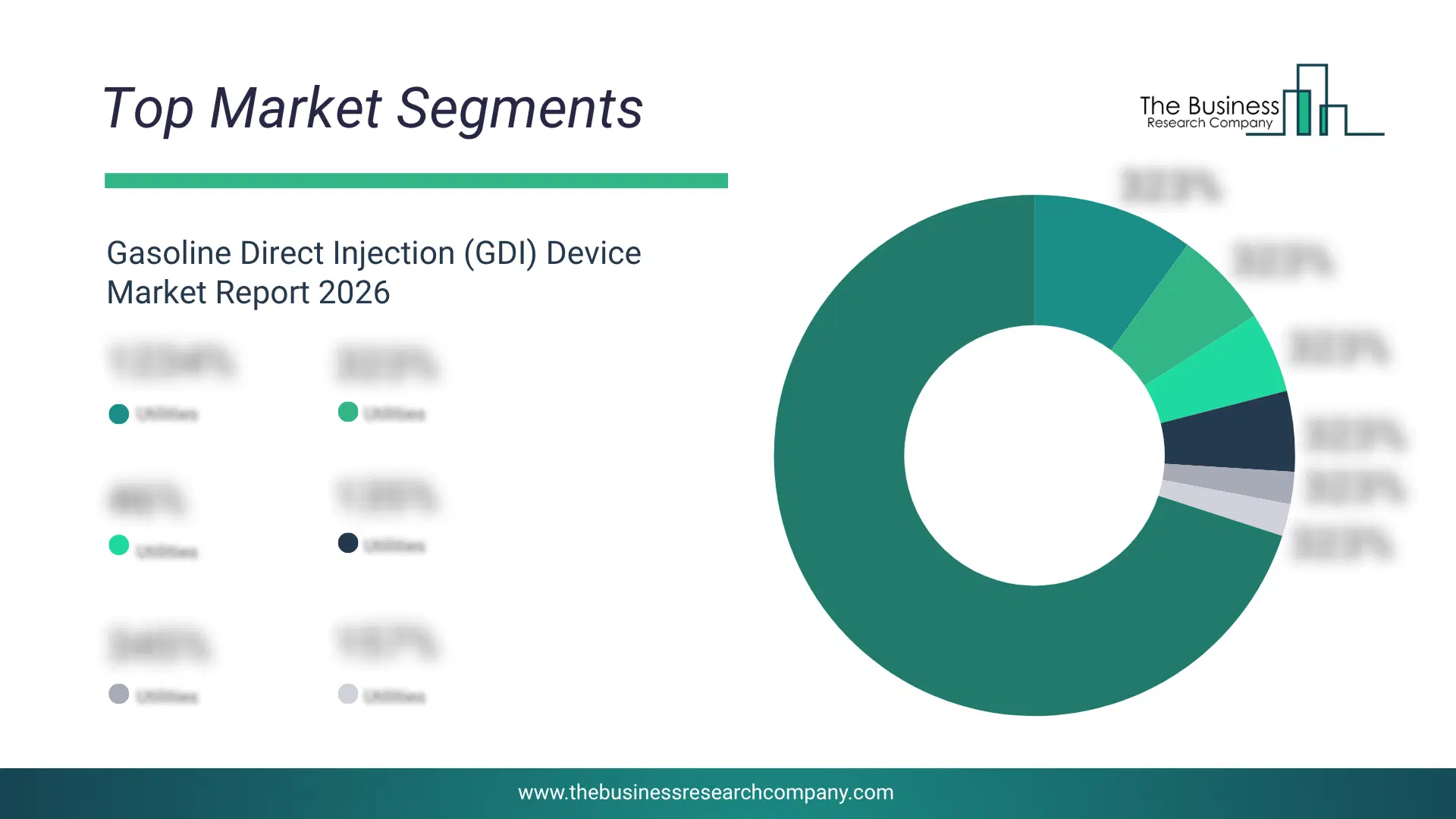
1) By Product Type: Four-Cylinder GDI, Six-Cylinder GDI, Other Products 2) By Component: Fuel Injectors, Electronic Control Units, Sensors, Fuel Pumps 3) By Operating Mode: Stratified Mode, Homogenous Mode 4) By Application: Passenger Cars (PC), Commercial Vehicles (CV) Subsegments: 1) By Four-Cylinder GDI: Naturally Aspirated Four-Cylinder GDI, Turbocharged Four-Cylinder GDI 2) By Six-Cylinder GDI: Naturally Aspirated Six-Cylinder GDI, Turbocharged Six-Cylinder GDI 3) By Other Products: Inline GDI Systems, V-Type GDI Systems, Hybrid GDI SystemsWhat Is The Driver Of The Gasoline Direct Injection (GDI) Device Market?
The rising automobile manufacturing and sales are expected to drive the are expected to propel the growth of the gasoline direct injection (GDI) device market in the coming future. Automobile manufacturing can be described as the transformation of basic materials into automobiles and their components. Automobile sales refer to the number of motor vehicles manufactured, repaired, and sold. The rising automobile manufacturing and sales are driving the gasoline direct injection (GDI) device market as it enhances fuel efficiency and decreases carbon emissions comparatively. For instance, in January 2024, according to Cox Automotive, a US-based automobile manufacturers association, new-vehicle sales in 2024 are projected to reach 15.7 million units, reflecting a growth of less than 2% compared to 2023. Therefore, the rising automobile manufacturing and sales are driving the gasoline direct injection (GDI) device industry.Key Players In The Global Gasoline Direct Injection (GDI) Device Market
Major companies operating in the gasoline direct injection (gdi) device market are Robert Bosch GmbH, Denso Corporation, Hitachi Ltd., Continental AG, Delphi Technologies plc, BorgWarner Inc., Magneti Marelli S.p.A., Eaton Corporation, STMicroelectronics N.V., NGK Spark Plug Co. Ltd., Sensata Technologies Inc., TI Fluid Systems, Keihin Co. Ltd., Stanadyne LLC, Hyundai KEFICO Corporation, GDI Technology Inc., Infineon Technologies AG, Valeo SA, Aisin Corporation, and NXP Semiconductors N.V.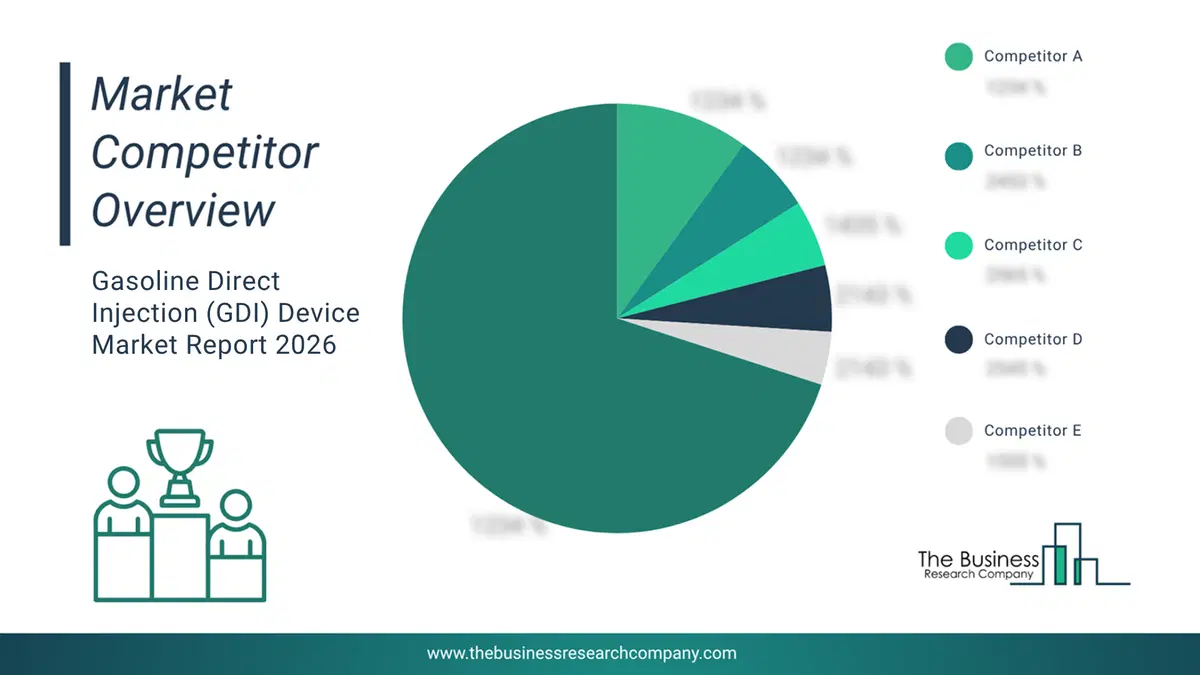
This chart is for illustrative purposes; the full report includes a detailed competitor analysis and comprehensive overview of the top 10 companies in the market.
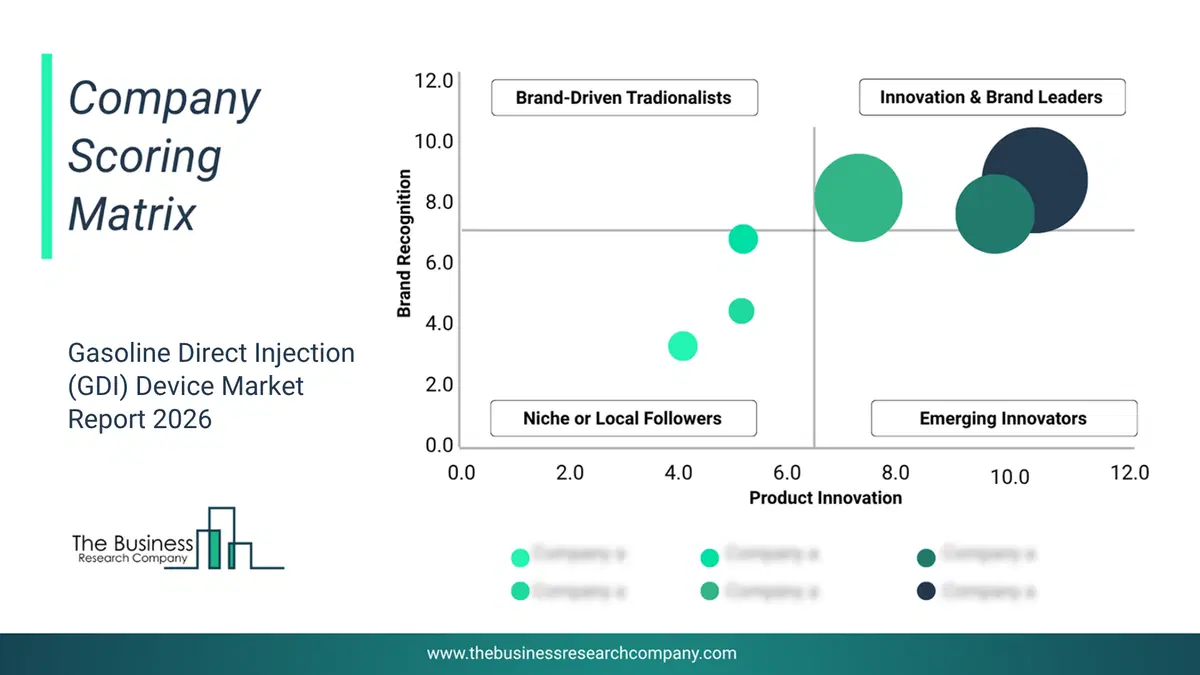
This chart maps companies by product innovation and brand strength, with bubble size indicating relative revenue, helping identify market leaders, challengers, and niche players. This is an illustrative chart; the full report provides a complete and accurate competitive analysis.
Global Gasoline Direct Injection (GDI) Device Market Trends and Insights
Major companies operating in the gasoline direct injection (GDI) market are adopting a strategic partnership approach for product distribution. Strategic partnerships refer to a process in which companies leverage each other's strengths and resources to achieve mutual benefits and success. For instance, in June 2023, IAV GmbH, a Germany-based automotive equipment company, announced a partnership with Sonplas GmbH, a Germany-based technological firm, on the sale of measurement devices used to validate and optimize injection systems for alternative and traditional fuels. As part of a collaboration, the technology firm IAV has handed the sales rights for IAV Cross, a technological system for hydraulic measurement and functional analysis of fuel injection valves, to Sonplas GmbH. This includes both the purchase of new equipment and the maintenance of old equipment.What Are Latest Mergers And Acquisitions In The Gasoline Direct Injection (GDI) Device Market?
In April 2024, Continental AG, a Germany-based multinational automotive manufacturing company, acquired EMT Puchov s.r.o. for an undisclosed amount. With this acquisition, Continental aims to strengthen its in-house capabilities in mold manufacturing, allowing for greater independence and efficiency in producing tire molds for all applications. EMT Púchov s.r.o., a Slovak company that specializes in mold manufacturing, particularly for the tire industry.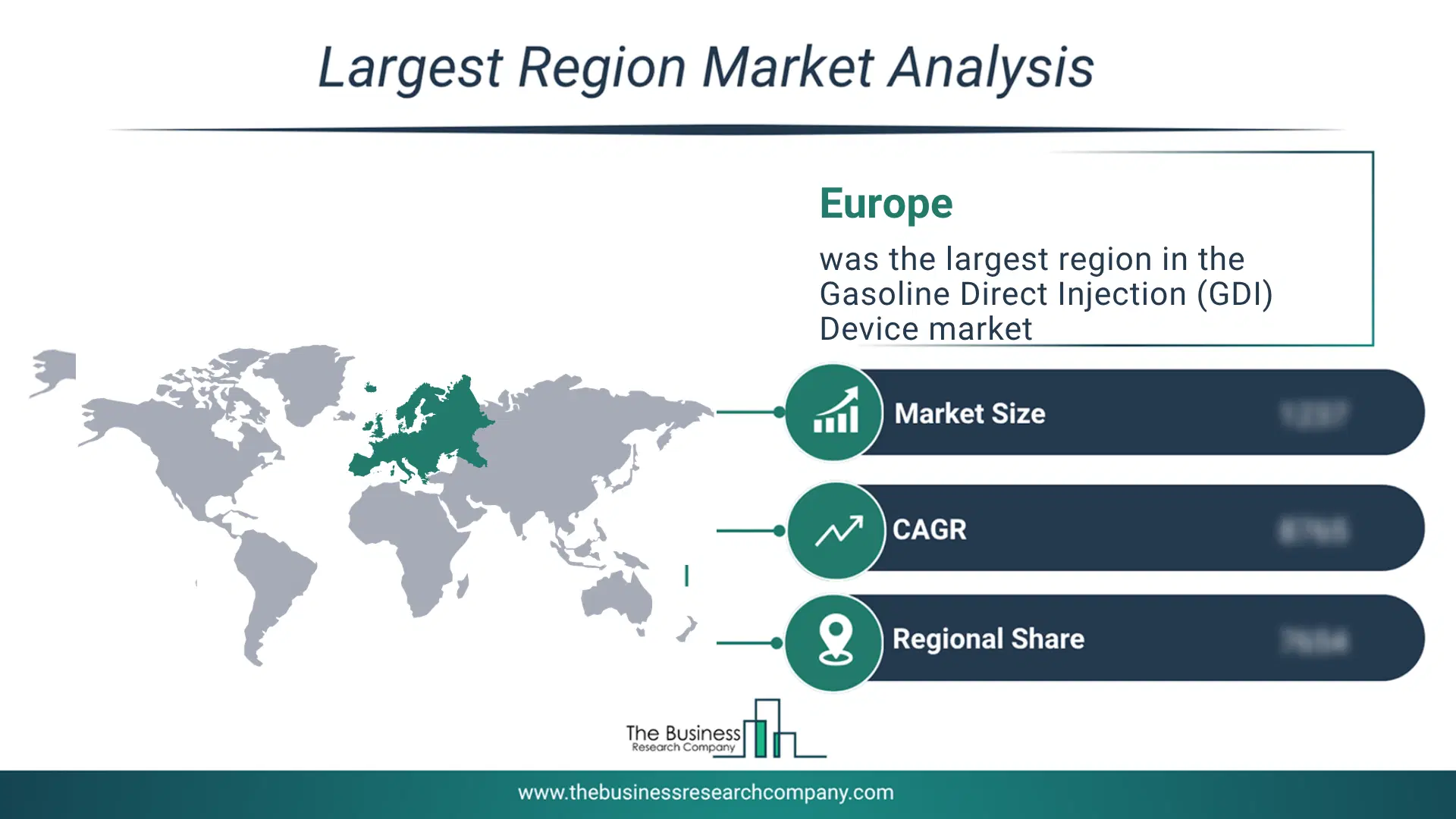
Regional Outlook
Europe was the largest region in the gasoline direct injection (GDI) market in 2025. The regions covered in this market report are Asia-Pacific, South East Asia, Western Europe, Eastern Europe, North America, South America, Middle East, Africa The countries covered in this market report are Australia, Brazil, China, France, Germany, India, Indonesia, Japan, Taiwan, Russia, South Korea, UK, USA, Canada, Italy, Spain.What Defines the Gasoline Direct Injection (GDI) Device Market?
The gasoline direct injection (GDI) device market consists of sales of fuel tanks, fuel filters, fuel rails, and fuel pressure control valves. Values in this market are ‘factory gate’ values, that is the value of goods sold by the manufacturers or creators of the goods, whether to other entities (including downstream manufacturers, wholesalers, distributors, and retailers) or directly to end customers. The value of goods in this market includes related services sold by the creators of the goods.How is Market Value Defined and Measured?
The market value is defined as the revenues that enterprises gain from the sale of goods and/or services within the specified market and geography through sales, grants, or donations in terms of the currency (in USD unless otherwise specified). The revenues for a specified geography are consumption values that are revenues generated by organizations in the specified geography within the market, irrespective of where they are produced. It does not include revenues from resales along the supply chain, either further along the supply chain or as part of other products.
This chart presents market attractiveness based on a quantitative evaluation of growth, competition, strategic alignment, and risk, offering a clear view of opportunity areas for decision-making. This chart is for illustrative purposes; the full report contains the complete analysis.

This chart highlights the Total Addressable Market (TAM) by estimating the maximum revenue opportunity using an assumption-driven approach, supporting strategic planning and opportunity sizing across markets. The chart is illustrative; the full report provides a more comprehensive analysis.
What Key Data and Analysis Are Included in the Gasoline Direct Injection (GDI) Device Market Report 2026?
The gasoline direct injection (gdi) device market research report is one of a series of new reports from The Business Research Company that provides market statistics, including industry global market size, regional shares, competitors with the market share, detailed market segments, market trends and opportunities, and any further data you may need to thrive in the gasoline direct injection (gdi) device industry. The market research report delivers a complete perspective of everything you need, with an in-depth analysis of the current and future state of the industry.Gasoline Direct Injection GDI Device Market Report Forecast Analysis
| Report Attribute | Details |
|---|---|
| Market Size Value In 2026 | $10.71 billion |
| Revenue Forecast In 2030 | $17.12 billion |
| Base Year For Estimation | 2025 |
| Actual Estimates/Historical Data | 2020-2025 |
| Forecast Period | 2026 - 2030 |
| Market Representation | Revenue in USD Billion and CAGR from 2026 to 2030 |
| Segments Covered | Product Type, Component, Operating Mode, Application |
| Regional Scope | Asia-Pacific, Western Europe, Eastern Europe, North America, South America, Middle East, Africa |
| Key Companies Profiled | Robert Bosch GmbH, Denso Corporation, Hitachi Ltd., Continental AG, Delphi Technologies plc, BorgWarner Inc., Magneti Marelli S.p.A., Eaton Corporation, STMicroelectronics N.V., NGK Spark Plug Co. Ltd., Sensata Technologies Inc., TI Fluid Systems, Keihin Co. Ltd., Stanadyne LLC, Hyundai KEFICO Corporation, GDI Technology Inc., Infineon Technologies AG, Valeo SA, Aisin Corporation, and NXP Semiconductors N.V. |
| Customization Scope | Request for Customization |
| Pricing And Purchase Options | Explore Purchase Options |