
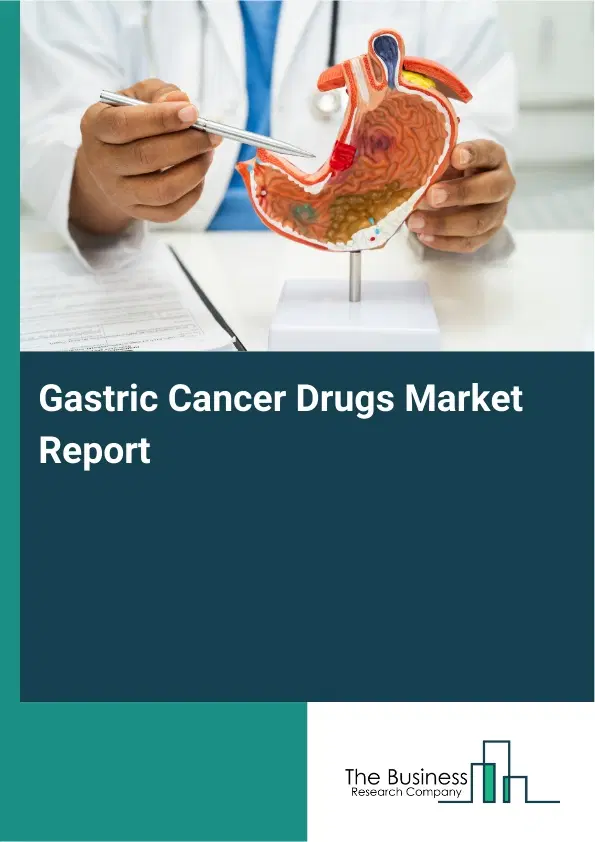
Gastric Cancer Drugs Market Report 2026
Global Outlook – By Type (Imatinib, Trastuzumab, Other Types), By Route of Administration (Oral, Parenteral), By End User (Hospitals, Clinics, Cancer Speciality Centers) – Market Size, Trends, Strategies, and Forecast to 2030
Gastric Cancer Drugs Market Overview
• Gastric Cancer Drugs market size has reached to $4.9 billion in 2025 • Expected to grow to $8.14 billion in 2030 at a compound annual growth rate (CAGR) of 10.9% • Growth Driver: Growing Global Aging Population And Its Impact On The Gastric Cancer Drug Market • Market Trend: Advancements In Gastric Cancer Treatments With CLDN18.2-Targeted Therapies • North America was the largest region in 2025 and Middle East is the fastest growing region.What Is Covered Under Gastric Cancer Drugs Market?
Gastric cancer drugs refer to anti-cancer medications that are taken orally as pills or are injected into a vein (via an IV line or central venous catheter). This treatment is effective for cancer that has spread to organs other than those where it originated since these medications penetrate the bloodstream and reach every part of the body. The main types of gastric cancer drugs are doxorubicin hydrochloride, sunitinib, docetaxel, mitomycin, fluorouracil, imatinib, and trastuzumab. Sunitinib is a chemotherapeutic agent and receptor tyrosine kinase inhibitor used to treat renal cell carcinoma (RCC) and imatinib-resistant gastrointestinal stromal tumor (GIST). The drugs are administered orally and parenterally and are used by hospitals, clinics, and others.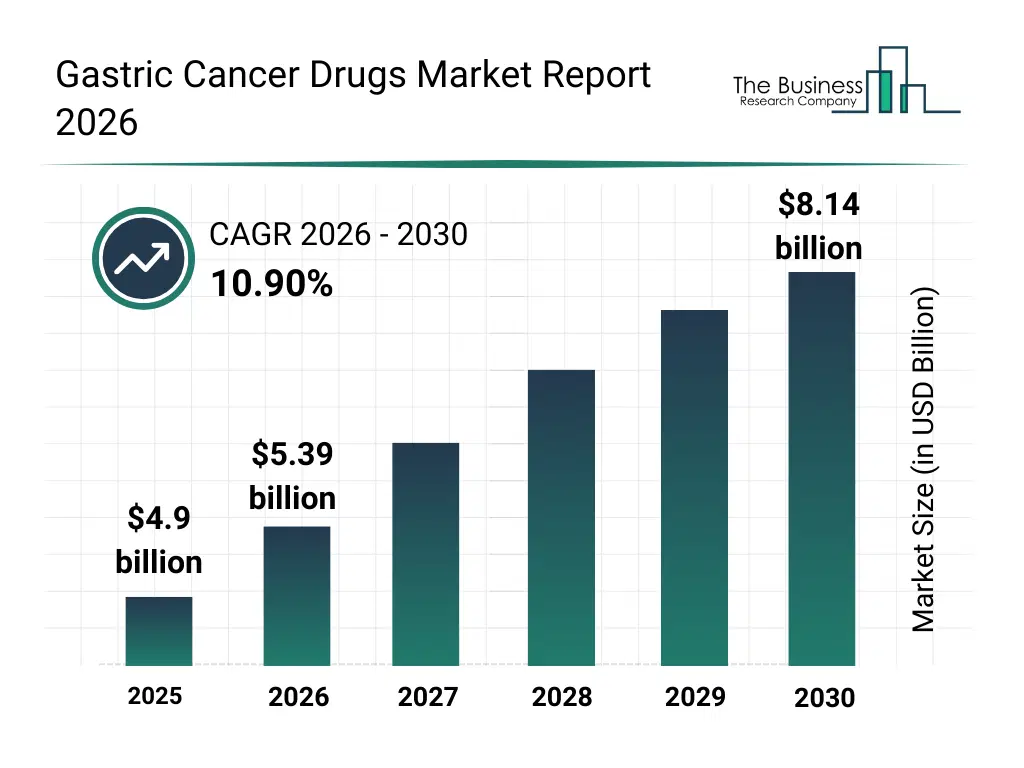
What Is The Gastric Cancer Drugs Market Size and Share 2026?
The gastric cancer drugs market size has grown strongly in recent years. It will grow from $4.9 billion in 2025 to $5.39 billion in 2026 at a compound annual growth rate (CAGR) of 9.9%. The growth in the historic period can be attributed to rising prevalence of gastric cancer, limited awareness of early detection, reliance on conventional chemotherapy, increasing adoption of hospital-based treatment, high cost of branded drugs.What Is The Gastric Cancer Drugs Market Growth Forecast?
The gastric cancer drugs market size is expected to see rapid growth in the next few years. It will grow to $8.14 billion in 2030 at a compound annual growth rate (CAGR) of 10.9%. The growth in the forecast period can be attributed to advancements in targeted therapies, growth in immunotherapy adoption, expansion of precision medicine, development of oral and injectable formulations, increasing government and private funding for cancer research. Major trends in the forecast period include personalized gastric cancer therapies, development of targeted drug delivery systems, increased use of combination therapies, expansion of outpatient cancer treatment services, growth in supportive care and symptom management.
Global Gastric Cancer Drugs Market Segmentation
1) By Type: Imatinib, Trastuzumab, Other Types 2) By Route of Administration: Oral, Parenteral 3) By End User: Hospitals, Clinics, Cancer Speciality Centers Subsegments: 1) By Imatinib: Oral Formulations, Injectable Formulations, Combination Therapies 2) By Trastuzumab: Monotherapy, Combination Therapy With Chemotherapy, Biosimilars Of Trastuzumab 3) By Other Types: Chemotherapy Agents, Targeted Therapy Agents, Immunotherapy Agents, Supportive Care MedicationsWhat Is The Driver Of The Gastric Cancer Drugs Market?
The increasing global aging population is expected to propel the growth of the gastric cancer drug market going forward. An aging population refers to a demographic situation in which a significant proportion of a nation's or region's residents are older, typically aged 65 and above. This phenomenon occurs when there is a sustained increase in life expectancy and a decrease in birth rates, resulting in a higher proportion of elderly individuals relative to the overall population. Older patients may have limited tolerance for certain cancer treatments, such as surgery or chemotherapy. As a result, there is a need for more tailored treatment options, including drugs, to address the specific needs and tolerances of elderly patients. For instance, in July 2024, according to the UK Parliament's House of Commons Library, a UK-based government administration, in 2022, there were 12.7 million people aged 65 or older in the UK, representing 19% of the total population. This number is projected to rise to 22.1 million by 2072, accounting for 27% of the population.Therefore, the gastric cancer drug industry is anticipated to experience growth in the future, driven by the growing elderly population.Key Players In The Global Gastric Cancer Drugs Market
Major companies operating in the gastric cancer drugs market are F. Hoffmann-La Roche, Eli Lilly and Company, Jiangsu HengRui Medicine, Biocon, Sanofi, PV Pharma Healthcare (India), Novartis Oncology, Arlak Biotech (India), CStone Pharma (China), CARsgen Therapeutics (China), JW Therapeutics (China), BeiGene (China), Takeda Pharmaceuticals (Japan), Astellas Pharma Inc. (Japan), Daiichi Sankyo, AstraZeneca plc, GlaxoSmithKline plc, Biocad, Bristol-Myers Squibb, Celon Pharma, Celltrion Inc., Merck & Co. Inc., Pfizer Inc., Sandoz AG (Novartis), Eurofarma Laboratórios S.A., TUTEUR Argentina / Pierre Fabre Group, Johnson & Johnson, Teva Pharmaceutical Industries Ltd., Mylan Laboratories, Gilead Sciences, BMS
This chart is for illustrative purposes; the full report includes a detailed competitor analysis and comprehensive overview of the top 10 companies in the market.
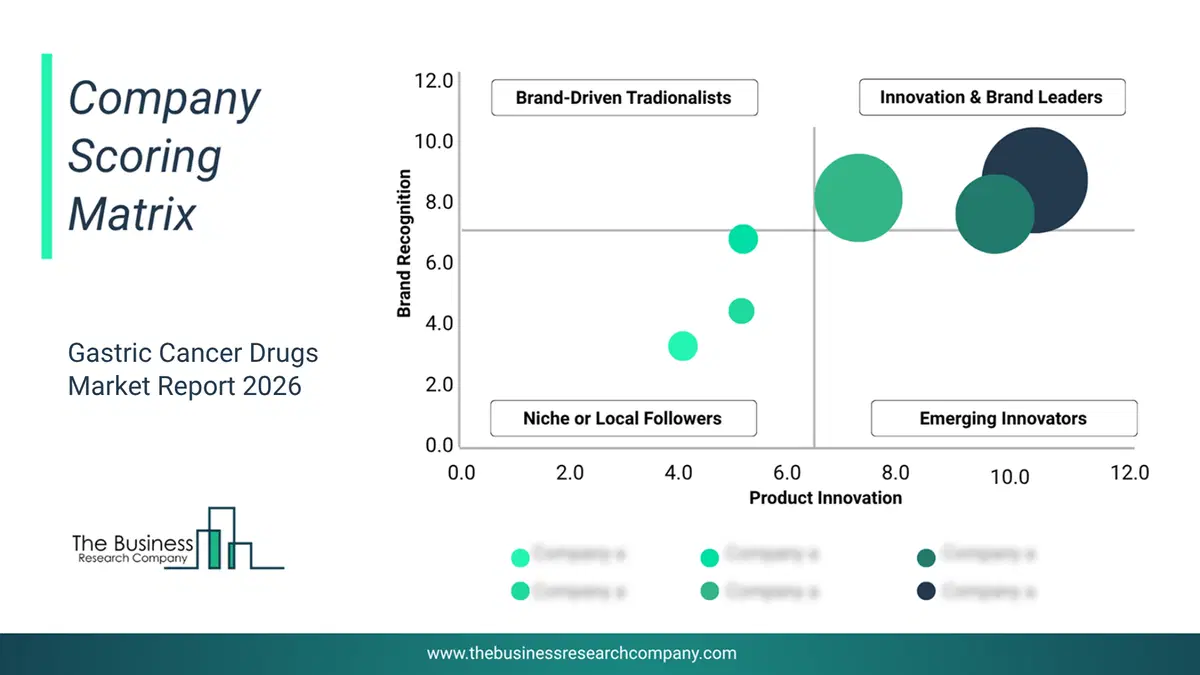
This chart maps companies by product innovation and brand strength, with bubble size indicating relative revenue, helping identify market leaders, challengers, and niche players. This is an illustrative chart; the full report provides a complete and accurate competitive analysis.
Global Gastric Cancer Drugs Market Trends and Insights
Many companies operating in the gastric cancer drugs market are focused on developing innovative products, such as CLDN18.2-targeted treatments, to improve the efficacy of therapies and provide more personalized options for patients. CLDN18.2-targeted treatment refers to therapies designed to target claudin 18.2 (CLDN18.2), a protein that is primarily expressed in certain epithelial tissues, including the gastric epithelium. For instance, in October 2024, Astellas Pharma Inc., a Japan-based company received approval from the Food and Drug Administration (FDA), a US-based federal agency for protecting the public health for VYLOY (zolbetuximab). VYLOY (zolbetuximab) is the first only CLDN18.2-targeted treatment used for advanced gastric and gastroesophageal junction cancer whose tumors are CLDN18.2 positive. The treatment is administered in combination with fluoropyrimidine- and platinum-based chemotherapy regimens. It is indicated for adults with locally advanced unresectable negative gastric or gastroesophageal junction cancer adenocarcinoma.What Are Latest Mergers And Acquisitions In The Gastric Cancer Drugs Market?
In January 2023, Leap Therapeutics Inc. a US-based biotechnology company acquired Flame Biosciences, Inc. for an undisclosed amount. With this acquisition, Leap Therapeutics Inc. aims to enhance its oncology pipeline and expand its therapeutic offerings. This acquisition also allows Leap to integrate Flame's clinical-stage anti-Claudin18.2 antibody, FL-301, which is being developed for gastric and pancreatic cancers, into its portfolio. Flame Biosciences Inc. is a US-based biotechnology company that provides gastric cancer drugs.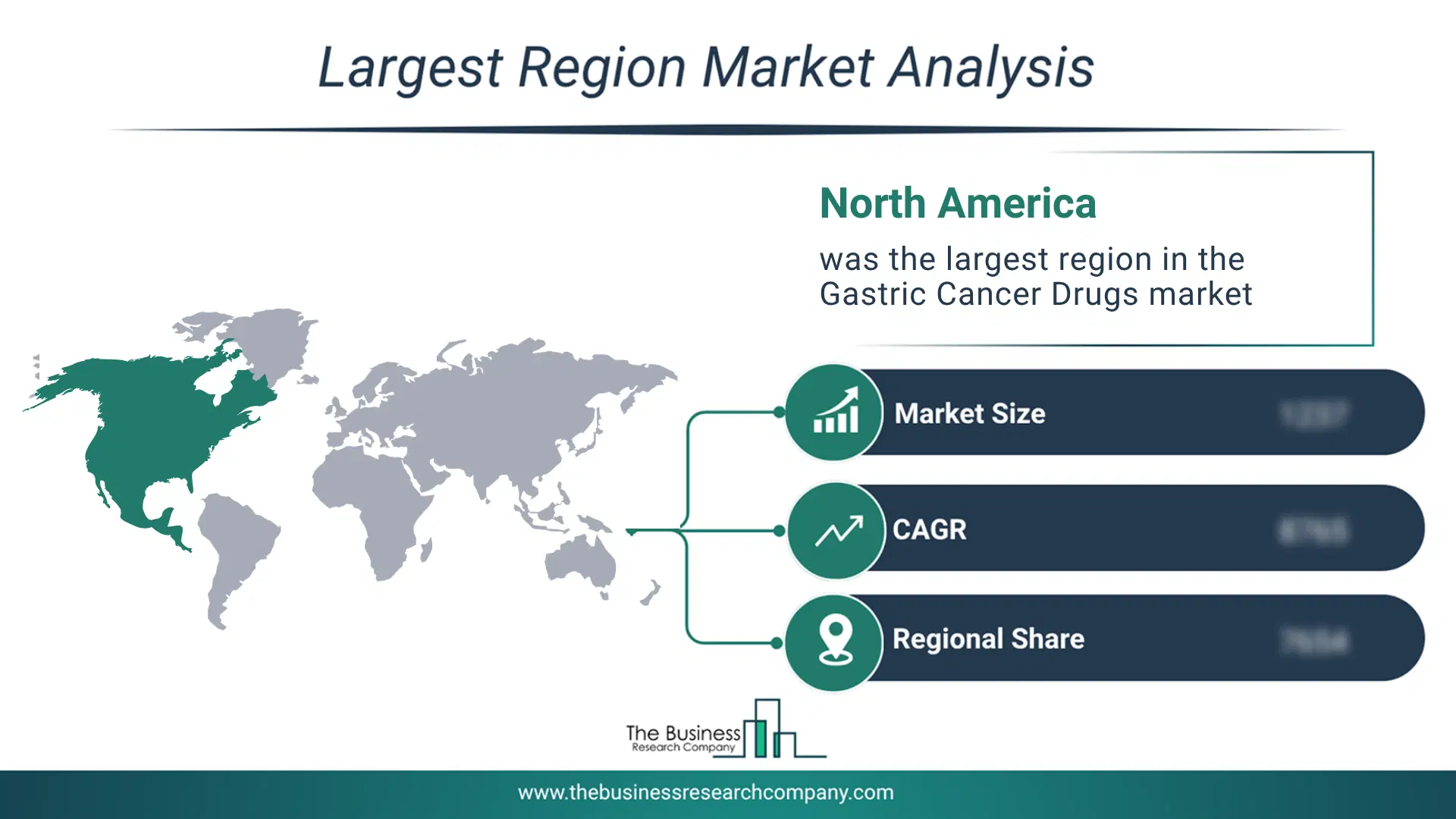
Regional Insights
North America was the largest region in the gastric cancer drugs market in 2025. Middle East is expected to be the largest growing region in the global gastric cancer drugs market share during the forecast period. The regions covered in this market report are Asia-Pacific, South East Asia, Western Europe, Eastern Europe, North America, South America, Middle East, Africa. The countries covered in this market report are Australia, Brazil, China, France, Germany, India, Indonesia, Japan, Taiwan, Russia, South Korea, UK, USA, Canada, Italy, Spain.What Defines the Gastric Cancer Drugs Market?
The gastric cancer drugs market consists of sales of cyramza, docetaxel, and doxorubicin hydrochloride. Values in this market are factory gate values, that is the value of goods sold by the manufacturers or creators of the goods, whether to other entities (including downstream manufacturers, wholesalers, distributors and retailers) or directly to end customers. The value of goods in this market includes related services sold by the creators of the goods.How is Market Value Defined and Measured?
The market value is defined as the revenues that enterprises gain from the sale of goods and/or services within the specified market and geography through sales, grants, or donations in terms of the currency (in USD unless otherwise specified). The revenues for a specified geography are consumption values that are revenues generated by organizations in the specified geography within the market, irrespective of where they are produced. It does not include revenues from resales along the supply chain, either further along the supply chain or as part of other products.
This chart presents market attractiveness based on a quantitative evaluation of growth, competition, strategic alignment, and risk, offering a clear view of opportunity areas for decision-making. This chart is for illustrative purposes; the full report contains the complete analysis.

This chart highlights the Total Addressable Market (TAM) by estimating the maximum revenue opportunity using an assumption-driven approach, supporting strategic planning and opportunity sizing across markets. The chart is illustrative; the full report provides a more comprehensive analysis.
What Key Data and Analysis Are Included in the Gastric Cancer Drugs Market Report 2026?
The gastric cancer drugs market research report is one of a series of new reports from The Business Research Company that provides market statistics, including industry global market size, regional shares, competitors with the market share, detailed market segments, market trends and opportunities, and any further data you may need to thrive in the gastric cancer drugs industry. The market research report delivers a complete perspective of everything you need, with an in-depth analysis of the current and future state of the industry.Gastric Cancer Drugs Market Report Forecast Analysis
| Report Attribute | Details |
|---|---|
| Market Size Value In 2026 | $5.39 billion |
| Revenue Forecast In 2030 | $8.14 billion |
| Growth Rate | CAGR of 9.9% from 2026 to 2030 |
| Base Year For Estimation | 2025 |
| Actual Estimates/Historical Data | 2020-2025 |
| Forecast Period | 2026 - 2030 |
| Market Representation | Revenue in USD Billion and CAGR from 2026 to 2030 |
| Segments Covered | Type, Route of Administration, End User |
| Regional Scope | Asia-Pacific, Western Europe, Eastern Europe, North America, South America, Middle East, Africa |
| Country Scope | The countries covered in the report are Australia, Brazil, China, France, Germany, India, Indonesia, Japan, Taiwan, Russia, South Korea, UK, USA, Canada, Italy, Spain. |
| Key Companies Profiled | F. Hoffmann-La Roche, Eli Lilly and Company, Jiangsu HengRui Medicine, Biocon, Sanofi, PV Pharma Healthcare (India), Novartis Oncology, Arlak Biotech (India), CStone Pharma (China), CARsgen Therapeutics (China), JW Therapeutics (China), BeiGene (China), Takeda Pharmaceuticals (Japan), Astellas Pharma Inc. (Japan), Daiichi Sankyo, AstraZeneca plc, GlaxoSmithKline plc, Biocad, Bristol-Myers Squibb, Celon Pharma, Celltrion Inc., Merck & Co. Inc., Pfizer Inc., Sandoz AG (Novartis), Eurofarma Laboratórios S.A., TUTEUR Argentina / Pierre Fabre Group, Johnson & Johnson, Teva Pharmaceutical Industries Ltd., Mylan Laboratories, Gilead Sciences, BMS |
| Customization Scope | Request for Customization |
| Pricing And Purchase Options | Explore Purchase Options |