
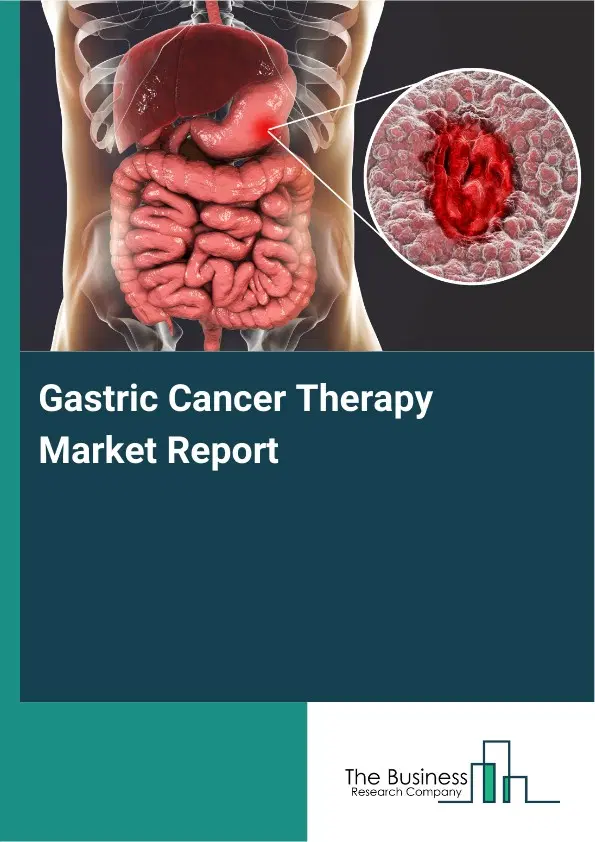
Gastric Cancer Therapy Market Report 2026
Global Outlook – By Therapy Type (Chemotherapy, Targeted Therapy, Immunotherapy, Radiation Therapy, Surgery), By Drug Class (Cytotoxic Agents, Monoclonal Antibodies, Tyrosine Kinase Inhibitors, Checkpoint Inhibitors, Miscellaneous Agents), By Administration Route (Oral, Intravenous, Intramuscular, Subcutaneous), By Stage of Disease (Early Stage, Locally Advanced Stage, Metastatic Stage), By End User (Hospitals, Oncology Clinics, Ambulatory Surgical Centers, Research Institutions, Home Care Settings) – Market Size, Trends, Strategies, and Forecast to 2030
Gastric Cancer Therapy Market Overview
• Gastric Cancer Therapy market size has reached to $4.5 billion in 2025 • Expected to grow to $6.96 billion in 2030 at a compound annual growth rate (CAGR) of 9.1% • Growth Driver: Rising Prevalence Of Helicobacter Pylori Infection Driving The Market Growth Due To Increasing Risk Of Gastric Complications And Cancer • Market Trend: Clinical Evidence Supporting Combination Therapy • North America was the largest region in 2025 and Asia-Pacific is the fastest growing region.What Is Covered Under Gastric Cancer Therapy Market?
Gastric cancer therapy refers to the medical treatment approaches used to manage and eliminate cancer that originates in the stomach lining, including surgery, chemotherapy, radiation therapy, targeted therapy, and immunotherapy, either alone or in combination, depending on the stage and characteristics of the disease. These therapies work through mechanisms such as killing rapidly dividing cancer cells, blocking specific molecular pathways that drive tumor growth, or stimulating the immune system to attack cancer cells. The main types of gastric cancer therapy include chemotherapy, targeted therapy, immunotherapy, radiation therapy, and surgery. Chemotherapy involves the use of drugs to kill rapidly dividing cancer cells throughout the body. The drugs are classified into cytotoxic agents, monoclonal antibodies, tyrosine kinase inhibitors, checkpoint inhibitors, and miscellaneous agents and can be administered through various routes such as oral, intravenous, intramuscular, and subcutaneous. These therapies are applied at different stages of the disease, including early stage, locally advanced stage, and metastatic stage, and are utilized by various end users such as hospitals, oncology clinics, ambulatory surgical centers, research institutions, and home care settings.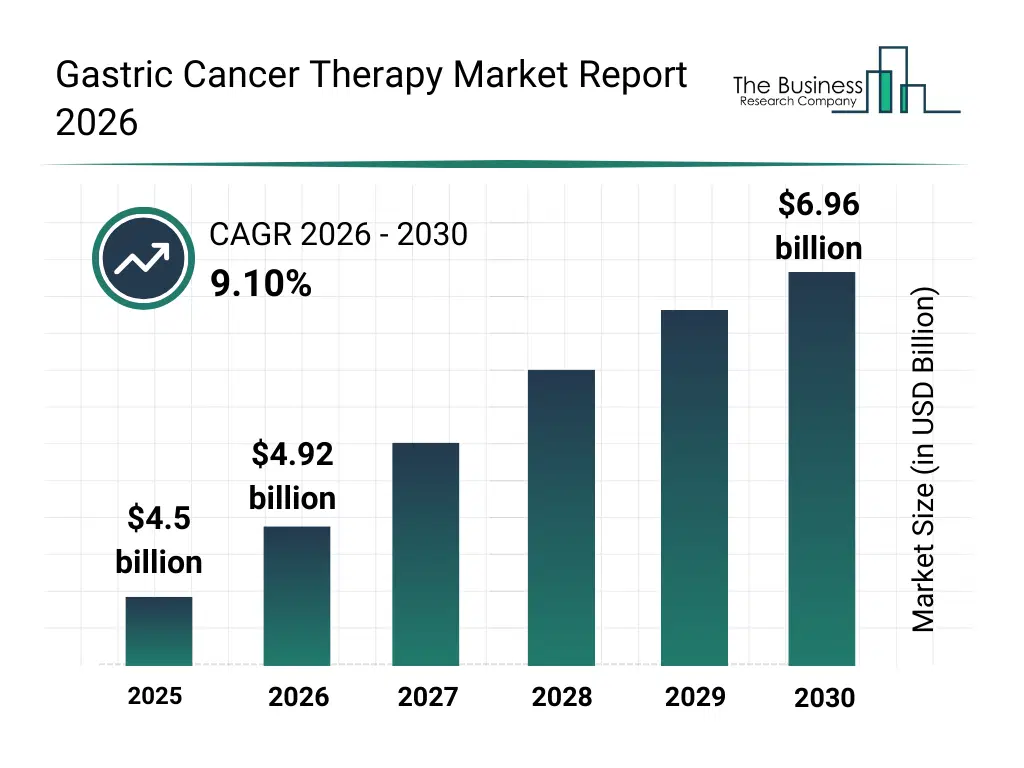
What Is The Gastric Cancer Therapy Market Size and Share 2026?
The gastric cancer therapy market size has grown strongly in recent years. It will grow from $4.5 billion in 2025 to $4.92 billion in 2026 at a compound annual growth rate (CAGR) of 9.3%. The growth in the historic period can be attributed to limited targeted therapy availability, reliance on conventional chemotherapy and surgery, growing gastric cancer prevalence, increasing hospital oncology infrastructure, awareness of early detection programs.What Is The Gastric Cancer Therapy Market Growth Forecast?
The gastric cancer therapy market size is expected to see strong growth in the next few years. It will grow to $6.96 billion in 2030 at a compound annual growth rate (CAGR) of 9.1%. The growth in the forecast period can be attributed to development of novel immunotherapies and checkpoint inhibitors, rising precision medicine adoption, expansion of outpatient oncology services, increasing investment in gastric cancer research, integration of digital health tools for patient monitoring. Major trends in the forecast period include increasing adoption of targeted and personalized therapies, rising use of combination therapy approaches, growth in early detection and screening programs, expansion of home care and ambulatory treatment options, focus on reducing adverse effects and improving patient quality of life.
Global Gastric Cancer Therapy Market Segmentation
1) By Therapy Type: Chemotherapy, Targeted Therapy, Immunotherapy, Radiation Therapy, Surgery 2) By Drug Class: Cytotoxic Agents, Monoclonal Antibodies, Tyrosine Kinase Inhibitors, Checkpoint Inhibitors, Miscellaneous Agents 3) By Administration Route: Oral, Intravenous, Intramuscular, Subcutaneous 4) By Stage of Disease: Early Stage, Locally Advanced Stage, Metastatic Stage 5) By End User: Hospitals, Oncology Clinics, Ambulatory Surgical Centers, Research Institutions, Home Care Settings Subsegments: 1) By Chemotherapy: Neoadjuvant Chemotherapy (NAC), Adjuvant Chemotherapy (AC), Palliative Chemotherapy (PC), Combination Chemotherapy, Monotherapy 2) By Targeted Therapy: Human Epidermal Growth Factor Receptor 2 (HER2) Targeted Therapy, Vascular Endothelial Growth Factor (VEGF) Inhibitors, Fibroblast Growth Factor Receptor (FGFR) Inhibitors, Mesenchymal-Epithelial Transition (MET) Inhibitors, Claudin 18 Isoform 2 Inhibitors 3) By Immunotherapy: Immune Checkpoint Inhibitors, Cancer Vaccines, Adoptive Cell Transfer, Cytokine Therapy, Combination Immunotherapy 4) By Radiation Therapy: External Beam Radiation Therapy (EBRT), Intensity-Modulated Radiation Therapy (IMRT), Three-Dimensional Conformal Radiation Therapy (3D-CRT), Brachytherapy 5) By Surgery: Endoscopic Mucosal Resection (EMR), Endoscopic Submucosal Dissection (ESD), Subtotal Gastrectomy, Total Gastrectomy, LymphadenectomyWhat Is The Driver Of The Gastric Cancer Therapy Market?
The rising prevalence of helicobacter pylori infection is expected to propel the growth of the gastric cancer therapy market going forward. Helicobacter pylori infection is a bacterial infection that primarily affects the stomach lining and is a leading cause of chronic gastritis and gastric cancer. The rising prevalence of helicobacter pylori infection is primarily due to poor sanitation, as inadequate hygiene practices and contaminated food or water sources facilitate the oral-oral or fecal-oral transmission of the bacteria. Gastric cancer therapy helps to reduce the risk of gastric cancer that is caused by helicobacter pylori infection by treating the infection, minimizing associated gastric inflammation and cellular damage, and preventing the progression of chronic gastritis and atrophic changes that can lead to malignant transformation of the gastric mucosa. For instance, in November 2024, according to the report published by the Government of Canada, a Canada-based government administration, as of January 2023, the recurrence rate of H. pylori infection is estimated to be up to 19%, although it varies based on geographic region and age. Therefore, the rising prevalence of helicobacter pylori infection is driving the growth of the gastric cancer therapy industry.Key Players In The Global Gastric Cancer Therapy Market
Major companies operating in the gastric cancer therapy market are Pfizer Inc., F. Hoffmann-La Roche Ltd., Merck & Co. Inc., Sanofi S.A., Bristol-Myers Squibb Company, AstraZeneca PLC, Novartis AG, Eli Lilly and Company, Amgen Inc., Astellas Pharma Inc., Jiangsu Hengrui Pharmaceuticals Co. Ltd., BeiGene Ltd., Celltrion Healthcare Co. Ltd., Hutchison MediPharma Limited, Shanghai Henlius Biotech Inc.
This chart is for illustrative purposes; the full report includes a detailed competitor analysis and comprehensive overview of the top 10 companies in the market.
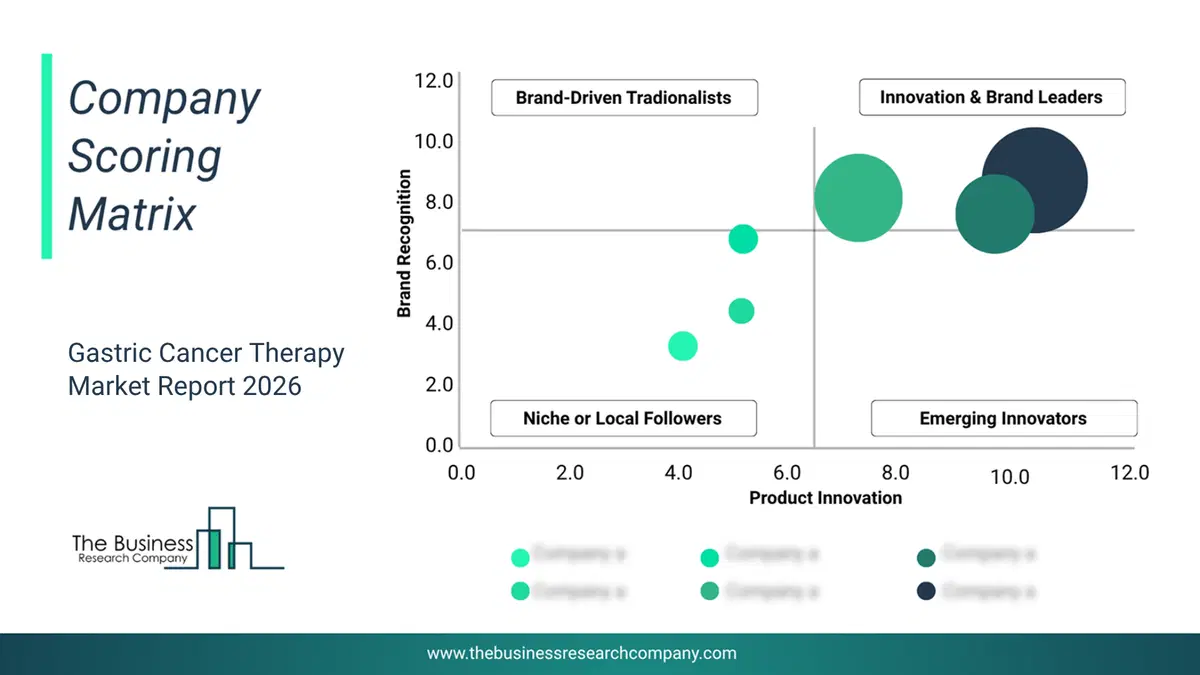
This chart maps companies by product innovation and brand strength, with bubble size indicating relative revenue, helping identify market leaders, challengers, and niche players. This is an illustrative chart; the full report provides a complete and accurate competitive analysis.
Global Gastric Cancer Therapy Market Trends and Insights
Major companies operating in the gastric cancer therapy market are focusing on developing innovative treatments, such as combination therapy, to improve treatment efficacy and patient outcomes. Combination therapy involves using two or more treatments, such as chemotherapy, targeted therapy, or immunotherapy, together to enhance overall effectiveness. For instance, in December 2024, BeOne Medicines Ltd., a China-based pharmaceutical company formerly known as BeiGene, received approval from the U.S. Food and Drug Administration (FDA) for Tevimbra (tislelizumab-jsgr) in combination with platinum- and fluoropyrimidine-based chemotherapy for the first-line treatment of adults with unresectable or metastatic HER2-negative gastric or gastroesophageal junction (G/GEJ) adenocarcinoma whose tumors express PD-L1 (≥1). This approval was based on data from the Phase 3 RATIONALE-305 trial, which demonstrated that the combination therapy significantly improved median overall survival to 15.0 months, compared to 12.9 months with chemotherapy alone, representing a 20% reduction in the risk of death. This milestone highlights a growing trend among leading pharmaceutical companies to invest in innovative, multimodal treatment strategies that integrate immunotherapy with conventional chemotherapy regimens to enhance clinical outcomes, delay disease progression, and improve survival rates in patients with advanced gastric cancer.What Are Latest Mergers And Acquisitions In The Gastric Cancer Therapy Market?
In January 2023, Leap Therapeutics Inc., a US-based biotechnology company, acquired Flame Biosciences Inc. for an undisclosed amount. With this acquisition, Leap Therapeutics aims to strengthen its oncology pipeline by incorporating Flame Biosciences' clinical-stage anti-Claudin18.2 antibody FL-301 and two preclinical antibody programs, thereby advancing its development of biomarker-targeted therapies for cancer treatment. Flame Biosciences Inc. is a US-based biotechnology company that specializes in providing gastric cancer therapy.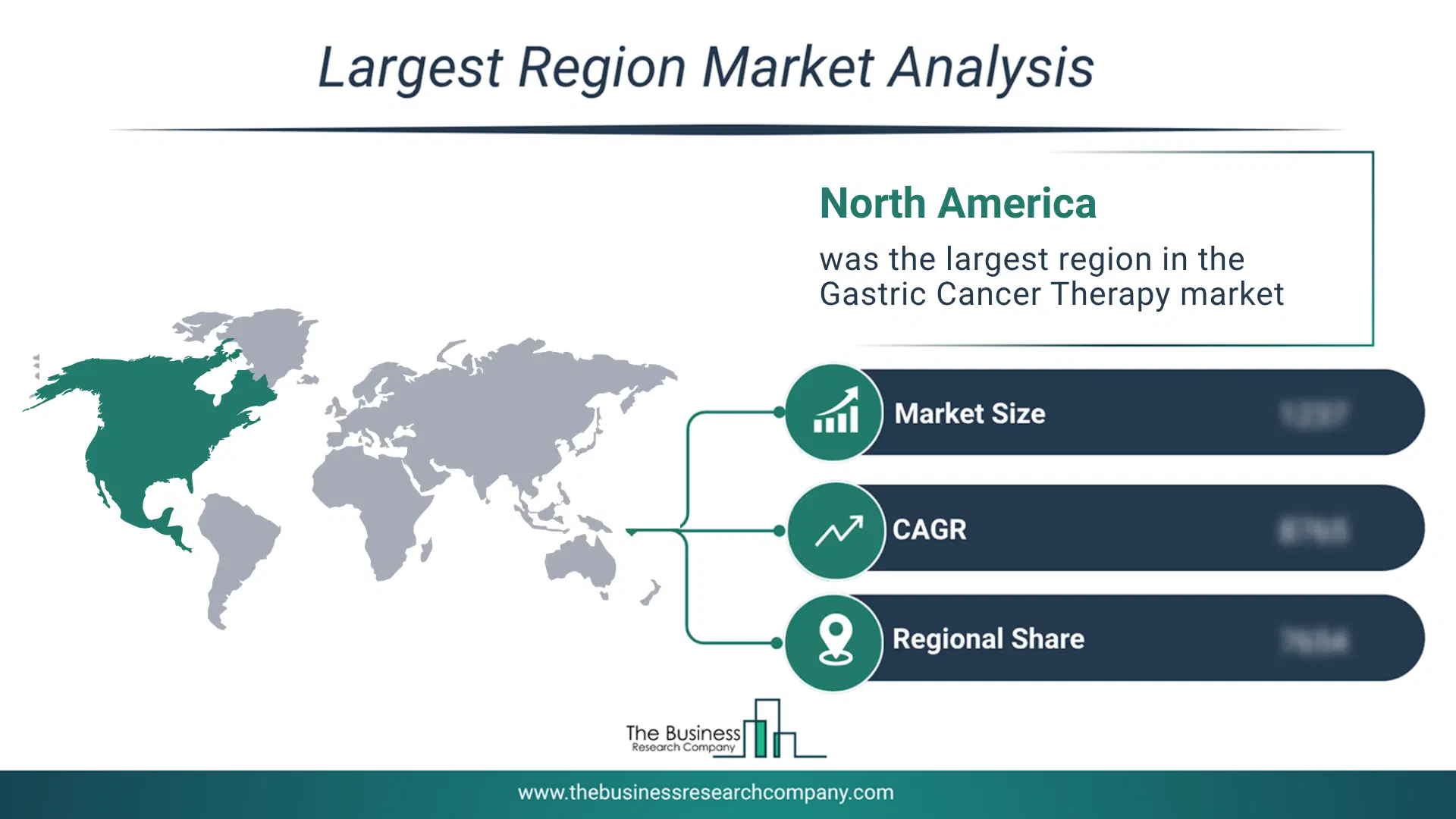
Regional Insights
North America was the largest region in the gastric cancer therapy market in 2025. Asia-Pacific is expected to be the fastest-growing region in the forecast period. The regions covered in this market report are Asia-Pacific, South East Asia, Western Europe, Eastern Europe, North America, South America, Middle East, Africa. The countries covered in this market report are Australia, Brazil, China, France, Germany, India, Indonesia, Japan, Taiwan, Russia, South Korea, UK, USA, Canada, Italy, Spain.What Defines the Gastric Cancer Therapy Market?
The gastric cancer therapy market consists of revenues earned by entities by providing services such as diagnostic testing and imaging, supportive care and palliative services, and clinical trial and research services. The market value includes the value of related goods sold by the service provider or included within the service offering. The gastric cancer therapy market also includes sales of trastuzumab (Herceptin), nivolumab (Opdivo), ramucirumab (Cyramza), and fluorouracil-based chemotherapy, and endoscopic devices and imaging systems. Values in this market are ‘factory gate’ values, that is the value of goods sold by the manufacturers or creators of the goods, whether to other entities (including downstream manufacturers, wholesalers, distributors and retailers) or directly to end customers. The value of goods in this market includes related services sold by the creators of the goods.How is Market Value Defined and Measured?
The market value is defined as the revenues that enterprises gain from the sale of goods and/or services within the specified market and geography through sales, grants, or donations in terms of the currency (in USD unless otherwise specified). The revenues for a specified geography are consumption values that are revenues generated by organizations in the specified geography within the market, irrespective of where they are produced. It does not include revenues from resales along the supply chain, either further along the supply chain or as part of other products.
This chart presents market attractiveness based on a quantitative evaluation of growth, competition, strategic alignment, and risk, offering a clear view of opportunity areas for decision-making. This chart is for illustrative purposes; the full report contains the complete analysis.

This chart highlights the Total Addressable Market (TAM) by estimating the maximum revenue opportunity using an assumption-driven approach, supporting strategic planning and opportunity sizing across markets. The chart is illustrative; the full report provides a more comprehensive analysis.
What Key Data and Analysis Are Included in the Gastric Cancer Therapy Market Report 2026?
The gastric cancer therapy market research report is one of a series of new reports from The Business Research Company that provides market statistics, including industry global market size, regional shares, competitors with the market share, detailed market segments, market trends and opportunities, and any further data you may need to thrive in the gastric cancer therapy industry. The market research report delivers a complete perspective of everything you need, with an in-depth analysis of the current and future state of the industry.Gastric Cancer Therapy Market Report Forecast Analysis
| Report Attribute | Details |
|---|---|
| Market Size Value In 2026 | $4.92 billion |
| Revenue Forecast In 2030 | $6.96 billion |
| Growth Rate | CAGR of 9.3% from 2026 to 2030 |
| Base Year For Estimation | 2025 |
| Actual Estimates/Historical Data | 2020-2025 |
| Forecast Period | 2026 - 2030 |
| Market Representation | Revenue in USD Billion and CAGR from 2026 to 2030 |
| Segments Covered | Therapy Type, Drug Class, Administration Route, Stage of Disease, End User |
| Regional Scope | Asia-Pacific, Western Europe, Eastern Europe, North America, South America, Middle East, Africa |
| Country Scope | The countries covered in the report are Australia, Brazil, China, France, Germany, India, Indonesia, Japan, Taiwan, Russia, South Korea, UK, USA, Canada, Italy, Spain. |
| Key Companies Profiled | Pfizer Inc., F. Hoffmann-La Roche Ltd., Merck & Co. Inc., Sanofi S.A., Bristol-Myers Squibb Company, AstraZeneca PLC, Novartis AG, Eli Lilly and Company, Amgen Inc., Astellas Pharma Inc., Jiangsu Hengrui Pharmaceuticals Co. Ltd., BeiGene Ltd., Celltrion Healthcare Co. Ltd., Hutchison MediPharma Limited, Shanghai Henlius Biotech Inc. |
| Customization Scope | Request for Customization |
| Pricing And Purchase Options | Explore Purchase Options |