
GCC Enterprise Software Market Report 2026
Global Outlook – By Software Type (Enterprise Resource Planning, Customer Relationship Management, Supply Chain Management, Human Capital Management, Business Intelligence And Analytics, Enterprise Content Management, Enterprise Asset Management, Governance, Risk, And Compliance, Other Enterprise Software), By Deployment Mode (Cloud Based, On-Premises, Hybrid), By Organization Size (Large Enterprises, Small And Medium Sized Enterprises), By Technology (Artificial Intelligence, Machine Learning, Automation, Advanced Analytics, Cloud Computing, Internet Of Things, Blockchain), By Industry Vertical (Banking And Financial Services, Information Technology And Business Services, Manufacturing And Industrial, Healthcare And Life Sciences, Retail And Consumer Goods, Telecommunications And Media, Energy And Utilities, Government And Public Sector) – Market Size, Trends, Strategies, and Forecast to 2035
GCC Enterprise Software Market Overview
• GCC Enterprise Software market size has reached to $6.18 billion in 2025 • Expected to grow to $10.84 billion in 2030 at a compound annual growth rate (CAGR) of 11.8% • Growth Driver: Increasing Digital Transformation Initiatives Driving The Growth Of The Market Due To Growing Demand For Data-Driven Decision-Making • Market Trend: Artificial Intelligence Accelerates Enterprise Capability Center Establishment • North America was the largest region in 2025 and Asia-Pacific is the fastest growing region.What Is Covered Under GCC Enterprise Software Market?
GCC enterprise software refers to integrated software solutions designed to manage, automate, and optimize business processes, workflows, and digital operations within Global Capability Centers (GCCs). These platforms can support functions such as finance, human resources, information technology, procurement, analytics, workflow management, and collaboration, helping GCCs standardize processes, improve operational efficiency, enhance data-driven decision-making, and provide scalable services to their parent organizations. The main software types of GCC enterprise software include enterprise resource planning, customer relationship management, supply chain management, human capital management, business intelligence and analytics, enterprise content management, enterprise asset management, governance, risk, and compliance, and other enterprise software. Enterprise resource planning refers to integrated software solutions that help organizations manage core business processes such as finance, human resources, procurement, supply chain, and operations. These software solutions are deployed through cloud based, On-Premises, and hybrid models and are adopted by large enterprises and small and medium sized enterprises. They incorporate artificial intelligence, machine learning, automation, advanced analytics, cloud computing, internet of things, and blockchain technologies and the industry verticals include banking and financial services, information technology and business services, manufacturing and industrial, healthcare and life sciences, retail and consumer goods, telecommunications and media, energy and utilities, and government and public sector.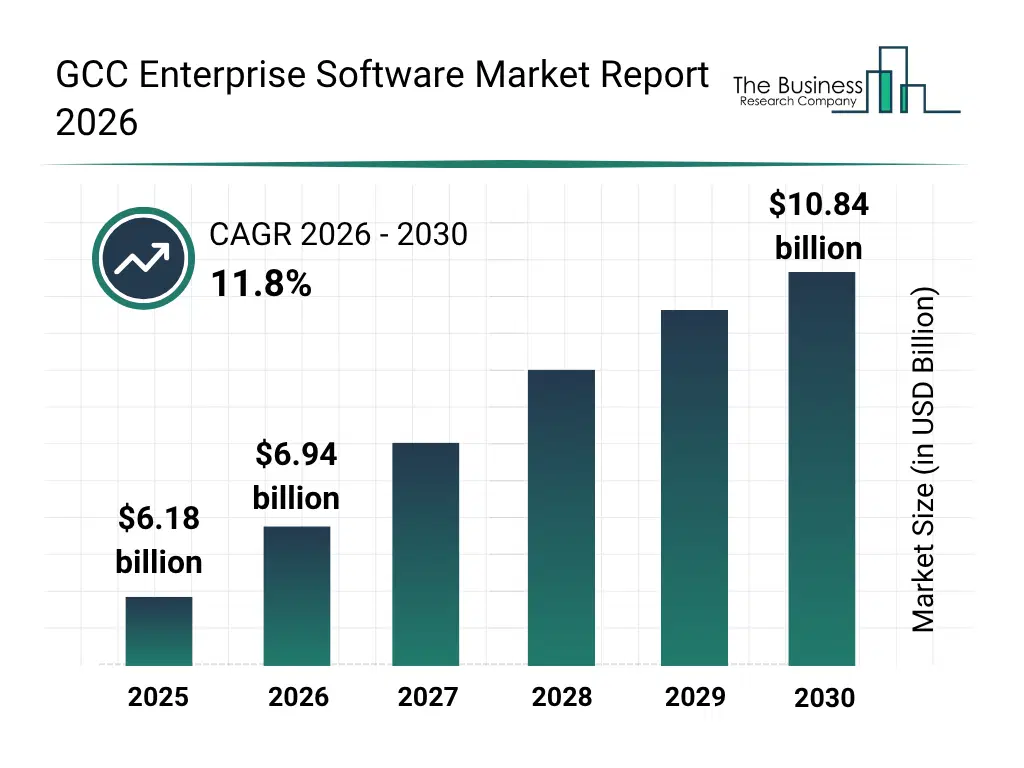
What Is The GCC Enterprise Software Market Size and Share 2026?
The gcc enterprise software market size has grown rapidly in recent years. It will grow from $6.18 billion in 2025 to $6.94 billion in 2026 at a compound annual growth rate (CAGR) of 12.2%. The growth in the historic period can be attributed to increasing enterprise digitization, rising demand for centralized business process management, growing adoption of shared service centers, increasing need for standardized enterprise workflows, expanding multinational business operations.What Is The GCC Enterprise Software Market Growth Forecast?
The gcc enterprise software market size is expected to see rapid growth in the next few years. It will grow to $10.84 billion in 2030 at a compound annual growth rate (CAGR) of 11.8%. The growth in the forecast period can be attributed to rising demand for scalable enterprise software platforms, increasing focus on software interoperability, growing need for real time operational visibility, expanding enterprise software localization, rising demand for modular enterprise software suites. Major trends in the forecast period include enterprise process standardization, centralized workflow consolidation, cross functional business process integration, global enterprise software localization, enterprise software suite consolidation.Tariff Impact On GCC Enterprise Software Market
Tariffs are impacting the GCC enterprise software market by increasing the cost of imported servers, networking equipment, data center infrastructure, and semiconductor-based hardware required to support enterprise software deployments. This is increasing deployment and infrastructure costs, particularly for on-premises and hybrid enterprise software environments in regions dependent on imported technology equipment. Hardware-intensive segments supporting enterprise resource planning, business intelligence and analytics, enterprise asset management, and cloud infrastructure are most affected due to global supply chain dependencies. However, tariffs are also encouraging regional supplier diversification, localized infrastructure sourcing, domestic technology ecosystems, and greater adoption of scalable cloud-based enterprise software solutions, creating long-term resilience in the market.
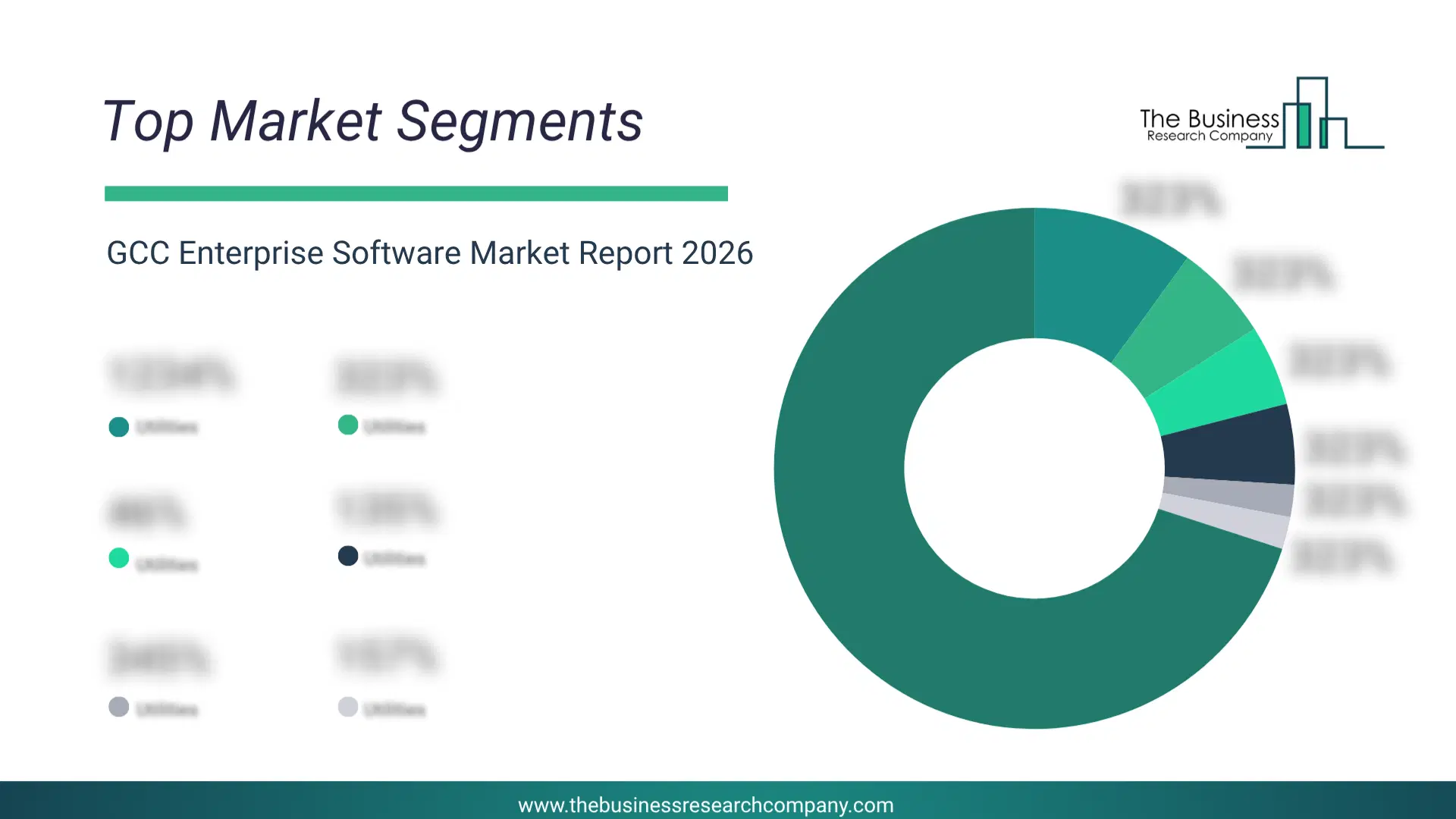
Global GCC Enterprise Software Market Segmentation
2) By Deployment Mode: Cloud Based, On-Premises, Hybrid 3) By Organization Size: Large Enterprises, Small And Medium Sized Enterprises 4) By Technology: Artificial Intelligence, Machine Learning, Automation, Advanced Analytics, Cloud Computing, Internet Of Things, Blockchain 5) By Industry Vertical: Banking And Financial Services, Information Technology And Business Services, Manufacturing And Industrial, Healthcare And Life Sciences, Retail And Consumer Goods, Telecommunications And Media, Energy And Utilities, Government And Public Sector Subsegments: 1) By Enterprise Resource Planning: Financial Management, Procurement Management, Inventory Management, Manufacturing Management, Project Management 2) By Customer Relationship Management: Sales Automation, Marketing Automation, Customer Service Management, Customer Experience Management, Partner Relationship Management 3) By Supply Chain Management: Demand Planning, Warehouse Management, Transportation Management, Supplier Collaboration, Order Management 4) By Human Capital Management: Core Human Resources Management, Payroll Management, Talent Acquisition, Learning And Development, Workforce Planning 5) By Business Intelligence And Analytics: Data Visualization, Predictive Analytics, Self Service Analytics, Performance Management, Reporting And Dashboards 6) By Enterprise Content Management: Document Management, Records Management, Digital Asset Management, Workflow Automation, Content Collaboration 7) By Enterprise Asset Management: Asset Lifecycle Management, Maintenance Management, Work Order Management, Spare Parts Management, Asset Performance Monitoring 8) By Governance, Risk, And Compliance: Risk Management, Regulatory Compliance Management, Internal Audit Management, Policy Management, Third Party Risk Management 9) By Other Enterprise Software: Knowledge Management, Collaboration Software, Business Process Management, Application Performance Monitoring, Integration Platform SoftwareWhat Is The Driver Of The GCC Enterprise Software Market?
The increasing digital transformation initiatives are expected to propel the growth of the GCC enterprise software market going forward. Digital transformation initiatives refer to strategic programs that integrate digital technologies into business operations to improve efficiency, innovation, customer experience, and organizational agility. Increasing digital transformation initiatives is due to growing demand for data-driven decision-making, as organizations are adopting advanced analytics, artificial intelligence, and real-time data platforms to improve operational efficiency, optimize processes, and gain actionable business insights. Digital transformation initiatives help global capability center (GCC) enterprise software adoption by enabling organizations to integrate advanced technologies, automate business processes, improve data-driven decision-making, and enhance the scalability, efficiency, and global coordination of GCC operations. For instance, in September 2025, according to TD Securities, a Canada-based financial-services company, 75% of surveyed North American companies were using or implementing generative AI tools in 2025, up from 66% in the previous year's survey. Therefore, the increasing digital transformation initiatives are driving the growth of the GCC enterprise software industry.Key Players In The Global GCC Enterprise Software Market
Major companies operating in the gcc enterprise software market are Microsoft Corporation, Amazon.com Inc., Alphabet Inc., International Business Machines Corporation, Oracle Corporation, SAP SE, Adobe Inc., Salesforce Inc., Broadcom Inc., ServiceNow Inc., Workday Inc., The Sage Group plc, OpenText Corporation, Atlassian Corporation, Hexagon AB, SAS Institute Inc., Infor Inc., Zoho Corporation Private Limited, Pegasystems Inc., IFS AB, Epicor Software Corporation, QlikTech International AB, OneStream Inc., Hyland Software Inc., Unit4 N.V., Acumatica Inc., Odoo S.A.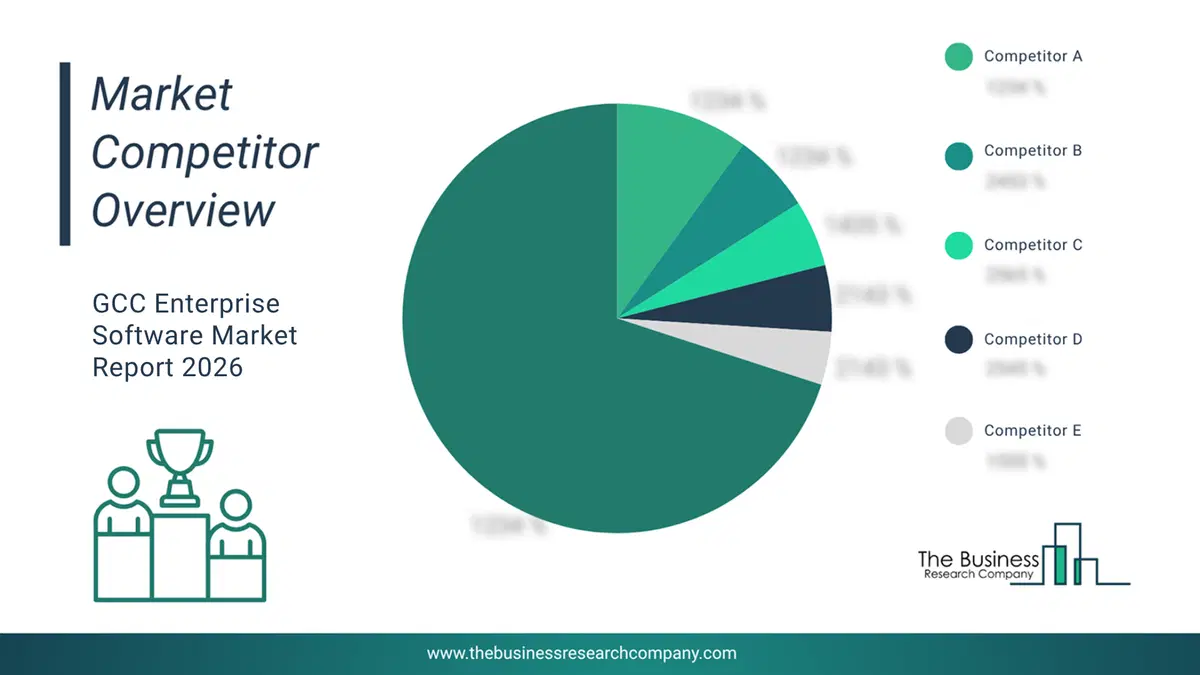
This chart is for illustrative purposes; the full report includes a detailed competitor analysis and comprehensive overview of the top 10 companies in the market.
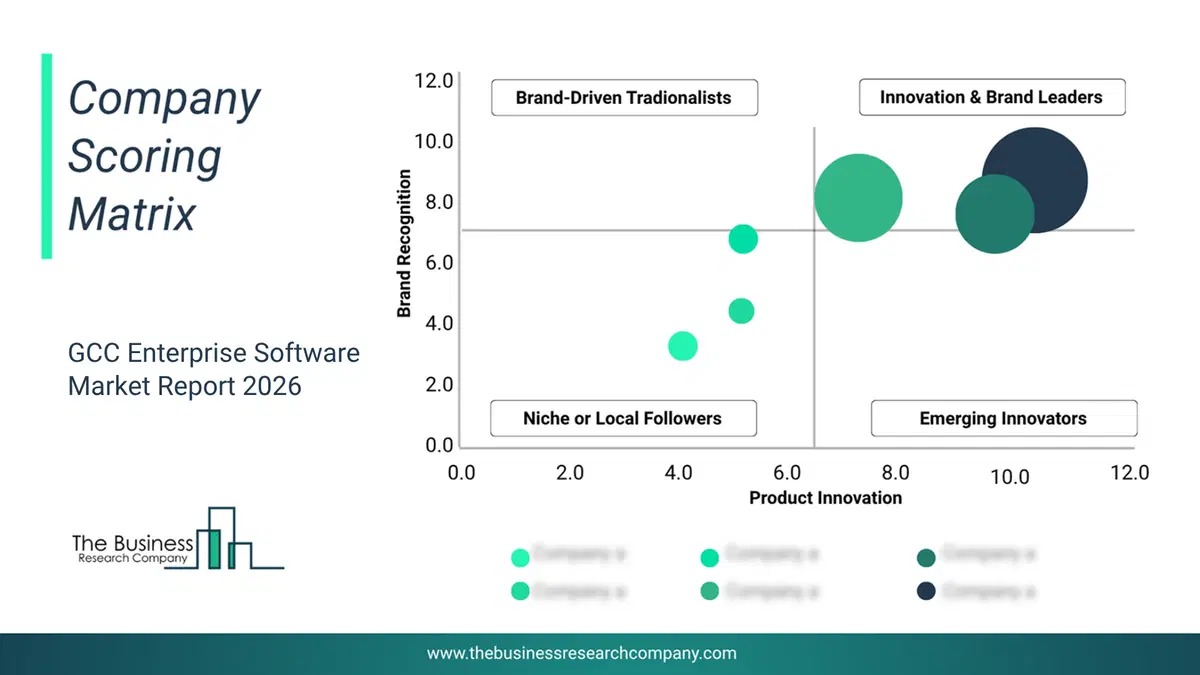
This chart maps companies by product innovation and brand strength, with bubble size indicating relative revenue, helping identify market leaders, challengers, and niche players. This is an illustrative chart; the full report provides a complete and accurate competitive analysis.
Global GCC Enterprise Software Market Trends and Insights
Major companies operating in the GCC enterprise software market are focusing on developing innovative solutions, such as AI-powered global capability center management platforms, to enhance the speed, efficiency, governance, and scalability of global capability center establishment and operations. AI-powered GCC management platforms integrate artificial intelligence, automation, analytics, and standardized operating frameworks to streamline GCC planning, talent management, compliance, infrastructure setup, and performance monitoring, offering a more intelligent and automated alternative to traditional manual consulting-led GCC implementation models. For instance, in January 2026, R Systems International Limited, an India-based digital product engineering and technology services company, launched GCC Copilot, an AI-assisted platform designed to help enterprises establish, scale, and optimize global capability centers. The platform combines AI-driven decision intelligence with curated implementation playbooks covering governance, compliance, talent acquisition, infrastructure planning, and operational processes, enabling organizations to accelerate GCC deployment in as little as 90 days. It also provides automated OKR tracking, productivity measurement, operational insights, and continuous optimization capabilities to improve decision-making and reduce operational complexity while supporting scalable, AI-first GCC operations across global enterprises.What Are Latest Mergers And Acquisitions In The GCC Enterprise Software Market?
In February 2025, IFS, a Sweden-based provider of enterprise cloud and Industrial AI software, partnered with Saudi Business Machines (SBM) to expand the market footprint of IFS solutions in Saudi Arabia. With this partnership, IFS and SBM aim to establish a dedicated Saudi-based IFS practice, expand services across aerospace and defense, energy, utilities and resources, manufacturing, construction and engineering, telecommunications, and service industries, while investing in local talent through sales training and IFS certification programs. Saudi Business Machines is a Saudi Arabia-based enterprise IT and telecommunications solutions provider offering networking, systems integration, consulting, implementation, business recovery, operations support, maintenance, and support services.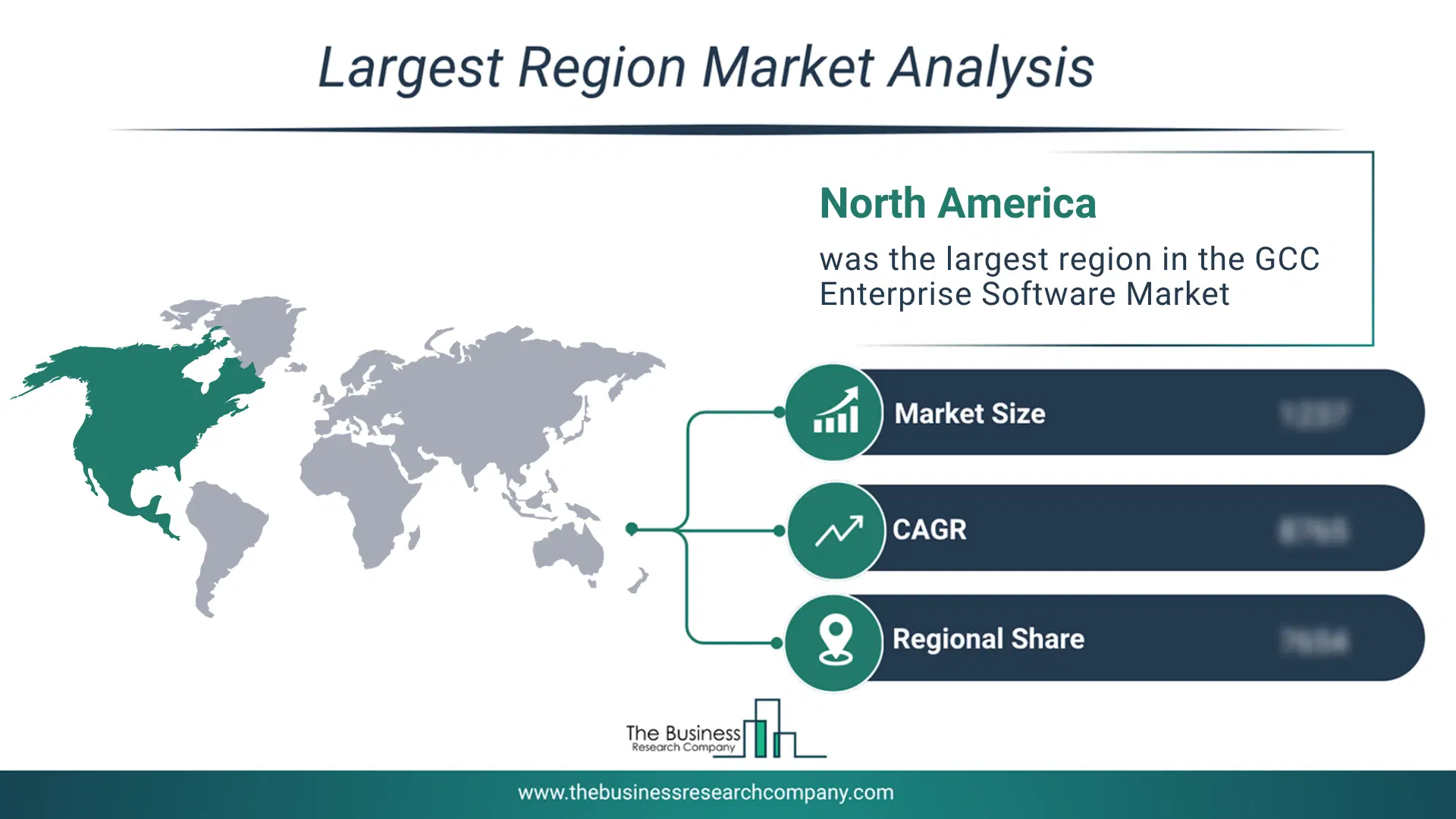
Regional Outlook/Insights
North America was the largest region in the GCC enterprise software market in 2025. Asia-Pacific is expected to be the fastest-growing region in the forecast period. The regions covered in this market report are Asia-Pacific, South East Asia, Western Europe, Eastern Europe, North America, South America, Middle East, Africa. The countries covered in this market report are Australia, Brazil, China, France, Germany, India, Indonesia, Japan, Taiwan, Russia, South Korea, UK, USA, Canada, Italy, Spain.What Defines the GCC Enterprise Software Market?
The GCC enterprise software market includes revenue earned by entities by providing services such as cloud migration and application modernization, software customization and managed application services, enterprise software consulting and digital transformation services, and application maintenance, support, and performance optimization. The market value includes the value of related goods sold by the service provider or included within the service offering. Only goods and services traded between entities or sold to end consumers are included.How is Market Value Defined and Measured?
The market value is defined as the revenues that enterprises gain from the sale of goods and/or services within the specified market and geography through sales, grants, or donations in terms of the currency (in USD unless otherwise specified). The revenues for a specified geography are consumption values that are revenues generated by organizations in the specified geography within the market, irrespective of where they are produced. It does not include revenues from resales along the supply chain, either further along the supply chain or as part of other products.
This chart presents market attractiveness based on a quantitative evaluation of growth, competition, strategic alignment, and risk, offering a clear view of opportunity areas for decision-making. This chart is for illustrative purposes; the full report contains the complete analysis.

This chart highlights the Total Addressable Market (TAM) by estimating the maximum revenue opportunity using an assumption-driven approach, supporting strategic planning and opportunity sizing across markets. The chart is illustrative; the full report provides a more comprehensive analysis.
What Key Data and Analysis Are Included in the GCC Enterprise Software Market Report 2026?
The gcc enterprise software market research report is one of a series of new reports from The Business Research Company that provides market statistics, including industry global market size, regional shares, competitors with the market share, detailed market segments, market trends and opportunities, and any further data you may need to thrive in the gcc enterprise software industry. The market research report delivers a complete perspective of everything you need, with an in-depth analysis of the current and future state of the industry.GCC Enterprise Software Market Report Forecast Analysis
| Report Attribute | Details |
|---|---|
| Market Size Value In 2026 | $6.94 billion |
| Revenue Forecast In 2030 | $10.84 billion |
| Growth Rate | CAGR of 11.8% from 2026 to 2035 |
| Base Year For Estimation | 2025 |
| Actual Estimates/Historical Data | 2020-2025 |
| Forecast Period | 2026 - 2030 |
| Market Representation | Revenue in USD Billion and CAGR from 2026 to 2030 |
| Segments Covered | Software Type, Deployment Mode, Organization Size, Technology, Industry Vertical |
| Regional Scope | Asia-Pacific, Western Europe, Eastern Europe, North America, South America, Middle East, Africa |
| Country Scope | The countries covered in the report are Australia, Brazil, China, France, Germany, India, Indonesia, Japan, Taiwan, Russia, South Korea, UK, USA, Canada, Italy, Spain. |
| Customization Scope | Request for Customization |
| Pricing And Purchase Options | Explore Purchase Options |