
Generative AI In Chip Design Market Report 2026
Global Outlook – By Type (Generative Adversarial Networks, Variational Autoencoder, Reinforcement Learning, Evolutionary Algorithms, Deep Learning Models), By Deployment (Offline Deployment, Cloud-Based, On-Premises, Hybrid), By Application (Logic Design, Physical Design, Analog And Mixed-Signal Design, Power Optimization, Design Verification, Other Applications) – Market Size, Trends, Strategies, and Forecast to 2030
Generative AI In Chip Design Market Overview
• Generative AI In Chip Design market size has reached to $0.26 billion in 2025 • Expected to grow to $0.88 billion in 2030 at a compound annual growth rate (CAGR) of 26.8% • Growth Driver: Growing Demand For Automotive Applications Driving The Generative AI In Chip Design Market • Market Trend: Advancements In Chip Design With GenAI Capabilities • North America was the largest region in 2025 and Asia-Pacific is the fastest growing region.What Is Covered Under Generative AI In Chip Design Market?
Generative AI in chip design refers to the utilization of generative artificial intelligence (AI) techniques to assist in creating and optimizing computer chip designs. This technology is used to explore and generate novel chip architectures, optimize chip layouts for performance and power efficiency, and automate various stages of the chip design process, ultimately leading to faster development cycles and more efficient chip designs. The main types of generative AI in chip design are generative adversarial networks, variational autoencoders, reinforcement learning, evolutionary algorithms, deep learning models, and others. Generative adversarial networks (GANs) are a class of machine learning algorithms used in unsupervised learning that are capable of generating new data instances similar to those in a given dataset. It has different types of deployment modes, including offline deployment, cloud-based, on-premises, embedded, and hybrid. It is applied for logic design, physical design, analog and mixed-signal design, power optimization, design verification, and others.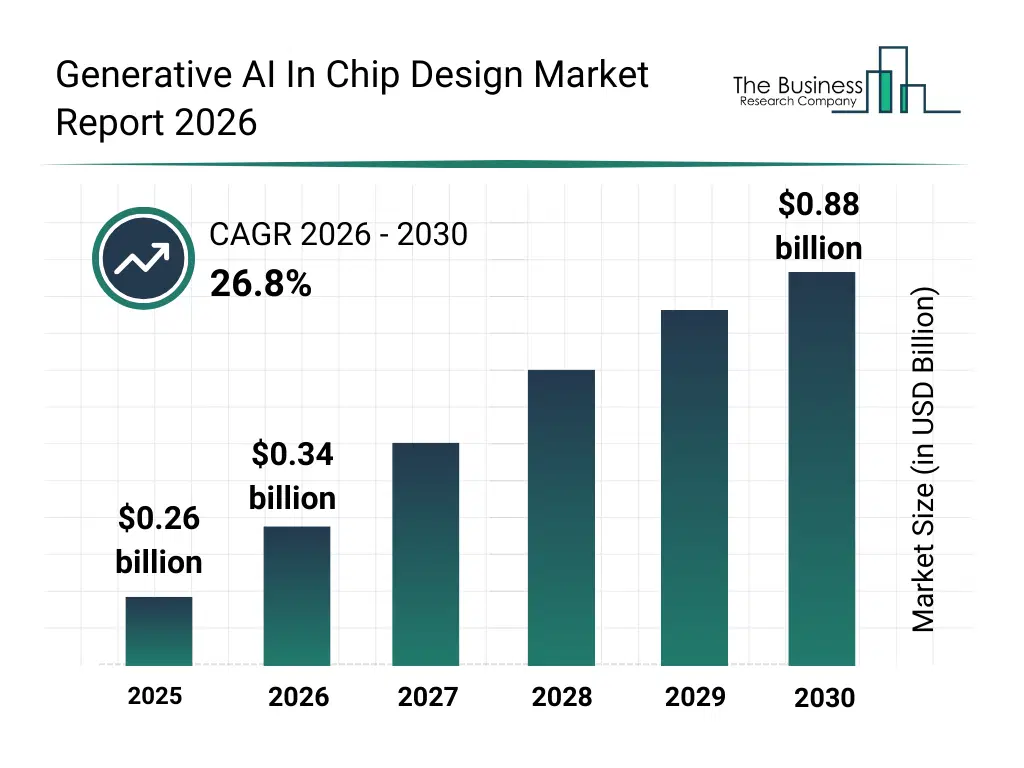
What Is The Generative AI In Chip Design Market Size and Share 2026?
The generative AI in chip design market size has grown exponentially in recent years. It will grow from $0.26 billion in 2025 to $0.34 billion in 2026 at a compound annual growth rate (CAGR) of 31.9%. The growth in the historic period can be attributed to increasing semiconductor design complexity, rising demand for high-performance chips, expansion of advanced node manufacturing, growing reliance on electronic design automation tools, early integration of machine learning in chip design workflows.What Is The Generative AI In Chip Design Market Growth Forecast?
The generative AI in chip design market size is expected to see exponential growth in the next few years. It will grow to $0.88 billion in 2030 at a compound annual growth rate (CAGR) of 26.8%. The growth in the forecast period can be attributed to increasing investments in AI-native semiconductor design platforms, rising demand for energy-efficient chips, expansion of custom silicon development, growing adoption of cloud-based design environments, increasing focus on reducing time-to-market. Major trends in the forecast period include increasing adoption of AI-driven chip architecture generation, rising use of reinforcement learning for layout optimization, growing automation of physical design processes, expansion of power and performance co-optimization tools, enhanced focus on faster design iteration cycles.
Global Generative AI In Chip Design Market Segmentation
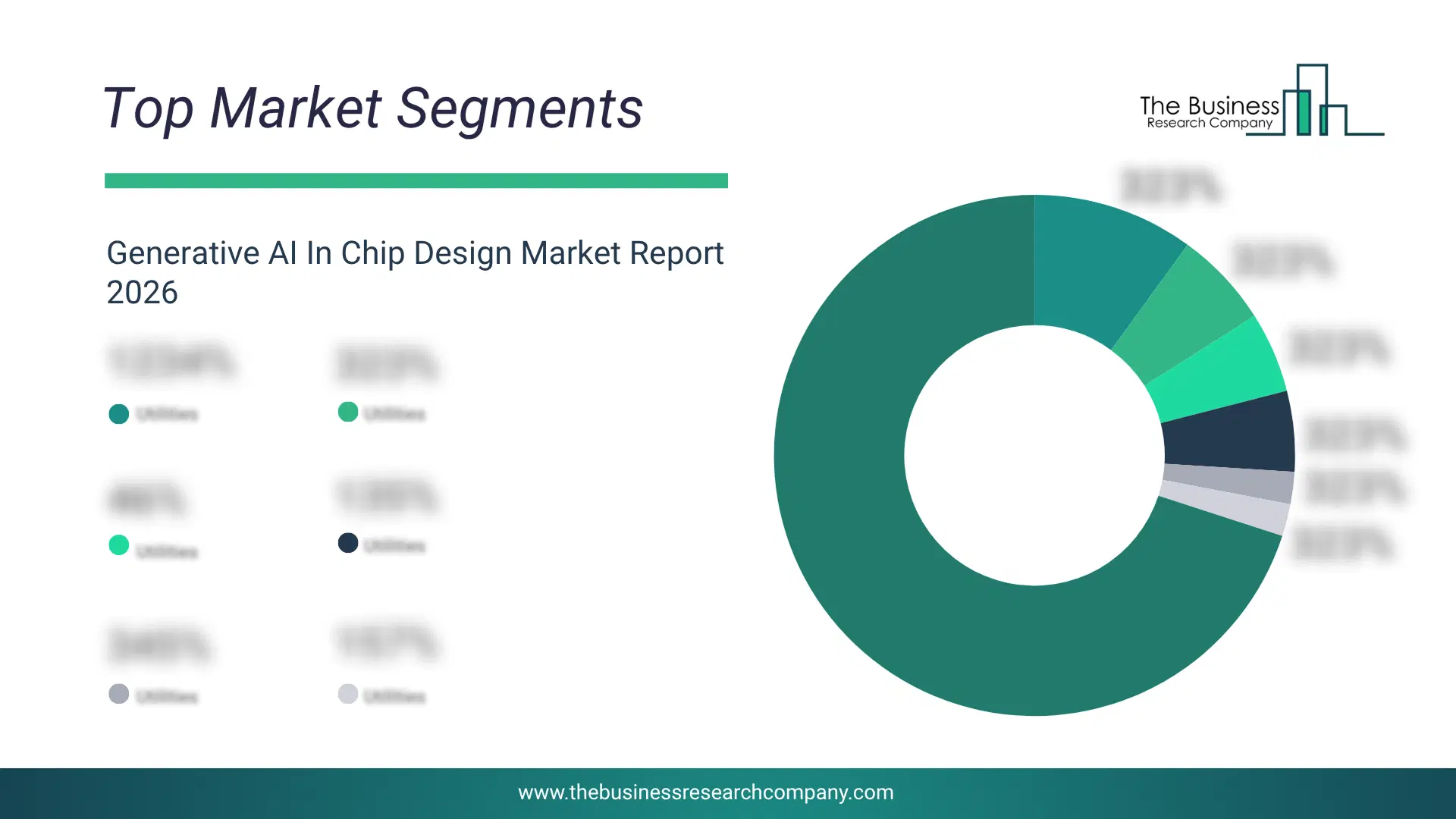
1) By Type: Generative Adversarial Networks, Variational Autoencoder, Reinforcement Learning, Evolutionary Algorithms, Deep Learning Models 2) By Deployment: Offline Deployment, Cloud-Based, On-Premises, Hybrid 3) By Application: Logic Design, Physical Design, Analog And Mixed-Signal Design, Power Optimization, Design Verification, Other Applications Subsegments: 1) By Generative Adversarial Networks: Vanilla GANs, Conditional GANs, Wasserstein GANs 2) By Variational Autoencoder: Basic VAEs, Conditional VAEs 3) By Reinforcement Learning: Model-Free Reinforcement Learning, Model-Based Reinforcement Learning, Deep Reinforcement Learning 4) By Evolutionary Algorithms: Genetic Algorithms, Genetic Programming, Differential Evolution Algorithms, Evolution Strategies 5) By Deep Learning Models: Convolutional Neural Networks (CNNs), Transformer Models, Multilayer Perceptrons (MLPs)What Is The Driver Of The Generative AI In Chip Design Market?
The increasing automotive industry is expected to propel the growth of the generative AI in chip design market going forward. The automotive industry encompasses the design, production, marketing, and sale of motor vehicles and related components. The automotive industry is rising due to increasing consumer demand for personal mobility as urbanization and lifestyle changes drive the need for flexible and efficient transportation options. Generative AI in chip design enhances the automotive industry by accelerating the development of high-performance, energy-efficient semiconductors and autonomous systems. It improves design accuracy and reduces time-to-market by automating complex chip architecture tasks, boosting overall vehicle intelligence and reliability. For instance, in 2024, according to the International Energy Agency, a France-based intergovernmental organization, the electric car sales reached 3.5 million in 2023, a 35% year-on-year increase over 2022. Therefore, the increasing automotive industry is driving the growth of the generative AI in chip design industry.Key Players In The Global Generative AI In Chip Design Market
Major companies operating in the generative AI in chip design market are Synopsys Inc., Cadence Design Systems Inc., Ansys Inc., Silvaco Group Inc., Arteris Inc., Empyrean Technology, Zuken Inc., Keysight Technologies Inc., Agnisys Inc., IC Manage, Xpeedic, Bronco AI, Cognichip, Chipmind, Celera EDA, Chipstack, Classiq, Real Intent, Flex Logix, Blue Cheetah Analog Design, Movellus Circuits, Expedera Inc.
This chart is for illustrative purposes; the full report includes a detailed competitor analysis and comprehensive overview of the top 10 companies in the market.
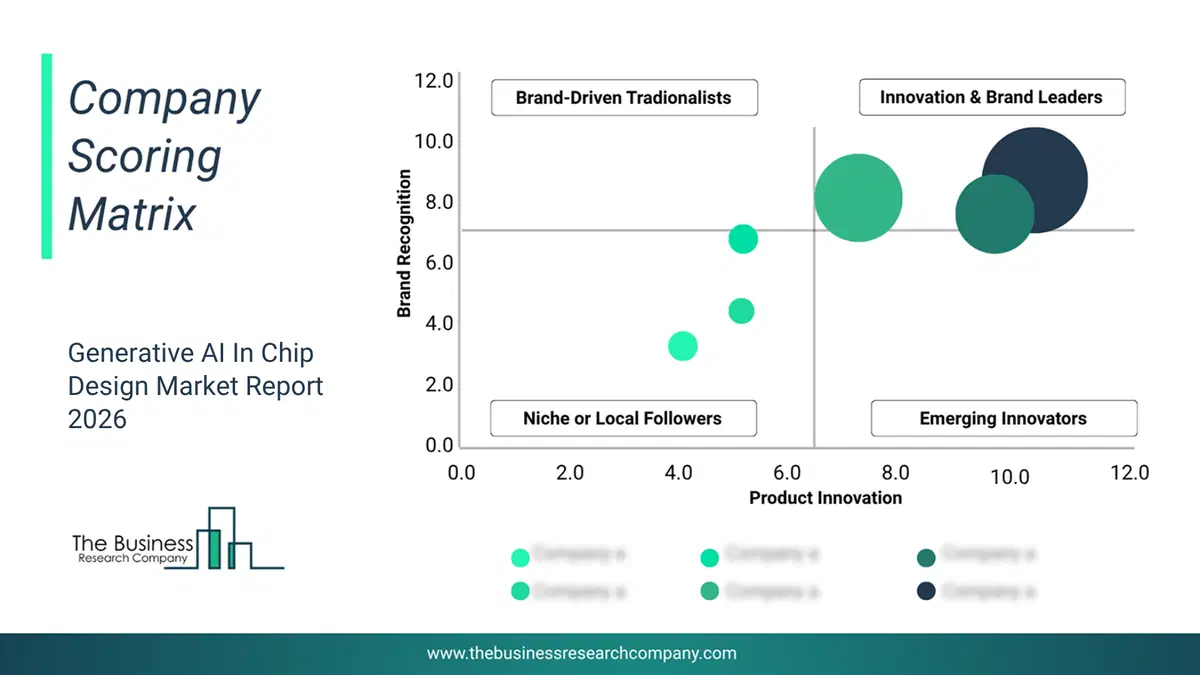
This chart maps companies by product innovation and brand strength, with bubble size indicating relative revenue, helping identify market leaders, challengers, and niche players. This is an illustrative chart; the full report provides a complete and accurate competitive analysis.
Global Generative AI In Chip Design Market Trends and Insights
Major companies operating in the generative AI in chip design market are focusing on developing technologically advanced solutions, such as generative AI-based copilot, to meet the increasing demand for high-performance, energy-efficient computing solutions. A generative AI-based copilot is an artificial intelligence system that assists users by generating content, suggestions, or solutions based on context and user input. For instance, in November 2023, Synopsys Inc., a US-based electronic design automation company, launched Synopsys.AI Copilot. This tool provides a breakthrough generative artificial intelligence (GenAI) capability for accelerating chip design. The innovative tool integrates the Microsoft Azure OpenAI Service, providing access to OpenAI's large language models (LLMs) within the capabilities of Microsoft Azure. It enhances the chip design process with conversational intelligence and generative capabilities in natural language across design teams.What Are Latest Mergers And Acquisitions In The Generative AI In Chip Design Market?
In January 2024, Synopsys Inc., a US-based electronic design automation company, acquired Ansys Inc. for $35 billion. With this acquisition, Synopsys seeks to strengthen its position in the chip design market by enhancing its capabilities and addressing demand across industries such as aerospace, defense, automotive, and energy. Ansys Inc. is a US-based software company providing generative chip design AI through its AI-augmented simulation technology.
Regional Insights
North America was the largest region in the generative AI in chip design market in 2025. Asia-Pacific is expected to be the fastest-growing region in the forecast period. The regions covered in this market report are Asia-Pacific, South East Asia, Western Europe, Eastern Europe, North America, South America, Middle East, Africa. The countries covered in this market report are Australia, Brazil, China, France, Germany, India, Indonesia, Japan, Taiwan, Russia, South Korea, UK, USA, Canada, Italy, Spain.What Defines the Generative AI In Chip Design Market?
The generative AI in chip design market includes revenues earned by entities by providing services such as algorithm development, consultation and expertise, training and education, customization and integration, prototype development, and performance optimization. The market value includes the value of related goods sold by the service provider or included within the service offering. Only goods and services traded between entities or sold to end consumers are included.How is Market Value Defined and Measured?
The market value is defined as the revenues that enterprises gain from the sale of goods and/or services within the specified market and geography through sales, grants, or donations in terms of the currency (in USD unless otherwise specified). The revenues for a specified geography are consumption values that are revenues generated by organizations in the specified geography within the market, irrespective of where they are produced. It does not include revenues from resales along the supply chain, either further along the supply chain or as part of other products.
This chart presents market attractiveness based on a quantitative evaluation of growth, competition, strategic alignment, and risk, offering a clear view of opportunity areas for decision-making. This chart is for illustrative purposes; the full report contains the complete analysis.

This chart highlights the Total Addressable Market (TAM) by estimating the maximum revenue opportunity using an assumption-driven approach, supporting strategic planning and opportunity sizing across markets. The chart is illustrative; the full report provides a more comprehensive analysis.
What Key Data and Analysis Are Included in the Generative AI In Chip Design Market Report 2026?
The generative ai in chip design market research report is one of a series of new reports from The Business Research Company that provides market statistics, including industry global market size, regional shares, competitors with the market share, detailed market segments, market trends and opportunities, and any further data you may need to thrive in the generative ai in chip design industry. The market research report delivers a complete perspective of everything you need, with an in-depth analysis of the current and future state of the industry.Generative AI In Chip Design Market Report Forecast Analysis
| Report Attribute | Details |
|---|---|
| Market Size Value In 2026 | $0.34 billion |
| Revenue Forecast In 2030 | $0.88 billion |
| Growth Rate | CAGR of 26.8% from 2026 to 2030 |
| Base Year For Estimation | 2025 |
| Actual Estimates/Historical Data | 2020-2025 |
| Forecast Period | 2026 - 2030 |
| Market Representation | Revenue in USD Billion and CAGR from 2026 to 2030 |
| Segments Covered | Type, Deployment, Application |
| Regional Scope | Asia-Pacific, Western Europe, Eastern Europe, North America, South America, Middle East, Africa |
| Country Scope | The Countries Covered In This Market Report Are Australia, Brazil, China, France, Germany, India, Indonesia, Japan, Taiwan, Russia, South Korea, Uk, Usa, Canada, Italy, Spain. |
| Key Companies Profiled | Synopsys Inc., Cadence Design Systems Inc., Ansys Inc., Silvaco Group Inc., Arteris Inc., Empyrean Technology, Zuken Inc., Keysight Technologies Inc., Agnisys Inc., IC Manage, Xpeedic, Bronco AI, Cognichip, Chipmind, Celera EDA, Chipstack, Classiq, Real Intent, Flex Logix, Blue Cheetah Analog Design, Movellus Circuits, Expedera Inc. |
| Customization Scope | Request for Customization |
| Pricing And Purchase Options | Explore Purchase Options |