
Generative AI In Software Development Lifecycle Market Report 2026
Global Outlook – By Component (Solutions, Services), By Deployment Mode (On-Premise, Cloud-Based), By Application (Code Generation, Code Optimization, Bug Detection, Testing And Quality Assurance, Other Applications), By End-User (Software Engineers Or DevOps Professionals, Security Professionals Or SecOps) – Market Size, Trends, Strategies, and Forecast to 2030
Generative AI In Software Development Lifecycle Market Overview
• Generative AI In Software Development Lifecycle market size has reached to $0.69 billion in 2025 • Expected to grow to $2.92 billion in 2030 at a compound annual growth rate (CAGR) of 32.2% • Growth Driver: Increasing Demand For Automation Driving The Generative AI In Software Development Lifecycle Market • Market Trend: Innovation In Generative AI in Software Development Lifecycle • North America was the largest region in 2025 and Asia-Pacific is the fastest growing region.Market Gains By 2030 – Top Opportunities By Segment
Market Gain identifies the most promising market opportunities by highlighting the segments or products expected to generate the highest incremental revenue growth over the next five years.
What Is Covered Under Generative AI In Software Development Lifecycle Market?
Generative AI in the software development lifecycle refers to the integration of artificial intelligence techniques, particularly generative models, into various stages of software development processes. This integration enables faster development cycles, reduces manual effort, and leads to the creation of more efficient and reliable software solutions. The main components of generative AI in the software development lifecycle include solutions and services. Services refer to non-physical, intangible components of the economy, contrasting with goods that are tangible and can be touched or handled. The deployment modes encompass both on-premise and cloud-based, which are used for several applications, including code generation, code optimization, bug detection, testing and quality assurance, and others. It is used by various end-users, including software engineers, or DevOps professionals, as well as security professionals, or SecOps.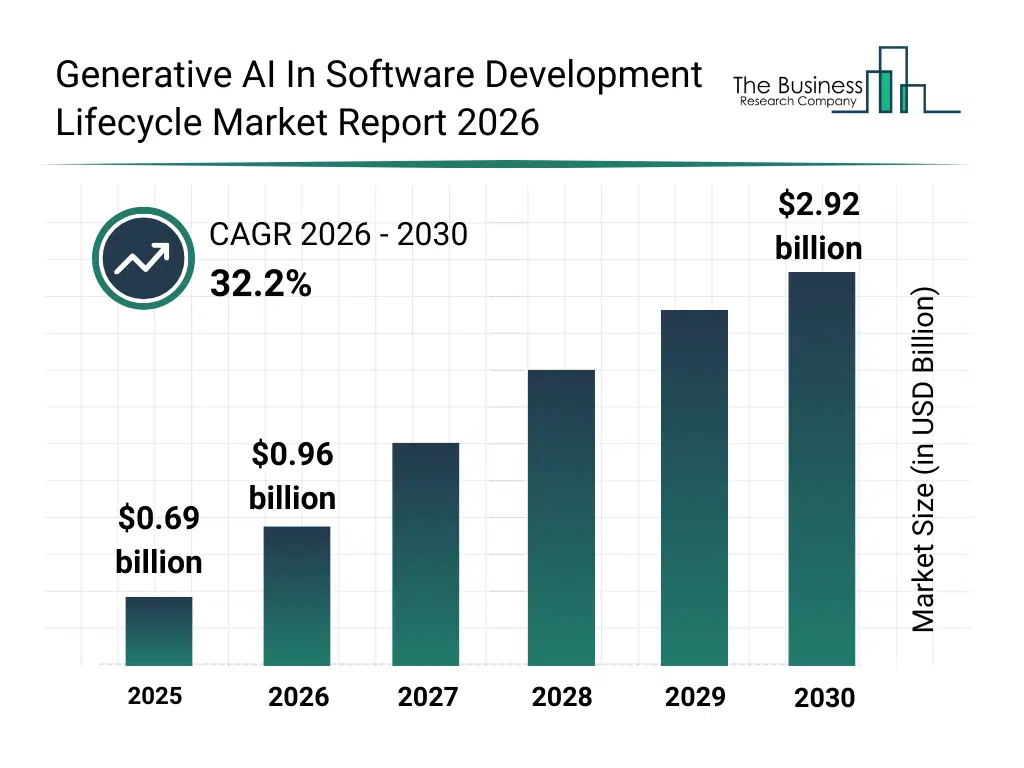
What Is The Generative AI In Software Development Lifecycle Market Size and Share 2026?
The generative AI in software development lifecycle market size has grown exponentially in recent years. It will grow from $0.69 billion in 2025 to $0.96 billion in 2026 at a compound annual growth rate (CAGR) of 38.6%. The growth in the historic period can be attributed to growth of agile and devops methodologies, rising complexity of enterprise software systems, increasing demand for faster release cycles, expansion of cloud-native application development, early adoption of automation tools.What Is The Generative AI In Software Development Lifecycle Market Growth Forecast?
The generative AI in software development lifecycle market size is expected to see exponential growth in the next few years. It will grow to $2.92 billion in 2030 at a compound annual growth rate (CAGR) of 32.2%. The growth in the forecast period can be attributed to increasing investments in AI-powered software platforms, rising demand for secure and scalable applications, expansion of continuous integration automation, growing focus on developer productivity, increasing use of generative AI for lifecycle optimization. Major trends in the forecast period include increasing adoption of AI-based code generation tools, rising use of automated testing and qa solutions, expansion of AI-driven code refactoring practices, growing integration of generative AI in devops pipelines, enhanced focus on software quality and reliability.
Global Generative AI In Software Development Lifecycle Market Segmentation
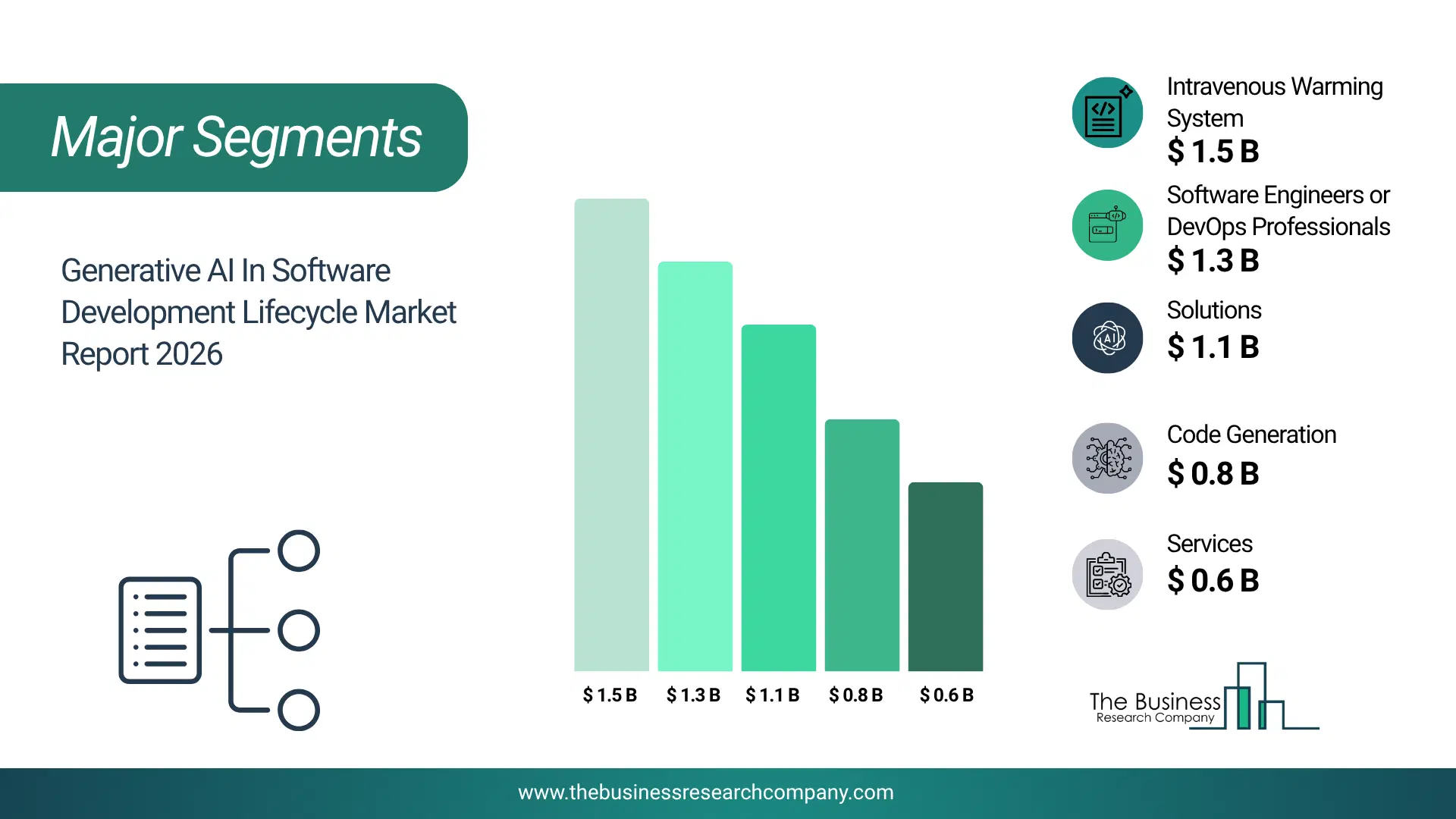
1) By Component: Solutions, Services 2) By Deployment Mode: On-Premise, Cloud-Based 3) By Application: Code Generation, Code Optimization, Bug Detection, Testing And Quality Assurance, Other Applications 4) By End-User: Software Engineers Or DevOps Professionals, Security Professionals Or SecOps Subsegments: 1) By Solutions: Code Generation Solutions, Automated Testing Solutions, Code Refactoring Solutions, Bug Detection And Fixing Solutions, Code Review And Quality Assurance Solutions, Continuous Integration Or Continuous Deployment (CI Or CD) Solutions, DevOps Automation Solutions, AI-Powered Documentation Solutions, Other Generative AI Solutions 2) By Services: Consulting Services, System Integration Services, AI Model Training And Fine-Tuning Services, Customization And Development Services, Support And Maintenance Services, Managed Services, Other Services The top segments in the generative ai in software development lifecycle market will be: • Cloud-Based will reach $1497.26 Million by 2030. • Software Engineers or DevOps Professionals will reach $1321.22 Million by 2030. • Solutions will reach $1179.66 Million by 2030. • Services will reach $621.1 Million by 2030. • Code Generation will reach $802.11 Million by 2030.What Is The Driver Of The Generative AI In Software Development Lifecycle Market?
The increasing demand for automation is expected to propel the growth of the generative AI in software development lifecycle market going forward. Automation refers to the use of technology or machines to perform tasks with minimal or no human intervention. The demand for automation is rising due to the need for increased operational efficiency as businesses aim to reduce costs, minimize errors, and boost productivity. Automation enhances generative AI in the software development lifecycle by streamlining repetitive tasks such as code generation, testing, and optimization, enabling faster and more efficient development workflows. It improves software quality and reliability by reducing human error and ensuring consistent, AI-driven outputs across the entire development process. For instance, in November 2024, according to the Organisation for Economic Co‑operation and Development (OECD), a Paris‑based intergovernmental organisation, enterprise adoption of AI rose significantly between 2023 and 2024, with post‑Gen AI adoption rates in EU27 firms increasing to as high as 28% from 4% compared to 2022-2023. Therefore, the increasing demand for automation is driving the growth of the generative AI in software development lifecycle industry.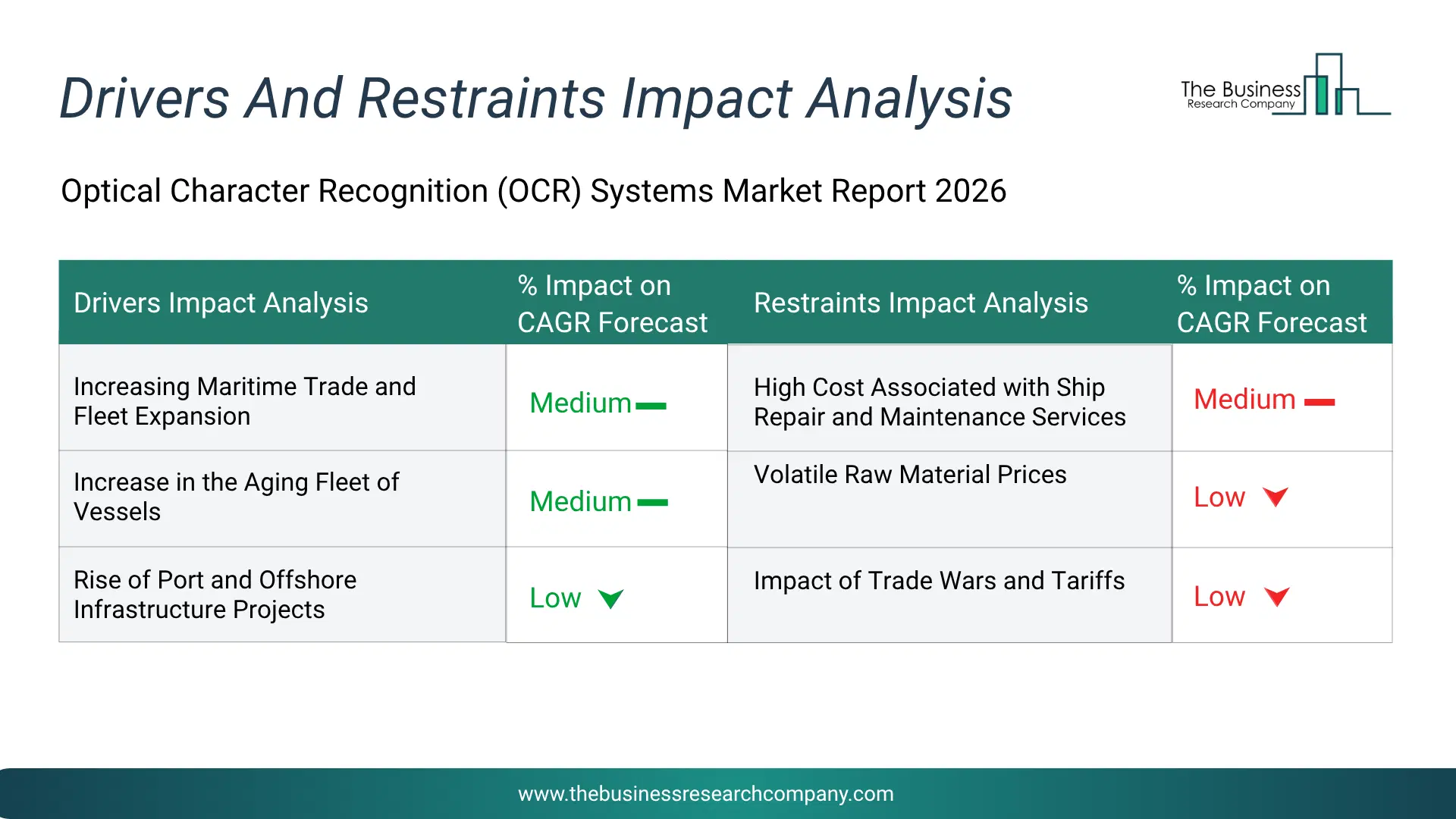
Infographic Chart Showing Key Market Drivers Analysis And Restraints For Generative Ai In Software Development Lifecycle Market
The chart presents an impact analysis of key drivers and restraints, quantifying their relative influence on the market's growth rate and helping assess the balance between growth enablers and limiting factors. This chart offers a high-level perspective; the full report contains more detailed insights.
How Will The Drivers Impact Growth In The Global Generative AI In Software Development Lifecycle Market?
• Increasing Digital Transformation Initiatives (Low) – During the forecast period, the increasing digital transformation initiatives will become a key driver of growth in the generative ai in software development lifecycle market by 2030. as governments and public sector organizations expand digital service delivery, modernize legacy systems and invest in data-driven administration, the scale and complexity of public digital platforms continue to grow across sectors. expanding digital programs increase the volume of software projects and raise requirements for rapid, reliable and scalable development practices across government technology teams. greater digital adoption across public services also encourages the use of tools that improve development speed, standardization and lifecycle management discipline. as a result, generative ai solution providers are strengthening automated coding, testing and documentation capabilities to support faster delivery of digital services and more efficient modernization efforts, which aligns with public sector transformation priorities and sustains growth in the global generative ai in software development lifecycle market. as a result, increasing digital transformation initiatives is anticipated to contributing to a 1.0% annual growth in the market. • Expansion of SaaS and Cloud-Native Applications (Low) – During the forecast period, the expansion of saas and cloud-native applications will emerge as a major factor driving the expansion of the generative ai in software development lifecycle market by 2030. as organizations accelerate digital transformation, migrate workloads to cloud environments and adopt microservices, containers and orchestration platforms, the scale of saas and cloud-native application development continues to rise, creating greater demand for faster and more efficient software delivery processes. a growing cloud-native base increases development complexity and release frequency, which drives demand for ai-enabled coding, testing and devops tools that can automate repetitive tasks and improve code quality across distributed environments. as a result, generative ai solution providers are expanding platform capabilities, integrating ai across development pipelines and strengthening cloud compatibility to support modern application architectures and sustain long-term growth in the global generative ai in software development lifecycle market. consequently, the expansion of saas and cloud-native applications is projected to contributing to a 0.8% annual growth in the market. • Demand for Improved Code Quality and Faster Release Cycles (Low) – During the forecast period, the demand for improved code quality and faster release cycles will serve as a key growth catalyst for the generative ai in software development lifecycle market by 2030. as organizations compete in digital markets that require continuous updates, stable performance and secure applications, the need to deliver reliable software at high frequency continues to intensify across industries. stronger delivery expectations increase pressure on development teams to reduce defects and accelerate deployment timelines, which raises demand for automation and intelligent development support tools. greater focus on software reliability also encourages organizations to adopt solutions that strengthen testing discipline and coding consistency throughout development workflows. as a result, generative ai solution providers are enhancing code generation, automated review and ai-assisted testing capabilities to support higher release velocity and stronger quality outcomes, which aligns with enterprise priorities and sustains growth in the global generative ai in software development lifecycle market. therefore, demand for improved code quality and faster release cycles is projected to supporting to a 0.5% annual growth in the market. • Growing Need for Cost Optimization in Software Projects (Low) – During the forecast period, the growing need for cost optimization in software projects is expected to be a key driver propelling growth in the generative AI in software development lifecycle market. As organizations tighten technology budgets, scrutinize return on digital investments and seek to reduce software delivery costs, pressure to improve development efficiency continues to increase across both public and private sectors. Heightened cost focus raises demand for tools that shorten development cycles and reduce reliance on large engineering teams, which strengthens the case for AI-enabled automation across coding, testing and maintenance activities. A stronger cost discipline also pushes organizations to limit rework and production defects, which increases interest in AI-assisted quality assurance and code validation throughout the lifecycle. As a result, generative AI solution providers are expanding automation features, improving productivity support and positioning their platforms as cost-reduction enablers to align with budget-conscious software strategies and to sustain long-term growth in the global generative AI in software development lifecycle market. The growing need for cost optimization in software projects growth contribution during the forecast period in 2025 is 0.3%.How Will The Restraints Impact Growth In The Global Generative AI In Software Development Lifecycle Market?
• Regulatory and Legal Uncertainty (Low) – During the forecast period, regulatory and legal uncertainty is restricting the growth of the generative AI in software development lifecycle market. Persistent ambiguity in AI-specific laws and compliance frameworks across global jurisdictions, including questions around data privacy, intellectual property ownership, content accountability and algorithmic transparency, are placing legal and operational strain on technology providers and enterprise adopters, which in turn discourages broader deployment and long-term strategic investments. From a commercial and operational perspective, the evolving regulatory landscape—spanning GDPR-style data protection mandates, AI fairness legislation and unclear liability for AI-generated code outputs—raises compliance costs, escalates legal risk exposure and increases pressure on organizations to defer or scale back implementation plans, often at the expense of potential productivity gains. These regulatory and legal dynamics, coupled with the lack of standardized AI governance practices, inconsistent enforcement mechanisms across regions and limited clarity on open-source training data rights, intensify compliance burdens and heighten the risk of fines, litigation and operational disruptions. As a result, software developers, enterprise IT teams and AI tool vendors may face constrained demand for generative AI solutions, more cautious adoption strategies and delayed investments in advanced lifecycle automation tools through 2030. Growth affected by the regulatory and legal uncertainty during the forecast period in 2025 is -3.5%. • Bias, Accuracy, and Reliability Concerns (Low) – During the forecast period, bias, accuracy and reliability concerns are restricting the growth of the generative AI in software development lifecycle market. Persistent issues related to algorithmic bias inherited from training data, inconsistent output quality and the probabilistic nature of generative models are placing operational and strategic strain on development teams, which in turn discourages full trust and integration of AI-generated code and recommendations across software engineering workflows. From a commercial and operational perspective, biased or inaccurate AI outputs that require extensive manual validation, debugging and correction increase pressure on developers and project managers to invest additional time and resources in review processes, often at the expense of productivity gains and accelerated delivery timelines. These accuracy and bias dynamics, coupled with potential legal and reputational risks associated with unreliable outputs, inconsistent functional correctness and fairness concerns in automated code generation, intensify scrutiny and slow adoption of generative AI tools in mission-critical software development environments. As a result, enterprises, development teams and technology vendors may face constrained generative AI implementation, more cautious deployment strategies and delayed investments in robust governance, validation frameworks and trust-enhancing mechanisms across SDLC processes. Growth affected by the bias, accuracy and reliability concerns during the forecast period in 2025 is -3.0%. • Impact of Trade War and Tariffs (Low) – During the forecast period, the impact of trade war and tariffs is expected to restrict the growth of the generative AI in software development lifecycle market. Escalating tariffs on imported hardware used to build generative AI infrastructure—such as GPUs, servers and data center components—are increasing upfront procurement costs and operational expenditures for AI model training, deployment and API delivery, placing financial strain on enterprises, start-ups and cloud service providers, which in turn discourages broader investment in generative AI platforms and services. From an economic and strategic perspective, higher import duties on critical electronics and processing chips raise capital requirements for building and expanding AI capabilities, intensify price pressures on cloud-based development environments and force organizations to either absorb added expenses or delay project rollouts, often at the expense of innovation velocity and competitive differentiation. These trade policy dynamics, combined with tariff-induced supply chain realignment, fragmented sourcing strategies and global cost inflation in computing infrastructure, heighten budgetary risks and prolong time-to-market for AI-enhanced software solutions across sectors reliant on generative AI. As a result, software vendors, development teams and enterprise adopters may face constrained generative AI adoption, more cautious investment frameworks and delayed expansions of their AI-enabled software development lifecycles during the 2025–2030 period. Growth affected by the impact of trade wars and tariffs during the forecast period in 2025 is -0.3%.Key Players In The Global Generative AI In Software Development Lifecycle Market
Major companies operating in the generative AI in software development lifecycle market are Microsoft Corporation, IBM, Atlassian Corporation Plc, GitHub Inc., Harness Inc., CloudBees Inc., Hugging Face Inc., Replit, Tabnine Ltd., DeepCode (Snyk)†, Sourcegraph, Codota, Kite (programming assistant)†, OpenAI, GitLab Inc., AppSmith, Codeium, Codenjoy, CodeStream, PolyCoder, MutableAI, Diffblue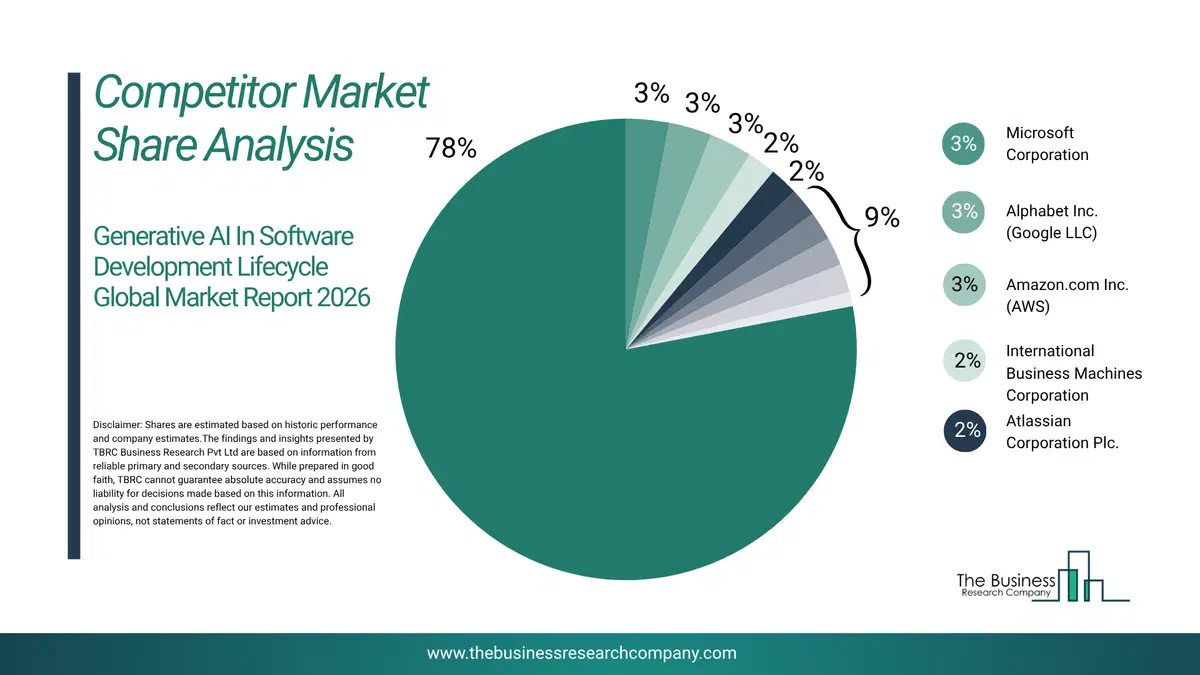
This chart is for illustrative purposes; the full report includes a detailed competitor analysis and comprehensive overview of the top 10 companies in the market.
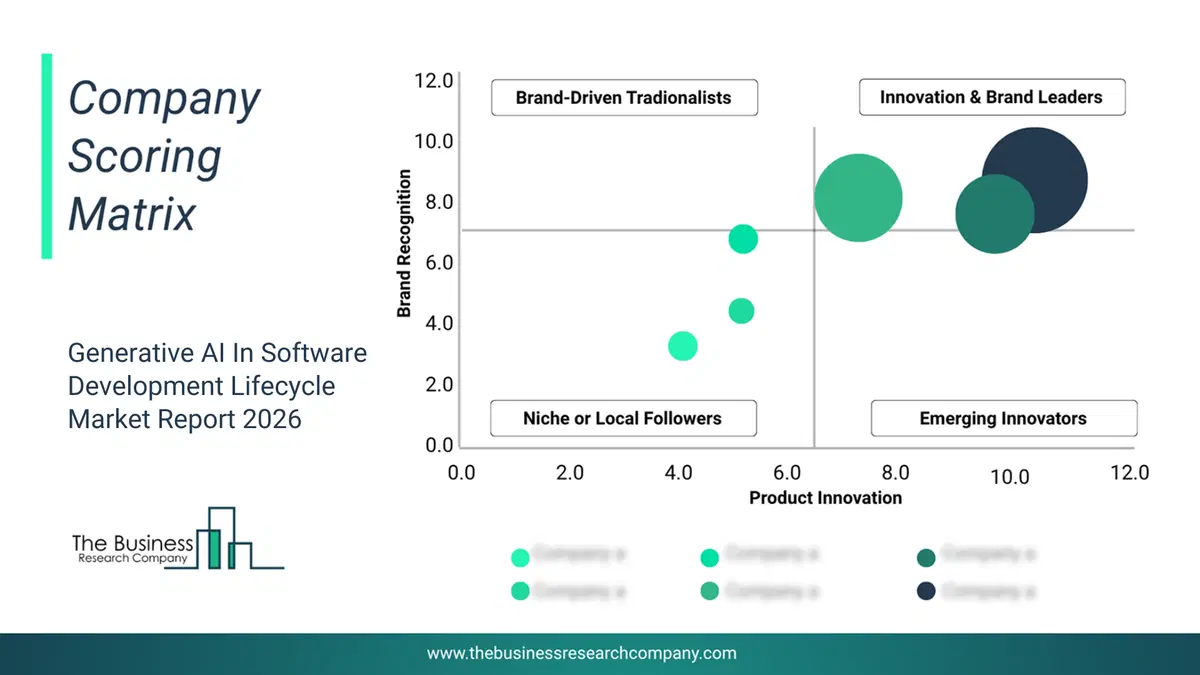
This chart maps companies by product innovation and brand strength, with bubble size indicating relative revenue, helping identify market leaders, challengers, and niche players. This is an illustrative chart; the full report provides a complete and accurate competitive analysis.
Global Generative AI In Software Development Lifecycle Market Trends and Insights
Major companies operating in the generative AI in software development lifecycle market are focusing on developing innovative solutions, such as generative AI assistants, to enhance software security and drive their revenues in the market. A generative AI assistant refers to an AI-powered tool that aids developers by autonomously generating code snippets, and documentation, or assisting in security analysis, enhancing productivity and efficiency. For instance, in June 2023, Harness Inc., a US-based software delivery platform company, launched the AIDA (AI Development Assistant), a generative AI assistant designed to streamline the software development lifecycle. It was developed to assist developers at every stage of the software development lifecycle, with features such as automatic resolution of build and deployment failures, finding security vulnerabilities and automatically fixing them, and helping control cloud costs using natural language.What Are Latest Mergers And Acquisitions In The Generative AI In Software Development Lifecycle Market?
In July 2023, Databricks Inc., a US-based global data, analytics, and artificial intelligence company, acquired MosaicML for approximately $1.3 billion. This acquisition aims to make generative AI accessible to organizations of all sizes, enabling them to build, own, and secure generative AI models with their proprietary data. MosaicML is a US-based generative AI development platform.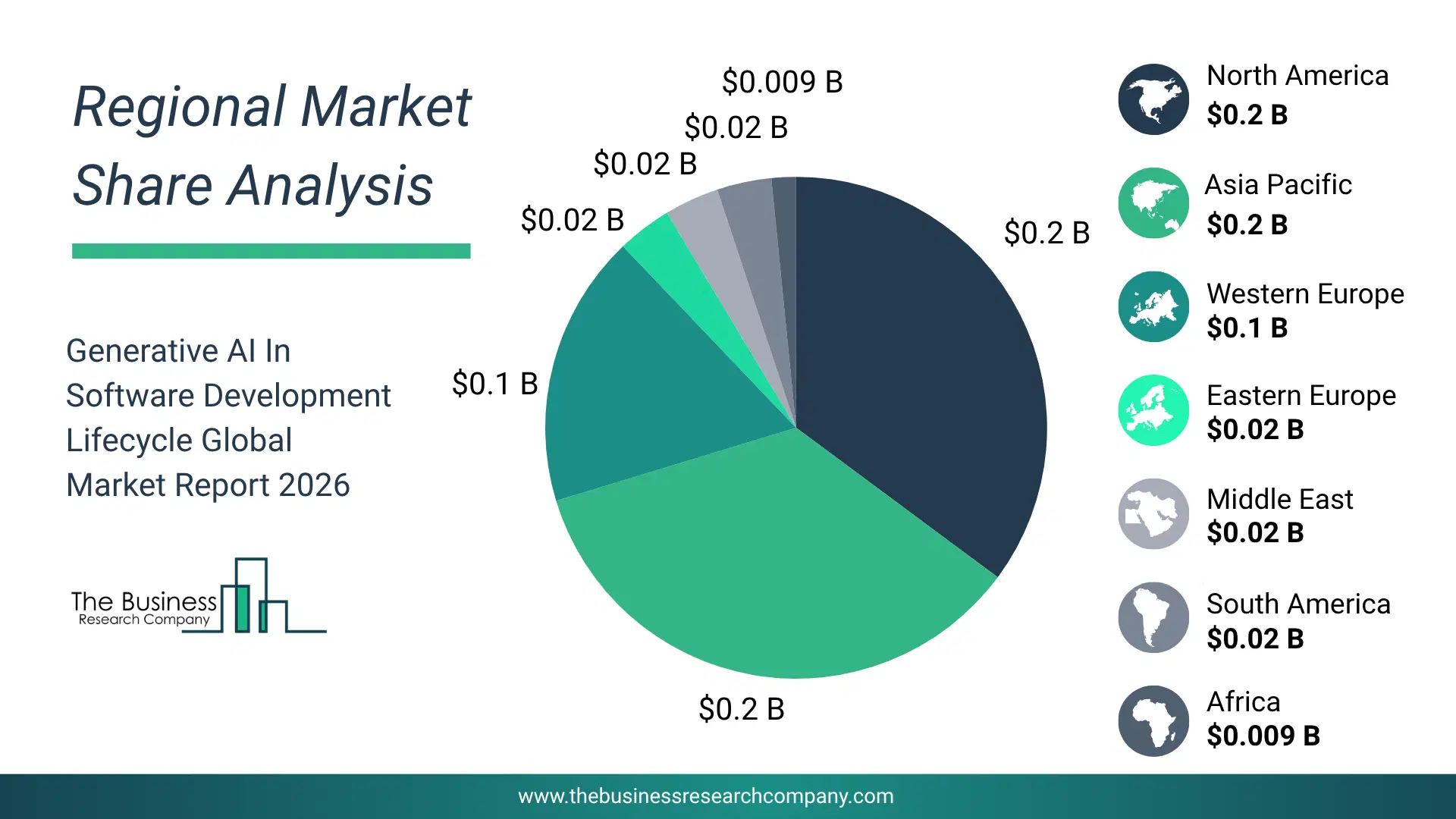
Regional Insights
North America was the largest region in the generative AI in software development lifecycle market in 2025. Asia-Pacific is expected to be the fastest-growing region in the forecast period. The regions covered in this market report are Asia-Pacific, South East Asia, Western Europe, Eastern Europe, North America, South America, Middle East, Africa. The countries covered in this market report are Australia, Brazil, China, France, Germany, India, Indonesia, Japan, Taiwan, Russia, South Korea, UK, USA, Canada, Italy, Spain.What Defines the Generative AI In Software Development Lifecycle Market?
The generative AI in software development lifecycle market includes revenues earned by entities by providing services, such as requirement analysis, prototyping and design, code generation, testing automation, debugging assistance, performance optimization, and bug prediction and prevention. The market value includes the value of related goods sold by the service provider or included within the service offering. Only goods and services traded between entities or sold to end consumers are included.How is Market Value Defined and Measured?
The market value is defined as the revenues that enterprises gain from the sale of goods and/or services within the specified market and geography through sales, grants, or donations in terms of the currency (in USD unless otherwise specified). The revenues for a specified geography are consumption values that are revenues generated by organizations in the specified geography within the market, irrespective of where they are produced. It does not include revenues from resales along the supply chain, either further along the supply chain or as part of other products.
This chart presents market attractiveness based on a quantitative evaluation of growth, competition, strategic alignment, and risk, offering a clear view of opportunity areas for decision-making. This chart is for illustrative purposes; the full report contains the complete analysis.

This chart highlights the Total Addressable Market (TAM) by estimating the maximum revenue opportunity using an assumption-driven approach, supporting strategic planning and opportunity sizing across markets. The chart is illustrative; the full report provides a more comprehensive analysis.
What Key Data and Analysis Are Included in the Generative AI In Software Development Lifecycle Market Report 2026?
The generative ai in software development lifecycle market research report is one of a series of new reports from The Business Research Company that provides market statistics, including industry global market size, regional shares, competitors with the market share, detailed market segments, market trends and opportunities, and any further data you may need to thrive in the generative ai in software development lifecycle industry. The market research report delivers a complete perspective of everything you need, with an in-depth analysis of the current and future state of the industry.Generative AI In Software Development Lifecycle Market Report Forecast Analysis
| Report Attribute | Details |
|---|---|
| Market Size Value In 2026 | $0.96 billion |
| Revenue Forecast In 2030 | $2.92 billion |
| Growth Rate | CAGR of 38.6% from 2026 to 2030 |
| Base Year For Estimation | 2025 |
| Actual Estimates/Historical Data | 2020-2025 |
| Forecast Period | 2026 - 2030 - 2035 |
| Market Representation | Revenue in USD Billion and CAGR from 2026 to 2030 |
| Segments Covered | Component, Deployment Mode, Application, End-User |
| Regional Scope | Asia-Pacific, Western Europe, Eastern Europe, North America, South America, Middle East, Africa |
| Country Scope | The countries covered in the report are Australia, Brazil, China, France, Germany, India, Indonesia, Japan, Taiwan, Russia, South Korea, UK, USA, Canada, Italy, Spain. |
| Key Companies Profiled | Microsoft Corporation, IBM, Atlassian Corporation Plc, GitHub Inc., Harness Inc., CloudBees Inc., Hugging Face Inc., Replit, Tabnine Ltd., DeepCode (Snyk)†, Sourcegraph, Codota, Kite (programming assistant)†, OpenAI, GitLab Inc., AppSmith, Codeium, Codenjoy, CodeStream, PolyCoder, MutableAI, Diffblue |
| Customization Scope | Request for Customization |
| Pricing And Purchase Options | Explore Purchase Options |