
Generative AI In Software Development Lifecycle Global Market Opportunities And Strategies To 2035
By Component (Solutions, Services), By Deployment Mode (On-Premise, Cloud-Based), By Application (Code Generation, Code Optimization, Bug Detection, Testing And Quality Assurance, Other Applications), By End User (Software Engineers Or DevOps Professionals, Security Professionals Or SecOps), And By Region, Opportunities And Strategies – Global Forecast To 2035
Generative AI In Software Development Lifecycle Market Definition
Generative artificial intelligence (AI) in the software development lifecycle (SDLC) refers to the use of artificial intelligence model, such as large language models and code-generation systems, to assist and automate activities across all stages of software development. These stages include requirements analysis, design, coding, testing, documentation, deployment and maintenance. The primary purpose of using generative AI in the SDLC is to improve development efficiency, quality and speed while reducing manual effort and errors. The generative AI in software development lifecycle market consists of sales by entities (organizations, sole traders, or partnerships) that develop and provide generative AI-powered tools, platforms and associated services that are integrated into software engineering workflows. These offerings are used by software engineers, DevOps professionals, security professionals and SecOps teams across industries to enhance productivity, reduce development cycles, improve software quality and strengthen security postures.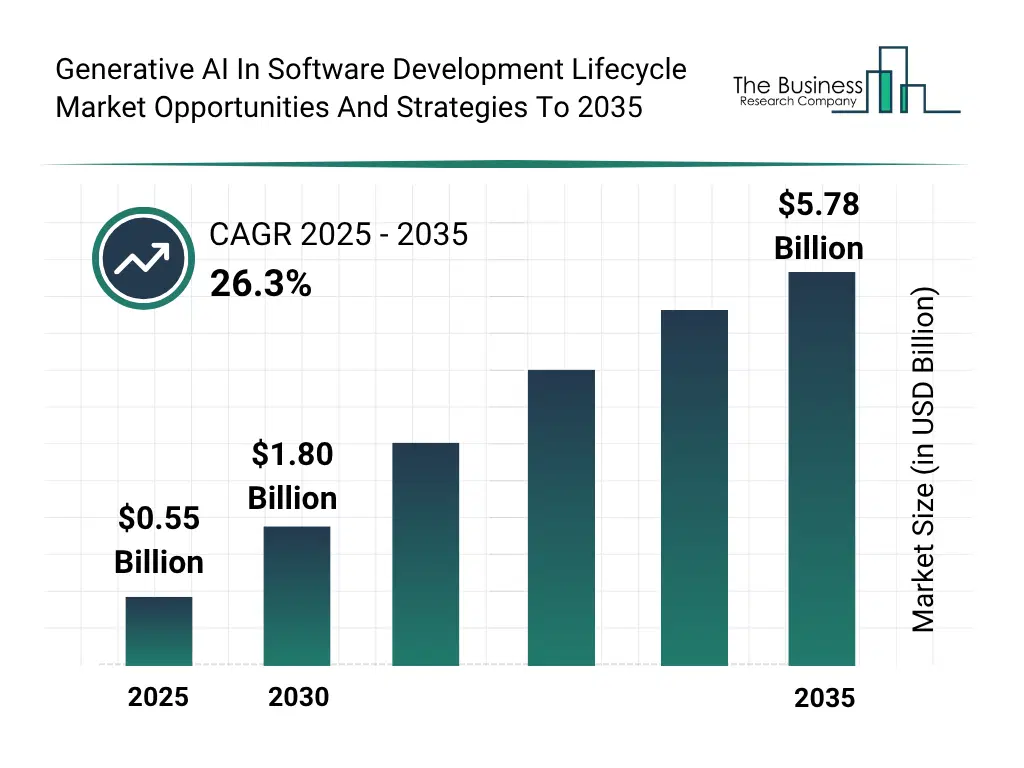
Generative AI In Software Development Lifecycle Market Size
The global generative AI in software development lifecycle market reached a value of nearly $552.1 million in 2025, having grown at a compound annual growth rate (CAGR) of 28.6% since 2020. The market is expected to grow from $552.1 million in 2025 to $1,800.8 million in 2030 at a rate of 26.7%. The market is then expected to grow at a CAGR of 26.3% from 2030 and reach $5,775.9 million in 2035. Growth in the historic period resulted from growing demand for automation in software development, rapid growth of cloud computing services, increasing adoption of AI-assisted coding tools and growing focus on software security and compliance. Factors that negatively affected growth in the historic period were Data privacy and intellectual property risks and talent shortage and limited ai expertise. Going forward, expansion of SaaS and cloud-native applications, growing need for cost optimization in software projects, demand for improved code quality and faster release cycles and increasing digital transformation initiatives will drive the growth. Factors that could hinder the growth of the generative AI in software development lifecycle market in the future include regulatory and legal uncertainty, bias, accuracy and reliability concerns and impact of trade war and tariffs.
Generative AI In Software Development Lifecycle Market Segmentation
The generative AI in software development lifecycle market is segmented by component, by deployment mode, by application and by end-user.By Component–
The generative AI in software development lifecycle market is segmented by component into:
- a) Solutions
- b) Services
By Deployment Mode–
The generative AI in software development lifecycle market is segmented by deployment mode into:
- a) On-Premise
- b) Cloud-Based
By Application–
The generative AI in software development lifecycle market is segmented by application into:
- a) Code Generation
- b) Code Optimization
- c) Bug Detection
- d) Testing And Quality Assurance
- e) Other Applications
By End-User–
The generative AI in software development lifecycle market is segmented by end user into:
- a) Software Engineers Or DevOps Professionals
- b) Security Professionals Or SecOps
By Geography - The generative AI in software development lifecycle market is segmented by geography into:
- China
- India
- Japan
- Australia
- Indonesia
- South Korea
- USA
- Canada
- Brazil
- France
- Germany
- UK
- Italy
- Spain
- Russia
-
o Asia Pacific
o Africa