
Generative Artificial Intelligence (AI) In Art Market Report 2026
Global Outlook – By Type of Artwork (Visual Art, Music, Literature), By Technology or Platform (Standalone Software, Cloud-Based Services), By Application Area (Fine Art, Advertising And Marketing, Entertainment And Gaming, Design And Fashion), By End-User (Artists, Creative Professionals, General Audience) – Market Size, Trends, Strategies, and Forecast to 2030
Generative Artificial Intelligence (AI) In Art Market Overview
• Generative Artificial Intelligence (AI) In Art market size has reached to $0.62 billion in 2025 • Expected to grow to $3.56 billion in 2030 at a compound annual growth rate (CAGR) of 42% • Growth Driver: Increasing Adoption Of Artificial Intelligence Technologies Fueling The Growth Of The Market Due To Expanding Creative Automation And Enhancing Content Generation • Market Trend: Innovative Integration Of AI In Music Production • North America was the largest region in 2025.What Is Covered Under Generative Artificial Intelligence (AI) In Art Market?
Generative artificial intelligence (AI) in art refers to the use of algorithms and machine learning techniques to create art autonomously or in collaboration with human artists. This approach allows for the generation of novel artworks, designs, or multimedia content based on predefined rules, patterns, or training data. The main types of generative artificial intelligence (AI) in art are visual art, music, and literature. Visual art encompasses various forms of creative expression that are primarily visual, such as painting, sculpture, photography, and digital art. The realm of generative AI involves using algorithms to create or assist in the creation of artwork, often producing unique and intricate designs that might be difficult for humans to conceive independently. The various technology or platforms include standalone software, cloud-based services, and AI-enabled hardware, and the various application areas involved are fine art, advertising and marketing, entertainment and gaming, and design and fashion. It is used by artists, creative professionals, art collectors and galleries, and general audience.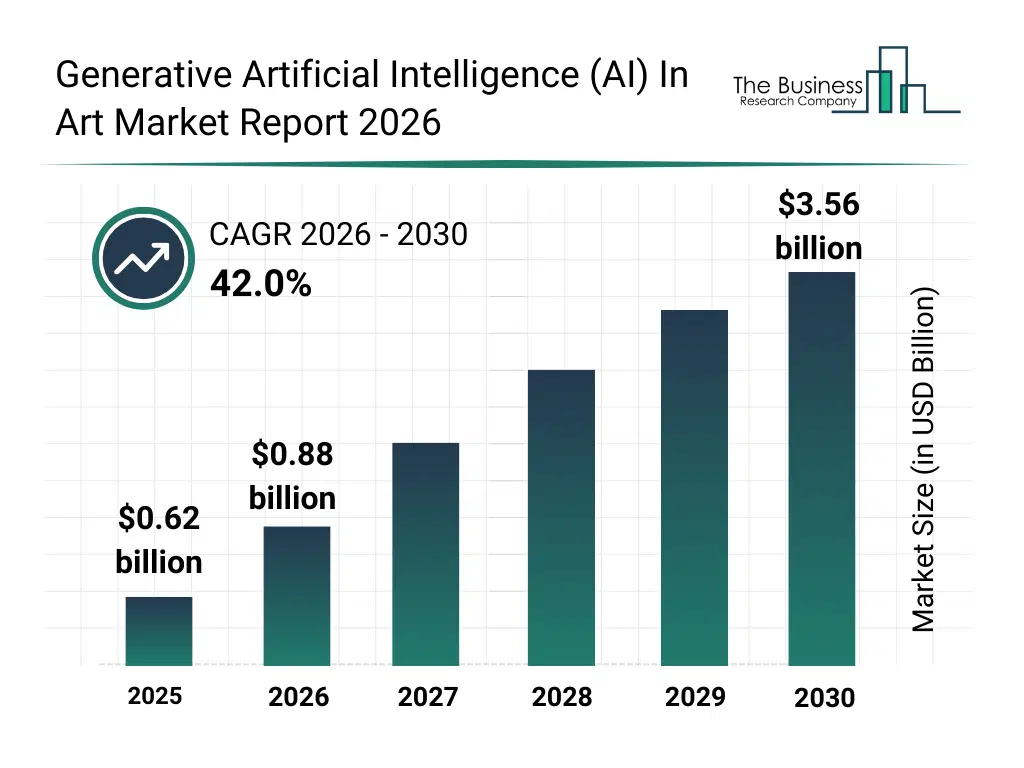
What Is The Generative Artificial Intelligence (AI) In Art Market Size and Share 2026?
The generative artificial intelligence (AI) in art market size has grown exponentially in recent years. It will grow from $0.62 billion in 2025 to $0.88 billion in 2026 at a compound annual growth rate (CAGR) of 42.1%. The growth in the historic period can be attributed to digitalization of creative industries, growth of digital art platforms, increasing accessibility of creative software, expansion of online art marketplaces, early experimentation with algorithmic art.What Is The Generative Artificial Intelligence (AI) In Art Market Growth Forecast?
The generative artificial intelligence (AI) in art market size is expected to see exponential growth in the next few years. It will grow to $3.56 billion in 2030 at a compound annual growth rate (CAGR) of 42.0%. The growth in the forecast period can be attributed to increasing adoption of immersive digital art experiences, rising commercial use of AI-generated content, expansion of nft-based art ecosystems, growing integration of AI in advertising and media, increasing focus on ethical AI art practices. Major trends in the forecast period include increasing use of AI-generated digital artworks, rising adoption of AI tools by creative professionals, expansion of generative AI in multimedia content creation, growing integration of AI art in commercial design, enhanced focus on human-AI collaborative creativity.
Global Generative Artificial Intelligence (AI) In Art Market Segmentation
1) By Type of Artwork: Visual Art, Music, Literature 2) By Technology or Platform: Standalone Software, Cloud-Based Services 3) By Application Area: Fine Art, Advertising And Marketing, Entertainment And Gaming, Design And Fashion 4) By End-User: Artists, Creative Professionals, General Audience Subsegments: 1) By Visual Art: Digital Paintings, 3D Art and Animation, Image Generation 2) By Music: Music Composition, Soundscapes, Lyric Generation 3) By Literature: Poetry, Story Generation, ScriptwritingWhat Is The Driver Of The Generative Artificial Intelligence (AI) In Art Market?
The increasing adoption of artificial intelligence technologies is expected to propel the growth of the generative artificial intelligence (AI) in art market going forward. Artificial intelligence technologies refer to computer systems capable of performing tasks that normally require human intelligence, such as learning, reasoning, problem‑solving and creation. The adoption of artificial intelligence technologies is rising as organisations and creative industries are increasingly leveraging AI tools to automate and enhance creative processes and generate novel content, thereby accelerating tech integration in art and design. Artificial intelligence technologies adoption enhances generative AI in art by enabling creators to produce complex, stylized, and highly personalized artworks with greater speed and precision. It expands creative possibilities by automating intricate design processes and allowing artists to experiment with new forms, patterns, and visual expressions. For instance, in February 2024, according to the Organisation for Economic Co‑operation and Development (OECD), a Paris‑based intergovernmental organisation, in 2023, around 28 % of firms in the information and communication technology (ICT) sector reported using AI, compared with an average of just 8 % across all firms in OECD countries. Therefore, the increasing adoption of artificial intelligence technologies is driving the growth of the generative artificial intelligence (AI) in art industry.Key Players In The Global Generative Artificial Intelligence (AI) In Art Market
Major companies operating in the generative artificial intelligence (AI) in art market are OpenAI, Midjourney Inc., Runway ML Inc., Prisma Labs Inc., Obvious, Wombo Inc., Rosebud AI Inc., Aiva Technologies SA, Artbreeder, Playform IO, DeepArt.io, NightCafe Studio, DALL-E (OpenAI product but listed here as part of OpenAI’s direct generative AI art offering), Stability AI, Leonardo AI, Magic Pony Technology (independent generative art focus)†, Pixray, Artomatix, Lensa AI, Synthesia, Kaedim3D, Dream by WOMBO, Text to Image AI Labs, Craiyon
This chart is for illustrative purposes; the full report includes a detailed competitor analysis and comprehensive overview of the top 10 companies in the market.
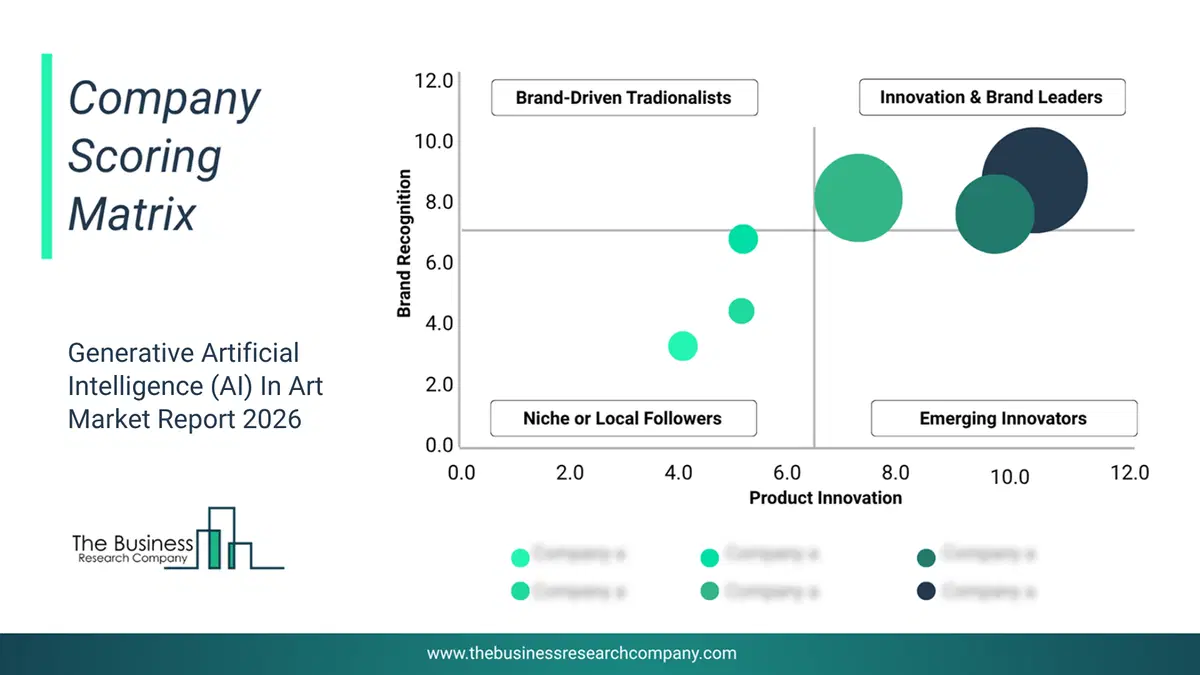
This chart maps companies by product innovation and brand strength, with bubble size indicating relative revenue, helping identify market leaders, challengers, and niche players. This is an illustrative chart; the full report provides a complete and accurate competitive analysis.
Global Generative Artificial Intelligence (AI) In Art Market Trends and Insights
Major companies operating in generative artificial intelligence (AI) in the arts market are developing innovative music and sound generation AI tools to enhance creativity, streamline workflows, and inspire innovative compositions. Music and sound generation AI tool generates melodies, harmonies, rhythms, sound effects, and entire musical compositions autonomously or in collaboration with human users. For instance, in September 2023, Stability AI Ltd., a UK-based free and open-source generative AI company, launched Stable Audio. It delivers faster, higher-quality music through an intuitive online interface using the most recent artificial intelligence (AI) algorithms. Stable Audio comes in two main types, the basic free edition, used to create and download songs up to 20 seconds long, and the 'Pro' membership, which offers 90-second tracks that may be downloaded for use in commercial projects. Stable Audio provides musicians with a solution to create samples for their songs with the help of the latest AI technologies.What Are Latest Mergers And Acquisitions In The Generative Artificial Intelligence (AI) In Art Market?
In May 2024, Autodesk, a US-based software company, acquired Wonder Dynamics for an undisclosed amount. With this acquisition, Autodesk aims to integrate Wonder Dynamics' advanced AI-driven visual effects technology into its suite of creative tools, enhancing capabilities for filmmakers and content creators. Wonder Dynamics is a US-based company specializing in artificial intelligence and visual effects.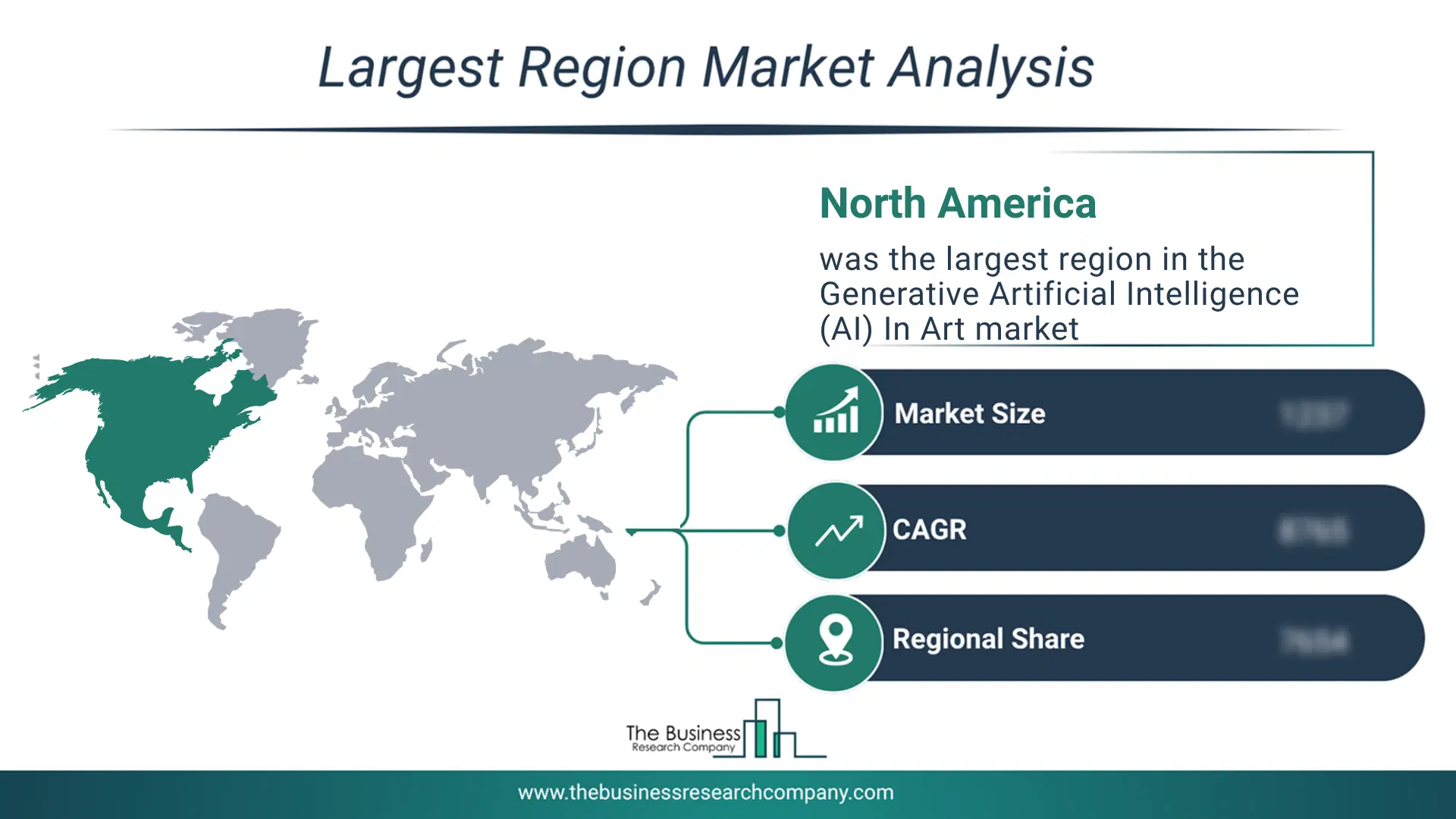
Regional Insights
North America was the largest region in the generative artificial intelligence (AI) in art market in 2025. The regions covered in this market report are Asia-Pacific, South East Asia, Western Europe, Eastern Europe, North America, South America, Middle East, Africa. The countries covered in this market report are Australia, Brazil, China, France, Germany, India, Indonesia, Japan, Taiwan, Russia, South Korea, UK, USA, Canada, Italy, Spain.What Defines the Generative Artificial Intelligence (AI) In Art Market?
The generative artificial intelligence (AI) in art market includes revenues earned by entities by providing services such as creating AI-generated artworks, developing AI tools for artists, and offering AI-based art curation and recommendation systems. The market value includes the value of related goods sold by the service provider or included within the service offering. The generative artificial intelligence (AI) in art market also consists of sales of hardware for AI processing, blockchain integration tools, and data sets and training models. Values in this market are ‘factory gate’ values, that is the value of goods sold by the manufacturers or creators of the goods, whether to other entities (including downstream manufacturers, wholesalers, distributors and retailers) or directly to end customers. The value of goods in this market includes related services sold by the creators of the goods.How is Market Value Defined and Measured?
The market value is defined as the revenues that enterprises gain from the sale of goods and/or services within the specified market and geography through sales, grants, or donations in terms of the currency (in USD unless otherwise specified). The revenues for a specified geography are consumption values that are revenues generated by organizations in the specified geography within the market, irrespective of where they are produced. It does not include revenues from resales along the supply chain, either further along the supply chain or as part of other products.
This chart presents market attractiveness based on a quantitative evaluation of growth, competition, strategic alignment, and risk, offering a clear view of opportunity areas for decision-making. This chart is for illustrative purposes; the full report contains the complete analysis.

This chart highlights the Total Addressable Market (TAM) by estimating the maximum revenue opportunity using an assumption-driven approach, supporting strategic planning and opportunity sizing across markets. The chart is illustrative; the full report provides a more comprehensive analysis.
What Key Data and Analysis Are Included in the Generative Artificial Intelligence (AI) In Art Market Report 2026?
The generative artificial intelligence (ai) in art market research report is one of a series of new reports from The Business Research Company that provides market statistics, including industry global market size, regional shares, competitors with the market share, detailed market segments, market trends and opportunities, and any further data you may need to thrive in the generative artificial intelligence (ai) in art industry. The market research report delivers a complete perspective of everything you need, with an in-depth analysis of the current and future state of the industry.Generative Artificial Intelligence (AI) In Art Market Report Forecast Analysis
| Report Attribute | Details |
|---|---|
| Market Size Value In 2026 | $0.88 billion |
| Revenue Forecast In 2030 | $3.56 billion |
| Growth Rate | CAGR of 42% from 2026 to 2030 |
| Base Year For Estimation | 2025 |
| Actual Estimates/Historical Data | 2020-2025 |
| Forecast Period | 2026 - 2030 |
| Market Representation | Revenue in USD Billion and CAGR from 2026 to 2030 |
| Segments Covered | Type of Artwork, Technology or Platform, Application Area, End-User |
| Regional Scope | Asia-Pacific, Western Europe, Eastern Europe, North America, South America, Middle East, Africa |
| Country Scope | The Countries Covered In This Market Report Are Australia, Brazil, China, France, Germany, India, Indonesia, Japan, Taiwan, Russia, South Korea, Uk, Usa, Canada, Italy, Spain. |
| Key Companies Profiled | OpenAI, Midjourney Inc., Runway ML Inc., Prisma Labs Inc., Obvious, Wombo Inc., Rosebud AI Inc., Aiva Technologies SA, Artbreeder, Playform IO, DeepArt.io, NightCafe Studio, DALL-E (OpenAI product but listed here as part of OpenAI’s direct generative AI art offering), Stability AI, Leonardo AI, Magic Pony Technology (independent generative art focus)†, Pixray, Artomatix, Lensa AI, Synthesia, Kaedim3D, Dream by WOMBO, Text to Image AI Labs, Craiyon |
| Customization Scope | Request for Customization |
| Pricing And Purchase Options | Explore Purchase Options |