
Generative Artificial Intelligence (AI) In Human Resources (HR) Market Report 2026
Global Outlook – By Technology (Machine Learning, Natural Language Processing, Deep Learning, Computer Vision, Robotic Process Automation), By Deployment Mode (Cloud-Based, On-Premise), By Application (Recruiting And Hiring, Onboarding, Performance Management, Improved Efficiency, Other Applications) – Market Size, Trends, Strategies, and Forecast to 2030
Generative Artificial Intelligence (AI) In Human Resources (HR) Market Overview
• Generative Artificial Intelligence (AI) In Human Resources (HR) market size has reached to $0.75 billion in 2025 • Expected to grow to $1.7 billion in 2030 at a compound annual growth rate (CAGR) of 17.8% • Growth Driver: Rising Automation Demand Fuels Growth In Generative AI For HR Market • Market Trend: Generative AI In HR With Beanery’s TalentGPT Revolutionizing Talent Management And Engagement • North America was the largest region in 2025 and Asia-Pacific is the fastest growing region.Market Gains By 2030 – Top Opportunities By Segment
Market Gain identifies the most promising market opportunities by highlighting the segments or products expected to generate the highest incremental revenue growth over the next five years.
What Is Covered Under Generative Artificial Intelligence (AI) In Human Resources (HR) Market?
Generative artificial intelligence (AI) in human resources (HR) refers to the use of artificial intelligence models that can generate new content, such as text, images, or audio, to assist with various human resources (HR) tasks and processes. These artificial intelligence (AI) models are trained on large datasets and can create novel outputs that resemble the training data. The main technologies of generative artificial intelligence (AI) in human resources (HR) are machine learning, natural language processing, deep learning, computer vision, and robotic process automation. Machine learning (ML) in HR refers to AI technologies that learn and improve from data over time without being explicitly programmed. The various deployment modes include cloud-based and on-premise for varying applications such as recruiting and hiring, onboarding, performance management, improved efficiency, and others.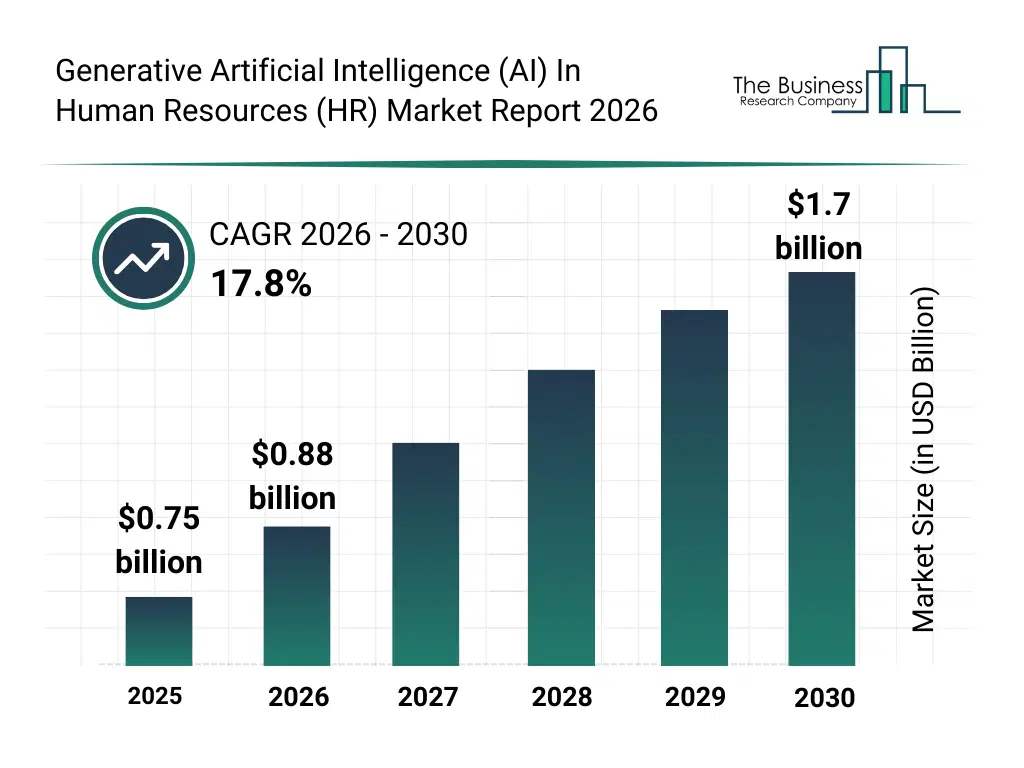
What Is The Generative Artificial Intelligence (AI) In Human Resources (HR) Market Size and Share 2026?
The generative artificial intelligence (AI) in human resources (hr) market size has grown rapidly in recent years. It will grow from $0.75 billion in 2025 to $0.88 billion in 2026 at a compound annual growth rate (CAGR) of 18.1%. The growth in the historic period can be attributed to adoption of hr management software, early use of AI in recruiting, increased focus on employee retention, growth of online recruitment platforms, demand for hr process automation.What Is The Generative Artificial Intelligence (AI) In Human Resources (HR) Market Growth Forecast?
The generative artificial intelligence (AI) in human resources (hr) market size is expected to see rapid growth in the next few years. It will grow to $1.7 billion in 2030 at a compound annual growth rate (CAGR) of 17.8%. The growth in the forecast period can be attributed to integration of AI for workforce planning, adoption of predictive analytics for performance evaluation, use of virtual reality for training simulations, expansion of chatbots for employee communication, deployment of rpa for payroll and compliance automation. Major trends in the forecast period include AI-driven talent acquisition, automated resume screening, predictive employee retention models, AI-powered performance management, chatbots for employee engagement.
Global Generative Artificial Intelligence (AI) In Human Resources (HR) Market Segmentation
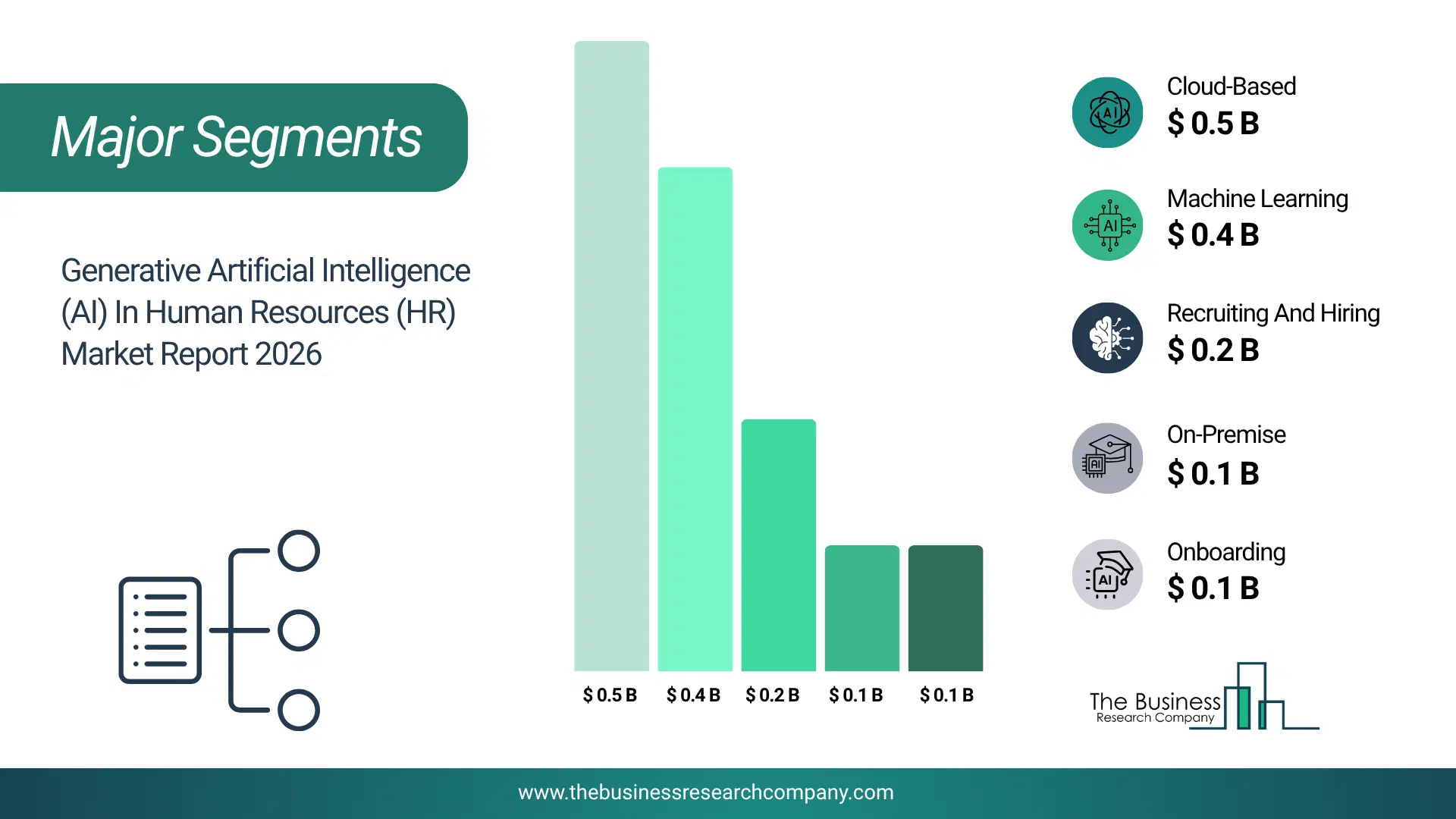
1) By Technology: Machine Learning, Natural Language Processing, Deep Learning, Computer Vision, Robotic Process Automation 2) By Deployment Mode: Cloud-Based, On-Premise 3) By Application: Recruiting And Hiring, Onboarding, Performance Management, Improved Efficiency, Other Applications Subsegments: 1) By Machine Learning: Predictive Analytics For Employee Retention, Talent Acquisition And Recruitment Optimization, Performance Evaluation Models, Employee Engagement Analysis, Skills Gap Analysis 2) By Natural Language Processing (NLP): Automated Resume Screening And Parsing, Chatbots For Candidate Interaction, Sentiment Analysis Of Employee Feedback, Personalized Communication And Engagement Tools, Job Description Optimization 3) By Deep Learning: Candidate Skill Matching And Assessment, Video Interview Analysis, Employee Training Personalization, Advanced Predictive Models For Workforce Planning, Learning Experience Platforms (LEPs) 4) By Computer Vision: Facial Recognition For Attendance Tracking, Analysis Of Employee Behavior And Engagement, Virtual Reality (VR) For Training Simulations, Safety Monitoring In Workplace Environments, Automated Visual Inspections For Facilities Management 5) By Robotic Process Automation (RPA): Automating Repetitive HR Tasks, Data Entry And Record Management Automation, Payroll Processing And Compliance Automation, Employee Self-Service Portals, HR Reporting And Analytics Automation. The top segments in the generative artificial intelligence (ai) in human resources (hr) market will be: • Cloud-Based will reach $519.74 Million by 2025. • Machine Learning will reach $403.18 Million by 2025. • Recruiting And Hiring will reach $230.8 Million by 2025. • On-Premise will reach $198 Million by 2025. • Onboarding will reach $157.58 Million by 2025.What Is The Driver Of The Generative Artificial Intelligence (AI) In Human Resources (HR) Market?
The increasing demand for automation is expected to propel the growth of generative artificial intelligence (AI) in the human resources (HR) market going forward. Automation is the technology-driven process of executing tasks with little to no human involvement, enhancing efficiency and productivity by substituting manual efforts with automated systems. The growing need for automation is driven by the quest for greater efficiency, cost savings, and accuracy. Generative AI in HR aids the surge in automation demand by automating repetitive HR tasks such as candidate screening, job description creation, and performance evaluations. This technology enhances HR efficiency, reduces manual workloads, and allows HR professionals to focus on more strategic initiatives. For instance, in January 2025, according to Eurostat, a Luxembourg-based government department, reported that in 2023, 8.0% of enterprises in the European Union with 10 or more employees used artificial intelligence (AI) technologies to conduct their business, which increased to 13.5% in 2024, representing a 5.5 percentage point growth. Therefore, the increasing demand for automation drives the growth of generative artificial intelligence (AI) in the human resources (HR) market.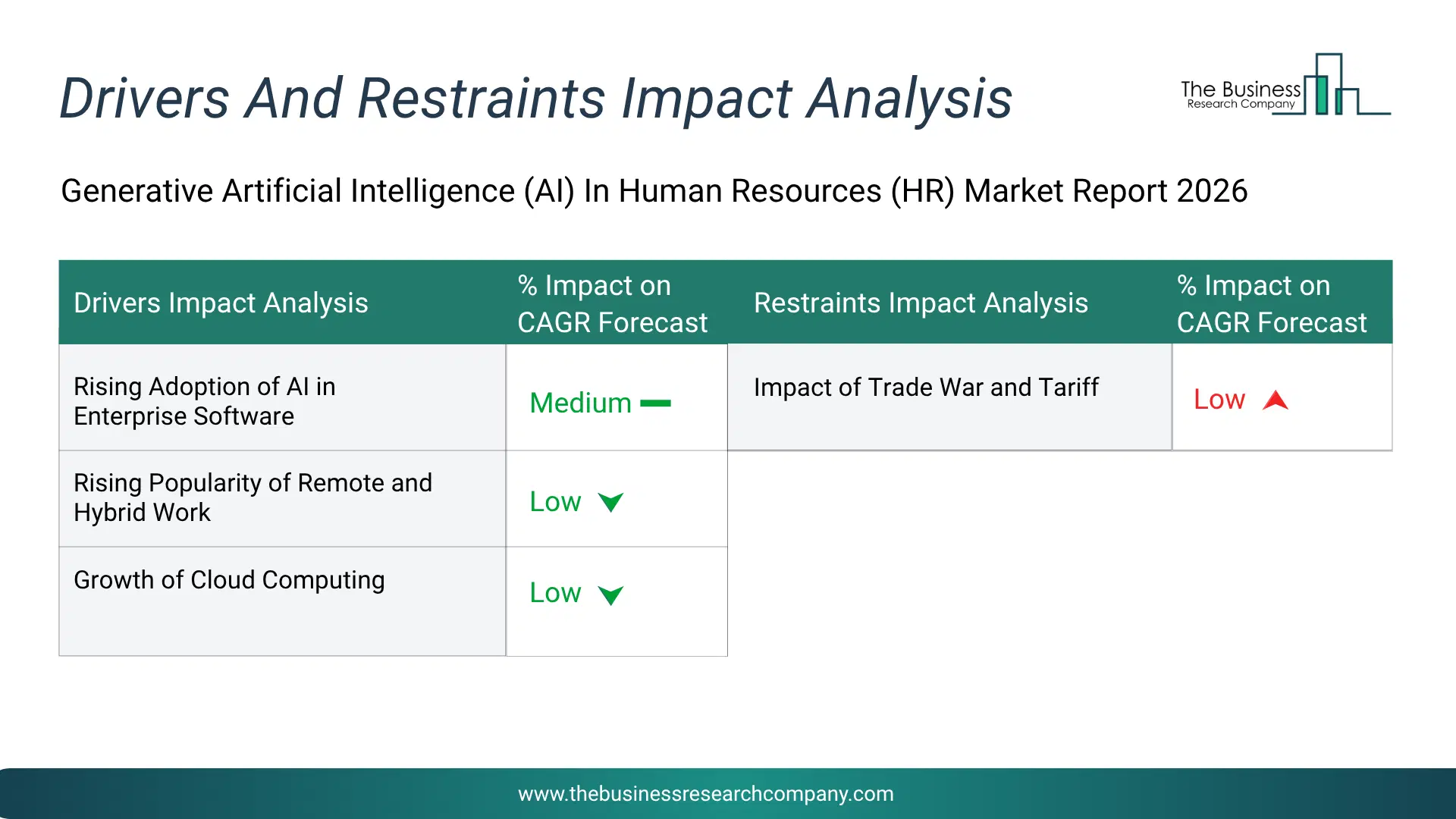
Infographic Chart Showing Key Market Drivers Analysis And Restraints For Generative Artificial Intelligence (Ai) In Human Resources (Hr) Market
The chart presents an impact analysis of key drivers and restraints, quantifying their relative influence on the market's growth rate and helping assess the balance between growth enablers and limiting factors. This chart offers a high-level perspective; the full report contains more detailed insights.
How Will The Drivers Impact Growth In The Global Generative Artificial Intelligence (AI) In Human Resources (HR) Market?
• Rising Adoption of AI in Enterprise Software (Medium) – The rising adoption of AI in enterprise software will become a key driver of growth in the generative artificial intelligence (AI) in human resources (HR) market by 2030. The adoption of AI in enterprise software enhances generative AI applications in HR by integrating intelligent automation into core HR systems, such as applicant tracking and performance management platforms. This enables HR teams to streamline workflows, generate personalized content and make data-driven decisions more efficiently. As a result, the rising adoption of AI in enterprise software is anticipated to contributing to a 1.2% annual growth in the market. • Rising Popularity of Remote and Hybrid Work (Low) – The rising popularity of remote and hybrid work will emerge as a major factor driving the expansion of the generative artificial intelligence (AI) in human resources (HR) market by 2030. Generative AI in HR supports remote and hybrid work by automating tasks such as drafting job descriptions, onboarding materials and personalized employee communications. It also enhances employee engagement and performance management by generating insights from communication patterns and feedback, enabling more responsive and adaptive HR strategies. Consequently, the rising popularity of remote and hybrid work capabilities is projected to contributing to a 1.0% annual growth in the market. • Growth of Cloud Computing (Low) – The growth of cloud computing within digital manufacturing processes will serve as a key growth catalyst for the generative artificial intelligence (AI) in human resources (HR) market by 2030. Cloud computing plays a crucial role in enabling generative artificial intelligence (AI) in human resources (HR) by providing scalable infrastructure, storage and computing power necessary to process large volumes of HR data in real time. It allows seamless integration of AI tools into existing HR platforms, enabling functions like automated content generation, personalized employee experiences and real-time analytics without heavy on-premises investments. This flexibility accelerates innovation and enhances the accessibility and efficiency of AI-driven HR solutions. Therefore, this growth of cloud computing across digital manufacturing operations is projected to supporting to a 0.5% annual growth in the market. • Favorable Government Initiatives (Medium) – The favorable government initiatives will become a significant driver contributing to the growth of the generative artificial intelligence (AI) in human resources (HR) market by 2030. Favorable government initiatives, such as funding for AI research, supportive regulations and policies promoting digital transformation, accelerate the adoption of generative AI in HR by reducing barriers and encouraging innovation. These initiatives help create a trusted environment for deploying AI-powered HR solutions, ensuring compliance with data privacy and ethical standards while boosting market confidence. Consequently, the favorable government initiatives strategies is projected to contributing to a 0.3% annual growth in the market.How Will The Restraints Impact Growth In The Global Generative Artificial Intelligence (AI) In Human Resources (HR) Market?
• Cybersecurity Risks (Medium) – Cybersecurity Risks will restrict the growth of the Generative Artificial Intelligence (AI) In Human Resources (HR) market during the forecast period. AI-powered HR platforms handle sensitive employee data, making them targets for cyberattacks. Data breaches can result in regulatory penalties, legal liability, and reputational damage. Security concerns about AI system vulnerabilities and data protection can affect trust in generative AI HR solutions and slow adoption. • Regulatory Challenges (Low) – Regulatory Challenges will restrict the growth of the Generative Artificial Intelligence (AI) In Human Resources (HR) market during the forecast period. Generative AI in HR faces regulatory challenges related to fairness, bias, privacy, and employment law compliance. Evolving regulations on AI governance and algorithmic fairness create compliance costs and legal risks. Regulatory uncertainty about AI use in HR decisions can slow adoption and limit the deployment of generative AI solutions. • Impact of Trade War and Tariff (Low) – Impact of Trade War and Tariff will restrict the growth of the Generative Artificial Intelligence (AI) In Human Resources (HR) market during the forecast period. Trade tensions and economic uncertainty can affect corporate spending on HR technology investments. Reduced business activity and cost-cutting measures during trade disputes may lead to lower adoption of generative AI solutions. Trade barriers may also impact technology imports and international collaboration.Key Players In The Global Generative Artificial Intelligence (AI) In Human Resources (HR) Market
Major companies operating in the generative artificial intelligence (AI) in human resources (hr) market are International Business Machines Corp., Oracle Corporation, SAP SE, Automatic Data Processing Inc, Workday Inc., Cegid Group S.A., Cornerstone OnDemand Inc, Phenom People Inc, Jobvite Inc, Harver B.V., Eightfold AI Inc., Beamery Inc., Paradox Inc., Workable Technology Limited, ClearCompany Inc., Aisera Inc., Gloat Inc, JobAdder Operations Pty Ltd, SeekOut, TEXTIO INC., TalentGuard Inc., Cezanne HR Limited, Pymetrics Inc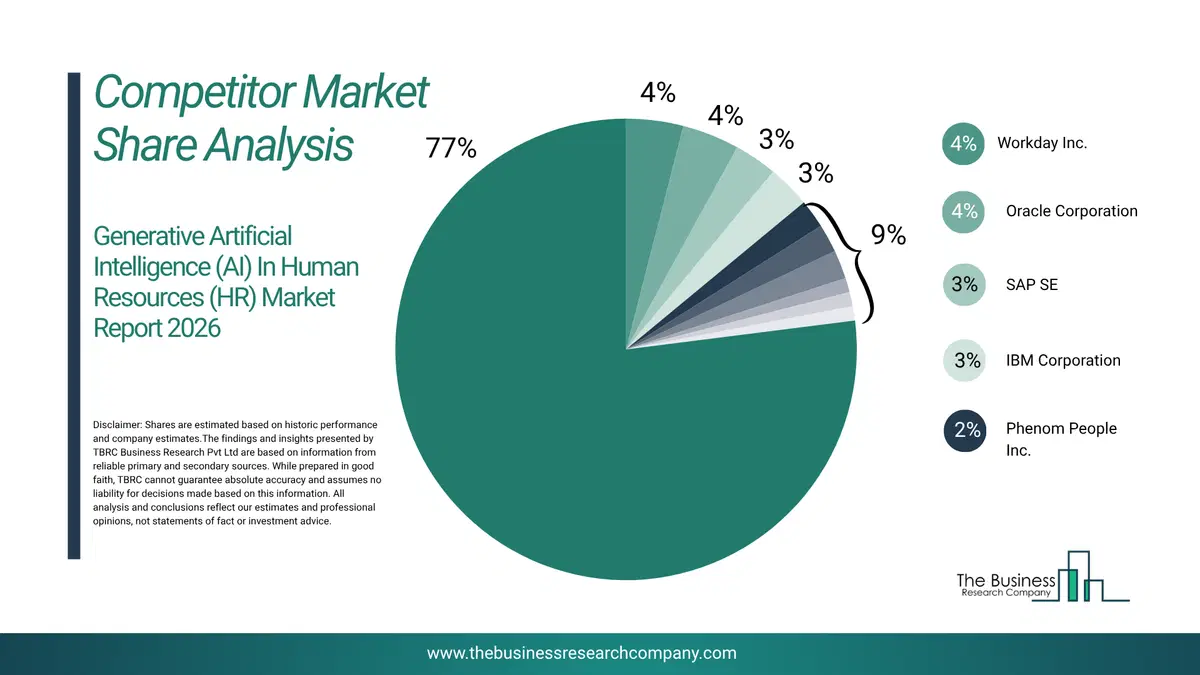
This chart is for illustrative purposes; the full report includes a detailed competitor analysis and comprehensive overview of the top 10 companies in the market.
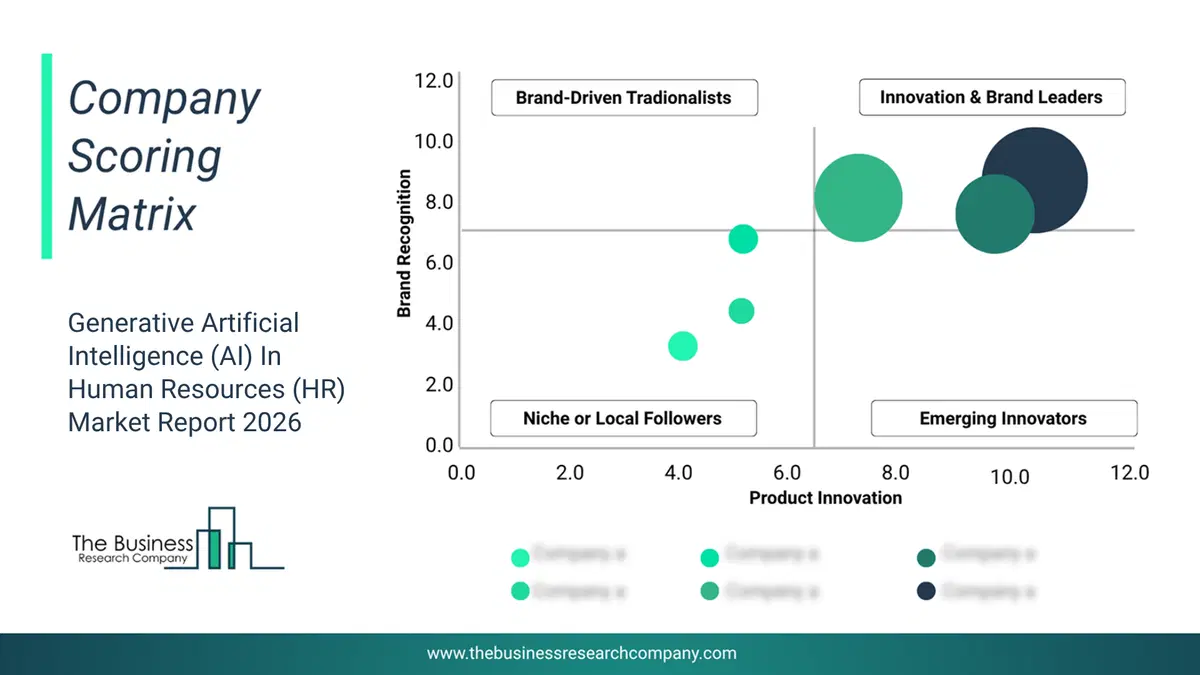
This chart maps companies by product innovation and brand strength, with bubble size indicating relative revenue, helping identify market leaders, challengers, and niche players. This is an illustrative chart; the full report provides a complete and accurate competitive analysis.
Global Generative Artificial Intelligence (AI) In Human Resources (HR) Market Trends and Insights
Major companies operating in the generative artificial intelligence (AI) in human resources (HR) market are developing advanced technologies, such as proprietary artificial intelligence (AI) technology, to enhance recruitment processes, streamline candidate sourcing, improve employee engagement, automate routine HR tasks, and provide data-driven insights for better decision-making and workforce management. Proprietary artificial intelligence (AI) technology refers to artificial intelligence systems and algorithms that are developed and owned exclusively by a company or individual. This technology is unique to its owner and is protected by intellectual property rights such as patents, copyrights, or trade secrets. For instance, in March 2023, Beamery, a UK-based talent engagement and recruitment software company, launched TalentGPT. It is the world’s first generative AI for HR technology. TalentGPT is designed to deeply personalize HR processes by leveraging both Beamery’s proprietary AI and advanced large language models like OpenAI’s GPT-4, enabling real-time adaptation of content, job descriptions, email templates, and career recommendations to meet the specific needs and evolving requirements of organizations and employees. TalentGPT is aimed at transforming HR practices by offering highly personalized and adaptive solutions.What Are Latest Mergers And Acquisitions In The Generative Artificial Intelligence (AI) In Human Resources (HR) Market?
In April 2024, Apax Funds, a UK-based private equity firm, acquired Zellis Group for an undisclosed amount. Through this acquisition, Apax plans to leverage the company's strong product offerings and customer relationships to drive long-term success. Apax's experience in the sector, including previous investments such as Paycor, positions them to enhance Zellis's technology and go-to-market infrastructure, further solidifying its market position. Zellis Group is a UK-based HR and payroll solutions company that provides comprehensive services, including generative AI solutions such as a generative AI-powered chat interface.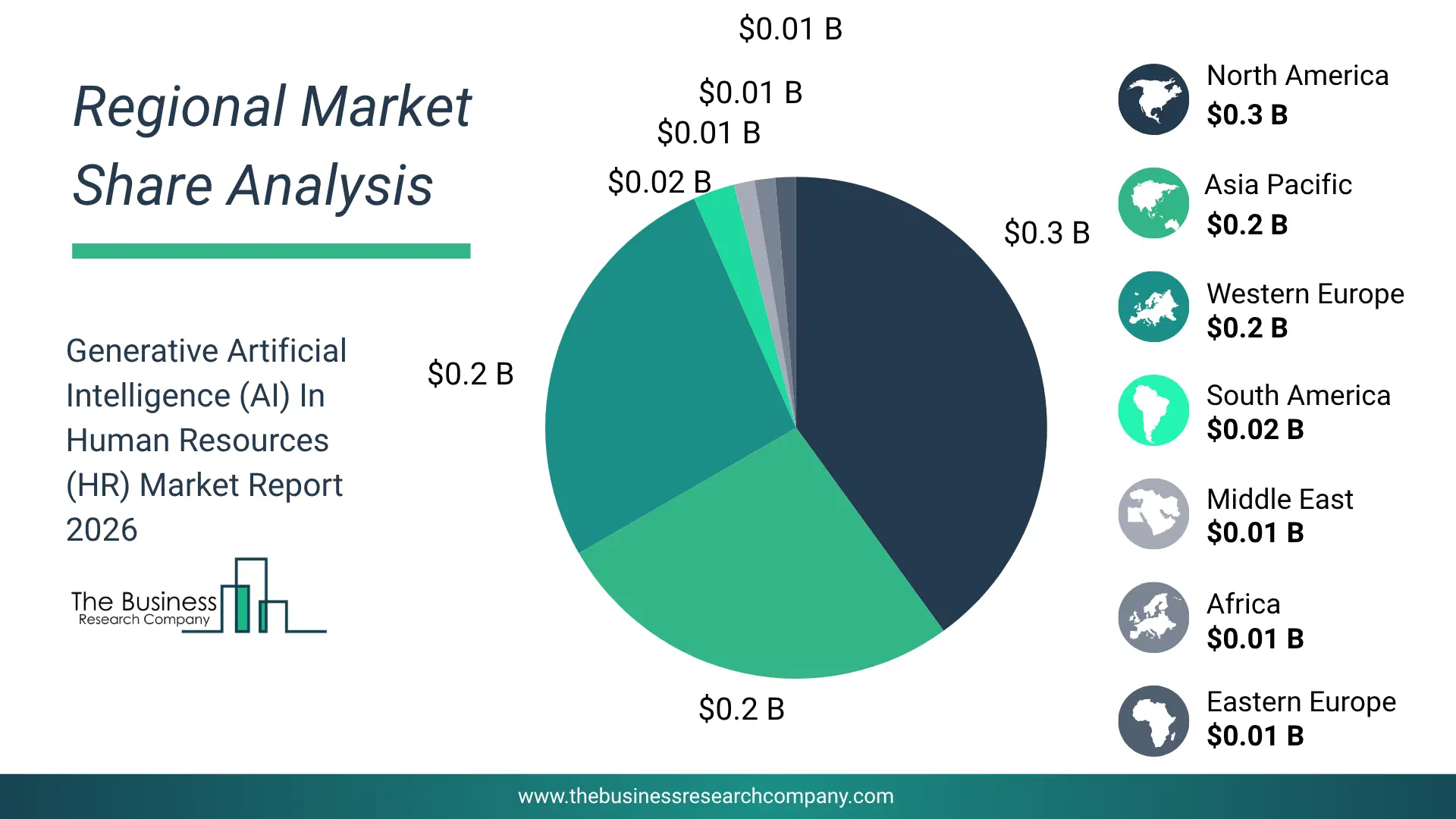
Regional Insights
North America was the largest region in the generative artificial intelligence (AI) in human resources (HR) market in 2025. Asia-Pacific is expected to be the fastest-growing region in the forecast period. The regions covered in this market report are Asia-Pacific, South East Asia, Western Europe, Eastern Europe, North America, South America, Middle East, Africa. The countries covered in this market report are Australia, Brazil, China, France, Germany, India, Indonesia, Japan, Taiwan, Russia, South Korea, UK, USA, Canada, Italy, Spain.What Defines the Generative Artificial Intelligence (AI) In Human Resources (HR) Market?
The generative artificial intelligence (AI) in the human resources (HR) market includes revenues earned by entities by providing services such as predictive analytics, AI-driven recruitment solutions and related talent management and development, human resources (HR) system integration, and administrative automation. The market value includes the value of related goods sold by the service provider or included within the service offering. Only goods and services traded between entities or sold to end consumers are included.How is Market Value Defined and Measured?
The market value is defined as the revenues that enterprises gain from the sale of goods and/or services within the specified market and geography through sales, grants, or donations in terms of the currency (in USD unless otherwise specified). The revenues for a specified geography are consumption values that are revenues generated by organizations in the specified geography within the market, irrespective of where they are produced. It does not include revenues from resales along the supply chain, either further along the supply chain or as part of other products.
This chart presents market attractiveness based on a quantitative evaluation of growth, competition, strategic alignment, and risk, offering a clear view of opportunity areas for decision-making. This chart is for illustrative purposes; the full report contains the complete analysis.

This chart highlights the Total Addressable Market (TAM) by estimating the maximum revenue opportunity using an assumption-driven approach, supporting strategic planning and opportunity sizing across markets. The chart is illustrative; the full report provides a more comprehensive analysis.
What Key Data and Analysis Are Included in the Generative Artificial Intelligence (AI) In Human Resources (HR) Market Report 2026?
The generative artificial intelligence (ai) in human resources (hr) market research report is one of a series of new reports from The Business Research Company that provides market statistics, including industry global market size, regional shares, competitors with the market share, detailed market segments, market trends and opportunities, and any further data you may need to thrive in the generative artificial intelligence (ai) in human resources (hr) industry. The market research report delivers a complete perspective of everything you need, with an in-depth analysis of the current and future state of the industry.Generative Artificial Intelligence (AI) In Human Resources (HR) Market Report Forecast Analysis
| Report Attribute | Details |
|---|---|
| Market Size Value In 2026 | $0.88 billion |
| Revenue Forecast In 2030 | $1.7 billion |
| Growth Rate | CAGR of 18.1% from 2026 to 2030 |
| Base Year For Estimation | 2025 |
| Actual Estimates/Historical Data | 2020-2025 |
| Forecast Period | 2026 - 2030 |
| Market Representation | Revenue in USD Billion and CAGR from 2026 to 2030 |
| Segments Covered | Technology, Deployment Mode, Application |
| Regional Scope | Asia-Pacific, Western Europe, Eastern Europe, North America, South America, Middle East, Africa |
| Country Scope | The countries covered in the report are Australia, Brazil, China, France, Germany, India, Indonesia, Japan, Taiwan, Russia, South Korea, UK, USA, Canada, Italy, Spain. |
| Key Companies Profiled | International Business Machines Corp., Oracle Corporation, SAP SE, Automatic Data Processing Inc, Workday Inc., Cegid Group S.A., Cornerstone OnDemand Inc, Phenom People Inc, Jobvite Inc, Harver B.V., Eightfold AI Inc., Beamery Inc., Paradox Inc., Workable Technology Limited, ClearCompany Inc., Aisera Inc., Gloat Inc, JobAdder Operations Pty Ltd, SeekOut, TEXTIO INC., TalentGuard Inc., Cezanne HR Limited, Pymetrics Inc |
| Customization Scope | Request for Customization |
| Pricing And Purchase Options | Explore Purchase Options |