
Generative Artificial Intelligence (AI) in Logistics Market Report 2026
Global Outlook – By Type (Variational Autoencoder (VAE), Generative Adversarial Networks (GANs), Recurrent Neural Networks (RNNs), Long Short-Term Memory (LSTM) Networks, Other Types), By Component (Software, Solution), By Deployment Mode (On-Premises, Cloud-Based), By Application (Warehouse Management, Route Optimization, Inventory Management, Supply Chain Analytics, Last-Mile Delivery Optimization, Customer Service Operations, Other Applications), By End-User (Retail, Healthcare, Aerospace, Telecommunication, Technology, Other End-Users) – Market Size, Trends, Strategies, and Forecast to 2030
Generative Artificial Intelligence (AI) in Logistics Market Overview
• Generative Artificial Intelligence (AI) in Logistics market size has reached to $0.8 billion in 2025 • Expected to grow to $3.25 billion in 2030 at a compound annual growth rate (CAGR) of 32.3% • Growth Driver: E-commerce Surge Fuels Generative artificial intelligence (AI) In Logistics Market Growth • Market Trend: Leveraging Generative AI And Advanced Technologies Adoption In Supply Chain Management • North America was the largest region in 2025 and Asia-Pacific is the fastest growing region.What Is Covered Under Generative Artificial Intelligence (AI) in Logistics Market?
Generative artificial intelligence (AI) in logistics refers to the use of advanced algorithms and machine learning to enhance logistics operations by predicting demand, optimizing routes, and managing inventory efficiently. This results in cost reductions, improved delivery precision, enhanced operational efficiency, and greater customer satisfaction. The main types of generative artificial intelligence (AI) in logistics are variational autoencoders (VAEs), generative adversarial networks (GANs), recurrent neural networks (RNNs), long short-term memory (LSTM) networks, and others. A Variational Autoencoder (VAE) is a type of artificial neural network used to generate new data that is similar to the input data. Components of generative AI include software, hardware, and solutions, and deployment modes are on-premises and cloud-based options. Applications of generative AI in logistics cover warehouse management, route optimization, inventory management, supply chain analytics, last-mile delivery optimization, customer service operations, and others, and it is used by various end-users such as retail, healthcare, banking and finance, aerospace, telecommunication, technology, and others.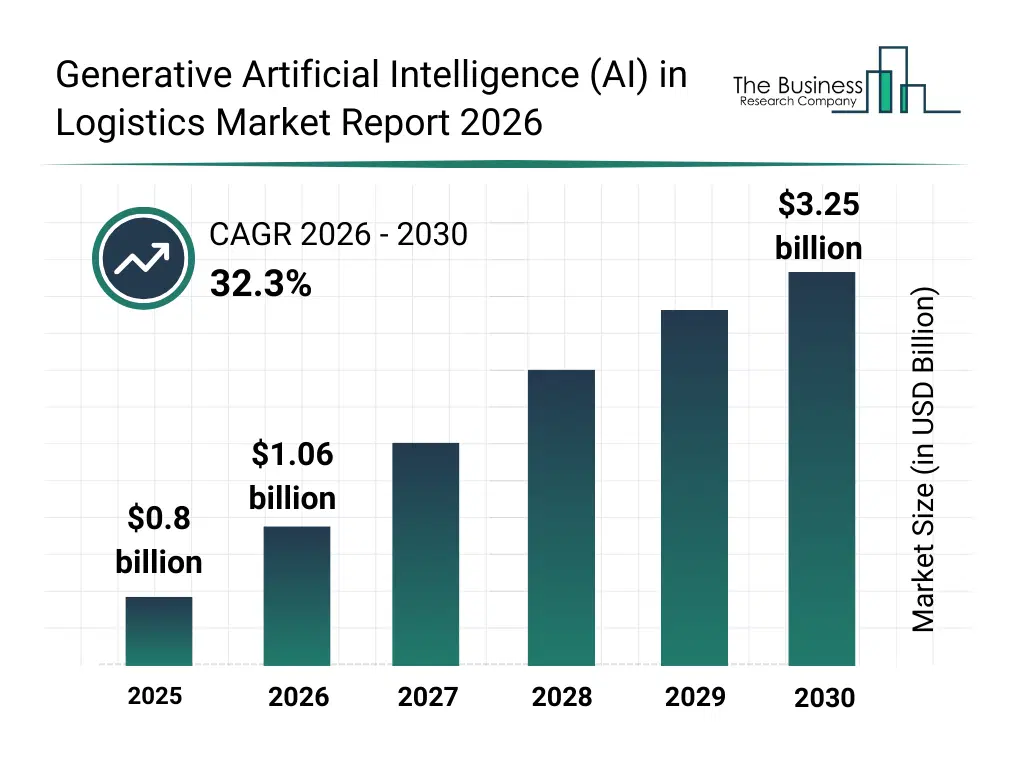
What Is The Generative Artificial Intelligence (AI) in Logistics Market Size and Share 2026?
The generative artificial intelligence (AI) in logistics market size has grown exponentially in recent years. It will grow from $0.8 billion in 2025 to $1.06 billion in 2026 at a compound annual growth rate (CAGR) of 32.6%. The growth in the historic period can be attributed to growth of e-commerce and logistics demand, adoption of warehouse management systems, early use of predictive analytics in transportation, increasing investment in fleet management, expansion of supply chain automation.What Is The Generative Artificial Intelligence (AI) in Logistics Market Growth Forecast?
The generative artificial intelligence (AI) in logistics market size is expected to see exponential growth in the next few years. It will grow to $3.25 billion in 2030 at a compound annual growth rate (CAGR) of 32.3%. The growth in the forecast period can be attributed to integration of generative AI for real-time logistics decision making, expansion of AI-enabled predictive maintenance for fleets, adoption of advanced route simulation tools, increased use of hybrid and edge AI models, growth of AI-powered customer service operations in logistics. Major trends in the forecast period include AI-powered route optimization, predictive demand forecasting, inventory management automation, supply chain analytics solutions, last-mile delivery optimization.
Global Generative Artificial Intelligence (AI) in Logistics Market Segmentation
1) By Type: Variational Autoencoder (VAE), Generative Adversarial Networks (GANs), Recurrent Neural Networks (RNNs), Long Short-Term Memory (LSTM) Networks, Other Types 2) By Component: Software, Solution 3) By Deployment Mode: On-Premises, Cloud-Based 4) By Application: Warehouse Management, Route Optimization, Inventory Management, Supply Chain Analytics, Last-Mile Delivery Optimization, Customer Service Operations, Other Applications 5) By End-User: Retail, Healthcare, Aerospace, Telecommunication, Technology, Other End-Users Subsegments: 1) By Variational Autoencoder (VAE): Demand Forecasting Models, Anomaly Detection In Logistics Operations, Predictive Maintenance For Fleet Management, Data Imputation For Incomplete Records, Supply Chain Optimization Solutions 2) By Generative Adversarial Networks (GANs): Synthetic Data Generation For Training Models, Route Optimization And Simulation, Image Generation For Inventory And Asset Management, Fraud Detection In Shipment And Delivery, Product Demand Forecasting Through Scenario Simulation 3) By Recurrent Neural Networks (RNNs): Time Series Analysis For Demand Prediction, Shipment Tracking And Forecasting, Customer Behavior Prediction For Delivery Services, Inventory Management Forecasting, Delivery Time Estimation Models 4) By Long Short-Term Memory (LSTM) Networks: Advanced Time Series Forecasting, Predictive Analytics For Supply Chain Performance, Transportation Optimization Models, Order Fulfillment Prediction, Capacity Planning And Resource Allocation 5) By Other Types: Reinforcement Learning For Route Optimization, Hybrid Models Combining Multiple AI Approaches, Flow-Based Models For Real-Time Data Analysis, Self-Supervised Learning Techniques, Edge AI For On-Site Decision MakingWhat Is The Driver Of The Generative Artificial Intelligence (AI) in Logistics Market?
A rise in e-commerce sales is expected to propel the growth of generative artificial intelligence (AI) in logistics market going forward. E-commerce popularity is growing due to its convenience, wider product selection, and the increasing use of digital technology. Generative AI in e-commerce logistics optimizes inventory management, enhances route planning, and predicts demand, driving efficiency and cost savings. For instance, in May 2024, according to a report published by the Census Bureau of the Department of Commerce, a US-based governmental organization, e-commerce sales reached approximately $1,118.7 billion in 2023. For the first quarter of 2024, total retail sales were estimated at $1,820.0 billion. E-commerce sales during this period saw an 8.5% increase (±1.1%) from the same quarter in 2023, while total retail sales grew by 2.8% (±0.5%). Therefore, a rise in e-commerce sales is driving the growth of generative artificial intelligence (AI) in logistics industry.Key Players In The Global Generative Artificial Intelligence (AI) in Logistics Market
Major companies operating in the generative artificial intelligence (AI) in logistics market are Microsoft Corporation, Amazon Web Services Inc., Intel Corporation, Accenture plc, International Business Machines Corporation, Oracle Corporation, Honeywell International Inc., SAP SE, NVIDIA Corporation, Cognizant Technology Solutions Corporation, Epicor Software Corporation, Blue Yonder Group Inc., Coupa Software Incorporated, Kinaxis Inc., ShipBob Inc., Project44 Inc., Vorto Inc., Logility Inc., FourKites Inc., Shippeo SAS, Freightos Ltd., Slync.io Inc., Locus.sh, ClearMetal Inc.
This chart is for illustrative purposes; the full report includes a detailed competitor analysis and comprehensive overview of the top 10 companies in the market.
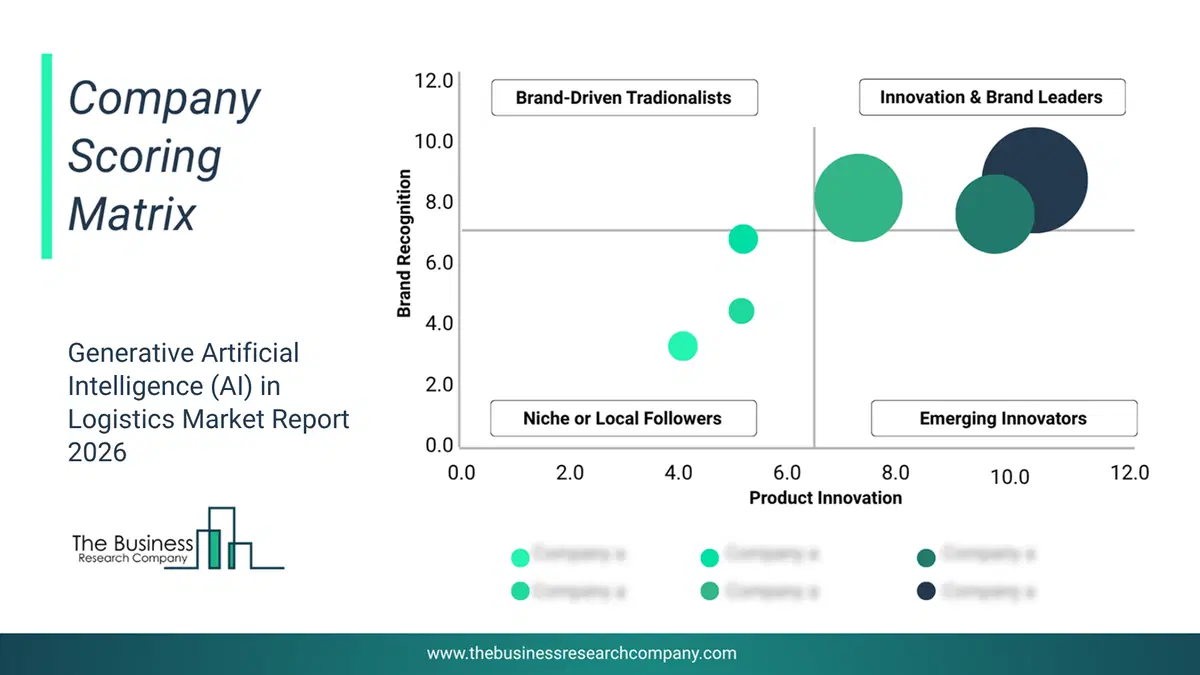
This chart maps companies by product innovation and brand strength, with bubble size indicating relative revenue, helping identify market leaders, challengers, and niche players. This is an illustrative chart; the full report provides a complete and accurate competitive analysis.
Global Generative Artificial Intelligence (AI) in Logistics Market Trends and Insights
Major companies operating in the generative artificial intelligence (AI) in logistics market are focusing on the adoption of advanced technologies, such as natural language interfaces, to enhance operational efficiency and improve accuracy in supply chain management. A natural language interface refers to a system that allows users to interact with supply chain management software or tools using everyday language, making it easier to query data, generate reports, and manage operations without needing specialized technical knowledge. For instance, in September 2023, FourKites, Inc., a US-based supply chain visibility and logistics technology company, launched FinAI, a generative AI tool designed to enhance supply chain management. Fin AI uses a natural language interface to uncover insights, automate tasks, and optimize operations by analyzing extensive data, including 3 million shipments daily, 18 million estimated times of arrival (ETAs), and 62 billion miles tracked annually.What Are Latest Mergers And Acquisitions In The Generative Artificial Intelligence (AI) in Logistics Market?
In September 2023, Logility Inc., a US-based software company, acquired Garvis BV for an undisclosed amount. The acquisition aims to accelerate the integration of AI-driven demand forecasting technology into Logility's supply chain learning solutions. Garvis BV is a Belgium-based provider of generative artificial intelligence (AI) in logistics.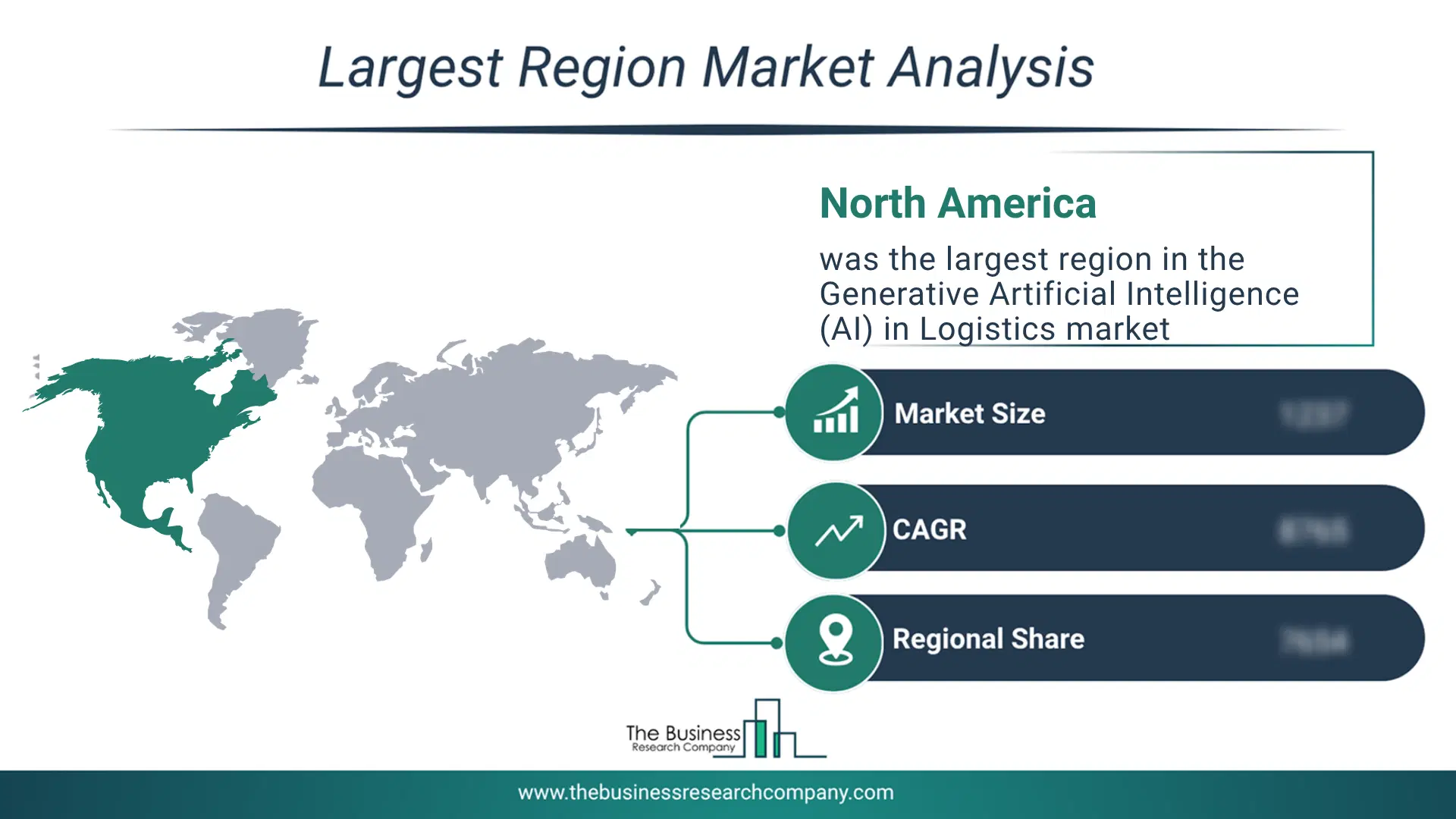
Regional Insights
North America was the largest region in the generative artificial intelligence (AI) in logistics market in 2025. Asia-Pacific is expected to be the fastest-growing region in the forecast period. The regions covered in this market report are Asia-Pacific, South East Asia, Western Europe, Eastern Europe, North America, South America, Middle East, Africa. The countries covered in this market report are Australia, Brazil, China, France, Germany, India, Indonesia, Japan, Taiwan, Russia, South Korea, UK, USA, Canada, Italy, Spain.What Defines the Generative Artificial Intelligence (AI) in Logistics Market?
The generative artificial intelligence (AI) in logistics market consists of revenues earned by entities by providing services such as real-time data analysis, dynamic pricing optimization, predictive maintenance, customer behavior analysis, and fraud detection. The market value includes the value of related goods sold by the service provider or included within the service offering. The generative artificial intelligence (AI) in logistics market also includes sales of autonomous vehicles, autonomous vehicle drones, and warehouse robotic solutions. Values in this market are ‘factory gate’ values, that is, the value of goods sold by the manufacturers or creators of the goods, whether to other entities (including downstream manufacturers, wholesalers, distributors, and retailers) or directly to end customers. The value of goods in this market includes related services sold by the creators of the goods.How is Market Value Defined and Measured?
The market value is defined as the revenues that enterprises gain from the sale of goods and/or services within the specified market and geography through sales, grants, or donations in terms of the currency (in USD unless otherwise specified). The revenues for a specified geography are consumption values that are revenues generated by organizations in the specified geography within the market, irrespective of where they are produced. It does not include revenues from resales along the supply chain, either further along the supply chain or as part of other products.
This chart presents market attractiveness based on a quantitative evaluation of growth, competition, strategic alignment, and risk, offering a clear view of opportunity areas for decision-making. This chart is for illustrative purposes; the full report contains the complete analysis.

This chart highlights the Total Addressable Market (TAM) by estimating the maximum revenue opportunity using an assumption-driven approach, supporting strategic planning and opportunity sizing across markets. The chart is illustrative; the full report provides a more comprehensive analysis.
What Key Data and Analysis Are Included in the Generative Artificial Intelligence (AI) in Logistics Market Report 2026?
The generative artificial intelligence (ai) in logistics market research report is one of a series of new reports from The Business Research Company that provides market statistics, including industry global market size, regional shares, competitors with the market share, detailed market segments, market trends and opportunities, and any further data you may need to thrive in the generative artificial intelligence (ai) in logistics industry. The market research report delivers a complete perspective of everything you need, with an in-depth analysis of the current and future state of the industry.Generative Artificial Intelligence (AI) in Logistics Market Report Forecast Analysis
| Report Attribute | Details |
|---|---|
| Market Size Value In 2026 | $1.06 billion |
| Revenue Forecast In 2030 | $3.25 billion |
| Growth Rate | CAGR of 32.3% from 2026 to 2030 |
| Base Year For Estimation | 2025 |
| Actual Estimates/Historical Data | 2020-2025 |
| Forecast Period | 2026 - 2030 |
| Market Representation | Revenue in USD Billion and CAGR from 2026 to 2030 |
| Segments Covered | Type, Component, Deployment Mode, Application, End-User |
| Regional Scope | Asia-Pacific, Western Europe, Eastern Europe, North America, South America, Middle East, Africa |
| Country Scope | The Countries Covered In This Market Report Are Australia, Brazil, China, France, Germany, India, Indonesia, Japan, Taiwan, Russia, South Korea, Uk, Usa, Canada, Italy, Spain. |
| Key Companies Profiled | Microsoft Corporation, Amazon Web Services Inc., Intel Corporation, Accenture plc, International Business Machines Corporation, Oracle Corporation, Honeywell International Inc., SAP SE, NVIDIA Corporation, Cognizant Technology Solutions Corporation, Epicor Software Corporation, Blue Yonder Group Inc., Coupa Software Incorporated, Kinaxis Inc., ShipBob Inc., Project44 Inc., Vorto Inc., Logility Inc., FourKites Inc., Shippeo SAS, Freightos Ltd., Slync.io Inc., Locus.sh, ClearMetal Inc. |
| Customization Scope | Request for Customization |
| Pricing And Purchase Options | Explore Purchase Options |