
Generative Artificial Intelligence (AI) In Telecom Market Report 2026
Global Outlook – By Type (Text-Based, Image-Based, Voice-Based), By Component (Software, Services), By Deployment (On-Premises, Cloud-Based, Edge, Hybrid), By Application (Network Optimization, Predictive Maintenance, Improve Call Center Operations And Customer Support, Personalized Product Or Service Recommendations, Security And Fraud Detection, Marketing And Personalized Product Recommendations, Other Applications) – Market Size, Trends, Strategies, and Forecast to 2030
Generative Artificial Intelligence (AI) In Telecom Market Overview
• Generative Artificial Intelligence (AI) In Telecom market size has reached to $0.73 billion in 2025 • Expected to grow to $6.16 billion in 2030 at a compound annual growth rate (CAGR) of 53% • Growth Driver: The Role Of Expanding Internet Of Things Devices In Shaping AI innovations In Telecom • Market Trend: Enhancing Telecom Efficiency With Artificial Intelligence Innovations • North America was the largest region in 2025.Market Gains By 2030 – Top Opportunities By Segment
Market Gain identifies the most promising market opportunities by highlighting the segments or products expected to generate the highest incremental revenue growth over the next five years.
What Is Covered Under Generative Artificial Intelligence (AI) In Telecom Market?
Generative artificial intelligence in telecom refers to the application of AI techniques to create new data or content, enhancing network operations and customer interactions. It is used to optimize network performance and personalize customer experiences through advanced data analysis and predictive modeling. The main types of generative artificial intelligence in telecom are text-based, image-based, and voice-based. Text-based generative AI in telecom refers to technologies that generate or manipulate written content through artificial intelligence. This type of AI encompasses various components, such as software and services, and can be deployed through on-premises, cloud-based, edge, and hybrid models. Its applications span across areas like network optimization, predictive maintenance, enhancing call center operations and customer support, personalized product or service recommendations, security and fraud detection, marketing, and other related fields.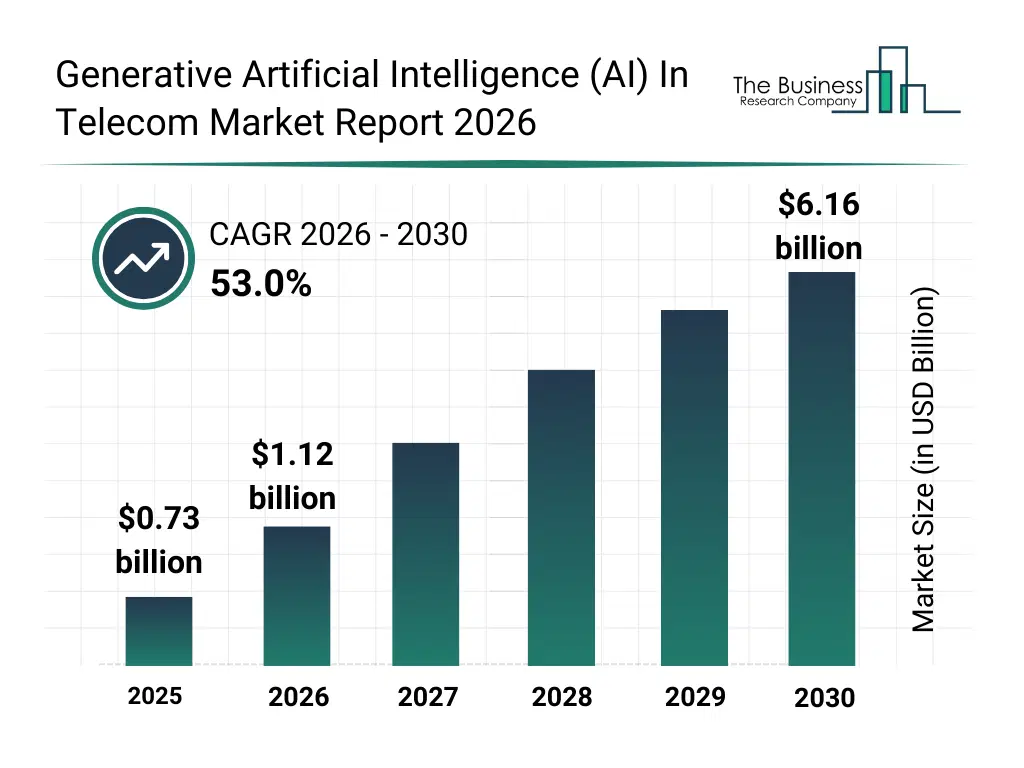
What Is The Generative Artificial Intelligence (AI) In Telecom Market Size and Share 2026?
The generative artificial intelligence (AI) in telecom market size has grown exponentially in recent years. It will grow from $0.73 billion in 2025 to $1.12 billion in 2026 at a compound annual growth rate (CAGR) of 53.4%. The growth in the historic period can be attributed to growing mobile subscriber base, increasing telecom data traffic, early adoption of AI in network management, rising demand for personalized customer experiences, expansion of cloud-based telecom solutions.What Is The Generative Artificial Intelligence (AI) In Telecom Market Growth Forecast?
The generative artificial intelligence (AI) in telecom market size is expected to see exponential growth in the next few years. It will grow to $6.16 billion in 2030 at a compound annual growth rate (CAGR) of 53.0%. The growth in the forecast period can be attributed to advancements in generative AI models, integration of AI with 5G and future networks, growth in edge computing for real-time analytics, adoption of AI for security and fraud prevention, expansion of AI-driven customer support solutions. Major trends in the forecast period include AI-driven network traffic prediction, predictive maintenance for telecom equipment, automated call center optimization, personalized telecom service recommendations, AI-based fraud and security detection.

Global Generative Artificial Intelligence (AI) In Telecom Market Segmentation
1) By Type: Text-Based, Image-Based, Voice-Based 2) By Component: Software, Services 3) By Deployment: On-Premises, Cloud-Based, Edge, Hybrid 4) By Application: Network Optimization, Predictive Maintenance, Improve Call Center Operations And Customer Support, Personalized Product Or Service Recommendations, Security And Fraud Detection, Marketing And Personalized Product Recommendations, Other Applications Subsegments: 1) By Text-Based: Chatbots And Virtual Assistants, Automated Customer Support, Sentiment Analysis Tools, Text Summarization And Generation 2) By Image-Based: Visual Quality Inspection, Image Recognition Systems, Augmented Reality (AR) Applications, Facial Recognition Technologies 3) By Voice-Based: Voice Assistants, Speech Recognition Systems, Voice Biometrics For Security, Voice Analysis For Customer Insights The top segments in the generative artificial intelligence (ai) in telecom market will be: • Software will reach $513.22 Million by 2025. • On-Premises will reach $311.46 Million by 2025. • Text-Based will reach $304.85 Million by 2025. • Image-Based will reach $242.28 Million by 2025. • Services will reach $209.62 Million by 2025.What Is The Driver Of The Generative Artificial Intelligence (AI) In Telecom Market?
The increasing number of Internet of Things devices is expected to propel the growth of generative artificial intelligence in telecom markets going forward. Internet of Things devices refer to interconnected devices that use advanced connectivity to communicate and exchange data over networks. The increasing number of Internet of Things devices is driven by advancements in technology and decreasing costs, along with rising demand for automation and data-driven insights. AI in telecom can enhance Internet of Things device connectivity by optimizing network management and predicting maintenance needs, leading to improved efficiency and scalability. For instance, in April 2024, according to a report published by Ericsson, a Sweden-based telecommunications company, the global IoT connections reached 15.7 billion connections in 2023 and are expected to increase by 16% to 38.8 billion connections by 2029. Therefore, the increasing number of Internet of Things devices is driving the growth of generative artificial intelligence in telecom market.
Infographic Chart Showing Key Market Drivers Analysis And Restraints For Generative Artificial Intelligence (Ai) In Telecom Market
The chart presents an impact analysis of key drivers and restraints, quantifying their relative influence on the market's growth rate and helping assess the balance between growth enablers and limiting factors. This chart offers a high-level perspective; the full report contains more detailed insights.
How Will The Drivers Impact Growth In The Global Generative Artificial Intelligence (AI) In Telecom Market?
• Increase In Deployment Of 5G (High) – The increase in deployment of 5g will become a key driver of growth in the generative artificial intelligence (AI) in telecom market by 2030. The increase in the deployment of 5G technologies is driven by the growing demand for high-speed, low-latency connectivity to support advanced applications across industries. As digital transformation accelerates, businesses and consumers require faster and more reliable networks for IoT, AI-driven automation, smart cities and high-definition streaming. 5G technologies enhance generative AI in telecom by providing high-speed, low-latency connectivity for real-time applications. Faster data transmission enables AI-driven fraud detection, automated customer support, predictive maintenance and personalized services. 5G also supports seamless AI automation, edge computing and cloud-based AI, improving network optimization and anomaly detection. As a result, the increase in deployment of 5G is anticipated to contributing to annual growth in the market. • Increase In Cloud Computing (Medium) – The increase in cloud computing will emerge as a major factor driving the expansion of the generative artificial intelligence (AI) in telecom market by 2030. Cloud computing is the on-demand delivery of computing resources, such as servers, storage, databases, networking, software and analytics, over the internet. The increase in cloud computing is due to the growing need for scalable, cost-effective and flexible IT solutions across industries. Businesses are shifting to cloud-based infrastructure to reduce capital expenditures on physical hardware while benefiting from on-demand computing power, storage and advanced analytics. Generative artificial intelligence (AI) in telecom enhances cloud computing by optimizing resource management, improving security and enabling automation. AI-driven models analyze vast network data to predict traffic patterns, allowing telecom providers to allocate cloud resources and reduce operational costs dynamically. Generative AI also strengthens cybersecurity by detecting anomalies, preventing fraud and automating threat responses in cloud environments. Consequently, the increase in cloud computing is projected to contributing to annual growth in the market. • Demand Of IoT And Connected Devices (Medium) – The demand of IoT and connected devices will serve as a key growth catalyst for the generative artificial intelligence (AI) in telecom market by 2030. IoT (Internet of Things) and connected devices refer to a network of physical objects embedded with sensors, software and other technologies that enable them to collect and exchange data over the internet. The demand for IoT and connected devices is due to the need for greater automation, efficiency and real-time data insights across various industries. Businesses and consumers increasingly rely on smart devices to streamline operations, enhance convenience and improve decision-making. As more devices connect to telecom networks, vast amounts of data are generated, requiring AI-driven solutions to analyze, manage and secure this information efficiently. Generative AI helps telecom companies enhance network performance through predictive maintenance, automated troubleshooting and intelligent traffic management. Therefore, this demand of IoT and connected devices is projected to supporting to annual growth in the market. • The Increasing Government Initiative (Low) – The increasing government initiative will become a significant driver contributing to the growth of the generative artificial intelligence (AI) in telecom market by 2030. A government initiative refers to a strategic plan, program, or policy introduced by a government to address specific issues, promote economic growth, improve public services, or drive technological advancements. These initiatives can focus on various sectors, such as healthcare, education, infrastructure, digital transformation and sustainability. Governments worldwide are investing in AI research, digital transformation and 5G expansion, which creates a strong foundation for telecom companies to adopt generative AI solutions. Policies promoting AI innovation, cybersecurity and data privacy also encourage telecom providers to integrate AI-driven automation, predictive analytics and intelligent customer support. Consequently, the increasing government initiative is projected to contributing to annual growth in the market.How Will The Restraints Impact Growth In The Global Generative Artificial Intelligence (AI) In Telecom Market?
• High Implementation Costs (Medium) – High Implementation Costs will restrict the growth of the Generative Artificial Intelligence (AI) In Telecom market during the forecast period. Generative AI implementation in telecom requires significant investment in infrastructure and expertise. High costs create barriers for smaller telecom operators with limited budgets. Cost constraints can limit the adoption of generative AI solutions and affect market growth. • Cybersecurity Threats (Medium) – Cybersecurity Threats will restrict the growth of the Generative Artificial Intelligence (AI) In Telecom market during the forecast period. Generative AI applications in telecom face cybersecurity threats that could compromise network security and customer data. Security vulnerabilities can affect trust and adoption of AI-powered telecom services. Cybersecurity concerns can limit the deployment of generative AI solutions in the telecom sector.Key Players In The Global Generative Artificial Intelligence (AI) In Telecom Market
Major companies operating in the generative artificial intelligence (AI) in telecom market are Amazon Web Services, Microsoft Corporation, Verizon Communications Inc., AT&T Inc., Deutsche Telekom AG, Huawei Technologies Co. Ltd., International Business Machines Corporation, Vodafone Group Public Limited Company, Telefónica S.A., Telefonaktiebolaget LM Ericsson, Amdocs Limited, Ciena Corporation, Netcracker Technology Corporation, C3.AI Inc, Subex Ltd, Alepo Technologies Private Limited, Cresta Intelligence Inc, Nokia Corporation, ZTE Corporation, Samsung Electronics Co. Ltd., Telefonica Tech, Rakuten Symphony, Mavenir Systems Inc., Casa Systems Inc., Affirmed Networks, Airspan Networks Inc., Parallel Wireless Inc., Aarna Networks
This chart is for illustrative purposes; the full report includes a detailed competitor analysis and comprehensive overview of the top 10 companies in the market.

This chart maps companies by product innovation and brand strength, with bubble size indicating relative revenue, helping identify market leaders, challengers, and niche players. This is an illustrative chart; the full report provides a complete and accurate competitive analysis.
Global Generative Artificial Intelligence (AI) In Telecom Market Trends and Insights
Major companies operating in generative artificial intelligence in telecom market are focusing on developing technologically advanced solutions, such as GenAI Telco platforms, to enhance the customer experience and optimize network performance. GenAI Telco platforms are AI-driven systems tailored for the telecom industry to automate processes, optimize network management, and enhance customer experiences. For instance, in September 2023, Netcracker Technology, a US-based information technology company, launched the GenAI Telco Solution to Accelerate the Adoption of High-Value Use Cases Across the Telecom Business. This solution enables communication service providers (CSPs) to securely leverage their valuable telecom data and knowledge to deliver exceptional benefits to customers, partners, and their own businesses. The GenAI Telco Platform includes knowledge management capabilities for developing, testing, and optimizing telecom-specific scenarios such as customer care, business operations, sales, and network management. By integrating with popular AI models, this solution allows CSPs to enhance customer interactions, improve operational efficiency, and achieve significant cost savings while ensuring compliance with data protection regulations.What Are Latest Mergers And Acquisitions In The Generative Artificial Intelligence (AI) In Telecom Market?
In November 2023, Amdocs, an Israel-based telecommunications company, collaborated with Nvidia Corporation. Through this collaboration, both companies aim to enhance the adoption of generative AI in telecommunications and media by leveraging NVIDIA's AI infrastructure and Amdocs' amAIz framework to improve customer experiences and operational efficiencies. Nvidia Corporation, a US-based technology company, offers generative artificial intelligence-enabled telecom solutions.
Regional Insights
North America was the largest region in the generative AI in telecom market in 2025. The regions covered in this market report are Asia-Pacific, South East Asia, Western Europe, Eastern Europe, North America, South America, Middle East, Africa. The countries covered in this market report are Australia, Brazil, China, France, Germany, India, Indonesia, Japan, Taiwan, Russia, South Korea, UK, USA, Canada, Italy, Spain.What Defines the Generative Artificial Intelligence (AI) In Telecom Market?
The generative artificial intelligence in the telecom market consists of revenues earned by entities providing services such as customer service automation, personalized content delivery, fraud detection, and prevention of network security. The market value includes the value of related goods sold by the service provider or included within the service offering. The generative artificial intelligence in the telecom market also includes sales of data management tools, customer experience enhancement tools, data management and analytics platforms, and fraud detection and prevention systems. Values in this market are ‘factory gate’ values, that is, the value of goods sold by the manufacturers or creators of the goods, whether to other entities (including downstream manufacturers, wholesalers, distributors, and retailers) or directly to end customers. The value of goods in this market includes related services sold by the creators of the goods.How is Market Value Defined and Measured?
The market value is defined as the revenues that enterprises gain from the sale of goods and/or services within the specified market and geography through sales, grants, or donations in terms of the currency (in USD unless otherwise specified). The revenues for a specified geography are consumption values that are revenues generated by organizations in the specified geography within the market, irrespective of where they are produced. It does not include revenues from resales along the supply chain, either further along the supply chain or as part of other products.
This chart presents market attractiveness based on a quantitative evaluation of growth, competition, strategic alignment, and risk, offering a clear view of opportunity areas for decision-making. This chart is for illustrative purposes; the full report contains the complete analysis.

This chart highlights the Total Addressable Market (TAM) by estimating the maximum revenue opportunity using an assumption-driven approach, supporting strategic planning and opportunity sizing across markets. The chart is illustrative; the full report provides a more comprehensive analysis.
What Key Data and Analysis Are Included in the Generative Artificial Intelligence (AI) In Telecom Market Report 2026?
The generative artificial intelligence (ai) in telecom market research report is one of a series of new reports from The Business Research Company that provides market statistics, including industry global market size, regional shares, competitors with the market share, detailed market segments, market trends and opportunities, and any further data you may need to thrive in the generative artificial intelligence (ai) in telecom industry. The market research report delivers a complete perspective of everything you need, with an in-depth analysis of the current and future state of the industry.Generative Artificial Intelligence (AI) In Telecom Market Report Forecast Analysis
| Report Attribute | Details |
|---|---|
| Market Size Value In 2026 | $1.12 billion |
| Revenue Forecast In 2030 | $6.16 billion |
| Growth Rate | CAGR of 53.4% from 2026 to 2030 |
| Base Year For Estimation | 2025 |
| Actual Estimates/Historical Data | 2020-2025 |
| Forecast Period | 2026 - 2030 |
| Market Representation | Revenue in USD Billion and CAGR from 2026 to 2030 |
| Segments Covered | Type, Component, Deployment, Application |
| Regional Scope | Asia-Pacific, Western Europe, Eastern Europe, North America, South America, Middle East, Africa |
| Country Scope | The countries covered in the report are Australia, Brazil, China, France, Germany, India, Indonesia, Japan, Taiwan, Russia, South Korea, UK, USA, Canada, Italy, Spain. |
| Key Companies Profiled | Amazon Web Services, Microsoft Corporation, Verizon Communications Inc., AT&T Inc., Deutsche Telekom AG, Huawei Technologies Co. Ltd., International Business Machines Corporation, Vodafone Group Public Limited Company, Telefónica S.A., Telefonaktiebolaget LM Ericsson, Amdocs Limited, Ciena Corporation, Netcracker Technology Corporation, C3.AI Inc, Subex Ltd, Alepo Technologies Private Limited, Cresta Intelligence Inc, Nokia Corporation, ZTE Corporation, Samsung Electronics Co. Ltd., Telefonica Tech, Rakuten Symphony, Mavenir Systems Inc., Casa Systems Inc., Affirmed Networks, Airspan Networks Inc., Parallel Wireless Inc., Aarna Networks |
| Customization Scope | Request for Customization |
| Pricing And Purchase Options | Explore Purchase Options |