
Generative Artificial Intelligence In Supply Chain Market Report 2026
Global Outlook – By Component (Solutions, Software), By Deployment Mode (Cloud-Based, On-Premise), By End-User (Retail, Manufacturing, Healthcare, Other End-Users) – Market Size, Trends, Strategies, and Forecast to 2035
Generative Artificial Intelligence In Supply Chain Market Overview
• Generative Artificial Intelligence In Supply Chain market size has reached to $0.58 billion in 2025 • Expected to grow to $3.56 billion in 2030 at a compound annual growth rate (CAGR) of 43.5% • Growth Driver: Rising E-Commerce Fuels Growth Of Generative Artificial Intelligence In The Supply Chain • Market Trend: Advancements In Artificial Intelligence For Optimizing Supply Chain Operations • North America was the largest region in 2025 and Asia-Pacific is the fastest growing region.What Is Covered Under Generative Artificial Intelligence In Supply Chain Market?
Generative artificial intelligence (AI) in the supply chain refers to the use of advanced AI technologies to create or optimize elements within the supply chain process. It includes generating new models for demand forecasting, optimizing logistics routes, creating simulations for supply chain scenarios, and more. Generative AI enhances decision-making by providing more accurate predictions and innovative solutions, ultimately leading to improved efficiency, reduced costs, and better responsiveness to market changes. The main components of generative artificial intelligence in supply chain are solutions and software. Solutions in the generative artificial intelligence in the supply chain market refer to comprehensive systems or packages designed to solve specific problems within supply chain management. The various deployment modes are cloud-based and on-premise and are used in multiple end-users such as retail, manufacturing, healthcare, and others.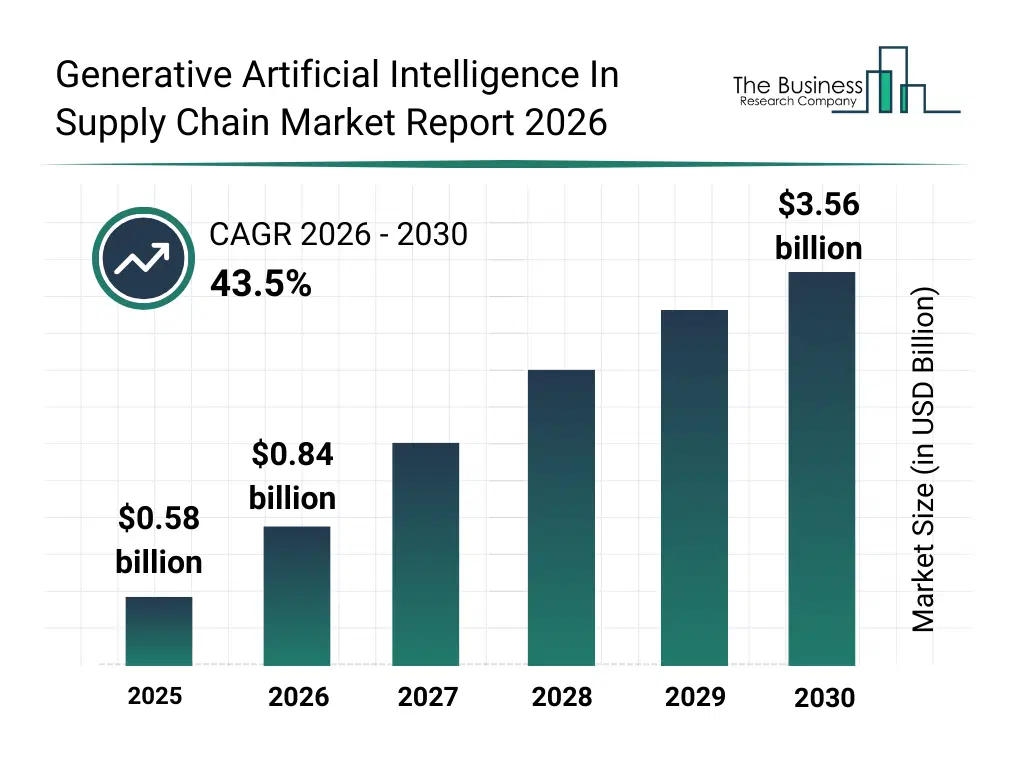
What Is The Generative Artificial Intelligence In Supply Chain Market Size and Share 2026?
The generative artificial intelligence in supply chain market size has grown exponentially in recent years. It will grow from $0.58 billion in 2025 to $0.84 billion in 2026 at a compound annual growth rate (CAGR) of 43.8%. The growth in the historic period can be attributed to growing complexity in global supply chains, increasing demand for faster delivery, early adoption of AI in logistics, rising investment in supply chain visibility tools, need for efficient inventory management.What Is The Generative Artificial Intelligence In Supply Chain Market Growth Forecast?
The generative artificial intelligence in supply chain market size is expected to see exponential growth in the next few years. It will grow to $3.56 billion in 2030 at a compound annual growth rate (CAGR) of 43.5%. The growth in the forecast period can be attributed to advancements in generative AI models, expansion of cloud-based supply chain solutions, integration of predictive analytics with rpa, growth in AI-driven supplier risk management, adoption of collaborative supply chain platforms. Major trends in the forecast period include AI-powered demand forecasting, generative supply chain simulation, logistics route optimization using ai, inventory management automation, supplier risk prediction and mitigation.
Global Generative Artificial Intelligence In Supply Chain Market Segmentation
1) By Component: Solutions, Software 2) By Deployment Mode: Cloud-Based, On-Premise 3) By End-User: Retail, Manufacturing, Healthcare, Other End-Users Subsegments: 1) By Solutions: Supply Chain Optimization Solutions, Demand Forecasting Solutions, Inventory Management Solutions, Logistics And Transportation Solutions, Supplier Risk Management Solutions, End-to-End Visibility Solutions 2) By Software: Predictive Analytics Software, Machine Learning Platforms, Robotics Process Automation (RPA) Software, Artificial Intelligence For Supply Chain Management (AI-SCM), Collaboration And Communication Software, Data Analytics ToolsWhat Is The Driver Of The Generative Artificial Intelligence In Supply Chain Market?
The rising e-commerce is expected to propel the growth of the generative artificial intelligence in supply chain market going forward. E-commerce is the buying and selling goods and services over the Internet, involving transactions and business activities conducted through online platforms and mobile applications. The rise in e-commerce is due to the growing adoption of online shopping, advancements in digital payment technologies, and the expansion of internet access. Generative artificial intelligence (AI) is used in the e-commerce supply chain to optimize inventory management, enhance demand forecasting, streamline logistics, automate order processing, and personalize customer experiences by analyzing large volumes of data to create efficient, data-driven supply chain strategies. For instance, in November 2023, according to the International Trade Administration, a US-based Department of Commerce, consumer eCommerce was expected to generate $285.60 billion in revenue by 2025, accounting for 36.3% of the UK retail market as of January 2021. Additionally, eCommerce revenues in the UK are projected to grow at an average annual rate of 12.6% by 2025. Therefore, rising e-commerce drives the growth of generative artificial intelligence in the supply chain market.Key Players In The Global Generative Artificial Intelligence In Supply Chain Market
Major companies operating in the generative artificial intelligence in supply chain market are Amazon.com Inc., Microsoft Corporation, Deutsche Post AG, Intel Corporation, International Business Machines Corporation, Oracle Corporation, SAP SE, NVIDIA Corporation, Dematic Inc., PTC Inc., Teradata Corporation, Blue Yonder Inc.,Manhattan Associates Inc., Logility Inc., LLamasoft Inc., Covariant Inc., FourKites Inc., ClearMetal Inc., o9 Solutions, Anaplan Inc., E2open LLC, Infor Inc., Flexport Inc., Descartes Systems Group Inc., GEP Worldwide, CelonisGlobal Generative Artificial Intelligence In Supply Chain Market Trends and Insights
Major companies operating in the generative artificial intelligence in supply chain market are focused on developing innovative technologies, such as cognitive solutions, to enhance predictive analytics and optimize supply chain operations. Cognitive solutions refer to advanced technologies that simulate human thought processes to analyze, interpret, and act on complex data. These solutions leverage artificial intelligence (AI), machine learning, and natural language processing to enable systems to understand, reason, and learn from data, much such as the human brain. For instance, in December 2023, Blue Yonder, a US-based supply chain management company, launched Blue Yonder Orchestrator, a generative AI tool that enables businesses to make more intelligent decisions and accelerate supply chain orchestration. This new capability leverages advanced AI algorithms to automate and optimize complex supply chain processes, enhancing efficiency and accuracy. Its key features include real-time data analysis, enabling dynamic inventory and logistics adjustments based on current conditions and forecasts. The system seamlessly integrates with existing supply chain infrastructure, providing actionable insights and recommendations to improve overall operational performance.What Are Latest Mergers And Acquisitions In The Generative Artificial Intelligence In Supply Chain Market?
In September 2023, Logility Inc., a US-based provider of AI-based Supply Chain Planning Solutions, acquired Garvis for an undisclosed amount. Through this acquisition, Logility aims to enhance its demand forecasting capabilities by integrating Garvis's AI-native and generative AI technologies. Garvis is a Belgium-based AI and cloud-based platform for supply chain forecasting and demand planning.Regional Insights
North America was the largest region in the generative artificial intelligence in supply chain market in 2025. Asia-Pacific is expected to be the fastest-growing region in the forecast period. The regions covered in this market report are Asia-Pacific, South East Asia, Western Europe, Eastern Europe, North America, South America, Middle East, Africa. The countries covered in this market report are Australia, Brazil, China, France, Germany, India, Indonesia, Japan, Taiwan, Russia, South Korea, UK, USA, Canada, Italy, Spain.What Defines the Generative Artificial Intelligence In Supply Chain Market?
The generative artificial intelligence in supply chain market consists of revenues earned by entities providing services such as supply chain planning and optimization, logistics and transportation management, supplier relationship management, and predictive maintenance. The market value includes the value of related goods sold by the service provider or included within the service offering. The generative artificial intelligence in supply chain market also includes sales of inventory optimization software, supply chain planning platforms, logistics and transportation management systems, warehouse automation and robotics, risk management software, and product lifecycle management software. Values in this market are ‘factory gate’ values, that is, the value of goods sold by the manufacturers or creators of the goods, whether to other entities (including downstream manufacturers, wholesalers, distributors, and retailers) or directly to end customers. The value of goods in this market includes related services sold by the creators of the goods.How is Market Value Defined and Measured?
The market value is defined as the revenues that enterprises gain from the sale of goods and/or services within the specified market and geography through sales, grants, or donations in terms of the currency (in USD unless otherwise specified). The revenues for a specified geography are consumption values that are revenues generated by organizations in the specified geography within the market, irrespective of where they are produced. It does not include revenues from resales along the supply chain, either further along the supply chain or as part of other products.What Key Data and Analysis Are Included in the Generative Artificial Intelligence In Supply Chain Market Report 2026?
The generative artificial intelligence in supply chain market research report is one of a series of new reports from The Business Research Company that provides market statistics, including industry global market size, regional shares, competitors with the market share, detailed market segments, market trends and opportunities, and any further data you may need to thrive in the generative artificial intelligence in supply chain industry. The market research report delivers a complete perspective of everything you need, with an in-depth analysis of the current and future state of the industry.Generative Artificial Intelligence In Supply Chain Market Report Forecast Analysis
| Report Attribute | Details |
|---|---|
| Market Size Value In 2026 | $0.84 billion |
| Revenue Forecast In 2035 | $3.56 billion |
| Growth Rate | CAGR of 43.8% from 2026 to 2035 |
| Base Year For Estimation | 2025 |
| Actual Estimates/Historical Data | 2020-2025 |
| Forecast Period | 2026 - 2030 - 2035 |
| Market Representation | Revenue in USD Billion and CAGR from 2026 to 2035 |
| Segments Covered | Component, Deployment Mode, End-User |
| Regional Scope | Asia-Pacific, Western Europe, Eastern Europe, North America, South America, Middle East, Africa |
| Country Scope | The countries covered in the report are Australia, Brazil, China, France, Germany, India, ... |
| Key Companies Profiled | Amazon.com Inc., Microsoft Corporation, Deutsche Post AG, Intel Corporation, International Business Machines Corporation, Oracle Corporation, SAP SE, NVIDIA Corporation, Dematic Inc., PTC Inc., Teradata Corporation, Blue Yonder Inc.,Manhattan Associates Inc., Logility Inc., LLamasoft Inc., Covariant Inc., FourKites Inc., ClearMetal Inc., o9 Solutions, Anaplan Inc., E2open LLC, Infor Inc., Flexport Inc., Descartes Systems Group Inc., GEP Worldwide, Celonis |
| Customization Scope | Request for Customization |
| Pricing And Purchase Options | Explore Purchase Options |