

Generative Protein Design Market Report 2026
Global Outlook – By Component (Software, Services), By Protein Type (Enzymes, Antibodies, Peptides, Hormones), By Technology (Deep Learning, Reinforcement Learning, Generative Adversarial Networks, Variational Autoencoders), By Application (Drug Discovery, Enzyme Engineering, Therapeutics, Industrial Biotechnology), By End User (Pharmaceutical And Biotechnology Companies, Academic And Research Institutes, Contract Research Organizations) – Market Size, Trends, Strategies, and Forecast to 2030
Generative Protein Design Market Overview
• Generative Protein Design market size has reached to $1.54 billion in 2025 • Expected to grow to $4.95 billion in 2030 at a compound annual growth rate (CAGR) of 26.3% • Growth Driver: The Increasing Focus On Biologics Is Fueling Market Growth Due To Advancements In Biotechnology And Immunology • Market Trend: Advancing Sustainable Biotechnology Through Open-Source Artificial Intelligence Innovation • North America was the largest region in 2025 and Asia-Pacific is the fastest growing region.What Is Covered Under Generative Protein Design Market?
Generative protein design refers to the use of artificial intelligence, machine learning, and computational models to create novel protein sequences with specific structures and biological functions. It enables researchers to design proteins with desired properties for applications in drug discovery, biotechnology, healthcare, agriculture, and industrial manufacturing. The main components of generative protein design include software and services. Software refers to computational platforms that use artificial intelligence and machine learning algorithms to design, optimize, and predict novel protein structures and functions. These solutions support protein types including enzymes, antibodies, peptides, and hormones and utilize technologies such as deep learning, reinforcement learning, generative adversarial networks, and variational autoencoders. The key applications of drug discovery, enzyme engineering, therapeutics, and industrial biotechnology, while the end-users includes pharmaceutical and biotechnology companies, academic and research institutes, and contract research organizations.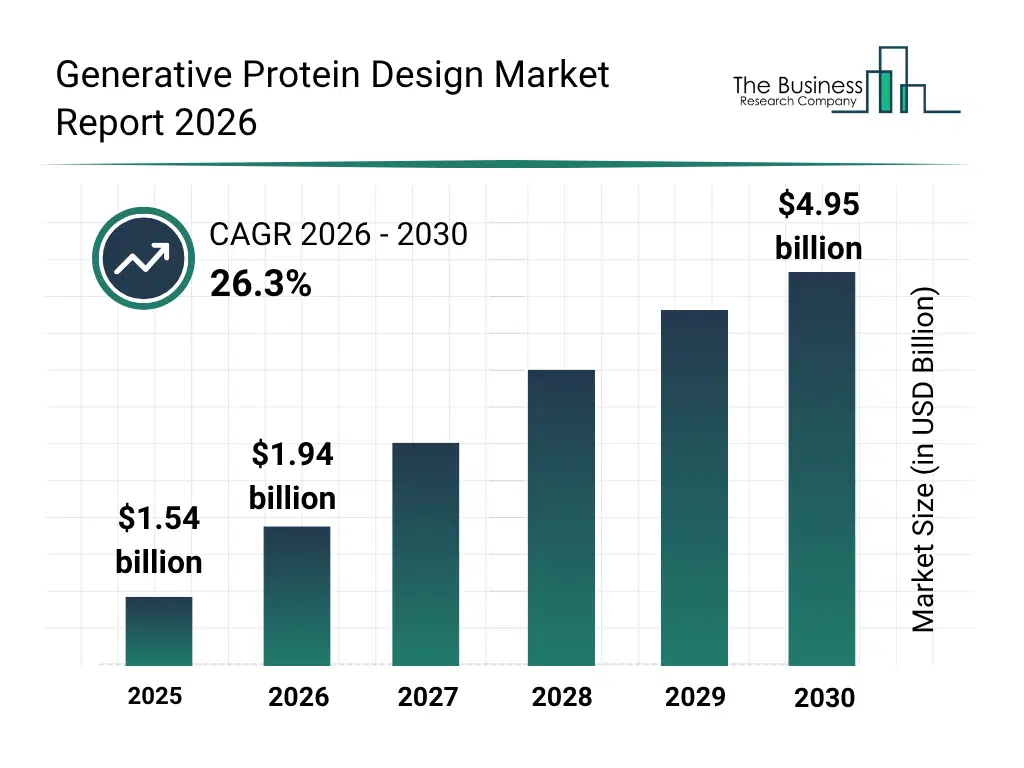
What Is The Generative Protein Design Market Size and Share 2026?
The generative protein design market size has grown exponentially in recent years. It will grow from $1.54 billion in 2025 to $1.94 billion in 2026 at a compound annual growth rate (CAGR) of 26.1%. The growth in the historic period can be attributed to advancement in structural biology and protein sequencing technologies, growth in computational biology and bioinformatics research, increasing pharmaceutical r&d investment in biologics, development of early machine learning models for molecular modeling, expansion of genome sequencing initiatives.What Is The Generative Protein Design Market Growth Forecast?
The generative protein design market size is expected to see exponential growth in the next few years. It will grow to $4.95 billion in 2030 at a compound annual growth rate (CAGR) of 26.3%. The growth in the forecast period can be attributed to rising demand for personalized medicine and targeted therapeutics, increasing adoption of AI driven drug discovery platforms, growth in synthetic biology and protein engineering applications, expansion of cloud based computational research infrastructure, increasing collaboration between biotech firms and AI technology providers. Major trends in the forecast period include AI driven de novo protein design for novel therapeutic discovery, integration of generative models for rapid protein sequence optimization, increasing adoption of computational biology platforms for protein engineering, rising use of cloud based bioinformatics for large scale protein simulation, expansion of AI enabled enzyme engineering for industrial biotechnology applications.
Global Generative Protein Design Market Segmentation
1) By Component: Software, Services 2) By Protein Type: Enzymes, Antibodies, Peptides, Hormones 3) By Technology: Deep Learning, Reinforcement Learning, Generative Adversarial Networks, Variational Autoencoders 4) By Application: Drug Discovery, Enzyme Engineering, Therapeutics, Industrial Biotechnology 5) By End User: Pharmaceutical And Biotechnology Companies, Academic And Research Institutes, Contract Research Organizations Subsegments: 1) By Software: Protein Modeling Software, Sequence Design Software, Structure Prediction Software, Simulation And Visualization Software, Data Analysis Software 2) By Services: Protein Engineering Services, Computational Biology Services, Consulting Services, Cloud-Based Design Services, Research And Development ServicesWhat Is The Driver Of The Generative Protein Design Market?
The increasing focus on biologics is expected to propel the growth of the generative protein design market going forward. Biologics are therapeutic products derived from living organisms or their components that target specific pathways in the immune system to treat diseases. The emphasis on biologics is growing due to advancements in biotechnology and immunology, which have enabled the development of more precise and effective treatments that target the underlying mechanisms of immune-mediated conditions rather than merely managing symptoms. Generative protein design helps biologics by enabling the rapid creation and optimization of novel proteins, antibodies, and therapeutic molecules with improved efficacy, stability, and target specificity. For instance, in February 2025, according to the World Health Organization (WHO), a Switzerland-based intergovernmental organization, the 2023 WHO Essential Medicines List includes 81 biologic therapies, representing over 15% of all listed medicines. Therefore, the increasing focus on biologics is driving the growth of generative protein design industry.Key Players In The Global Generative Protein Design Market
Major companies operating in the generative protein design market are DeepMind Technologies Limited, Schrödinger Inc., Ginkgo Bioworks Holdings Inc., Microsoft Research (Generative Biomedicine Group), Absci Corporation, Insilico Medicine Inc., Owkin Inc., Generate Biomedicines Inc., Isomorphic Labs Limited,Chan Zuckerberg Biohub, Cradle Bio B.V., Profluent Bio Inc., Basecamp Research Ltd., Arzeda Corporation, Cyrus Biotechnology, Synbio Technologies LLC, Latent Labs Inc., Peptone Limited, A-Alpha Bio Inc., LabGenius Therapeutics Limited, Monod Bio, ProteinQure Inc., Biomatter, Menten AI Inc., DenovAI Biotech GmbH, Innophore GmbHGlobal Generative Protein Design Market Trends and Insights
Major companies operating in the generative protein design market are focusing on developing innovative solutions, such as open-source, text-based generative artificial intelligence models, to accelerate enzyme discovery and enable sustainable industrial biotechnology applications. Open-source, text-based generative AI models are artificial intelligence systems that use text prompts or sequence inputs to generate new biological or protein designs, while allowing researchers to freely access, modify, and improve the underlying model. For instance, in June 2024, Basecamp Research Ltd., a UK-based biotechnology company, partnered with Ferrous Laboratories, a US-based academic research group, to launch ZymCTRL as the open-source, generative AI tool for designing novel enzymes from simple text prompts, such as enzyme commission (EC) numbers. The platform leverages generative artificial intelligence to design novel enzymes for sustainable industrial applications. It is designed to help researchers find and improve enzymes faster by allowing them to create enzyme designs more easily. The tool supports streamlined protein engineering workflows through open-source generative modeling capabilities, reflecting the company’s focus on advancing artificial intelligence-driven biological innovation.What Are Latest Mergers And Acquisitions In The Generative Protein Design Market?
In July 2023, BioNTech SE, a Germany-based biotechnology company, acquired InstaDeep for an undisclosed amount. With this acquisition, BioNTech aims to strengthen its artificial intelligence capabilities in drug discovery and accelerate the development of advanced protein and biomolecule design using machine learning technologies. InstaDeep Ltd. is a UK-based artificial intelligence company that offers generative protein design solutions.Regional Outlook
North America was the largest region in the generative protein design market in 2025. Asia-Pacific is expected to be the fastest-growing region in the forecast period. The regions covered in this market report are Australia, Brazil, China, France, Germany, India, Indonesia, Japan, Taiwan, Russia, South Korea, UK, USA, Canada, Italy, Spain. The countries covered in this market report are Australia, Brazil, China, France, Germany, India, Indonesia, Japan, Taiwan, Russia, South Korea, UK, USA, Canada, Italy, Spain.What Defines the Generative Protein Design Market?
The generative protein design market consists of revenues earned by entities by providing services such as protein sequence generation, de novo protein design, protein structure prediction and optimization, and therapeutic protein discovery services. The market value includes the value of related goods sold by the service provider or included within the service offering. The generative protein design market also includes sales of edge AI computing devices, automated liquid handling systems, microfluidic lab-on-chip systems, and peptide synthesizers. Values in this market are ‘factory gate’ values, that is the value of goods sold by the manufacturers or creators of the goods, whether to other entities (including downstream manufacturers, wholesalers, distributors and retailers) or directly to end customers. The value of goods in this market includes related services sold by the creators of the goods.How is Market Value Defined and Measured?
The market value is defined as the revenues that enterprises gain from the sale of goods and/or services within the specified market and geography through sales, grants, or donations in terms of the currency (in USD unless otherwise specified). The revenues for a specified geography are consumption values that are revenues generated by organizations in the specified geography within the market, irrespective of where they are produced. It does not include revenues from resales along the supply chain, either further along the supply chain or as part of other products.What Key Data and Analysis Are Included in the Generative Protein Design Market Report 2026?
The generative protein design market research report is one of a series of new reports from The Business Research Company that provides generative protein design market statistics, including generative protein design industry global market size, regional shares, competitors with a generative protein design market share, detailed generative protein design market segments, market trends and opportunities, and any further data you may need to thrive in the generative protein design industry. This generative protein design market research report delivers a complete perspective of everything you need, with an in-depth analysis of the current and future scenario of the industry.Generative Protein Design Market Report Forecast Analysis
| Report Attribute | Details |
|---|---|
| Market Size Value In 2026 | $1.94 billion |
| Revenue Forecast In 2030 | $4.95 billion |
| Growth Rate | CAGR of 26.3% from 2026 to 2030 |
| Base Year For Estimation | 2025 |
| Actual Estimates/Historical Data | 2020-2025 |
| Forecast Period | 2026 - 2030 |
| Market Representation | Revenue in USD Billion and CAGR from 2026 to 2030 |
| Segments Covered | Component, Protein Type, Technology, Application, End User |
| Regional Scope | Asia-Pacific, Western Europe, Eastern Europe, North America, South America, Middle East, Africa |
| Country Scope | The countries covered in the generative protein design market report are Australia, Brazil, China, France, Germany, India, Indonesia, Japan, Taiwan, Russia, South Korea, UK, USA, Canada, Italy, Spain. |
| Key Companies Profiled | DeepMind Technologies Limited, Schrödinger Inc., Ginkgo Bioworks Holdings Inc., Microsoft Research (Generative Biomedicine Group), Absci Corporation, Insilico Medicine Inc., Owkin Inc., Generate Biomedicines Inc., Isomorphic Labs Limited,Chan Zuckerberg Biohub, Cradle Bio B.V., Profluent Bio Inc., Basecamp Research Ltd., Arzeda Corporation, Cyrus Biotechnology, Synbio Technologies LLC, Latent Labs Inc., Peptone Limited, A-Alpha Bio Inc., LabGenius Therapeutics Limited, Monod Bio, ProteinQure Inc., Biomatter, Menten AI Inc., DenovAI Biotech GmbH, Innophore GmbH |
| Customization Scope | Request for Customization |
| Pricing And Purchase Options | Explore Purchase Options |