
Genetic Analysis Market Report 2026
Global Outlook – By Product (Reagents And Kits, Instruments, Software), By Test (Predictive Genetic Testing, Carrier Testing, Prenatal And Newborn Testing, Disease Diagnostic Testing, Pharmacogenomic Testing, Other Tests), By Technology (Next-Generation Sequencing (NGS), Real-Time PCR System, Other Technologies), By Application (Cancer, Genetic Diseases, Cardiovascular Diseases, Rare Diseases, Infectious Diseases, Other Applications), By End-Use (Hospitals, Research And Development Laboratories, Diagnostic Centers, Other End-Uses) – Market Size, Trends, Strategies, and Forecast to 2035
Genetic Analysis Market Overview
• Genetic Analysis market size has reached to $10.29 billion in 2025 • Expected to grow to $18.75 billion in 2030 at a compound annual growth rate (CAGR) of 12.7% • Growth Driver: Rising Cancer Prevalence Fueling The Growth Of The Market Due To Increasing Demand For Targeted And Personalized Treatment Solutions • Market Trend: Focus On Advancing Hereditary Cancer Detection Through Genetic Testing Innovation • North America was the largest region in 2025 and Asia-Pacific is the fastest growing region.What Is Covered Under Genetic Analysis Market?
Genetic analysis is a scientific method used to examine deoxyribonucleic acid (DNA), ribonucleic acid (RNA) and chromosomes to understand the structure, function, variation, and transmission of genetic material. It involves the study of genes and their interactions, enabling the identification of genetic sequences and mutations. By exploring genetic patterns and inheritance, this process provides insights into biological functions and hereditary traits. The main products of genetic analysis include reagents and kits, instruments, and software. Reagents and kits are chemical substances and prepared solutions used to carry out specific biological reactions or processes in laboratory experiments. It offers various types of tests, such as predictive genetic testing, carrier testing, prenatal and newborn testing, disease diagnostic testing, pharmacogenomic testing, and others, and uses different technologies, including next-generation sequencing (NGS), real-time PCR system, and others. It is applied for cancer, genetic diseases, cardiovascular diseases, rare diseases, infectious diseases, and others, and serves several end-uses, including hospitals, research and development laboratories, diagnostic centers, and others.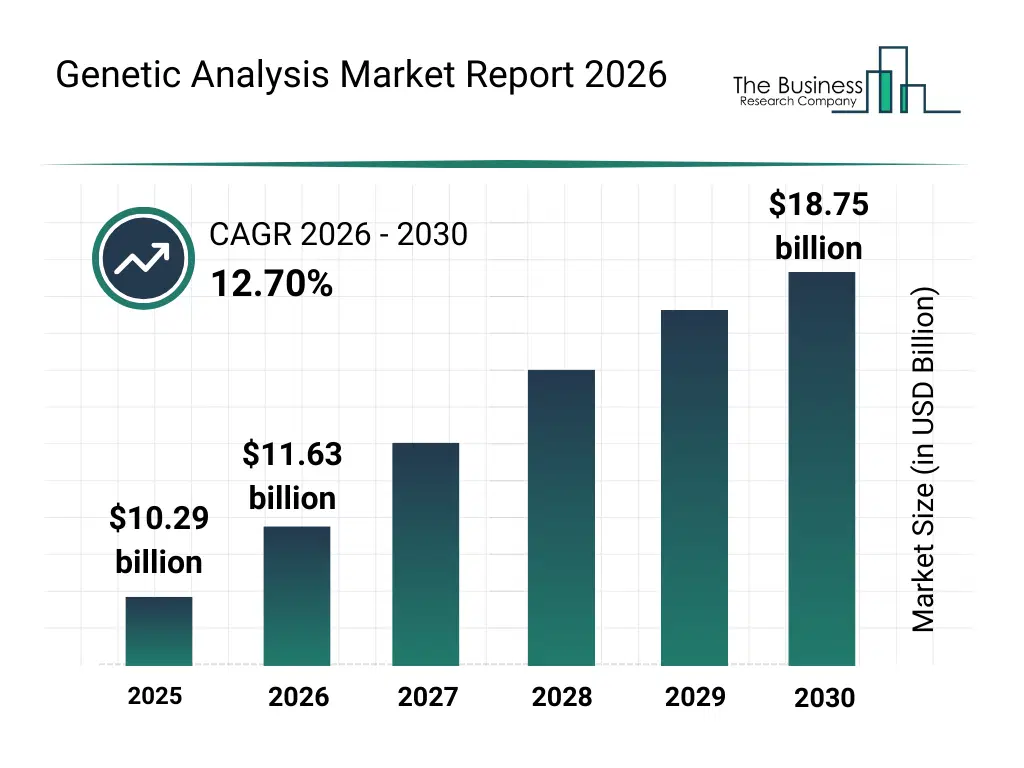
What Is The Genetic Analysis Market Size and Share 2026?
The genetic analysis market size has grown rapidly in recent years. It will grow from $10.29 billion in 2025 to $11.63 billion in 2026 at a compound annual growth rate (CAGR) of 13.0%. The growth in the historic period can be attributed to limited availability of high-throughput sequencing platforms, reliance on conventional genetic testing methods, growing awareness of genetic disorders, increasing investment in research laboratories, rising number of diagnostic centers.What Is The Genetic Analysis Market Growth Forecast?
The genetic analysis market size is expected to see rapid growth in the next few years. It will grow to $18.75 billion in 2030 at a compound annual growth rate (CAGR) of 12.7%. The growth in the forecast period can be attributed to advancements in ngs and real-time pcr technologies, development of cloud-based genomic data platforms, increasing adoption of personalized medicine, rising government initiatives for genetic disease screening, integration of ai and bioinformatics tools in diagnostics. Major trends in the forecast period include expansion of next-generation sequencing (ngs) and pcr-based genetic testing, growing adoption of pharmacogenomic testing for personalized medicine, increase in prenatal and newborn genetic screening programs, rising focus on rare disease and cancer genetic diagnostics, integration of bioinformatics and genomic data analysis tools.
Global Genetic Analysis Market Segmentation
1) By Product: Reagents And Kits, Instruments, Software 2) By Test: Predictive Genetic Testing, Carrier Testing, Prenatal And Newborn Testing, Disease Diagnostic Testing, Pharmacogenomic Testing, Other Tests 3) By Technology: Next-Generation Sequencing (NGS), Real-Time PCR System, Other Technologies 4) By Application: Cancer, Genetic Diseases, Cardiovascular Diseases, Rare Diseases, Infectious Diseases, Other Applications 5) By End-Use: Hospitals, Research And Development Laboratories, Diagnostic Centers, Other End-Uses Subsegments: 1) By Reagents And Kits: DNA Extraction Kits, RNA Extraction Kits, PCR Reagents, Sequencing Reagents, Library Preparation Kits, Electrophoresis Reagents, Microarray Kits, Genotyping Assay Kits, Target Enrichment Kits, Nucleic Acid Labeling Kits 2) By Instruments: DNA Sequencers, PCR Machines, Microarray Scanners, Electrophoresis Systems, Real-Time PCR Systems, Automated Sample Preparation Systems, Genetic Analyzers, Bioanalyzers, Fragment Analyzers, Next-Generation Sequencing (NGS) Platforms 3) By Software: Data Analysis Software, Bioinformatics Tools, Laboratory Information Management Systems (LIMS), Genomic Data Interpretation Software, DNA Sequence Alignment Tools, Variant Annotation Software, Clinical Decision Support Software, Cloud-Based Genomic Platforms, Workflow Management Software, Data Visualization ToolsWhat Is The Driver Of The Genetic Analysis Market?
The increasing cases of cancer are expected to propel the growth of the genetic analysis market going forward. Cancer is a disease in which certain cells in the body grow uncontrollably and may spread to other areas. Cancer cases are rising due to an aging population, as older individuals are more likely to accumulate genetic mutations and have prolonged exposure to environmental and lifestyle-related risk factors that contribute to cancer development. Genetic analysis is beneficial for cancer as it detects specific genetic mutations responsible for the disease, allowing doctors to choose targeted treatments that are more effective and cause fewer side effects. For instance, in May 2025, according to a report published by the National Cancer Institute (NCI), a US-based agency for cancer research and training, close to 20 million people worldwide were newly diagnosed with cancer in 2022, and about 9.7 million lost their lives to it. Estimates suggest that by 2050, the annual number of new cancer cases could reach 33 million, with cancer deaths expected to rise to 18.2 million. Therefore, the increasing cases of cancer are driving the growth of the genetic analysis industry.Key Players In The Global Genetic Analysis Market
Major companies operating in the genetic analysis market are Hoffmann-La Roche AG, Thermo Fisher Scientific Inc., Abbott Laboratories Inc., Danaher Corporation, Quest Diagnostics Inc., Illumina Inc., PerkinElmer Inc., BioRad Laboratories Inc., Qiagen NV, Oxford Nanopore Technologies Plc, 23andMe Inc., ELITech Group, MyHeritage Ltd., Dante Labs Inc., AutoGenomics Inc., IntegraGen SA, Family Tree DNA, 24 genetics, Centrillion Biosciences Inc., DNA Worldwide Group Ltd., Genebase.Global Genetic Analysis Market Trends and Insights
Major companies operating in the genetic analysis market are focusing on developing advanced solutions, such as genetic testing solutions, to take preventive measures or undergo early monitoring. Genetic testing solutions involve analyzing a person’s DNA to detect changes or variations in genes that may be linked to certain health conditions or inherited traits. For instance, in June 2023, Devyser, a Sweden-based company specializing in developing diagnostic kits, launched Devyser LynchFAP and Devyser BRCA PALB2, two genetic testing solutions for hereditary cancer. Devyser LynchFAP stands out by offering a complete solution for analyzing PMS2 and nine additional genes linked to hereditary colorectal cancer, effectively resolving the complex issue of distinguishing PMS2 from its pseudogene PMS2CL. It is the first commercial kit specifically designed for precise analysis of the PMS2 gene. Devyser BRCA PALB2 enables targeted detection of genetic variants in BRCA1, BRCA2, and PALB2, which are key genes associated with increased risk of breast and ovarian cancer. Its user-friendly design allows for quick integration into lab workflows and supports analysis of DNA from both blood and tumor samples within a single test.What Are Latest Mergers And Acquisitions In The Genetic Analysis Market?
In February 2025, Tempus AI Inc., a US-based health technology company, acquired Ambry Genetics for an undisclosed amount. The acquisition strengthens the strategic use of diagnostics and data to drive innovation. It enhances the ability to deliver advanced solutions to clinicians, patients, and life sciences companies. Ambry Genetics is a US-based provider of genetic analysis solutions.Regional Insights
North America was the largest region in the genetic analysis market in 2025. Asia-Pacific is expected to be the fastest-growing region in the forecast period. The regions covered in this market report are Asia-Pacific, South East Asia, Western Europe, Eastern Europe, North America, South America, Middle East, Africa. The countries covered in this market report are Australia, Brazil, China, France, Germany, India, Indonesia, Japan, Taiwan, Russia, South Korea, UK, USA, Canada, Italy, Spain.What Defines the Genetic Analysis Market?
The genetic analysis market consists of revenues earned by entities by providing services such as bioinformatics analysis, transcriptome analysis, microarray analysis services, and custom assay development. The market value includes the value of related goods sold by the service provider or included within the service offering. The genetic analysis market also includes sales of genotyping arrays, library preparation kits, gene expression assays, and microarray slides. Values in this market are ‘factory gate’ values, that is the value of goods sold by the manufacturers or creators of the goods, whether to other entities (including downstream manufacturers, wholesalers, distributors and retailers) or directly to end customers. The value of goods in this market includes related services sold by the creators of the goods.How is Market Value Defined and Measured?
The market value is defined as the revenues that enterprises gain from the sale of goods and/or services within the specified market and geography through sales, grants, or donations in terms of the currency (in USD unless otherwise specified). The revenues for a specified geography are consumption values that are revenues generated by organizations in the specified geography within the market, irrespective of where they are produced. It does not include revenues from resales along the supply chain, either further along the supply chain or as part of other products.What Key Data and Analysis Are Included in the Genetic Analysis Market Report 2026?
The genetic analysis market research report is one of a series of new reports from The Business Research Company that provides market statistics, including industry global market size, regional shares, competitors with the market share, detailed market segments, market trends and opportunities, and any further data you may need to thrive in the genetic analysis industry. The market research report delivers a complete perspective of everything you need, with an in-depth analysis of the current and future state of the industry.Genetic Analysis Market Report Forecast Analysis
| Report Attribute | Details |
|---|---|
| Market Size Value In 2026 | $11.63 billion |
| Revenue Forecast In 2035 | $18.75 billion |
| Growth Rate | CAGR of 13.0% from 2026 to 2035 |
| Base Year For Estimation | 2025 |
| Actual Estimates/Historical Data | 2020-2025 |
| Forecast Period | 2026 - 2030 - 2035 |
| Market Representation | Revenue in USD Billion and CAGR from 2026 to 2035 |
| Segments Covered | Product, Test, Technology, Application, End-Use |
| Regional Scope | Asia-Pacific, Western Europe, Eastern Europe, North America, South America, Middle East, Africa |
| Country Scope | The countries covered in the report are Australia, Brazil, China, France, Germany, India, ... |
| Key Companies Profiled | Hoffmann-La Roche AG, Thermo Fisher Scientific Inc., Abbott Laboratories Inc., Danaher Corporation, Quest Diagnostics Inc., Illumina Inc., PerkinElmer Inc., BioRad Laboratories Inc., Qiagen NV, Oxford Nanopore Technologies Plc, 23andMe Inc., ELITech Group, MyHeritage Ltd., Dante Labs Inc., AutoGenomics Inc., IntegraGen SA, Family Tree DNA, 24 genetics, Centrillion Biosciences Inc., DNA Worldwide Group Ltd., Genebase. |
| Customization Scope | Request for Customization |
| Pricing And Purchase Options | Explore Purchase Options |