
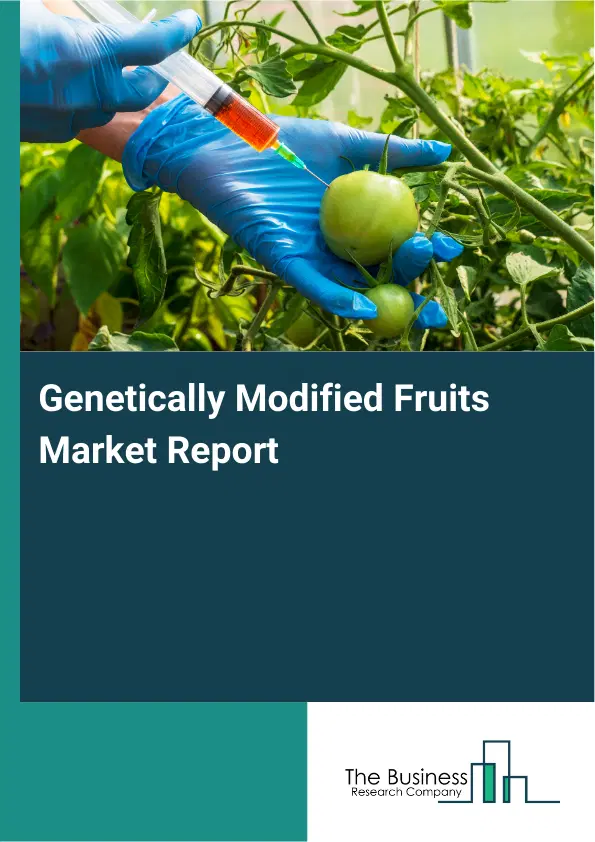
Genetically Modified Fruits Market Report 2026
Global Outlook – By Fruit Type (Berries, Bananas, Tomatoes, Citrus Fruits ), By Trait (Herbicide Tolerance (HR), Insect Resistance (IR), Stacked Traits (ST)), By Application (Human Consumption, Research & Development) – Market Size, Trends, Strategies, and Forecast to 2030
Genetically Modified Fruits Market Overview
• Genetically Modified Fruits market size has reached to $0.09 billion in 2025 • Expected to grow to $0.16 billion in 2030 at a compound annual growth rate (CAGR) of 12.3% • Growth Driver: Rising Consumer Health Consciousness Fuels Growth In The Genetically Modified Fruits Market • Market Trend: Leveraging Biotechnology For Enhanced Food Quality • North America was the largest region in 2025 and Asia-Pacific is the fastest growing region.What Is Covered Under Genetically Modified Fruits Market?
Genetically modified fruits refer to the fruits that have been developed to fulfill the distinct needs of growers and/or consumers. These fruits have distinctive agronomic traits that are frequently challenging to accomplish by conventional breeding. Genetically modified (GM) fruits are used to develop tolerance to herbicides or introduce plant disease resistance to increase yield. The major types of genetically modified fruits are vegetables, crops, fruits, and animal products. Vegetables are portions of plants that are eaten as food by people and other animals. GM vegetables are used to contain important vitamins, minerals, and plant chemicals. Various traits involved are herbicide tolerance (HR), insect resistance (IR), and stacked traits (ST). These are used in several applications such as poultry, swine, cattle, dairy, aquaculture, pet food, equine, and others.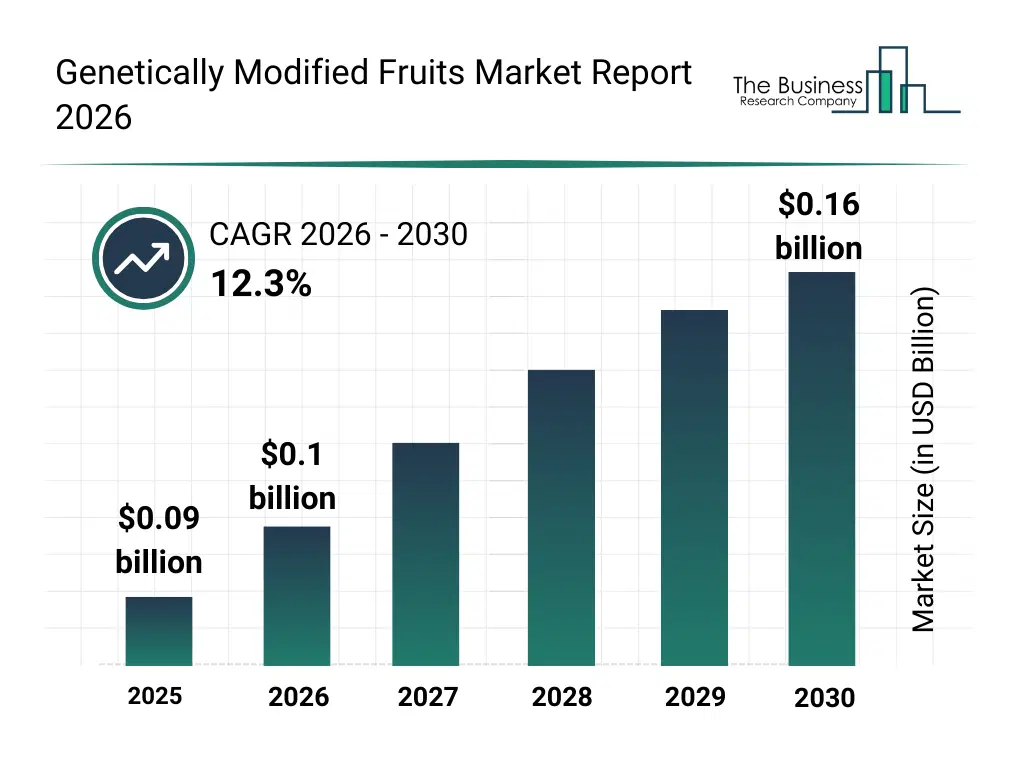
What Is The Genetically Modified Fruits Market Size and Share 2026?
The genetically modified fruits market size has grown rapidly in recent years. It will grow from $0.09 billion in 2025 to $0.1 billion in 2026 at a compound annual growth rate (CAGR) of 12.9%. The growth in the historic period can be attributed to increasing global food demand, early adoption of gm crop technologies, expansion of commercial fruit farming, rising pest and disease pressures, investments in agricultural biotechnology.What Is The Genetically Modified Fruits Market Growth Forecast?
The genetically modified fruits market size is expected to see rapid growth in the next few years. It will grow to $0.16 billion in 2030 at a compound annual growth rate (CAGR) of 12.3%. The growth in the forecast period can be attributed to increasing acceptance of gm foods, rising demand for high-yield fruits, expansion of climate-resilient crop development, growing investments in genomics research, increasing focus on sustainable agriculture practices. Major trends in the forecast period include increasing adoption of disease-resistant fruit varieties, rising development of herbicide-tolerant gm fruits, growing focus on yield-optimized fruit cultivation, expansion of trait-stacked fruit development, enhanced investment in advanced genetic research.
Global Genetically Modified Fruits Market Segmentation
1) By Fruit Type: Berries, Bananas, Tomatoes, Citrus Fruits 2) By Trait: Herbicide Tolerance (HR), Insect Resistance (IR), Stacked Traits (ST) 3) By Application: Human Consumption, Research & Development Subsegments: 1) By Berries: Strawberries, Blueberries, Raspberries, Blackberries 2) By Bananas: Cavendish Bananas, Plantains, Red Bananas 3) By Tomatoes: Cherry Tomatoes, Roma Tomatoes, Heirloom Tomatoes 4) By Citrus Fruits: Oranges, Lemons, Limes, GrapefruitsWhat Is The Driver Of The Genetically Modified Fruits Market?
Growing consumers’ demand for healthy food products is expected to propel the growth of the genetically modified fruits market going forward. Health food products refer to foods that provide all the nutrients needed to maintain good health, feel good, and lots of energy. Genetically modified fruits are themselves a source of nutrients and are used to enhance nutrient content and food quality, increase agricultural yields, and enhance the health of people. For instance, in May 2023, according to the International Food Information Council (IFIC), a US-based nonprofit organization focused on food and health research, its annual Food and Health Survey found that 52% of American adults reported following a specific eating pattern or diet in 2023, with the share among boomers rising to 41% up from 29% in 2022, and the most common eating patterns reported were high protein at 18%, mindful eating at 17%, calorie counting at 12%, clean eating at 12%, and intermittent fasting at 12%. Therefore, growing consumers’ demand for healthy food products will drive the growth of genetically modified fruits industry.Key Players In The Global Genetically Modified Fruits Market
Major companies operating in the genetically modified fruits market are BASF SE, Bayer AG, Syngenta Crop Protection AG, Sakata Seed America Inc., DuPont de Nemours Inc., Groupe Limagrain Holding SA, KWS SAAT SE & Co. KGaA, J.R. Simplot Company, Dow Inc., US Department of Agriculture, Okanagan Specialty Fruits Company, Huazhong Agricultural University, Cornell University and the University of Hawaii, University of Florida, JKAgri Genetics Ltd, Maharashtra Hybrid Seed Company, Calyxt Inc, Bioceres S.A, Beijing DaBeiNong Biotechnology Co. Ltd, Intrexon
This chart is for illustrative purposes; the full report includes a detailed competitor analysis and comprehensive overview of the top 10 companies in the market.
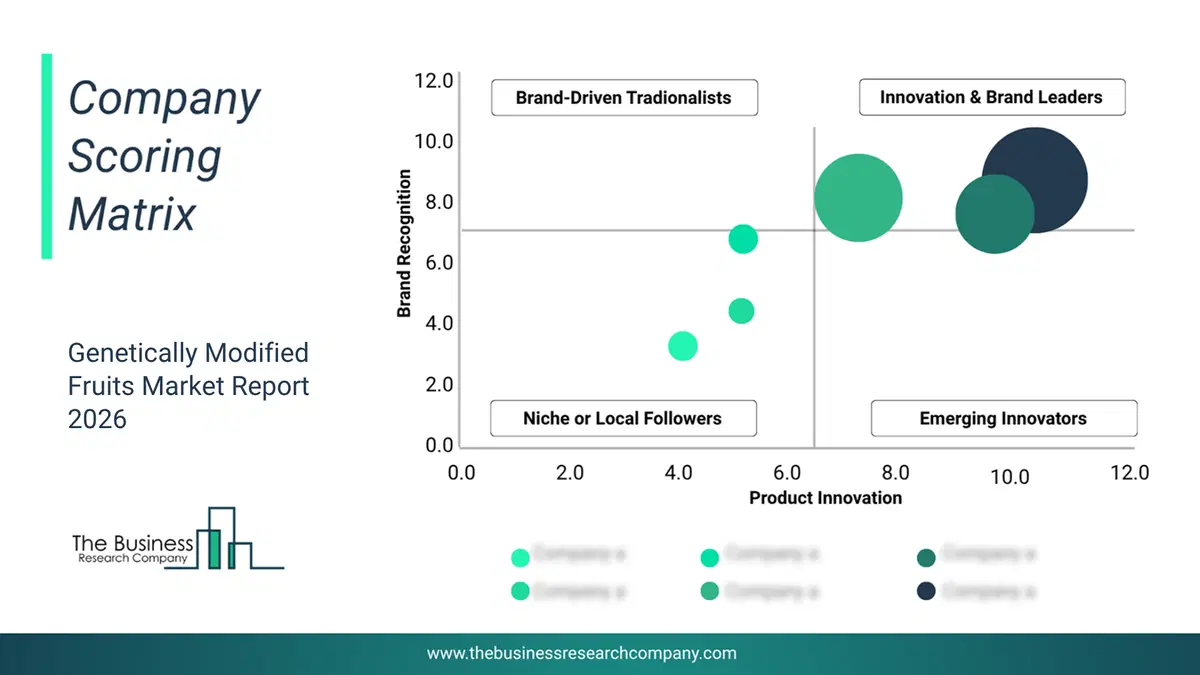
This chart maps companies by product innovation and brand strength, with bubble size indicating relative revenue, helping identify market leaders, challengers, and niche players. This is an illustrative chart; the full report provides a complete and accurate competitive analysis.
Global Genetically Modified Fruits Market Trends and Insights
Major companies operating in the genetically modified fruits market are focusing on leveraging gene-editing technology such as clustered regularly interspaced short palindromic repeats (CRISPR) gene editing to enhance shelf-life extension and food-waste reduction. CRISPR gene editing is a precision biotechnology approach that disables or alters specific genes in plant DNA to remove undesirable traits while preserving natural characteristics, enabling capabilities such as delayed browning and improved post-harvest durability. For instance, in March 2025, Tropic Biosciences, a UK-based plant-biotechnology company, introduced a gene-edited non-browning Cavendish banana designed to remain yellow and visually fresh for hours after peeling and to better withstand bruising, featuring suppression of polyphenol-oxidase activity while maintaining the same taste, texture, and aroma as conventional bananas. This innovation improves supply-chain efficiency, reduces spoilage during handling and distribution, and supports new value-added applications such as pre-cut fruit and ready-to-eat offerings.What Are Latest Mergers And Acquisitions In The Genetically Modified Fruits Market?
In December 2024, Prevar Limited, a New Zealand-based horticultural breeding company, partnered with Okanagan Specialty Fruits to accelerate the breeding of apples and pears using genome-editing technologies. With this collaboration they aim to integrate cutting-edge genome editing and advanced biotech development to produce fruit cultivars with enhanced disease resistance, longer shelf life and improved nutritional quality, thereby reducing food waste, increasing sustainability and delivering higher quality fruit to growers and consumers. Okanagan Specialty Fruits Inc. is a Canadian specialty-fruit biotechnology company that specializes in developing and marketing genetically engineered tree fruit varieties.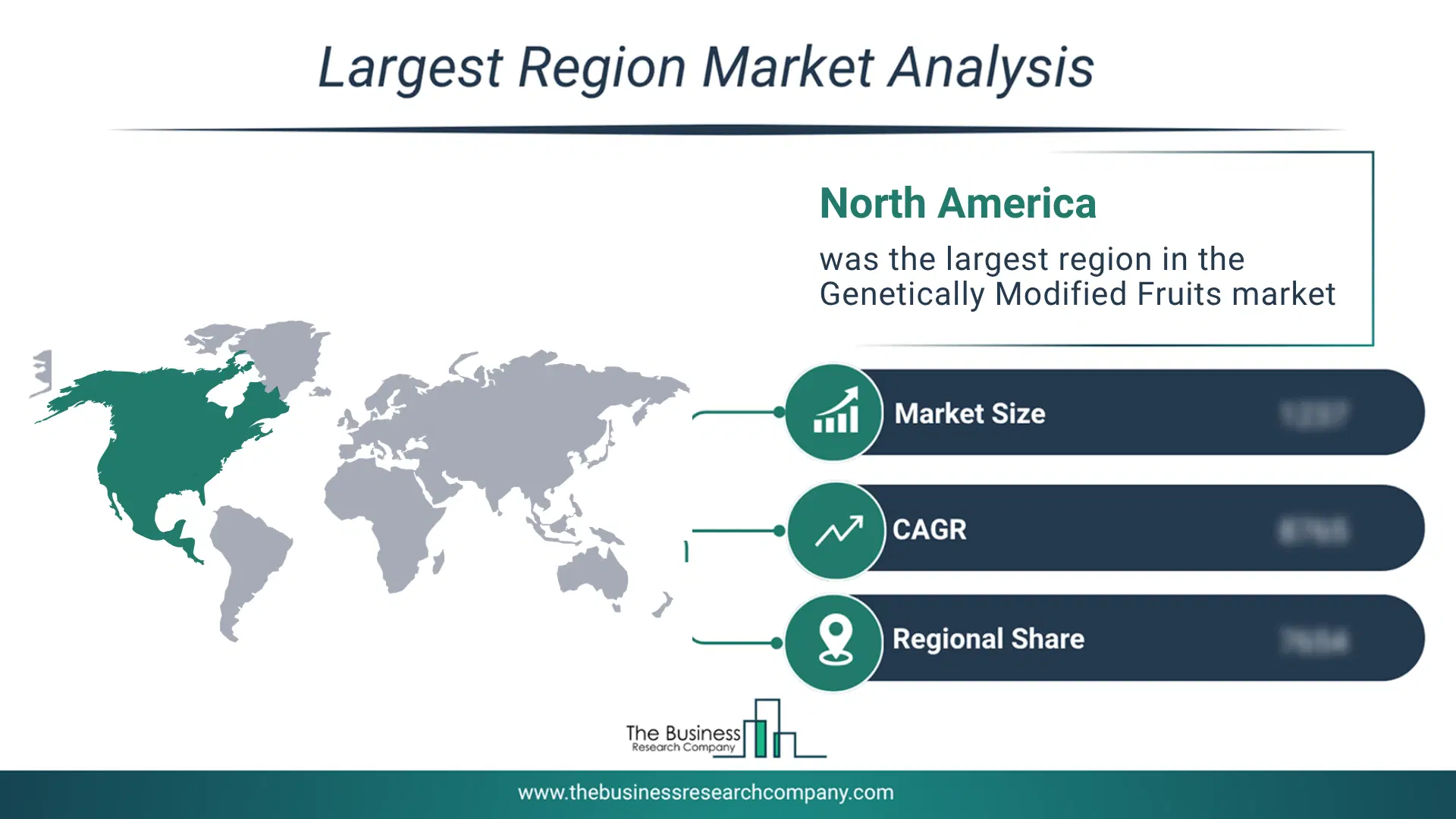
Regional Outlook
North America was the largest region in the genetically modified fruits market in 2025. Asia-Pacific is expected to be the fastest-growing region in the genetically modified fruits market share during the forecast period. The regions covered in this market report are Asia-Pacific, South East Asia, Western Europe, Eastern Europe, North America, South America, Middle East and Africa. The countries covered in this market report are Australia, Brazil, China, France, Germany, India, Indonesia, Japan, Taiwan, Russia, South Korea, UK, USA, Italy, Spain, CanadaWhat Defines the Genetically Modified Fruits Market?
The genetically modified fruits market consists of sales of genetically modified summer squash, apples, papayas, and pink pineapples. Values in this market are ‘factory gate’ values, that is the value of goods sold by the manufacturers or creators of the goods, whether to other entities (including downstream manufacturers, wholesalers, distributors and retailers) or directly to end customers. The value of goods in this market includes related services sold by the creators of the goods.How is Market Value Defined and Measured?
The market value is defined as the revenues that enterprises gain from the sale of goods and/or services within the specified market and geography through sales, grants, or donations in terms of the currency (in USD unless otherwise specified). The revenues for a specified geography are consumption values that are revenues generated by organizations in the specified geography within the market, irrespective of where they are produced. It does not include revenues from resales along the supply chain, either further along the supply chain or as part of other products.
This chart presents market attractiveness based on a quantitative evaluation of growth, competition, strategic alignment, and risk, offering a clear view of opportunity areas for decision-making. This chart is for illustrative purposes; the full report contains the complete analysis.

This chart highlights the Total Addressable Market (TAM) by estimating the maximum revenue opportunity using an assumption-driven approach, supporting strategic planning and opportunity sizing across markets. The chart is illustrative; the full report provides a more comprehensive analysis.
What Key Data and Analysis Are Included in the Genetically Modified Fruits Market Report 2026?
The genetically modified fruits market research report is one of a series of new reports from The Business Research Company that provides market statistics, including industry global market size, regional shares, competitors with the market share, detailed market segments, market trends and opportunities, and any further data you may need to thrive in the genetically modified fruits industry. The market research report delivers a complete perspective of everything you need, with an in-depth analysis of the current and future state of the industry.Genetically Modified Fruits Market Report Forecast Analysis
| Report Attribute | Details |
|---|---|
| Market Size Value In 2026 | $0.1 billion |
| Revenue Forecast In 2030 | $0.16 billion |
| Growth Rate | CAGR of 12.9% from 2026 to 2030 |
| Base Year For Estimation | 2025 |
| Actual Estimates/Historical Data | 2020-2025 |
| Forecast Period | 2026 - 2030 |
| Market Representation | Revenue in USD Billion and CAGR from 2026 to 2030 |
| Segments Covered | Fruit Type, Trait, Application |
| Regional Scope | Asia-Pacific, Western Europe, Eastern Europe, North America, South America, Middle East, Africa |
| Country Scope | The countries covered in the report are Australia, Brazil, China, France, Germany, India, Indonesia, Japan, Taiwan, Russia, South Korea, UK, USA, Canada, Italy, Spain. |
| Key Companies Profiled | BASF SE, Bayer AG, Syngenta Crop Protection AG, Sakata Seed America Inc., DuPont de Nemours Inc., Groupe Limagrain Holding SA, KWS SAAT SE & Co. KGaA, J.R. Simplot Company, Dow Inc., US Department of Agriculture, Okanagan Specialty Fruits Company, Huazhong Agricultural University, Cornell University and the University of Hawaii, University of Florida, JKAgri Genetics Ltd, Maharashtra Hybrid Seed Company, Calyxt Inc, Bioceres S.A, Beijing DaBeiNong Biotechnology Co. Ltd, Intrexon |
| Customization Scope | Request for Customization |
| Pricing And Purchase Options | Explore Purchase Options |