
Geodetic Measuring Devices Market Report 2026
Global Outlook – By Type (Total Stations, Levels, Global Navigation Satellite System Receivers, Other Types), By Technology (Global Navigation Satellite System (GNSS), Light Detection And Ranging (LiDAR), Photogrammetry, Remote Sensing), By Application (Civil Engineering, Mechanical Engineering, Construction, Geology, Other Applications) – Market Size, Trends, Strategies, and Forecast to 2030
Geodetic Measuring Devices Market Overview
• Geodetic Measuring Devices market size has reached to $35.53 billion in 2025 • Expected to grow to $57.25 billion in 2030 at a compound annual growth rate (CAGR) of 10.3% • Growth Driver: Surge In Geological Surveys Drives Growth In The Geodetic Measuring Devices Market • Market Trend: Advancing Precision Through Hybrid Positioning Technologies • North America was the largest region in 2025 and Asia-Pacific is the fastest growing region.What Is Covered Under Geodetic Measuring Devices Market?
Geodetic measuring devices are tools that measure geographic distance or area and use a curved (nonplanar) surface to model the earth to collect and transfer elevations while conducting site surveys or building construction. They measure georeferenced displacements or movements in one, two, or three dimensions. The main types of geodetic measuring devices are total stations, levels, global navigation satellite system receivers, and others. Total stations are precise optical-electronic instruments that measure angles and distances for accurate positioning and mapping. The various technologies are global navigation satellite system (GNSS), light detection and ranging (LiDAR), photogrammetry, and remote sensing applied in civil engineering, mechanical engineering, construction, geology, and others.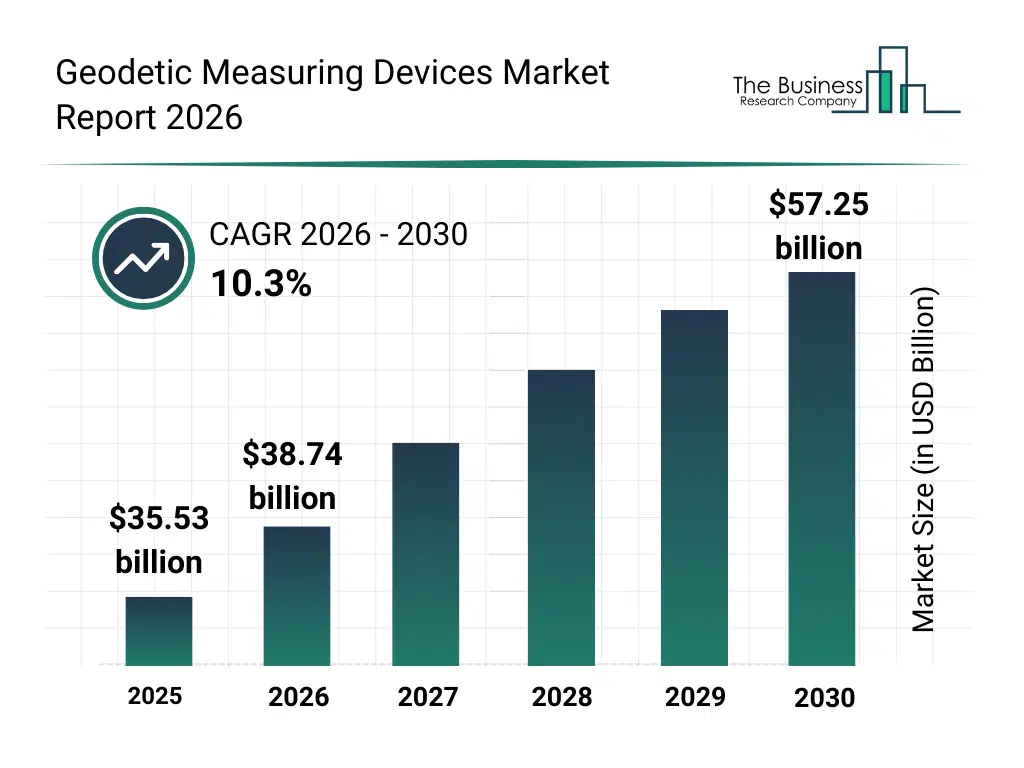
What Is The Geodetic Measuring Devices Market Size and Share 2026?
The geodetic measuring devices market size has grown strongly in recent years. It will grow from $35.53 billion in 2025 to $38.74 billion in 2026 at a compound annual growth rate (CAGR) of 9.0%. The growth in the historic period can be attributed to infrastructure development activities, growth in construction projects, demand for precise land surveying, adoption of digital mapping, expansion of civil engineering projects.What Is The Geodetic Measuring Devices Market Growth Forecast?
The geodetic measuring devices market size is expected to see rapid growth in the next few years. It will grow to $57.25 billion in 2030 at a compound annual growth rate (CAGR) of 10.3%. The growth in the forecast period can be attributed to smart city development, automation in surveying operations, increased use of 3d mapping, infrastructure digitization, demand for real-time monitoring. Major trends in the forecast period include adoption of robotic total stations, increased use of gnss-based surveying, integration of lidar in mapping, demand for real-time geospatial data, accuracy enhancement in construction surveys.Tariff Impact On Geodetic Measuring Devices Market
Tariffs are significantly impacting the geodetic measuring devices market by increasing the cost of imported optical lenses, laser modules, sensors, and electronic assemblies used in total stations, gnss receivers, and 3d scanners. Construction and infrastructure projects in North America and Europe are most affected due to dependence on imported precision instruments. Asia-Pacific faces cost pressure on exported surveying equipment. These tariffs are slowing procurement cycles and increasing project costs. However, they are encouraging regional manufacturing, technology localization, and development of competitively priced geospatial measurement solutions.
Global Geodetic Measuring Devices Market Segmentation
1) By Type: Total Stations, Levels, Global Navigation Satellite System Receivers, Other Types 2) By Technology: Global Navigation Satellite System (GNSS), Light Detection And Ranging (LiDAR), Photogrammetry, Remote Sensing 3) By Application: Civil Engineering, Mechanical Engineering, Construction, Geology, Other Applications Subsegments: 1) By Total Stations: Reflectorless Total Stations, Robotic Total Stations 2) By Levels: Automatic Levels, Digital Levels 3) By Global Navigation Satellite System (GNSS) Receivers: RTK GNSS Receivers, Static GNSS Receivers 4) By Other Types: Theodolites, Distance Measuring InstrumentsWhat Is The Driver Of The Geodetic Measuring Devices Market?
The growing demand for geological surveys is expected to propel the growth of the geodetic measuring devices market going forward. A geological survey systematically investigates the geology beneath a given piece of ground to create a geological map or model that employs techniques from the conventional walk-over survey, exploring outcrops and landforms, to invasive methods. Geodetic measuring devices are used in geological surveys to measure the position, elevation, and orientation of points on the Earth's surface and to create accurate maps and models of the Earth's surface, which can then be used to study the area's geology. For instance, in 2023, according to The United States Geological Survey, a US-based agency that understands natural resource conditions, issues, and problems, the United States Geological Survey (USGS) budget increased by 30.01% from $1,316 billion in 2022 to $1,711 billion in 2023 and estimates that staffing is 8,344 full-time equivalents (FTEs), with more than 8,000 scientists, technicians, and support personnel working for USGS at more than 400 facilities across the country. Further, the 2023 budget includes $147 million for Energy and Mineral Resources programs and $72.7 million for land management research. Therefore, the growing demand for geological surveys is expected to propel the growth of the geodetic measuring devices industry.Key Players In The Global Geodetic Measuring Devices Market
Major companies operating in the geodetic measuring devices market are Hexagon AB, Keller Group plc, Fugro N.V, Topcon Positioning Systems Inc., COWI A/S, FARO Technologies Inc., GaiaComm Ltd., RST Instruments Ltd., Roctest Ltd., Geodetic Systems Inc., GEOKON, Geocomp Corporation, GEODATA Group, Durham Geo Slope Indicator Inc., Measurand, Sherborne Sensors Ltd., Encardio-Rite Electronics Private Limited, GEONOR Inc., Geosense Ltd., Syscom Instruments SA, Canary Systems Inc., 3vGeomatics Inc., South Surveying & Mapping Instrument Co. Ltd., Mine Design Technologies Inc., Sisgeo Srl, NavStar Geomatics Ltd., Marmota Engineering AG, Nova Metrix LLC, Kolida Instrument Co. Ltd.
This chart is for illustrative purposes; the full report includes a detailed competitor analysis and comprehensive overview of the top 10 companies in the market.
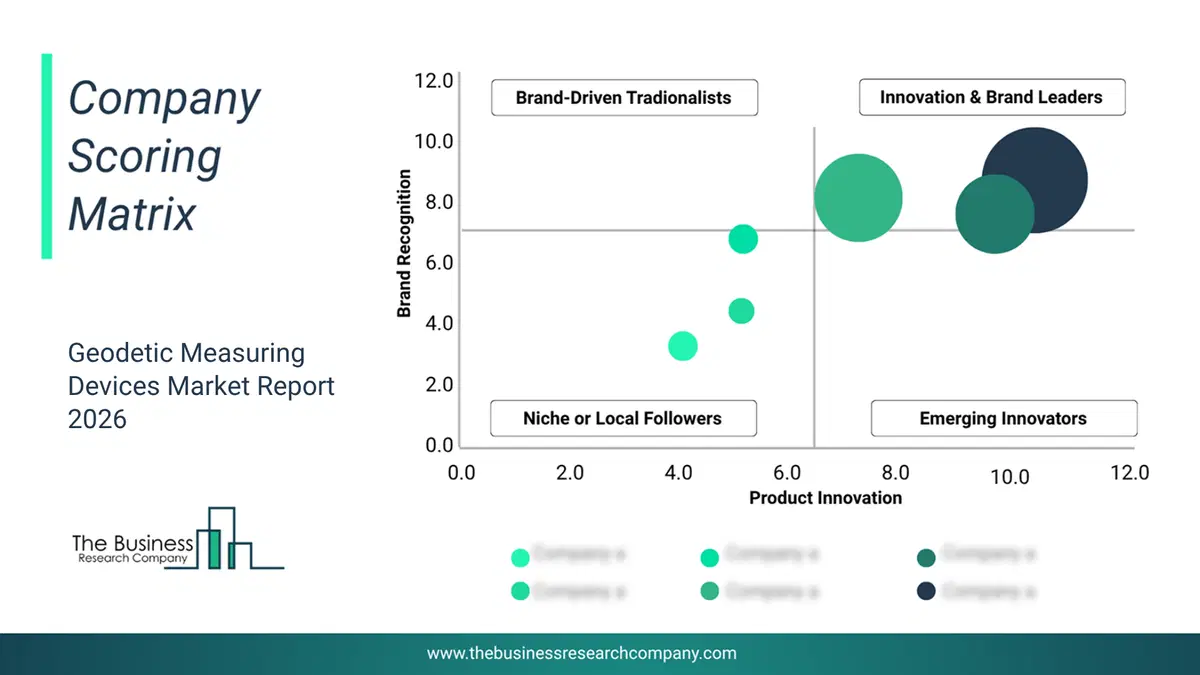
This chart maps companies by product innovation and brand strength, with bubble size indicating relative revenue, helping identify market leaders, challengers, and niche players. This is an illustrative chart; the full report provides a complete and accurate competitive analysis.
Global Geodetic Measuring Devices Market Trends and Insights
Major companies operating in the geodetic measuring devices market are focusing on incorporating hybrid sensor integration such as multi-constellation global navigation satellite system (GNSS) combined with inertial measurement unit (IMU) and laser ranging to enhance surveying efficiency and field resilience. Global navigation satellite system (GNSS) with IMU and laser is a method that combines satellite-based positioning, inertial motion sensing, and laser distance measurement to determine very accurate 3D coordinates even in challenging environments, enabling capabilities such as robust positioning, precise 3D data capture, and reliable operation where satellite signals may degrade. For instance, in August 2025, CHC Navigation, a China-based global geospatial-solutions provider, launched the i85 Laser IMU-RTK GNSS, a hybrid positioning receiver designed to improve high-efficiency surveying and 3D data capture in difficult field conditions, featuring a 1408-channel GNSS module, integrated IMU, and long-range laser rangefinder, plus dual-camera vision for clear target acquisition and up to 20-hour battery life. The i85 improves data collection productivity, reliability, and field flexibility, supporting more efficient surveying, mapping, and land-management workflows.What Are Latest Mergers And Acquisitions In The Geodetic Measuring Devices Market?
In May 2023, CBRE Group Inc, a US-based Real estate company, acquired Millman National Land Services for undisclosed amount. This acquisition of CBRE aim is to enhance its service offerings in commercial land surveying. By integrating Millman's capabilities, CBRE can provide American Land Title Association (ALTA) and National Society of Professional Surveyors (NSPS) survey services directly to clients. Millman National Land Services is a US-based commercial land surveying company, that utilizes geodetic measuring devices to deliver precise land surveying and boundary determination services.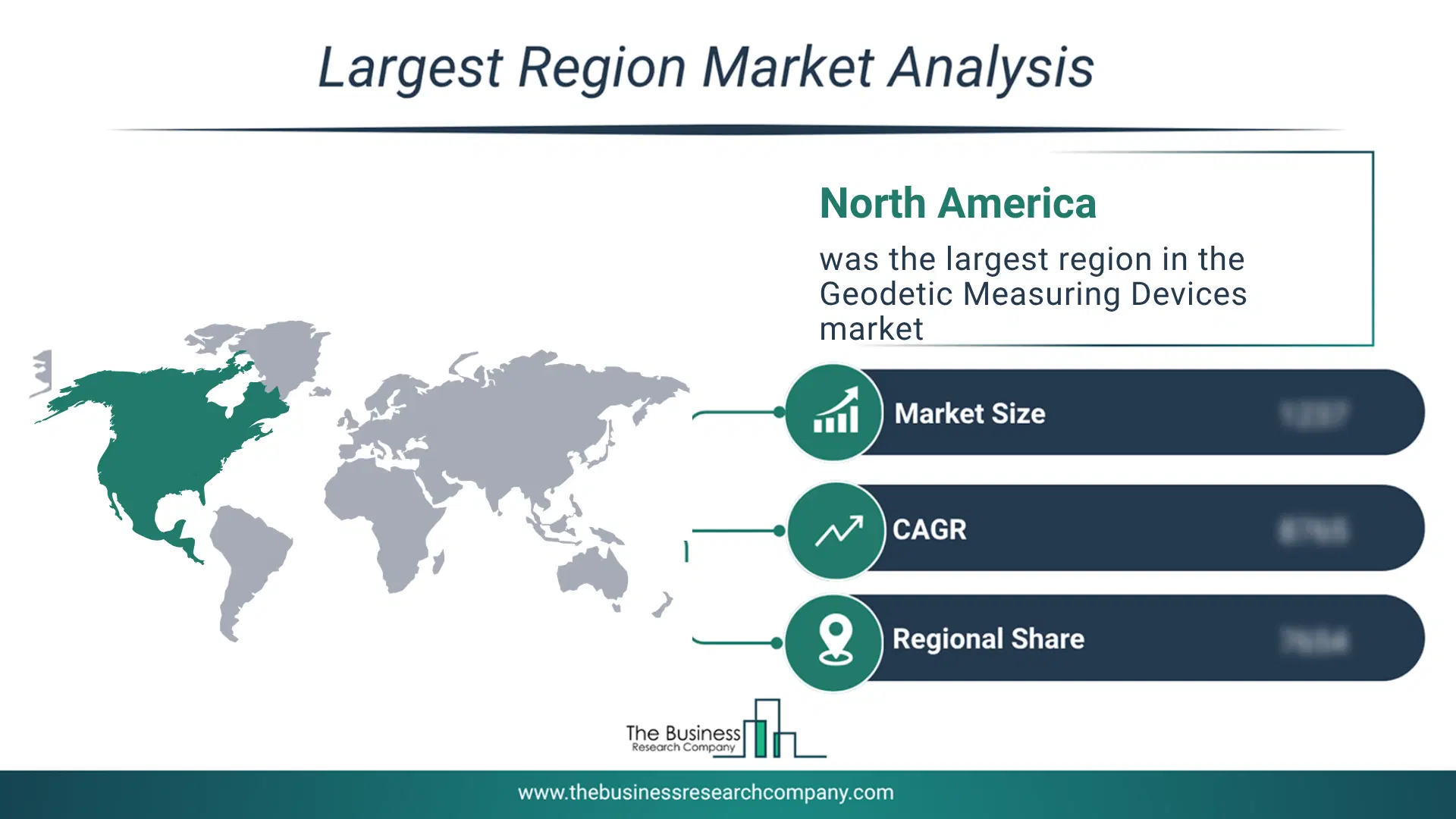
Regional Outlook
North America was the largest region in the geodetic measuring devices market in 2025. Asia-Pacific is expected to be the fastest-growing region in the forecast period. The regions covered in this market report are Asia-Pacific, South East Asia, Western Europe, Eastern Europe, North America, South America, Middle East, Africa The countries covered in this market report are Australia, Brazil, China, France, Germany, India, Indonesia, Japan, Taiwan, Russia, South Korea, UK, USA, Canada, Italy, Spain.What Defines the Geodetic Measuring Devices Market?
The geodetic measuring devices market consists of revenues earned by entities by providing services such as surveying, navigation, seismology, and deformation monitoring. The market value includes the value of related goods sold by the service provider or included within the service offering. The geodetic measuring devices market also includes sales of dumpy level, laser scanners, and theodolites. Values in this market are ‘factory gate’ values, that is the value of goods sold by the manufacturers or creators of the goods, whether to other entities (including downstream manufacturers, wholesalers, distributors and retailers) or directly to end customers. The value of goods in this market includes related services sold by the creators of the goods.How is Market Value Defined and Measured?
The market value is defined as the revenues that enterprises gain from the sale of goods and/or services within the specified market and geography through sales, grants, or donations in terms of the currency (in USD unless otherwise specified). The revenues for a specified geography are consumption values that are revenues generated by organizations in the specified geography within the market, irrespective of where they are produced. It does not include revenues from resales along the supply chain, either further along the supply chain or as part of other products.
This chart presents market attractiveness based on a quantitative evaluation of growth, competition, strategic alignment, and risk, offering a clear view of opportunity areas for decision-making. This chart is for illustrative purposes; the full report contains the complete analysis.

This chart highlights the Total Addressable Market (TAM) by estimating the maximum revenue opportunity using an assumption-driven approach, supporting strategic planning and opportunity sizing across markets. The chart is illustrative; the full report provides a more comprehensive analysis.
What Key Data and Analysis Are Included in the Geodetic Measuring Devices Market Report 2026?
The geodetic measuring devices market research report is one of a series of new reports from The Business Research Company that provides market statistics, including industry global market size, regional shares, competitors with the market share, detailed market segments, market trends and opportunities, and any further data you may need to thrive in the geodetic measuring devices industry. The market research report delivers a complete perspective of everything you need, with an in-depth analysis of the current and future state of the industry.Geodetic Measuring Devices Market Report Forecast Analysis
| Report Attribute | Details |
|---|---|
| Market Size Value In 2026 | $38.74 billion |
| Revenue Forecast In 2030 | $57.25 billion |
| Growth Rate | CAGR of 10.3% from 2026 to 2030 |
| Base Year For Estimation | 2025 |
| Actual Estimates/Historical Data | 2020-2025 |
| Forecast Period | 2026 - 2030 |
| Market Representation | Revenue in USD Billion and CAGR from 2026 to 2030 |
| Segments Covered | Type, Technology, Application |
| Regional Scope | Asia-Pacific, Western Europe, Eastern Europe, North America, South America, Middle East, Africa |
| Key Companies Profiled | Hexagon AB, Keller Group plc, Fugro N.V, Topcon Positioning Systems Inc., COWI A/S, FARO Technologies Inc., GaiaComm Ltd., RST Instruments Ltd., Roctest Ltd., Geodetic Systems Inc., GEOKON, Geocomp Corporation, GEODATA Group, Durham Geo Slope Indicator Inc., Measurand, Sherborne Sensors Ltd., Encardio-Rite Electronics Private Limited, GEONOR Inc., Geosense Ltd., Syscom Instruments SA, Canary Systems Inc., 3vGeomatics Inc., South Surveying & Mapping Instrument Co. Ltd., Mine Design Technologies Inc., Sisgeo Srl, NavStar Geomatics Ltd., Marmota Engineering AG, Nova Metrix LLC, Kolida Instrument Co. Ltd. |
| Customization Scope | Request for Customization |
| Pricing And Purchase Options | Explore Purchase Options |