
Geofencing Market Report 2026
Global Outlook – By Geofencing Type (Fixed Geofencing, Mobile Geofencing), By Component (Solution, Services), By Technology (Active Geofencing, Passive Geofencing ), By Enterprise Size (Small And Medium-Sized Enterprises, Large Enterprises), By Industry Vertical (Transportation And Logistics, Retail, Healthcare And Life Sciences, Industrial Manufacturing, Media And Entertainment, Government And Defense, Banking Financial Services and Insurance (BFSI), Other Industry Verticals) – Market Size, Trends, Strategies, and Forecast to 2030
Geofencing Market Overview
• Geofencing market size has reached to $3.39 billion in 2025 • Expected to grow to $8.82 billion in 2030 at a compound annual growth rate (CAGR) of 20.3% • Growth Driver: Mobile Device Penetration Driving The Geofencing Market Growth • Market Trend: Increasing Focus On Enhancing Cybersecurity Offerings With Geofencing Capabilities • North America was the largest region in 2025 and Asia-Pacific is the fastest growing region.What Is Covered Under Geofencing Market?
Geofencing refers to a location-based technology that creates virtual boundaries, enabling automated actions or notifications when a device enters or exits a specified geographical area. Geofencing is commonly used in location-based marketing and advertising to deliver personalized messages and promotions to users based on their proximity to a particular location. The main types of geofencing are fixed geofencing and mobile geofencing. Fixed geofencing involves establishing permanent virtual boundaries around specific geographic areas, such as retail stores, airports, or construction sites. It has various components, including solutions and services, and can be operated by technologies, including active geofencing and passive geofencing. It can be used in various enterprise sizes, such as small and medium-sized enterprises and large enterprises, of various industry verticals, including transportation and logistics, retail, healthcare and life sciences, industrial manufacturing, media and entertainment, government and defense, banking financial services and insurance (BFSI), and others.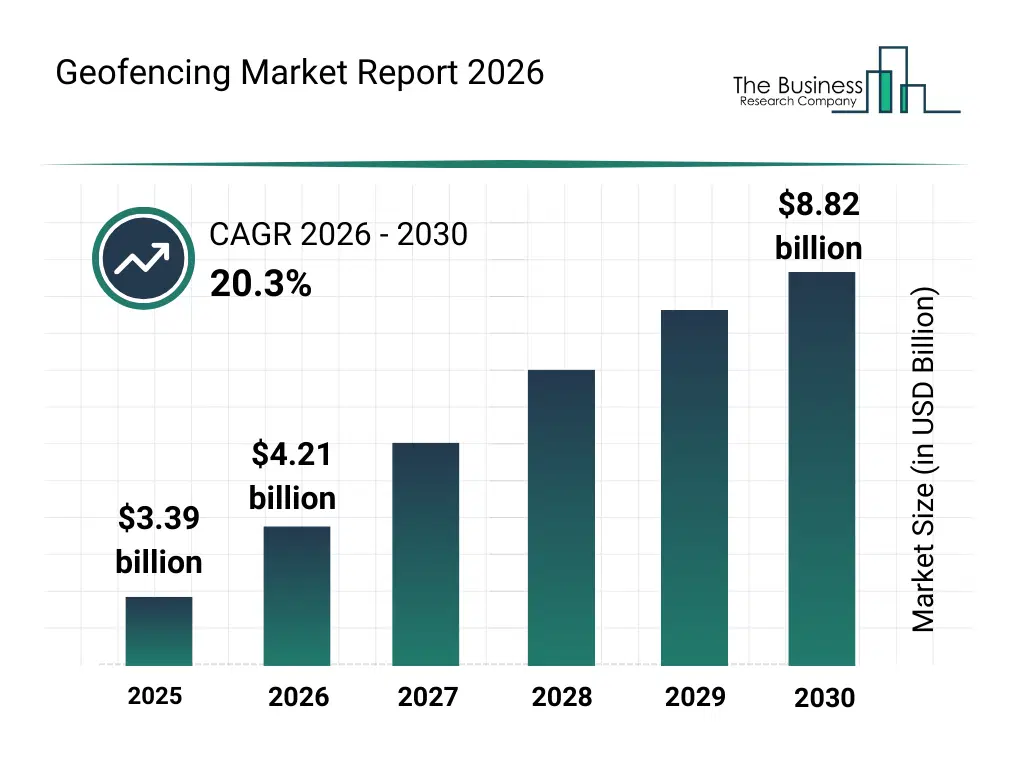
What Is The Geofencing Market Size and Share 2026?
The geofencing market size has grown exponentially in recent years. It will grow from $3.39 billion in 2025 to $4.21 billion in 2026 at a compound annual growth rate (CAGR) of 24.1%. The growth in the historic period can be attributed to growth in mobile device penetration, increasing use of location services, early adoption in marketing applications, rising demand for customer engagement tools, expansion of digital advertising practices.What Is The Geofencing Market Growth Forecast?
The geofencing market size is expected to see exponential growth in the next few years. It will grow to $8.82 billion in 2030 at a compound annual growth rate (CAGR) of 20.3%. The growth in the forecast period can be attributed to growing reliance on precision-based location systems, rising enterprise focus on targeted communication, increasing adoption across logistics and transportation, expanding smart infrastructure ecosystem, strengthening digital transformation initiatives. Major trends in the forecast period include growing use of location-based targeting, rising adoption in retail engagement strategies, increasing utilization in security and monitoring, expansion of personalized proximity marketing, strengthening use in enterprise mobility solutions.
Global Geofencing Market Segmentation
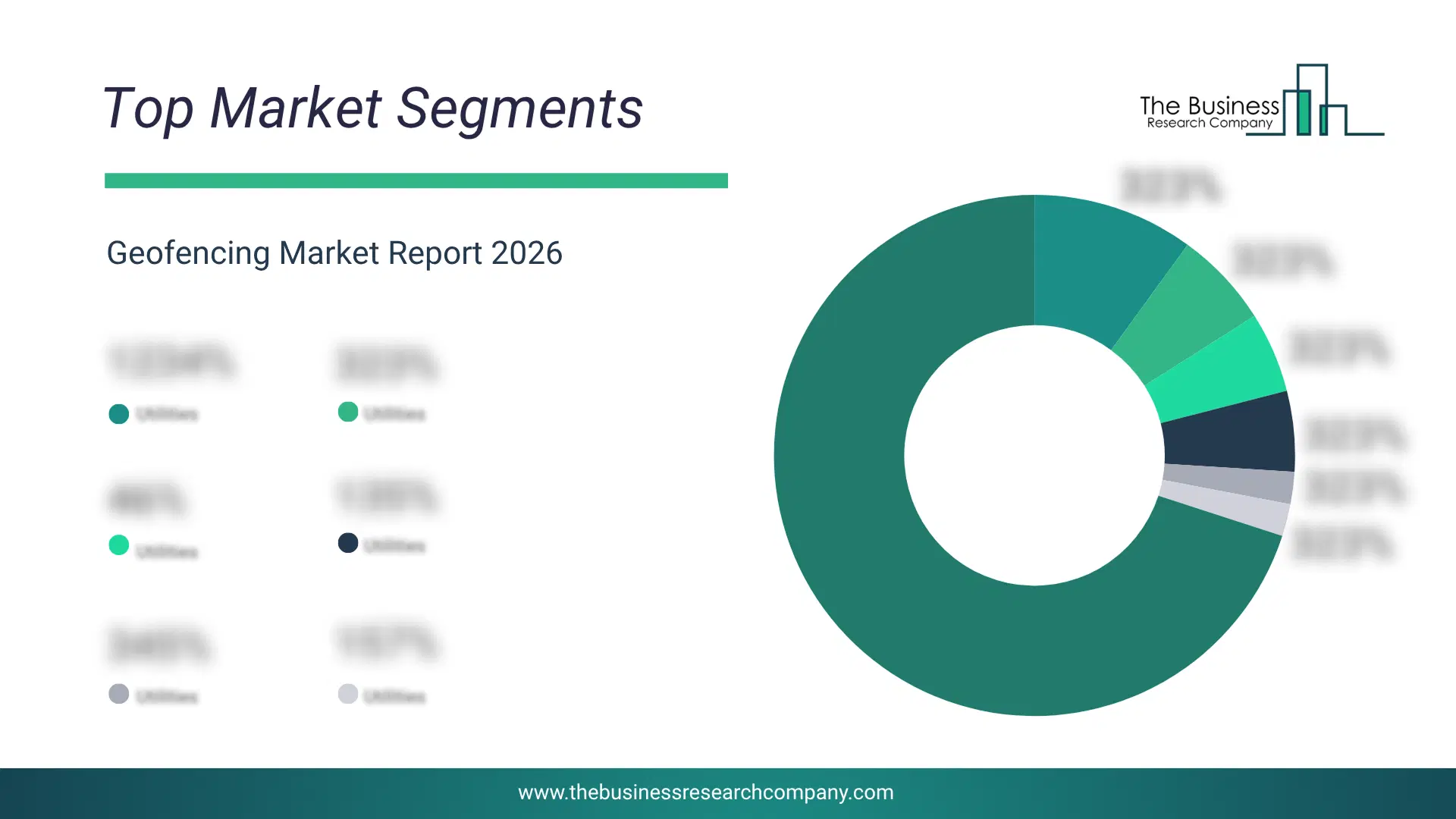
1) By Geofencing Type: Fixed Geofencing, Mobile Geofencing 2) By Component: Solution, Services 3) By Technology: Active Geofencing, Passive Geofencing 4) By Enterprise Size: Small And Medium-Sized Enterprises, Large Enterprises 5) By Industry Vertical: Transportation And Logistics, Retail, Healthcare And Life Sciences, Industrial Manufacturing, Media And Entertainment, Government And Defense, Banking Financial Services and Insurance (BFSI), Other Industry Verticals Subsegments: 1) By Fixed Geofencing: Perimeter Geofencing, Radius Geofencing, Polygon Geofencing 2) By Mobile Geofencing: GPS-Based Geofencing, Bluetooth-Based Geofencing, Wi-Fi-Based GeofencingWhat Is The Driver Of The Geofencing Market?
The growth in mobile device penetration is expected to propel the growth of the geofencing market going forward. A mobile device refers to a portable electronic gadget designed for wireless communication and transmitting data wirelessly. Mobile device penetration is increasing due to the popularity of social media platforms and messaging apps, the growth of e-commerce, and affordable data plans and tariffs. Geofencing utilizes mobile device GPS (Global Positioning System) hardware and software to create location-aware applications and integrate with apps for customized notifications and actions based on predefined geographic areas. For instance, in October 2023, according to the International Telecommunication Union (ITU), a Switzerland-based United Nations agency, in 2023, there were 111 mobile-cellular and 87 mobile-broadband subscriptions per 100 people. Over five years, mobile-broadband grew 27%, far outpacing the 7% growth in mobile-cellular services. Therefore, the growth in mobile device penetration is driving the growth of the geofencing industry.Key Players In The Global Geofencing Market
Major companies operating in the geofencing market report are Apple Inc, Google Plc, Microsoft Corporation, Verizon Communications Inc, AT&T Inc, Huawei Technologies Co. Ltd, T-Mobile US Inc, Intel Corporation, International Business Machines Corporation (IBM), Cisco Systems Inc, Oracle Corporation, Xiaomi Corporation, Qualcomm Incorporated, Honeywell International Inc, SAP SE, Ericsson AB, Nokia Corporation, Embratel, Esri, Upland Localytics, Embitel, Bluedot Innovation, Mobinius Technologies, Pulsate Ltd.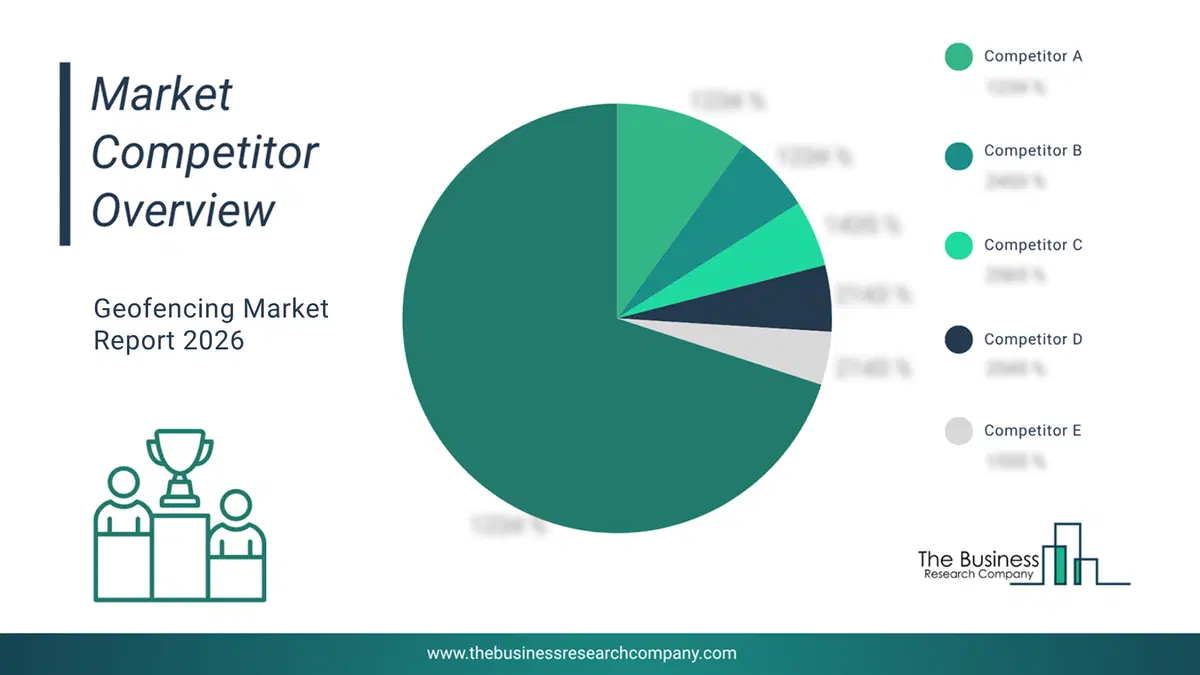
This chart is for illustrative purposes; the full report includes a detailed competitor analysis and comprehensive overview of the top 10 companies in the market.
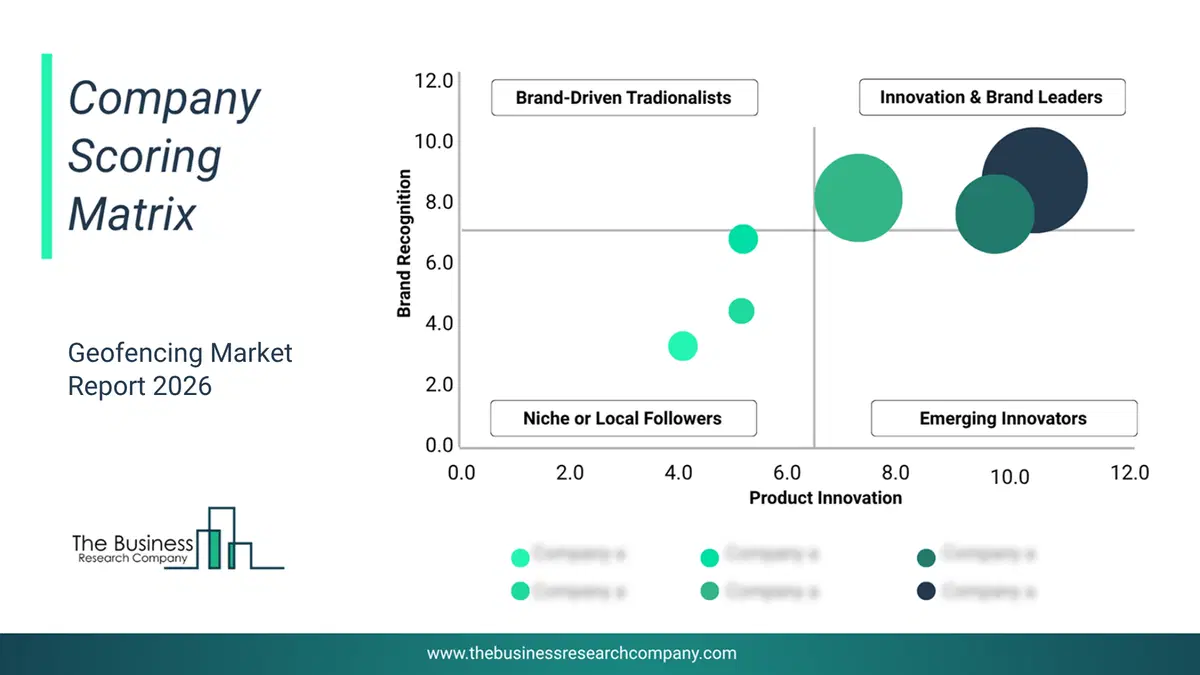
This chart maps companies by product innovation and brand strength, with bubble size indicating relative revenue, helping identify market leaders, challengers, and niche players. This is an illustrative chart; the full report provides a complete and accurate competitive analysis.
Global Geofencing Market Trends and Insights
Major companies operating in the geofencing market are focusing on developing advanced solutions such as geofencing capabilities to enhance cybersecurity offerings for managed service providers. Geofencing capabilities refer to the functionalities within a system or application that allow users to define virtual boundaries or geographic areas. These boundaries are then used to trigger actions or notifications when a mobile device enters or exits the specified area. For instance, in March 2024, Trustifi LLC, a US-based cyber security company, launched geofencing capabilities in Australia to provide increased security solutions. This innovative geofencing approach enhances data security by limiting geographical data transmission, particularly in sensitive sectors like healthcare, finance, and legal sectors. Trustifi's geofencing feature ensures that personal data is maintained locally, meets compliance standards, and protects sensitive information by establishing virtual boundaries that restrict data transit geographically.What Are Latest Mergers And Acquisitions In The Geofencing Market?
In April 2024, EYSA Group, a Spain-based IT services and consulting company, acquired Net4things for an undisclosed amount. This acquisition enhances EYSA's capabilities in smart mobility services, enabling improved traffic management and supporting environmental initiatives in urban areas within Spain and internationally. Net4things is a Spain-based software development company that specializes in developing advanced solutions for managing connected vehicle data and IoT applications.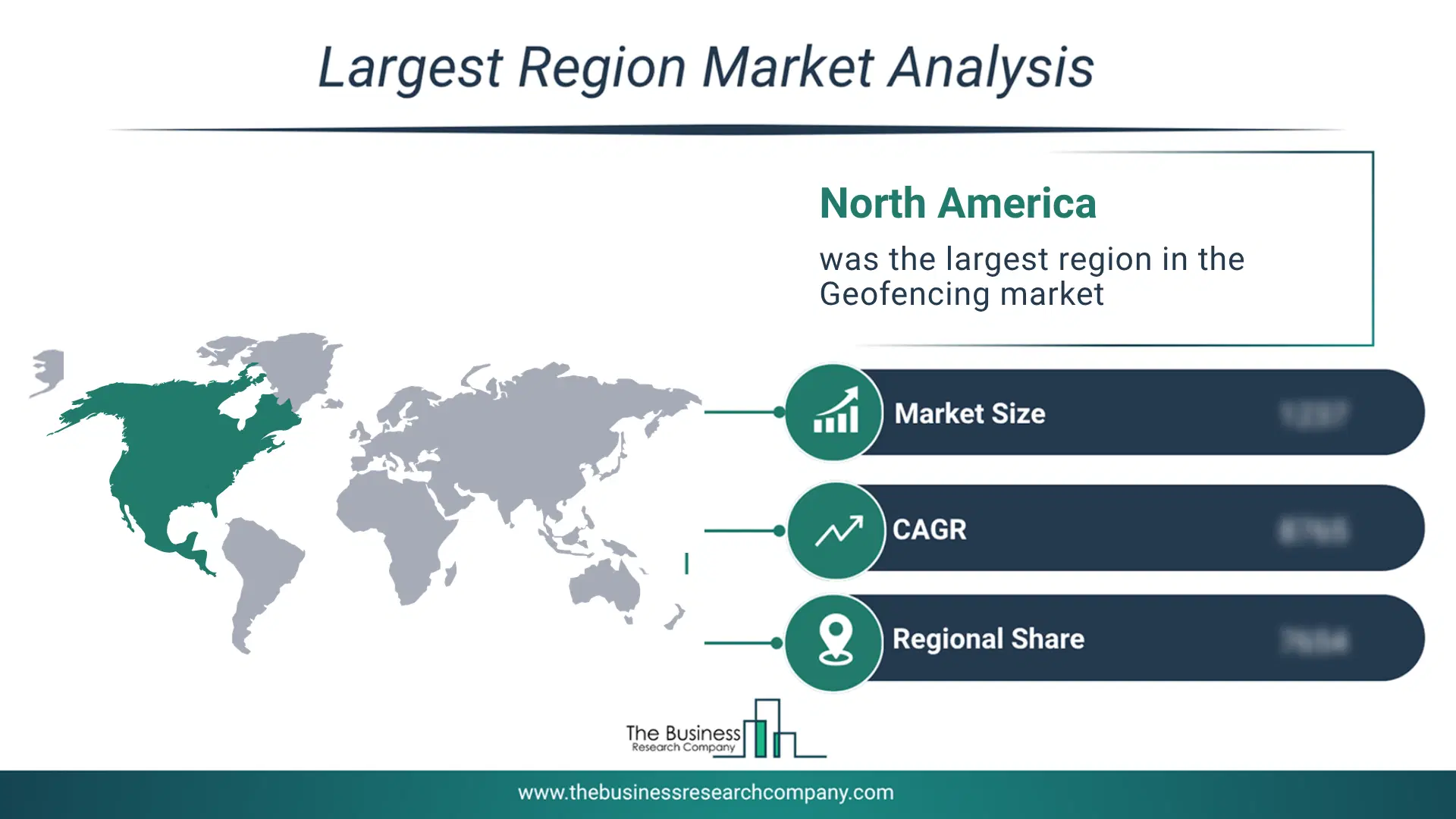
Regional Outlook
North America was the largest region in the geofencing market in 2025. Asia-Pacific is expected to be the fastest-growing region in the forecast period. The regions covered in this market report are Asia-Pacific, South East Asia, Western Europe, Eastern Europe, North America, South America, Middle East, Africa. The countries covered in this market report are Australia, Brazil, China, France, Germany, India, Indonesia, Japan, Taiwan, Russia, South Korea, UK, USA, Canada, Italy, SpainWhat Defines the Geofencing Market?
The geofencing market includes revenues earned by entities by providing services such as geotargeted promotions, real-time location tracking services, fleet management solutions, and emergency alerts. The market value includes the value of related goods sold by the service provider or included within the service offering. Only goods and services traded between entities or sold to end consumers are included.How is Market Value Defined and Measured?
The market value is defined as the revenues that enterprises gain from the sale of goods and/or services within the specified market and geography through sales, grants, or donations in terms of the currency (in USD unless otherwise specified). The revenues for a specified geography are consumption values that are revenues generated by organizations in the specified geography within the market, irrespective of where they are produced. It does not include revenues from resales along the supply chain, either further along the supply chain or as part of other products.
This chart presents market attractiveness based on a quantitative evaluation of growth, competition, strategic alignment, and risk, offering a clear view of opportunity areas for decision-making. This chart is for illustrative purposes; the full report contains the complete analysis.

This chart highlights the Total Addressable Market (TAM) by estimating the maximum revenue opportunity using an assumption-driven approach, supporting strategic planning and opportunity sizing across markets. The chart is illustrative; the full report provides a more comprehensive analysis.
What Key Data and Analysis Are Included in the Geofencing Market Report 2026?
The geofencing market research report is one of a series of new reports from The Business Research Company that provides market statistics, including industry global market size, regional shares, competitors with the market share, detailed market segments, market trends and opportunities, and any further data you may need to thrive in the geofencing industry. The market research report delivers a complete perspective of everything you need, with an in-depth analysis of the current and future state of the industry.Geofencing Market Report Forecast Analysis
| Report Attribute | Details |
|---|---|
| Market Size Value In 2026 | $4.21 billion |
| Revenue Forecast In 2030 | $8.82 billion |
| Growth Rate | CAGR of 24.1% from 2026 to 2030 |
| Base Year For Estimation | 2025 |
| Actual Estimates/Historical Data | 2020-2025 |
| Forecast Period | 2026 - 2030 - 2030 |
| Market Representation | Revenue in USD Billion and CAGR from 2026 to 2030 |
| Segments Covered | Geofencing Type, Component, Technology, Enterprise Size, Industry Vertical |
| Regional Scope | Asia-Pacific, Western Europe, Eastern Europe, North America, South America, Middle East, Africa |
| Country Scope | The countries covered in the report are Australia, Brazil, China, France, Germany, India, Indonesia, Japan, Taiwan, Russia, South Korea, UK, USA, Canada, Italy, Spain. |
| Key Companies Profiled | Apple Inc, Google Plc, Microsoft Corporation, Verizon Communications Inc, AT&T Inc, Huawei Technologies Co. Ltd, T-Mobile US Inc, Intel Corporation, International Business Machines Corporation (IBM), Cisco Systems Inc, Oracle Corporation, Xiaomi Corporation, Qualcomm Incorporated, Honeywell International Inc, SAP SE, Ericsson AB, Nokia Corporation, Embratel, Esri, Upland Localytics, Embitel, Bluedot Innovation, Mobinius Technologies, Pulsate Ltd. |
| Customization Scope | Request for Customization |
| Pricing And Purchase Options | Explore Purchase Options |