
Geospatial Analytics Market Report 2026
Global Outlook – By Components (Solutions, Services), By Type (Surface And Field Analytics, Network And Location Analytics, Geovisualization, Other Types), By Technology (Remote Sensing, GIS, GPS, Other Technologies), By Application (Surveying, Medicine And Public Safety, Disaster Risk Reduction And Management, Climate Change Adaptation, Other Applications), By End-User Industry (Agriculture, Utility And Communication, Defense And Intelligence, Government, Natural Resources, Other End User Industries) – Market Size, Trends, Strategies, and Forecast to 2030
Geospatial Analytics Market Overview
• Geospatial Analytics market size has reached to $103.75 billion in 2025 • Expected to grow to $243.83 billion in 2030 at a compound annual growth rate (CAGR) of 18.7% • Growth Driver: Digital Transformation Propelling Geospatial Analytics Market • Market Trend: Software Innovation Drives Geospatial Analytics Growth • North America was the largest region in 2025 and Asia-Pacific is the fastest growing region.What Is Covered Under Geospatial Analytics Market?
Geospatial analytics is a technology that gathers, display, and manipulate geographic information using a geographic information system (GIS) to manage and predict the phenomenon and affecting the earth and its inhabitants. The main types of components in geospatial analytics are solutions and services. The geospatial analytic solutions help to analyze businesses for changing conditions and trends. These include geocoding, data integration and ETL, data storage software, reporting and visualization, and thematic mapping and spatial analysis. The different types include surface and field analytics, network and location analytics, geo-visualization, and others. The various application includes surveying, medicine, public safety, disaster risk reduction and management, climate change adaptation, and others. The different technologies include remote sensing, GIS, GPS, and others and are implemented in various areas such as agriculture, utility and communication, defense and intelligence, government, natural resources, and others.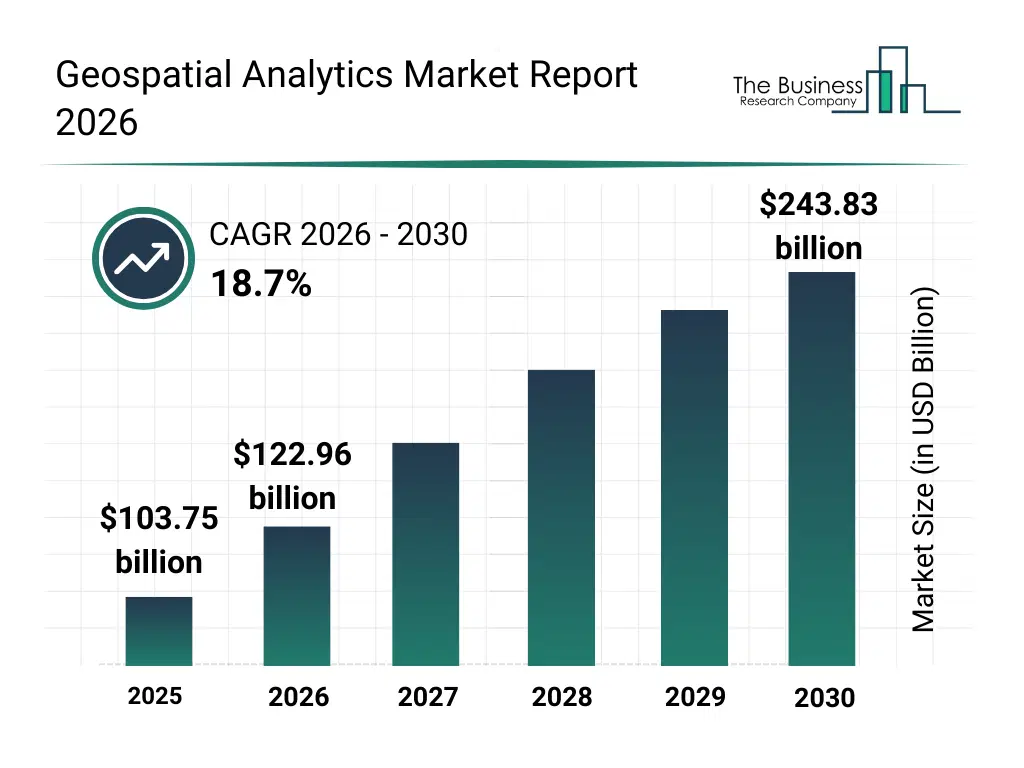
What Is The Geospatial Analytics Market Size and Share 2026?
The geospatial analytics market size has grown rapidly in recent years. It will grow from $103.75 billion in 2025 to $122.96 billion in 2026 at a compound annual growth rate (CAGR) of 18.5%. The growth in the historic period can be attributed to adoption of gis technologies, growth of satellite imaging, demand for spatial data analysis, government mapping initiatives, expansion of gps usage.What Is The Geospatial Analytics Market Growth Forecast?
The geospatial analytics market size is expected to see rapid growth in the next few years. It will grow to $243.83 billion in 2030 at a compound annual growth rate (CAGR) of 18.7%. The growth in the forecast period can be attributed to smart city planning demand, climate monitoring requirements, growth of autonomous navigation, integration of AI with gis, increasing use of real time spatial data. Major trends in the forecast period include AI driven spatial analysis, real time location intelligence, satellite and remote sensing analytics, geospatial visualization platforms, predictive location based insights.
Global Geospatial Analytics Market Segmentation
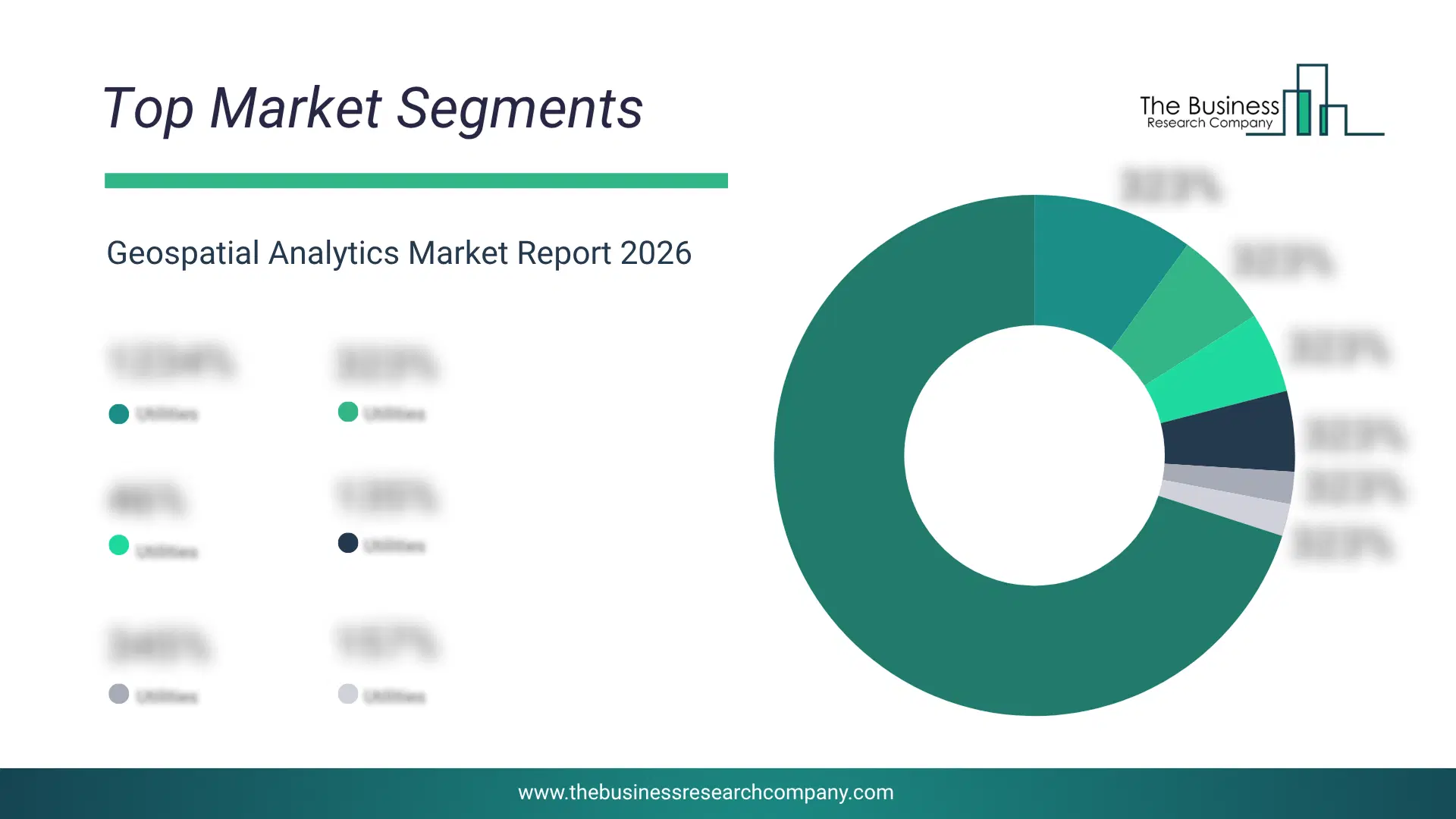
1) By Components: Solutions, Services 2) By Type: Surface And Field Analytics, Network And Location Analytics, Geovisualization, Other Types 3) By Technology: Remote Sensing, GIS, GPS, Other Technologies 4) By Application: Surveying, Medicine And Public Safety, Disaster Risk Reduction And Management, Climate Change Adaptation, Other Applications 5) By End-User Industry: Agriculture, Utility And Communication, Defense And Intelligence, Government, Natural Resources, Other End User Industries Subsegments: 1) By Solutions: Software, Platforms, Tools 2) By Services: Consulting, Implementation, Support And MaintenanceWhat Is The Driver Of The Geospatial Analytics Market?
Increasing digital transformation is expected to propel the growth of the geospatial analytics market going forward. Digital transformation refers to the integration of digital technologies into various aspects of an organization's operations, processes, and activities to fundamentally change the way it operates and delivers value to its stakeholders. Digital transformation empowers geospatial analytics by providing the tools and infrastructure needed to extract meaningful insights from spatial data, ultimately leading to more informed decision-making and improved operational efficiency. For instance, in September 2024, according to a Backlinko Digital Transformation Statistics, a US-based statistics, digital transformation spending reached $2.5 trillion in 2024 and is set to reach $3.9 trillion by 2027. Therefore, increasing digital transformation is driving the growth of the geospatial analytics industry.Key Players In The Global Geospatial Analytics Market
Major companies operating in the geospatial analytics market are Esri; Hexagon AB; Trimble Inc.; Google LLC; IBM Corporation; Microsoft Corporation; TomTom International BV; HERE Technologies; Bentley Systems Incorporated; Alteryx Inc.; Maxar Technologies; RMSI Pvt. Ltd.; TIBCO Software Inc.; Orbital Insight Inc.; CARTO; Pitney Bowes Inc.; DigitalGlobe Inc.; Precisely; GeoIQ; Mapbox Inc.; Fugro N.V.; Critigen LLC; Blue Marble Geographics; AAM Pty Ltd; TerraGo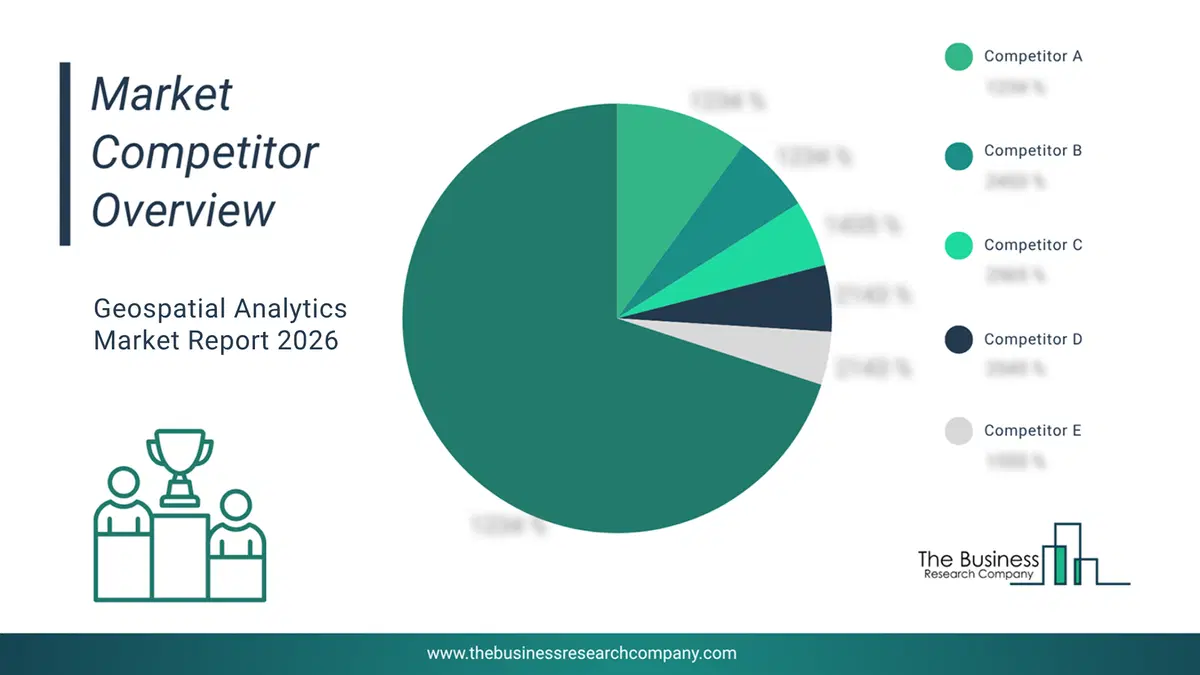
This chart is for illustrative purposes; the full report includes a detailed competitor analysis and comprehensive overview of the top 10 companies in the market.
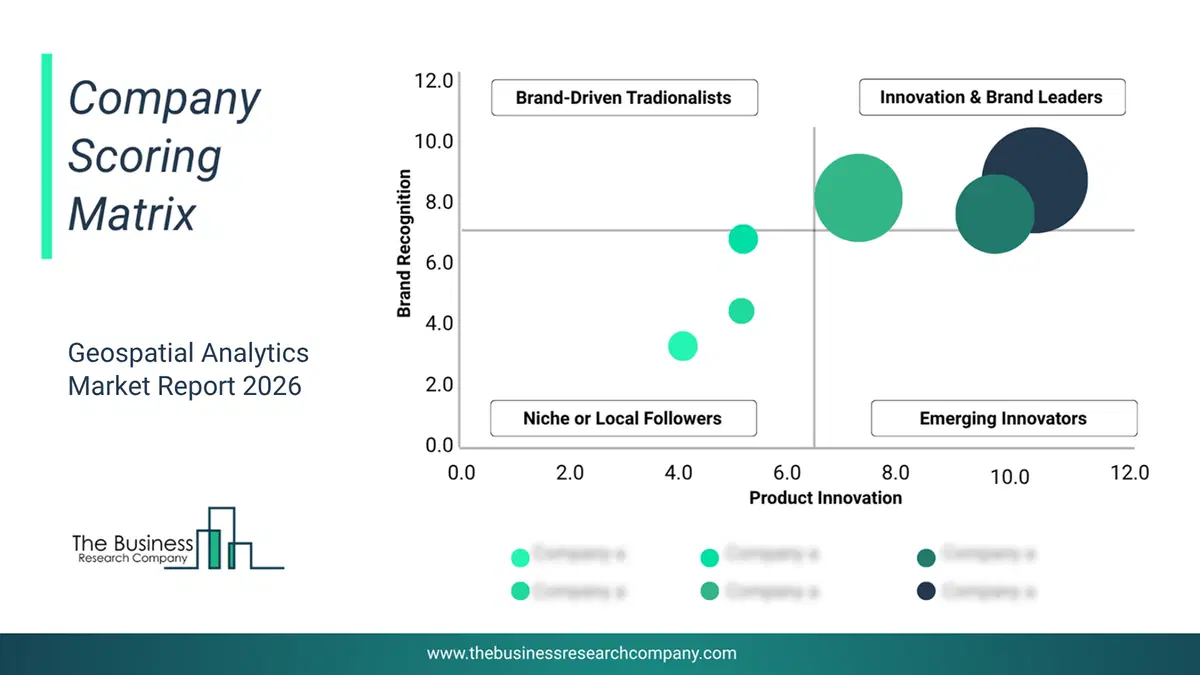
This chart maps companies by product innovation and brand strength, with bubble size indicating relative revenue, helping identify market leaders, challengers, and niche players. This is an illustrative chart; the full report provides a complete and accurate competitive analysis.
Global Geospatial Analytics Market Trends and Insights
Major companies operating in the geospatial analytics market are launching new software such as geospatial production software to increase their profitability in the market. Geospatial production software in geospatial analytics refers to a set of tools and applications designed to process, analyze, and visualize spatial data. For instance, in March 2023, Mach9 Robotics Inc., a US-based geospatial solution provider launched revolutionary software platform that generates 2D and 3D maps using mobile LiDAR technology at a staggering 30 times the speed of current solutions. By employing AI and computer vision, the platform swiftly transforms massive-scale LiDAR data into high-quality engineering models, offering a significant cost advantage. This accelerates the production of CAD and GIS deliverables, enabling engineering and construction organizations to focus on strategic planning rather than tedious data processing. The result is enhanced accessibility to top-notch maps and actionable data for efficient infrastructure management.What Are Latest Mergers And Acquisitions In The Geospatial Analytics Market?
In January 2025, Moody’s Corporation, a US-based provider of financial intelligence, acquired CAPE Analytics for an undisclosed amount. With this acquisition, Moody’s aimed to integrate CAPE’s advanced geospatial AI analytics with its Intelligent Risk Platform to enhance property-specific risk insights for the insurance and financial services sectors. CAPE Analytics is a US-based company specializing in geospatial analytics.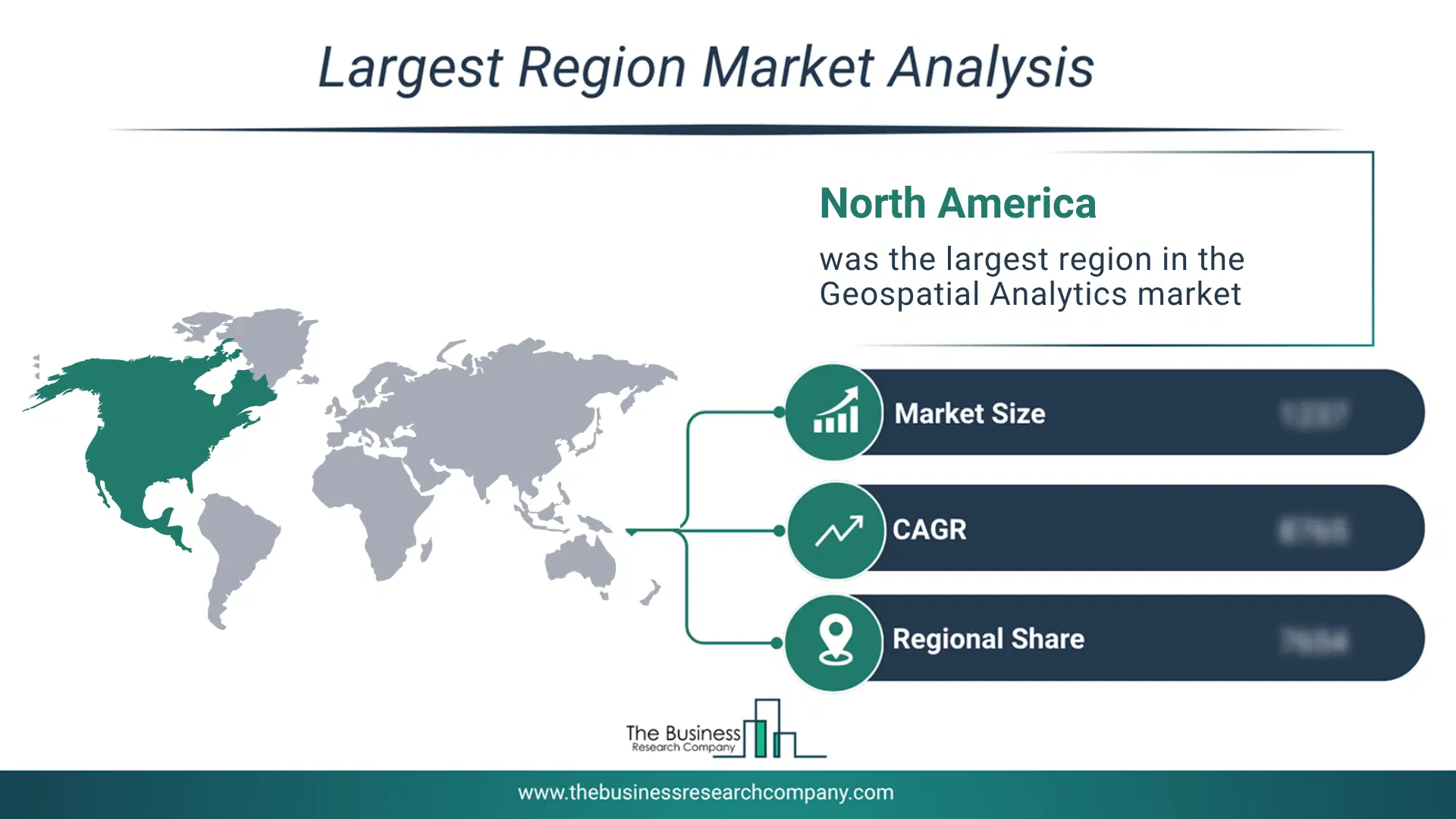
Regional Insights
North America was the largest region in the geospatial analytics market in 2025. Asia-Pacific is expected to be the fastest-growing region in the forecast period. The regions covered in this market report are Asia-Pacific, South East Asia, Western Europe, Eastern Europe, North America, South America, Middle East, Africa. The countries covered in this market report are Australia, Brazil, China, France, Germany, India, Indonesia, Japan, Taiwan, Russia, South Korea, UK, USA, Canada, Italy, SpainWhat Defines the Geospatial Analytics Market?
The geospatial analytics market includes revenues earned by entities by providing solutions that understand, analyze, and derive insights from geographic information system (GIS) data and imagery including GPS and satellite photographs by creating geographic models and real-time data visualizations for more accurate modeling and predictions of trends. The market value includes the value of related goods sold by the service provider or included within the service offering. Only goods and services traded between entities or sold to end consumers are included.How is Market Value Defined and Measured?
The market value is defined as the revenues that enterprises gain from the sale of goods and/or services within the specified market and geography through sales, grants, or donations in terms of the currency (in USD unless otherwise specified). The revenues for a specified geography are consumption values that are revenues generated by organizations in the specified geography within the market, irrespective of where they are produced. It does not include revenues from resales along the supply chain, either further along the supply chain or as part of other products.
This chart presents market attractiveness based on a quantitative evaluation of growth, competition, strategic alignment, and risk, offering a clear view of opportunity areas for decision-making. This chart is for illustrative purposes; the full report contains the complete analysis.

This chart highlights the Total Addressable Market (TAM) by estimating the maximum revenue opportunity using an assumption-driven approach, supporting strategic planning and opportunity sizing across markets. The chart is illustrative; the full report provides a more comprehensive analysis.
What Key Data and Analysis Are Included in the Geospatial Analytics Market Report 2026?
The geospatial analytics market research report is one of a series of new reports from The Business Research Company that provides market statistics, including industry global market size, regional shares, competitors with the market share, detailed market segments, market trends and opportunities, and any further data you may need to thrive in the geospatial analytics industry. The market research report delivers a complete perspective of everything you need, with an in-depth analysis of the current and future state of the industry.Geospatial Analytics Market Report Forecast Analysis
| Report Attribute | Details |
|---|---|
| Market Size Value In 2026 | $122.96 billion |
| Revenue Forecast In 2030 | $243.83 billion |
| Growth Rate | CAGR of 18.7% from 2026 to 2030 |
| Base Year For Estimation | 2025 |
| Actual Estimates/Historical Data | 2020-2025 |
| Forecast Period | 2026 - 2030 |
| Market Representation | Revenue in USD Billion and CAGR from 2026 to 2030 |
| Segments Covered | Components, Type, Technology, Application, End-User Industry |
| Regional Scope | Asia-Pacific, Western Europe, Eastern Europe, North America, South America, Middle East, Africa |
| Country Scope | The Countries Covered In This Market Report Are Australia, Brazil, China, France, Germany, India, Indonesia, Japan, Taiwan, Russia, South Korea, Uk, Usa, Canada, Italy, Spain. |
| Key Companies Profiled | Esri, Hexagon AB, Trimble Inc., Google LLC, IBM Corporation, Microsoft Corporation, TomTom International BV, HERE Technologies, Bentley Systems Incorporated, Alteryx Inc., Maxar Technologies, RMSI Pvt. Ltd., TIBCO Software Inc., Orbital Insight Inc., CARTO, Pitney Bowes Inc., DigitalGlobe Inc., Precisely, GeoIQ, Mapbox Inc., Fugro N.V., Critigen LLC, Blue Marble Geographics, AAM Pty Ltd, TerraGo |
| Customization Scope | Request for Customization |
| Pricing And Purchase Options | Explore Purchase Options |