
Geostationary Earth Orbit (GEO) Satellite Communications Market Report 2026
Global Outlook – By Service Model (Fixed Satellite Services, Mobile Satellite Services, Broadcast Satellite Services, Managed Satellite Communication Services), By Satellite Type (Conventional Communication Satellites, High Throughput Satellites, Very High Throughput Satellites, Software Defined Satellites), By Frequency Band (L Band, S Band, C Band, X Band, Ku Band, Ka Band), By End User (Commercial, Government And Civil, Defense And Military, Media And Broadcasting Companies, Telecommunications Service Providers, Maritime Operators) – Market Size, Trends, Strategies, and Forecast to 2035
Geostationary Earth Orbit (GEO) Satellite Communications Market Overview
• Geostationary Earth Orbit (GEO) Satellite Communications market size has reached to $22.32 billion in 2025 • Expected to grow to $36.91 billion in 2030 at a compound annual growth rate (CAGR) of 10.5% • Growth Driver: Increasing Demand For Global Broadband Connectivity Fueling The Growth Of The Market Due To Rising Need For Wide-area And Reliable Satellite Broadband Services • Market Trend: Advancements In High-Capacity Secure Satellites For Enhanced Connectivity, Coverage Flexibility, And Interference Resilience • North America was the largest region in 2025 and Asia-Pacific is the fastest growing region.What Is Covered Under Geostationary Earth Orbit (GEO) Satellite Communications Market?
Geostationary earth orbit (GEO) satellite communications refers to communication services delivered through satellites operating in geostationary orbit, approximately 35,786 kilometers above the Earth's equator, where they remain fixed over a specific geographic location. Their primary use is to enable television broadcasting, telecommunications, broadband connectivity, government and defense communications, and maritime and aviation connectivity across large geographic regions. The main service models of geostationary earth orbit (GEO) satellite communications include fixed satellite services, mobile satellite services, broadcast satellite services, and managed satellite communication services. Fixed satellite services provide communication links between fixed earth stations through satellites, supporting reliable transmission of voice, data, and video signals. These communications are provided through conventional communication satellites, high throughput satellites, very high throughput satellites, and software defined satellites. These operate across L band, S band, C band, X band, Ku band, and Ka band frequencies, are serving end users including among commercial, government and civil, defense and military, media and broadcasting companies, telecommunications service providers, and maritime operators.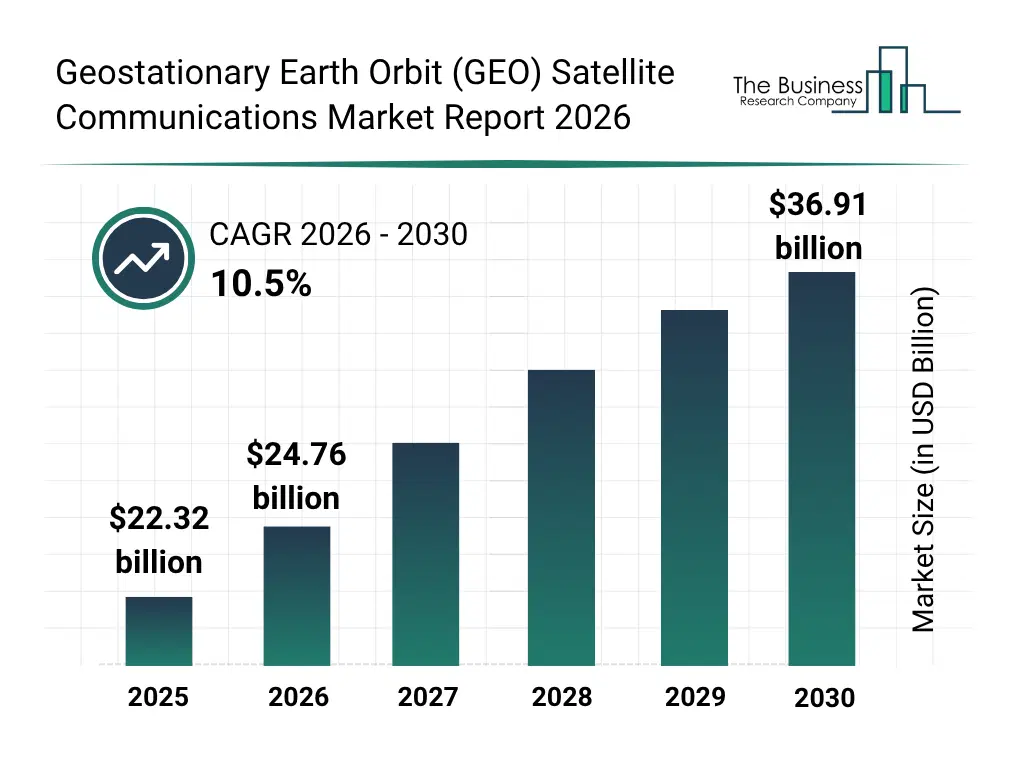
What Is The Geostationary Earth Orbit (GEO) Satellite Communications Market Size and Share 2026?
The geostationary earth orbit (GEO) satellite communications market size has grown rapidly in recent years. It will grow from $22.32 billion in 2025 to $24.76 billion in 2026 at a compound annual growth rate (CAGR) of 10.9%. The growth in the historic period can be attributed to increasing demand for satellite television broadcasting, growing telecommunications connectivity requirements, expansion of satellite broadband services, rising government and defense communication needs, increasing maritime and aviation connectivity requirements.What Is The Geostationary Earth Orbit (GEO) Satellite Communications Market Growth Forecast?
The geostationary earth orbit (geo) satellite communications market size is expected to see rapid growth in the next few years. It will grow to $36.91 billion in 2030 at a compound annual growth rate (CAGR) of 10.5%. The growth in the forecast period can be attributed to increasing deployment of high throughput satellites, rising demand for broadband connectivity in underserved regions, growing adoption of satellite-enabled mobility services, expansion of secure government and defense communications, increasing demand for flexible software defined satellite networks. Major trends in the forecast period include high throughput satellite deployment, software defined satellite adoption, multi-band satellite connectivity, low-latency GEO satellite services, satellite-based aviation and maritime connectivity.Tariff Impact On Geostationary Earth Orbit (GEO) Satellite Communications Market
Tariffs are impacting the geostationary earth orbit (GEO) satellite communications market by increasing the cost of satellite components, ground infrastructure, antennas, network equipment, and electronic systems sourced through international supply chains. Satellite operators, telecommunications service providers, defense organizations, and media and broadcasting companies may face higher equipment and deployment costs, with Asia-Pacific, North America, and Europe particularly exposed to cross-border technology trade. However, tariffs may encourage regional manufacturing, diversified sourcing, and greater investment in domestically produced satellite and ground communication equipment, strengthening supply-chain resilience over the longer term.
Global Geostationary Earth Orbit (GEO) Satellite Communications Market Segmentation
2) By Satellite Type: Conventional Communication Satellites, High Throughput Satellites, Very High Throughput Satellites, Software Defined Satellites 3) By Frequency Band: L Band, S Band, C Band, X Band, Ku Band, Ka Band 4) By End User: Commercial, Government And Civil, Defense And Military, Media And Broadcasting Companies, Telecommunications Service Providers, Maritime Operators Subsegments: 1) By Fixed Satellite Services: Fixed Broadband Services, Fixed Data Transmission Services, Fixed Voice Communication Services, Enterprise Network Connectivity Services, Backhaul Connectivity Services 2) By Mobile Satellite Services: Land Mobile Satellite Services, Maritime Mobile Satellite Services, Aeronautical Mobile Satellite Services, Satellite Internet Services, Emergency Communication Services 3) By Broadcast Satellite Services: Direct To Home Television Services, Satellite Television Distribution Services, Satellite Radio Broadcasting Services, Digital Audio Broadcasting Services, Content Distribution Services 4) By Managed Satellite Communication Services: Managed Network Services, Managed Security Services, Managed Bandwidth Services, Managed Teleport Services, Managed Cloud Connectivity ServicesWhat Is The Driver Of The Geostationary Earth Orbit (GEO) Satellite Communications Market?
The increasing demand for global broadband connectivity is expected to propel the growth of the geostationary earth orbit (GEO) satellite communications market going forward. Global broadband connectivity refers to the widespread availability of high-speed internet services that enable reliable access to digital communication, cloud applications, education, healthcare, entertainment, and business services across urban, rural, remote, and underserved regions. The demand for global broadband connectivity is rising due to the increasing use of digital services, which requires reliable high-speed internet access for communication, remote work, education, entertainment, and online transactions. The demand for global broadband connectivity drives the geostationary Earth orbit (GEO) satellite communications, by increasing the need for wide-area, reliable satellite broadband services, particularly in remote and underserved regions with limited terrestrial network infrastructure. For instance, in December 2025, according to the Fiber Broadband Association, a US-based broadband industry association, fiber broadband deployments reached 11.8 million U.S. homes passed in 2025 alone, increasing total FTTH passings to 98.3 million compared to previous years, reflecting continued expansion of fiber network coverage across the United States. Therefore, the increasing demand for global broadband connectivity is driving the growth of the geostationary earth orbit (GEO) satellite communications industry.Key Players In The Global Geostationary Earth Orbit (GEO) Satellite Communications Market
Major companies operating in the geostationary earth orbit (geo) satellite communications market are NTT Communications Corporation, Orange SA, Telefónica Global Solutions SLU, Viasat Inc, SES SA, Tata Communications Limited, Eutelsat SA, China Satellite Communications Co. Ltd., Telesat Corporation, Hispasat SA, Arab Satellite Communications Organization, APT Satellite Holdings Limited, PT Pasifik Satelit Nusantara, Nigerian Communications Satellite Limited, Russian Satellite Communications Company, Kacific Broadband Satellites Group, Türksat Uydu Haberleşme Kablo TV ve İşletme AŞ, Singapore Telecommunications Limited, Egyptian Satellite Company SAE
This chart is for illustrative purposes; the full report includes a detailed competitor analysis and comprehensive overview of the top 10 companies in the market.
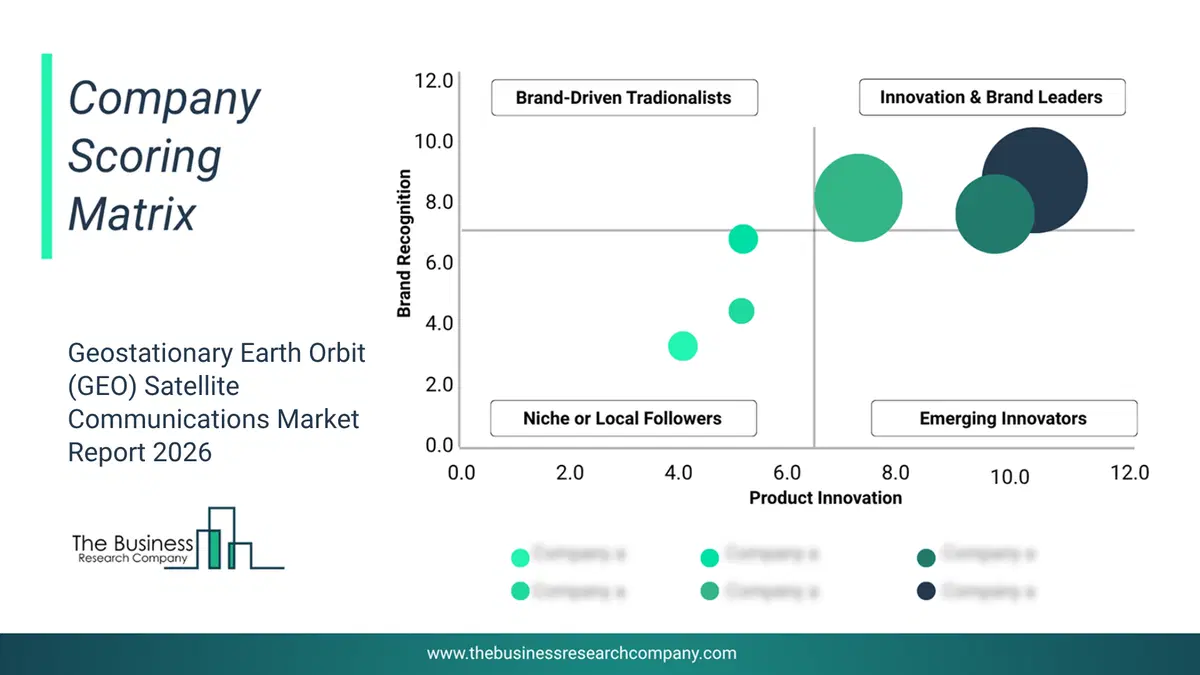
This chart maps companies by product innovation and brand strength, with bubble size indicating relative revenue, helping identify market leaders, challengers, and niche players. This is an illustrative chart; the full report provides a complete and accurate competitive analysis.
Global Geostationary Earth Orbit (GEO) Satellite Communications Market Trends and Insights
Major companies operating in the geostationary earth orbit (GEO) satellite communications market are focusing on developing innovative satellite communication solutions such as, high-capacity secure GEO communication satellites to enhance secure connectivity, communication capacity, coverage flexibility, interference resilience, and data transmission capabilities. High-capacity secure GEO communication satellites are advanced geostationary satellites designed to provide high-throughput and secure communications across large geographic areas while incorporating flexible antennas, radiation protection, and advanced signal-management technologies. For instance, in January 2025, Airbus SE, a Netherlands-based aerospace and defense company, successfully launched SpainSat NG-I, a new-generation secure communications satellite built for Hisdesat Servicios Estratégicos S.A. and operated for the Spanish Armed Forces. The satellite operates across UHF, Ka, and X bands and is designed to enter geostationary orbit following testing and commissioning. Airbus developed and integrated the satellite using its Eurostar Neo platform, while its Spanish operations developed an X-band active antenna system providing functionality equivalent to 16 traditional antennas. The active antennas can dynamically modify coverage up to 1,000 times per second and detect, geolocate, and mitigate multiple simultaneous sources of interference.What Are Latest Mergers And Acquisitions In The Geostationary Earth Orbit (GEO) Satellite Communications Market?
In July 2025, SES S.A., a Luxembourg-based space solutions and satellite communications company, acquired Intelsat Holdings S.à r.l. for $2.6 billion (€2.2 billion). With this acquisition, SES aims to create a stronger global multi-orbit satellite operator, expand its fleet and connectivity infrastructure, combine complementary GEO, MEO, and LEO capabilities, broaden its range of multi-orbit and multi-band connectivity solutions, strengthen its position in high-growth markets such as government, aviation, and maritime connectivity, and enhance its ability to provide integrated satellite connectivity solutions to customers worldwide. Intelsat Holdings S.à r.l. is a Luxembourg-based satellite communications company that specializes in providing geostationary earth orbit (GEO) satellite communications and connectivity services to customers across media, government, mobility, and commercial markets.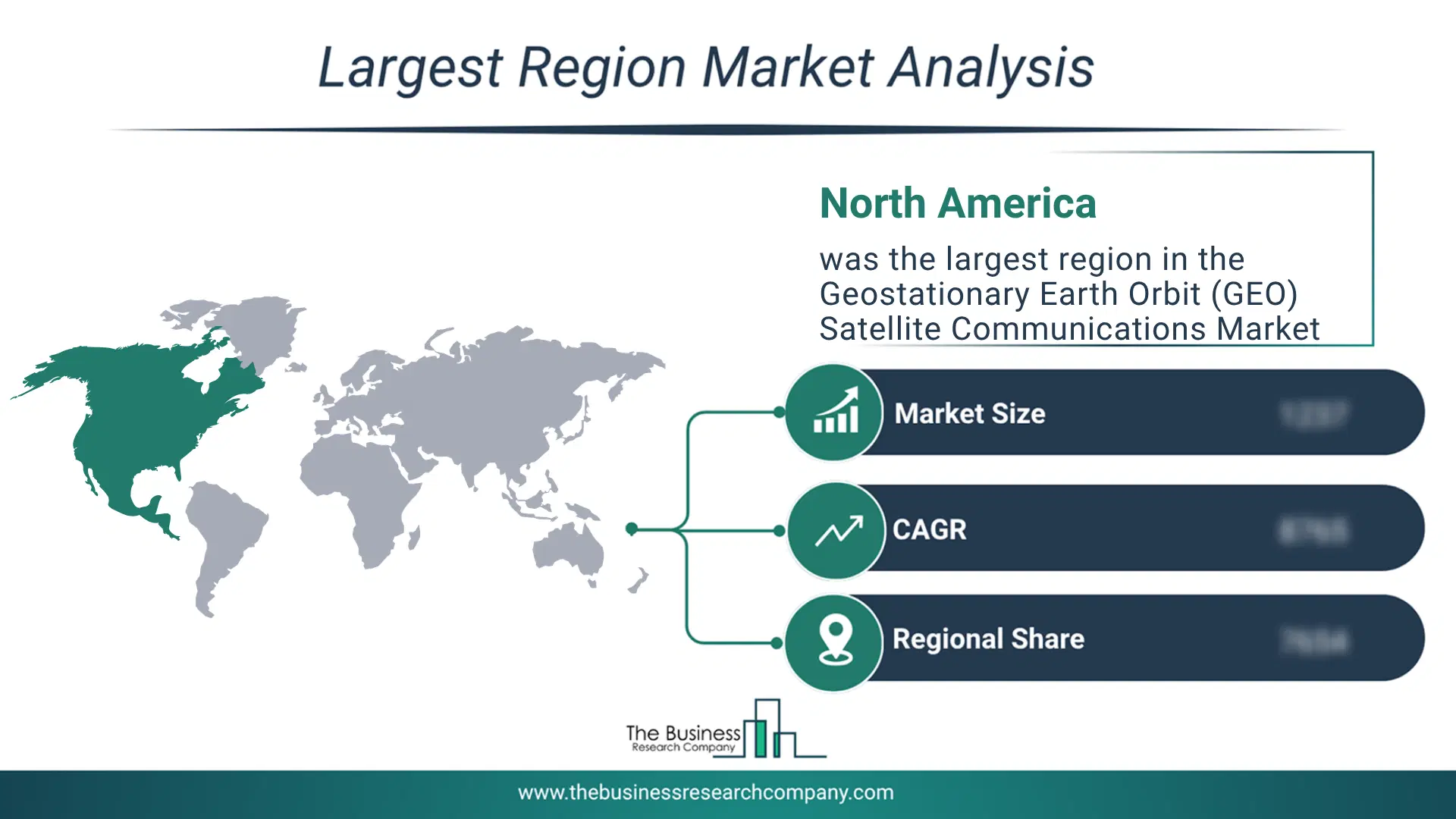
Regional Outlook/Insights
North America was the largest region in the geostationary earth orbit (GEO) satellite communications market in 2025. Asia-Pacific is expected to be the fastest-growing region in the forecast period. The regions covered in this market report are Asia-Pacific, South East Asia, Western Europe, Eastern Europe, North America, South America, Middle East, Africa. The countries covered in this market report are Australia, Brazil, China, France, Germany, India, Indonesia, Japan, Taiwan, Russia, South Korea, UK, USA, Canada, Italy, Spain.What Defines the Geostationary Earth Orbit (GEO) Satellite Communications Market?
The geostationary earth orbit (GEO) satellite communications market consists of revenues earned by entities by providing services such as satellite capacity leasing, transponder leasing, ground station operations, satellite network monitoring, telemetry and tracking support, satellite connectivity integration, network optimization, equipment installation and maintenance, signal uplinking and downlinking, and satellite communication consulting services. The market value includes the value of related goods sold by the service provider or included within the service offering. Only goods and services traded between entities or sold to end consumers are included.How is Market Value Defined and Measured?
The market value is defined as the revenues that enterprises gain from the sale of goods and/or services within the specified market and geography through sales, grants, or donations in terms of the currency (in USD unless otherwise specified). The revenues for a specified geography are consumption values that are revenues generated by organizations in the specified geography within the market, irrespective of where they are produced. It does not include revenues from resales along the supply chain, either further along the supply chain or as part of other products.
This chart presents market attractiveness based on a quantitative evaluation of growth, competition, strategic alignment, and risk, offering a clear view of opportunity areas for decision-making. This chart is for illustrative purposes; the full report contains the complete analysis.

This chart highlights the Total Addressable Market (TAM) by estimating the maximum revenue opportunity using an assumption-driven approach, supporting strategic planning and opportunity sizing across markets. The chart is illustrative; the full report provides a more comprehensive analysis.
What Key Data and Analysis Are Included in the Geostationary Earth Orbit (GEO) Satellite Communications Market Report 2026?
The geostationary earth orbit (geo) satellite communications market research report is one of a series of new reports from The Business Research Company that provides market statistics, including industry global market size, regional shares, competitors with the market share, detailed market segments, market trends and opportunities, and any further data you may need to thrive in the geostationary earth orbit (geo) satellite communications industry. The market research report delivers a complete perspective of everything you need, with an in-depth analysis of the current and future state of the industry.Geostationary Earth Orbit (GEO) Satellite Communications Market Report Forecast Analysis
| Report Attribute | Details |
|---|---|
| Market Size Value In 2026 | $24.76 billion |
| Revenue Forecast In 2030 | $36.91 billion |
| Growth Rate | CAGR of 10.5% from 2026 to 2035 |
| Base Year For Estimation | 2025 |
| Actual Estimates/Historical Data | 2020-2025 |
| Forecast Period | 2026 - 2030 |
| Market Representation | Revenue in USD Billion and CAGR from 2026 to 2030 |
| Segments Covered | Service Model, Satellite Type, Frequency Band, End User |
| Regional Scope | Asia-Pacific, Western Europe, Eastern Europe, North America, South America, Middle East, Africa |
| Country Scope | The countries covered in the report are Australia, Brazil, China, France, Germany, India, Indonesia, Japan, Taiwan, Russia, South Korea, UK, USA, Canada, Italy, Spain. |
| Customization Scope | Request for Customization |
| Pricing And Purchase Options | Explore Purchase Options |