
Geostationary Satellites Market Report 2026
Global Outlook – By Type Of Satellite ( Communications Satellites, Earth Observation Satellites, Weather Satellites, Scientific Satellites, Military Satellites), By Orbit Parameters ( Orbital Altitude, Inclination Angle), By Frequency Band ( C Band, Ku Band, Ka Band, X Band, L Band, S Band), By Application ( Telecommunication Services, Broadcasting Services, Data Collection And Analysis, Navigation And Timing Services, Environmental Monitoring), By End User ( Government Institutions, Commercial Companies, Research Organizations, Non Governmental Organizations) – Market Size, Trends, Strategies, and Forecast to 2030
Geostationary Satellites Market Report 2026 Market Overview
• Geostationary Satellites Market Report 2026 market size has reached to $17.87 billion in 2025 • Expected to grow to $24.2 billion in 2030 at a compound annual growth rate (CAGR) of 6.2% • Growth Driver: The Rising Demand For High-Capacity Broadband Connectivity Driving The Growth Of The Market Due To Rapid Growth Of Data-Intensive Applications • Market Trend: Advancements In Next-Generation Weather Monitoring Satellites Enhance Forecasting Accuracy And Climate Observation • North America was the largest region in 2025 and Asia-Pacific is the fastest growing region.What Is Covered Under Geostationary Satellites Market?
Geostationary satellites are artificial satellites that orbit the earth at an altitude of approximately 35,786 kilometers above the equator and rotate at the same angular speed as the Earth. As a result, they appear fixed over a specific geographic location, making them ideal for telecommunications, weather monitoring, broadcasting, and continuous Earth observation applications. The main types of geostationary satellites include communications satellites, earth observation satellites, weather satellites, scientific satellites, and military satellites. Communications satellites refer to space-based platforms placed in geostationary orbit to provide continuous communication services such as data, voice, and video transmission across wide geographic regions. These satellites are characterized by orbit parameters including orbital altitude and inclination angle and operate across frequency bands such as C band, Ku band, Ka band, X band, L band, and S band. The various applications involved are telecommunication services, broadcasting services, data collection and analysis, navigation and timing services, and environmental monitoring, and they are used by several end users such as government institutions, commercial companies, research organizations, and non governmental organizations.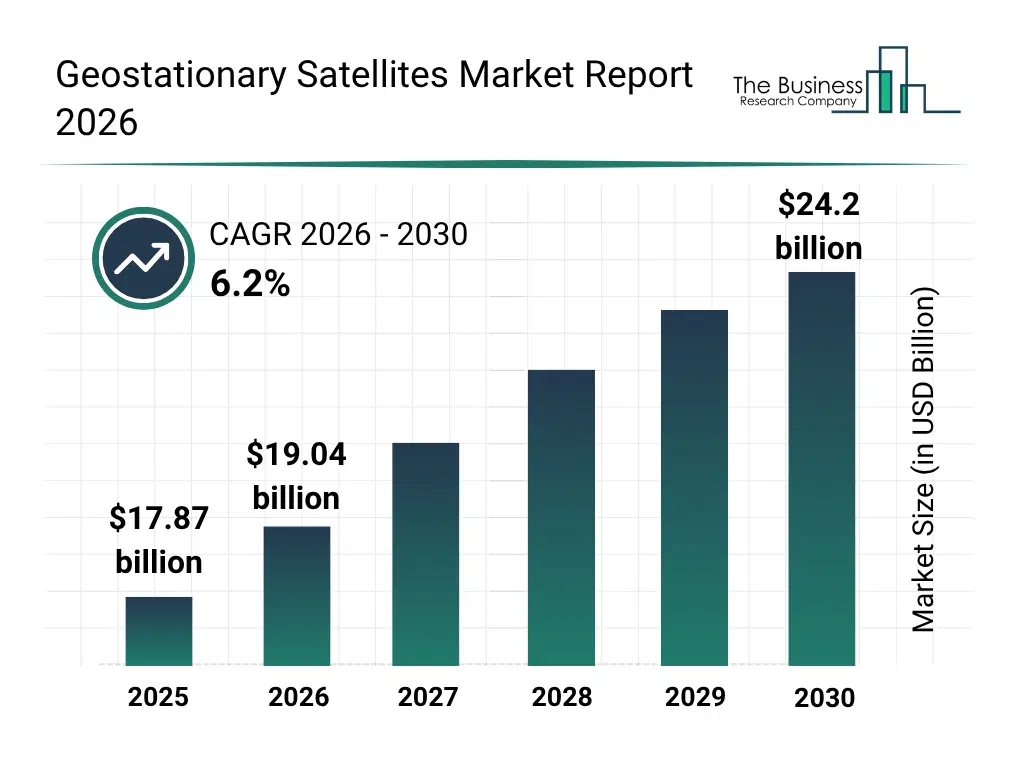
What Is The Geostationary Satellites Market Size and Share 2026?
The geostationary satellites market size has grown strongly in recent years. It will grow from $17.87 billion in 2025 to $19.04 billion in 2026 at a compound annual growth rate (CAGR) of 6.6%. The growth in the historic period can be attributed to early reliance on geostationary satellites for tv broadcasting, growing demand for weather forecasting and monitoring systems, expansion of global telecommunication infrastructure, government investment in space and defense communication systems, increasing adoption of satellite based navigation services.What Is The Geostationary Satellites Market Growth Forecast?
The geostationary satellites market size is expected to see strong growth in the next few years. It will grow to $24.2 billion in 2030 at a compound annual growth rate (CAGR) of 6.2%. The growth in the forecast period can be attributed to expansion of global broadband satellite constellations integration, rising demand for real time climate and disaster monitoring, increasing commercialization of space based services, growth in defense surveillance and secure communication systems, advancement in high capacity satellite communication technologies. Major trends in the forecast period include ai driven satellite image analytics for real time earth observation insights, iot enabled satellite communication networks for continuous connectivity, cloud based geospatial data processing and distribution platforms, autonomous satellite station keeping and orbit optimization systems, sustainable low fuel propulsion systems for long lifecycle satellites.
Global Geostationary Satellites Market Segmentation
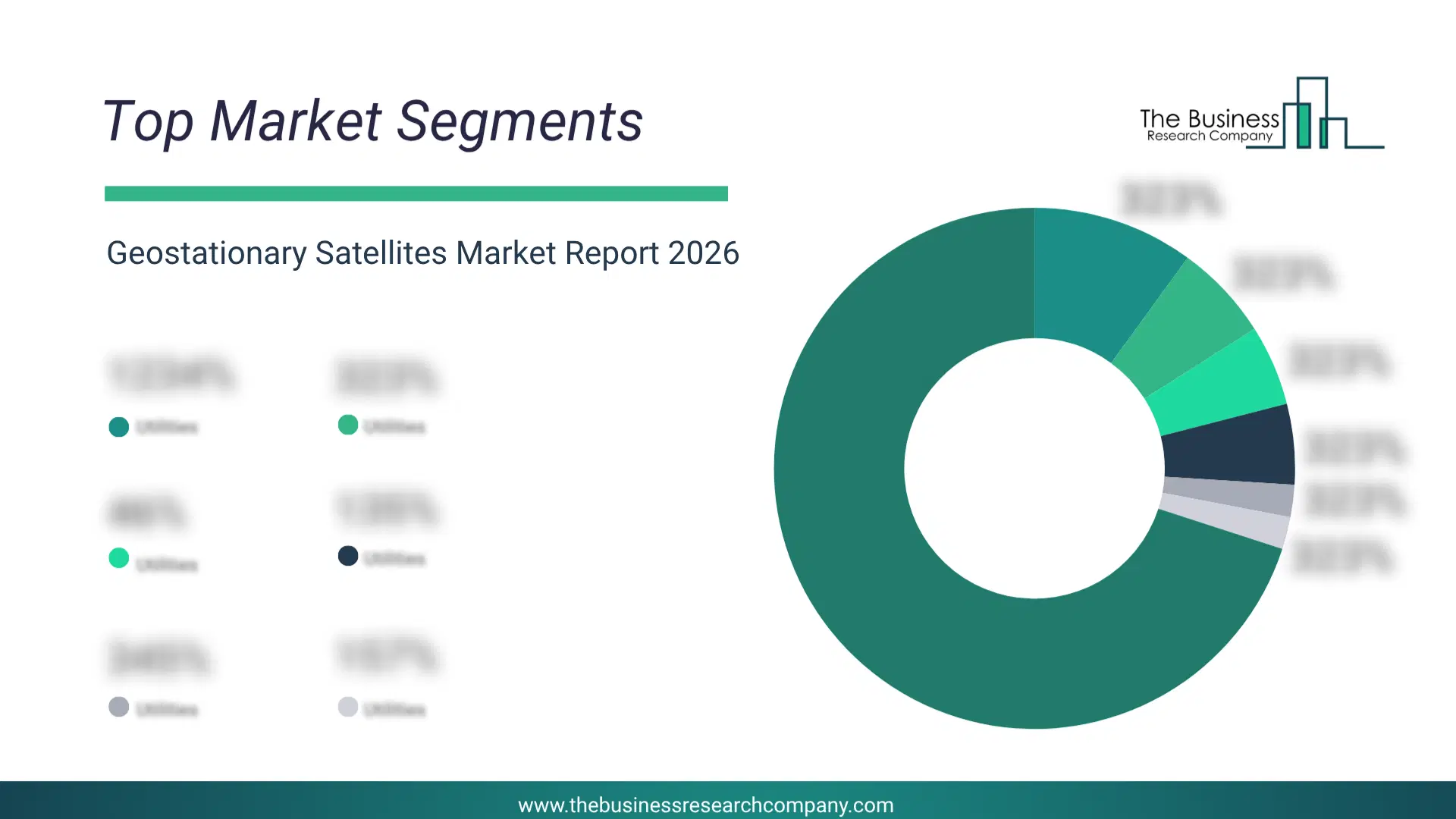
1) By Type Of Satellite: Communications Satellites, Earth Observation Satellites, Weather Satellites, Scientific Satellites, Military Satellites 2) By Orbit Parameters: Orbital Altitude, Inclination Angle 3) By Frequency Band: C Band, Ku Band, Ka Band, X Band, L Band, S Band 4) By Application: Telecommunication Services, Broadcasting Services, Data Collection And Analysis, Navigation And Timing Services, Environmental Monitoring 5) By End User: Government Institutions, Commercial Companies, Research Organizations, Non Governmental Organizations Subsegments: 1) By Communications Satellites: Fixed Satellite Service Satellites, Broadcasting Satellite Service Satellites, Mobile Satellite Service Satellites, Broadband Communication Satellites. 2) By Earth Observation Satellites: Optical Imaging Satellites, Synthetic Aperture Radar Satellites, Environmental Monitoring Satellites, Resource Mapping Satellites 3) By Weather Satellites: Meteorological Monitoring Satellites, Climate Observation Satellites, Atmospheric Sounding Satellites, Storm Tracking Satellites 4) By Scientific Satellites: Astronomy Satellites, Space Science Satellites, Solar Observation Satellites, Astrophysics Research Satellites 5) By Military Satellites: Reconnaissance Satellites, Surveillance Satellites, Military Communication Satellites, Early Warning SatellitesWhat Is The Driver Of The Geostationary Satellites Market?
The rising demand for high-capacity broadband connectivity is expected to propel the growth of the geostationary satellites market going forward. High-capacity broadband connectivity refers to high-speed communication networks that can transmit large volumes of data reliably and efficiently, enabling seamless internet access, streaming, and data-intensive applications across wide geographic areas. Rising demand for high-capacity broadband connectivity is due to the rapid growth of data-intensive applications such as video streaming, cloud computing, online gaming, and remote work, which require faster and more reliable internet bandwidth. Geostationary satellites help high-capacity broadband connectivity by providing continuous, wide-area coverage that enables reliable high-speed data transmission to underserved and remote regions. For instance, in November 2024, according to the International Telecommunication Union, a Switzerland-based specialized agency, in 2023, global mobile broadband traffic for end-user internet usage surpassed 1 zettabyte for the first time. It is projected to grow to around 1.3 zettabytes in 2024. In comparison, fixed broadband traffic is expected to increase from 5.1 zettabytes in 2023 to about 6 zettabytes in 2024. Therefore, the rising demand for high-capacity broadband connectivity is driving the growth of the geostationary satellites industry.Key Players In The Global Geostationary Satellites Market
Major companies operating in the geostationary satellites market report are The Boeing Company, Airbus SE, Lockheed Martin Corporation, China Aerospace Science and Technology Corporation, Mitsubishi Electric Corporation, EchoStar Corporation, Israel Aerospace Industries Ltd., Viasat Inc., Thales Alenia Space, SES S.A., Sierra Space Corporation, York Space Systems LLC, Astranis Space Technologies Corp., Apex Space LLC, SKY Perfect JSAT Corporation, MEASAT Satellite Systems Sdn. Bhd., Kacific Broadband Satellites Group, K2 Space Corporation, AscendArc Inc., JSC Information Satellite Systems Reshetnev, Maxar Technologies, Northrop Grumman Corporation, Hughes Network Systems, OHB SE, Eutelsat S.A.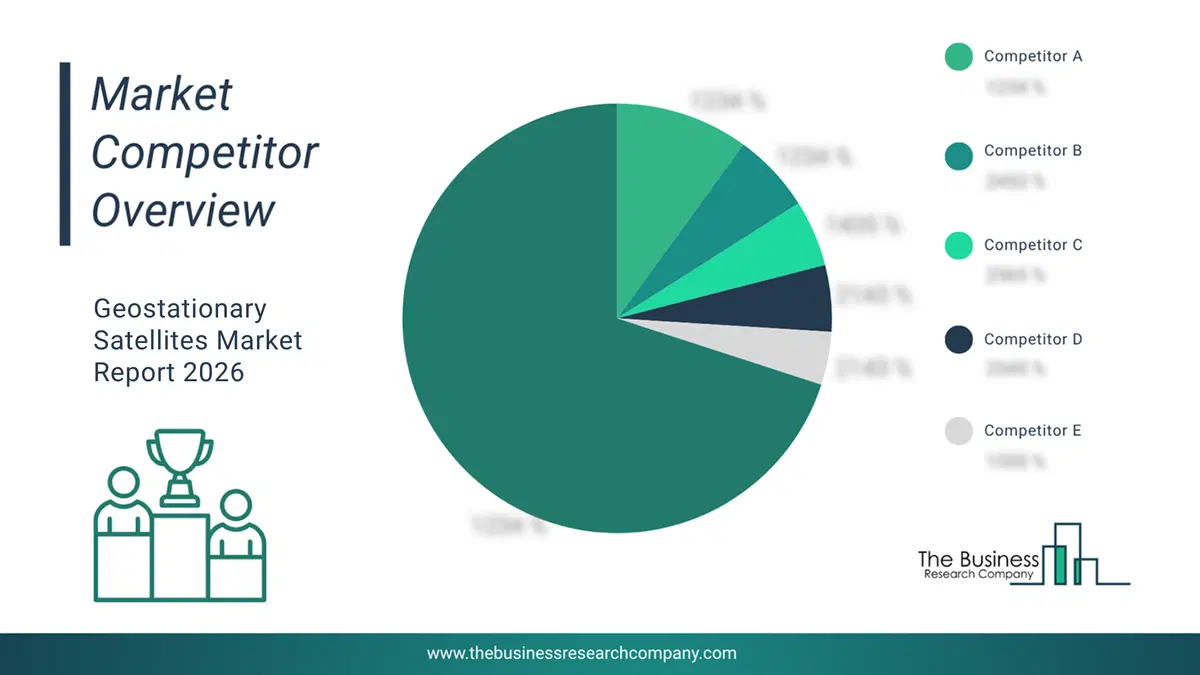
This chart is for illustrative purposes; the full report includes a detailed competitor analysis and comprehensive overview of the top 10 companies in the market.
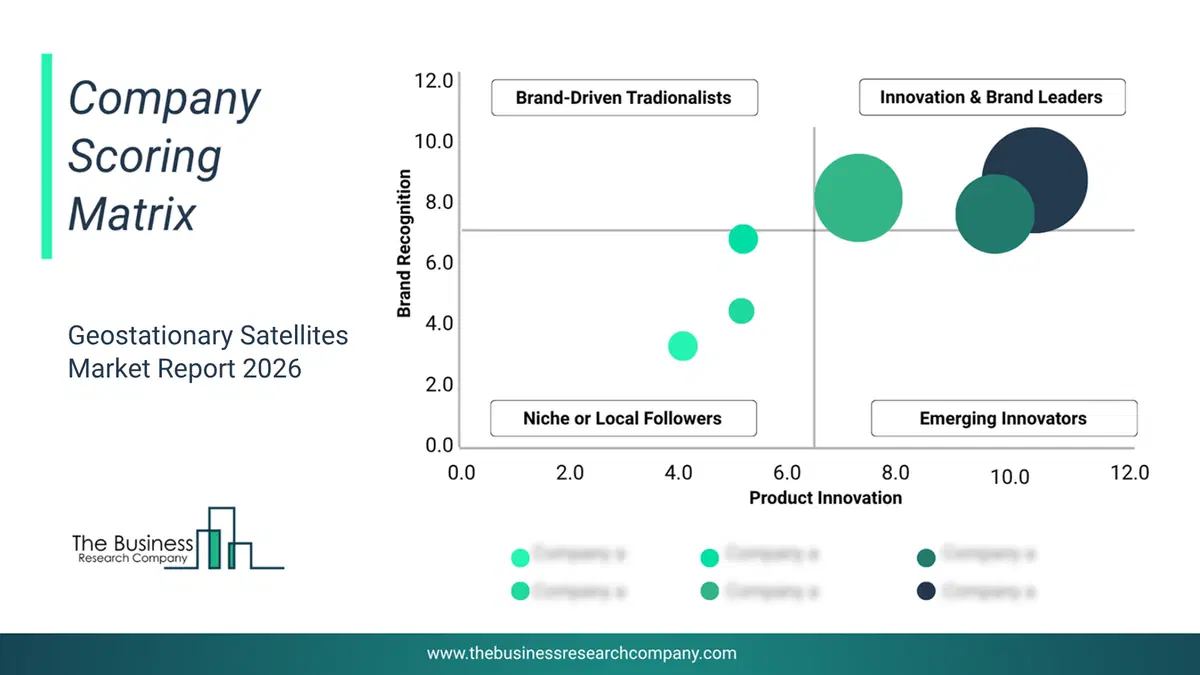
This chart maps companies by product innovation and brand strength, with bubble size indicating relative revenue, helping identify market leaders, challengers, and niche players. This is an illustrative chart; the full report provides a complete and accurate competitive analysis.
Global Geostationary Satellites Market Trends and Insights
Major companies operating in the geostationary satellites market are focusing on developing innovative solutions such as next-generation weather monitoring satellites to enhance real-time atmospheric observation, improve forecasting accuracy, and support climate monitoring applications. Next-generation weather monitoring satellites are advanced satellites equipped with high-resolution sensors and atmospheric sounding instruments that provide more accurate, real-time data for weather forecasting, climate monitoring, and severe weather detection. For instance, in July 2025 Space Exploration Technologies Corp., a US-based aerospace and space transportation company, launched the MTG-S1 (Meteosat Third Generation Sounder-1) satellite for European meteorological operations aboard a Falcon 9 rocket. The satellite was deployed into a geostationary transfer orbit to support next-generation weather forecasting and environmental monitoring services across Europe and surrounding regions. MTG-S1 is designed to deliver high-frequency atmospheric sounding data, enabling meteorologists to monitor temperature, humidity, and atmospheric instability with greater precision. The satellite enhances early detection of severe weather events, including storms and extreme climate conditions, thereby improving forecasting accuracy and public safety measures.What Are Latest Mergers And Acquisitions In The Geostationary Satellites Market?
In May 2023, Viasat Inc., a US-based communications company, acquired Inmarsat for an $7.3. With this acquisition, Viasat aimed to expand its global satellite communications footprint, combine complementary satellite and spectrum assets, accelerate innovation, and strengthen its position across aviation, maritime, government, and enterprise connectivity markets. Inmarsat Global Limited is a UK-based company that operates a massive fleet of approximately 14 Geostationary Earth Orbit (GEO) satellites.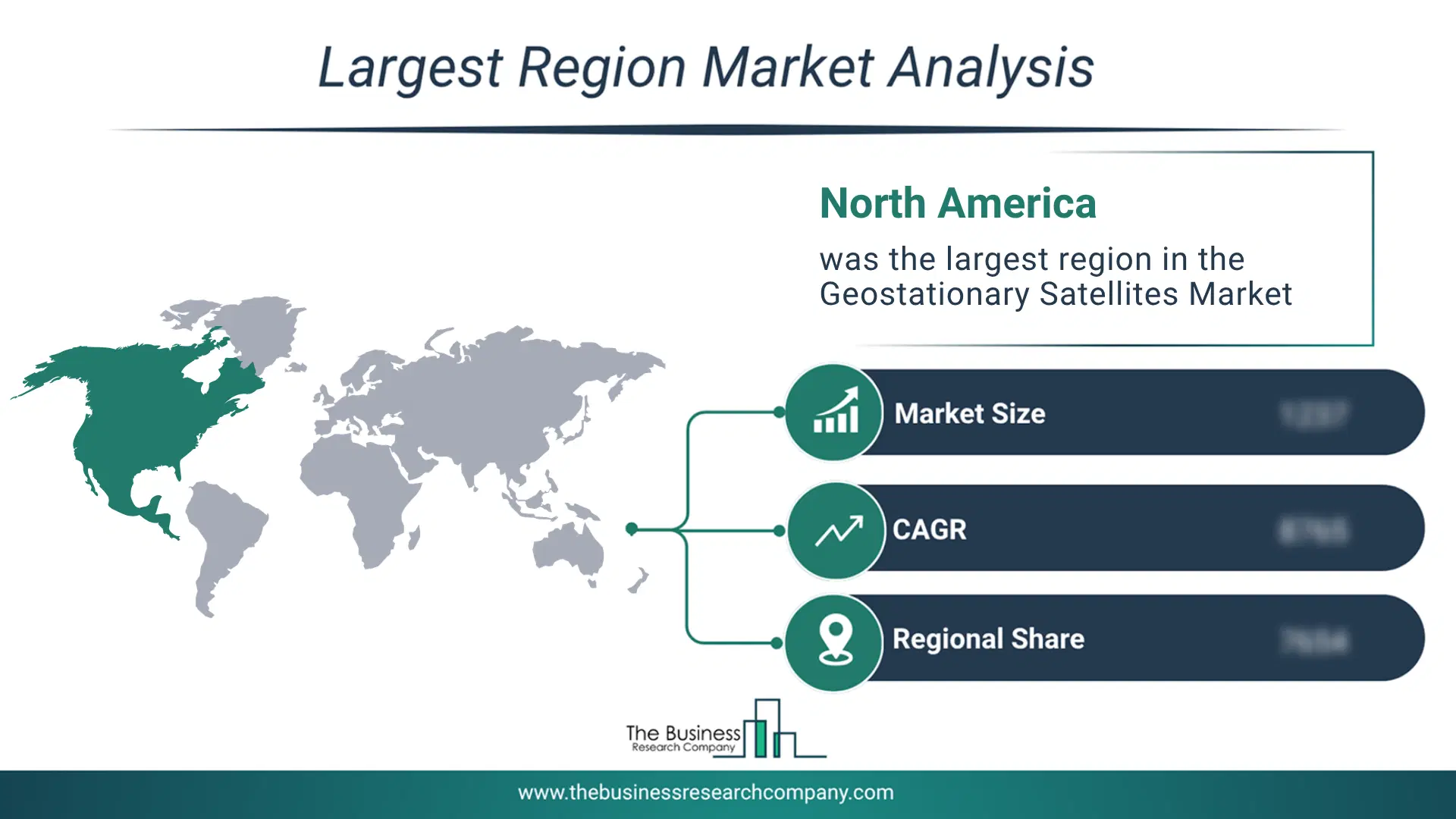
Regional Outlook
North America was the largest region in the geostationary satellites market in 2025. Asia-Pacific is expected to be the fastest-growing region in the forecast period. The regions covered in this market report are Asia-Pacific, South East Asia, Western Europe, Eastern Europe, North America, South America, Middle East, Africa. The countries covered in this market report are Australia, Brazil, China, France, Germany, India, Indonesia, Japan, Taiwan, Russia, South Korea, UK, USA, Canada, Italy, Spain.What Defines the Geostationary Satellites Market?
The geostationary satellites market consists of revenues earned by entities by providing services such as satellite launch support and deployment services, in-orbit satellite control and mission management services, satellite fleet operations and maintenance services, and satellite capacity leasing and transponder rental services. The market value includes the value of related goods sold by the service provider or included within the service offering. The geostationary satellites market also includes sales of satellite transponders, deployable satellite antennas, satellite propulsion systems, and onboard power generation system. Values in this market are ‘factory gate’ values, that is the value of goods sold by the manufacturers or creators of the goods, whether to other entities (including downstream manufacturers, wholesalers, distributors and retailers) or directly to end customers. The value of goods in this market includes related services sold by the creators of the goods.How is Market Value Defined and Measured?
The market value is defined as the revenues that enterprises gain from the sale of goods and/or services within the specified market and geography through sales, grants, or donations in terms of the currency (in USD unless otherwise specified). The revenues for a specified geography are consumption values that are revenues generated by organizations in the specified geography within the market, irrespective of where they are produced. It does not include revenues from resales along the supply chain, either further along the supply chain or as part of other products.
This chart presents market attractiveness based on a quantitative evaluation of growth, competition, strategic alignment, and risk, offering a clear view of opportunity areas for decision-making. This chart is for illustrative purposes; the full report contains the complete analysis.

This chart highlights the Total Addressable Market (TAM) by estimating the maximum revenue opportunity using an assumption-driven approach, supporting strategic planning and opportunity sizing across markets. The chart is illustrative; the full report provides a more comprehensive analysis.
What Key Data and Analysis Are Included in the Geostationary Satellites Market Report 2026?
The geostationary satellites market research report is one of a series of new reports from The Business Research Company that provides market statistics, including industry global market size, regional shares, competitors with the market share, detailed market segments, market trends and opportunities, and any further data you may need to thrive in the geostationary satellites industry. The market research report delivers a complete perspective of everything you need, with an in-depth analysis of the current and future state of the industry.Geostationary Satellites Market Report Forecast Analysis
| Report Attribute | Details |
|---|---|
| Market Size Value In 2026 | $19.04 billion |
| Revenue Forecast In 2030 | $24.2 billion |
| Growth Rate | CAGR of 6.2% from 2026 to 2030 |
| Base Year For Estimation | 2025 |
| Actual Estimates/Historical Data | 2020-2025 |
| Forecast Period | 2026 - 2030 |
| Market Representation | Revenue in USD Billion and CAGR from 2026 to 2030 |
| Segments Covered | Type Of Satellite, Orbit Parameters, Frequency Band, Application, End User |
| Regional Scope | Asia-Pacific, Western Europe, Eastern Europe, North America, South America, Middle East, Africa |
| Country Scope | The countries covered in the report are Australia, Brazil, China, France, Germany, India, Indonesia, Japan, Taiwan, Russia, South Korea, UK, USA, Canada, Italy, Spain. |
| Key Companies Profiled | The Boeing Company, Airbus SE, Lockheed Martin Corporation, China Aerospace Science and Technology Corporation, Mitsubishi Electric Corporation, EchoStar Corporation, Israel Aerospace Industries Ltd., Viasat Inc., Thales Alenia Space, SES S.A., Sierra Space Corporation, York Space Systems LLC, Astranis Space Technologies Corp., Apex Space LLC, SKY Perfect JSAT Corporation, MEASAT Satellite Systems Sdn. Bhd., Kacific Broadband Satellites Group, K2 Space Corporation, AscendArc Inc., JSC Information Satellite Systems Reshetnev, Maxar Technologies, Northrop Grumman Corporation, Hughes Network Systems, OHB SE, Eutelsat S.A. |
| Customization Scope | Request for Customization |
| Pricing And Purchase Options | Explore Purchase Options |