
Glass Bonding Adhesives Market Report 2026
Global Outlook – By Type (Polyurethane, Modified Silanes Adhesives, Silicone Adhesives, Acrylate Adhesives, Epoxy Adhesives, Cyanoacrylate Adhesives, Polysulfides, UV Or LED Curing, Other Types), By Application (Construction, Furniture, Automotive And Transportation, Electronics And Appliances, Consumer Goods, Medical Devices, Other Applications), By End-Use Industry (Automotive, Aerospace, Furniture, Construction, Electronics, Consumer Goods, Medical, Other End-Use Industries) – Market Size, Trends, Strategies, and Forecast to 2030
Glass Bonding Adhesives Market Overview
• Glass Bonding Adhesives market size has reached to $3.61 billion in 2025 • Expected to grow to $5.44 billion in 2030 at a compound annual growth rate (CAGR) of 8.4% • Growth Driver: Expanding Automotive Industry Drives The Glass Bonding Adhesive Market • Market Trend: Advancement In Bonding Technology • Asia-Pacific was the largest region in 2025 and North America is the fastest growing region.What Is Covered Under Glass Bonding Adhesives Market?
Glass bonding adhesives are substances made for fusing two surfaces together, such as glass to glass or other substrates like plastics, metals, and rubbers. They are produced using a variety of substances, including silicone, epoxy, polyurethane, and cyanoacrylate. The main types of glass bonding adhesives are polyurethane, modified silanes adhesives, silicone adhesives, acrylate adhesives, epoxy adhesives, cyanoacrylate adhesives, polysulfides, UV or led curing, and others. Polyurethane is a composite resinous, stringy, or elastomeric compound formed by the reaction of diisocyanates with other polyfunctional compounds such as glycols, used in glass bonding adhesives for its flexibility or solidity, relying on the composition. It is used in various applications such as construction, furniture, automotive and transportation, electronics and appliances, consumer goods, medical devices, and others by various end-use industries automotive, aerospace, furniture, construction, electronics, consumer goods, medical, and others.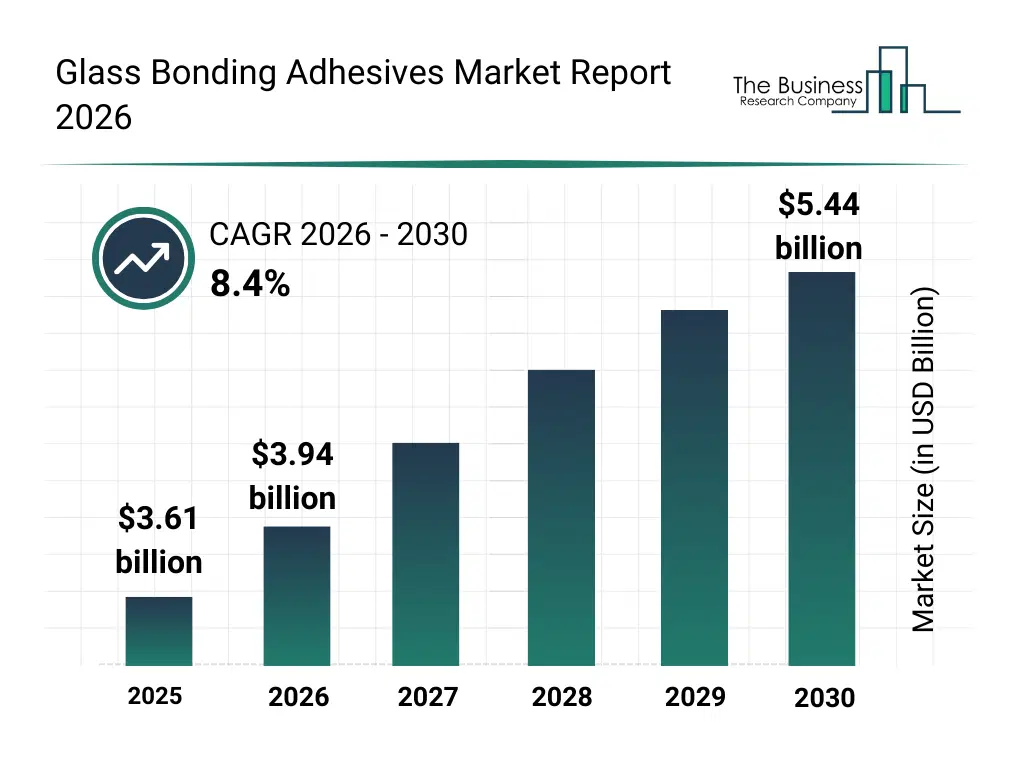
What Is The Glass Bonding Adhesives Market Size and Share 2026?
The glass bonding adhesives market size has grown strongly in recent years. It will grow from $3.61 billion in 2025 to $3.94 billion in 2026 at a compound annual growth rate (CAGR) of 9.0%. The growth in the historic period can be attributed to expansion of construction glazing applications, growth of automotive production, rising electronics device manufacturing, availability of advanced adhesive chemistries, industrial adoption of epoxy and silicone adhesives.What Is The Glass Bonding Adhesives Market Growth Forecast?
The glass bonding adhesives market size is expected to see strong growth in the next few years. It will grow to $5.44 billion in 2030 at a compound annual growth rate (CAGR) of 8.4%. The growth in the forecast period can be attributed to increasing demand for lightweight vehicle components, expansion of smart glass installations, growing use of adhesive bonding over mechanical fasteners, rising investments in electronics miniaturization, increased focus on durable bonding solutions. Major trends in the forecast period include increasing use of structural glass bonding solutions, rising adoption of uv and led curing adhesives, growing demand from automotive lightweighting, expansion of electronics assembly applications, enhanced focus on high-strength transparent bonds.
Global Glass Bonding Adhesives Market Segmentation
1) By Type: Polyurethane, Modified Silanes Adhesives, Silicone Adhesives, Acrylate Adhesives, Epoxy Adhesives, Cyanoacrylate Adhesives, Polysulfides, UV Or LED Curing, Other Types 2) By Application: Construction, Furniture, Automotive And Transportation, Electronics And Appliances, Consumer Goods, Medical Devices, Other Applications 3) By End-Use Industry: Automotive, Aerospace, Furniture, Construction, Electronics, Consumer Goods, Medical, Other End-Use Industries Subsegments: 1) By Polyurethane Adhesives: Moisture-Cured Polyurethane, One-Part Polyurethane, Two-Part Polyurethane 2) By Modified Silanes Adhesives: Silane Terminated Polyethers, Silane Terminated Polyurethanes 3) By Silicone Adhesives: Acetoxy Silicone, Neutral Silicone, Oxime Silicone 4) By Acrylate Adhesives: Methyl Methacrylate, Acrylate Copolymers 5) By Epoxy Adhesives: One-Part Epoxy, Two-Part Epoxy 6) By Cyanoacrylate Adhesives: Ethyl Cyanoacrylate, Methyl Cyanoacrylate 7) By Polysulfides: One-Part Polysulfide, Two-Part Polysulfide 8) By UV or LED Curing Adhesives: UV-Curing Acrylics, UV-Curing Epoxies 9) By Other Types: Thermal Set Adhesives, Pressure Sensitive AdhesivesWhat Is The Driver Of The Glass Bonding Adhesives Market?
The expanding automotive industry is expected to be the key driver of the glass bonding adhesive market. The automotive industry refers to an industry involved in designing, manufacturing, wholesaling, retailing, and maintaining motor vehicles. Glass bonding adhesive helps the automotive industry by being utilized in the vehicle assembly bonding process as makers progressively use sandwich panels, fiberglass composites, and sophisticated polymers in their vehicle designs to lighten them and increase their structural integrity, longevity, and thermal stability. For instance, in May 2024, according to the data published by the International Energy Agency (IEA), a France-based intergovernmental organization, accounting for 48% of global car sales, SUVs reached a new record in 2023, further solidifying their popularity in the automotive market. Therefore, the expanding automotive industry is driving the growth of the glass bonding adhesive industry.Key Players In The Global Glass Bonding Adhesives Market
Major companies operating in the glass bonding adhesives market are Arkema SA, Ashland Global Holdings Inc., Bohle AG, Chemence Ltd., Collano Adhesives AG, DELO Industrie Klebstoffe GmbH & Co KGaA, DIC Corporation, Dow Inc., DuPont de Nemours Inc., Dymax Corporation, Evonik Industries AG, Harvey Benjamin Fuller, Henkel AG & Co KGaA, Hexion Inc., Huntsman Corporation, Jowat SE, Kiwo Inc., Mapei SpA, Master Bond Inc., Minnesota Mining and Manufacturing Company, Momentive Performance Materials Inc., Permabond LLC, Pidilite Industries Limited, Scott Bader Company Ltd., Sika AG, Solvay SA, ThreeBond Group, Wacker Chemie AG
This chart is for illustrative purposes; the full report includes a detailed competitor analysis and comprehensive overview of the top 10 companies in the market.
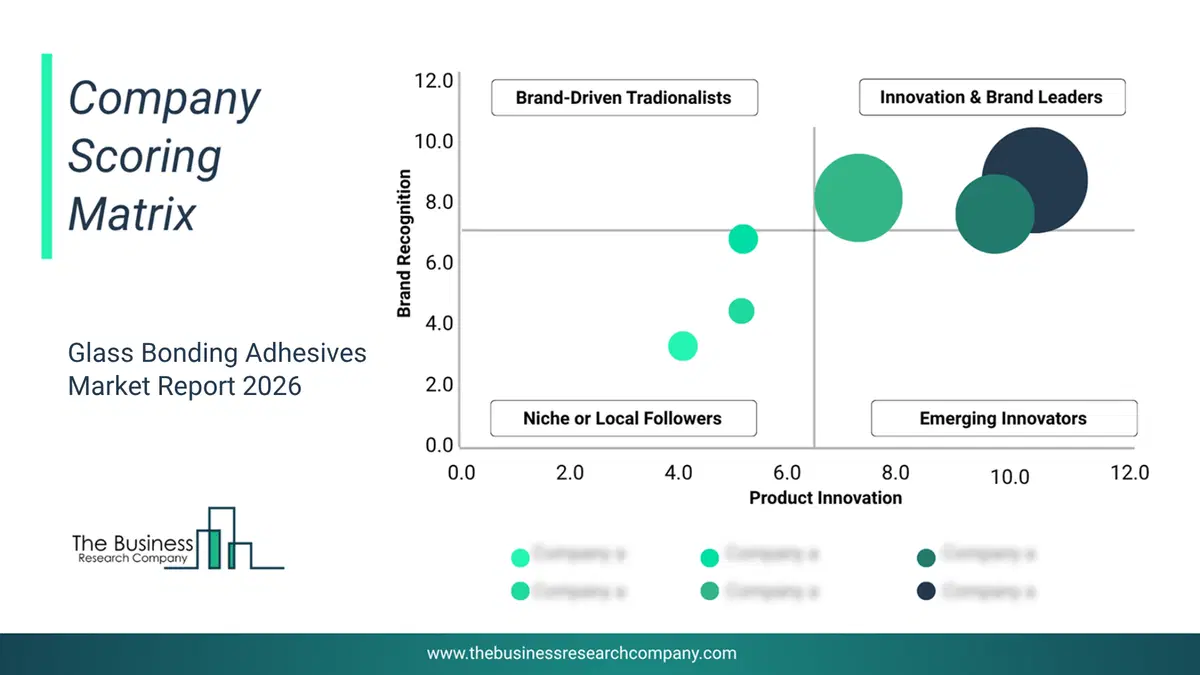
This chart maps companies by product innovation and brand strength, with bubble size indicating relative revenue, helping identify market leaders, challengers, and niche players. This is an illustrative chart; the full report provides a complete and accurate competitive analysis.
Global Glass Bonding Adhesives Market Trends and Insights
Major companies operating in the glass bonding adhesive market are focusing on developing innovative solutions, such as advanced bonding technologies, to meet the rising demand for stronger adhesion, faster curing, and improved performance in precision assembly applications. Advanced bonding technology offers superior bond strength, improved durability, and faster processing compared with conventional adhesives, supporting the growing use of high-precision components in automotive, electronics, and optical systems. For instance, in January 2023, Henkel AG & Co. KGaA, a Germany-based company operating in adhesives and sealants, introduced Loctite 3296, a new adhesive for lens bonding in ADAS sensors. Loctite 3296 is a dual-cure adhesive (UV and thermal) that meets a variety of assembly requirements through their respective adhesive performance characteristics. It is intended for assembly operations that require low post-cure temperatures and delivers a high cure depth after only a few seconds of exposure to UV light, which makes it advantageous for precisely assembling the components of a camera module.What Are Latest Mergers And Acquisitions In The Glass Bonding Adhesives Market?
In May 2023, Sika AG, a Switzerland-based chemicals company, acquired MBCC Group for an undisclosed amount. With the acquisition to enhance its product offerings in the construction chemicals industry, focusing on innovation and sustainability, and expanding its market presence across various sectors such as buildings, infrastructure, and underground construction. MBCC Group is a Germany-based construction chemicals and solutions company, including glass bonding adhesives.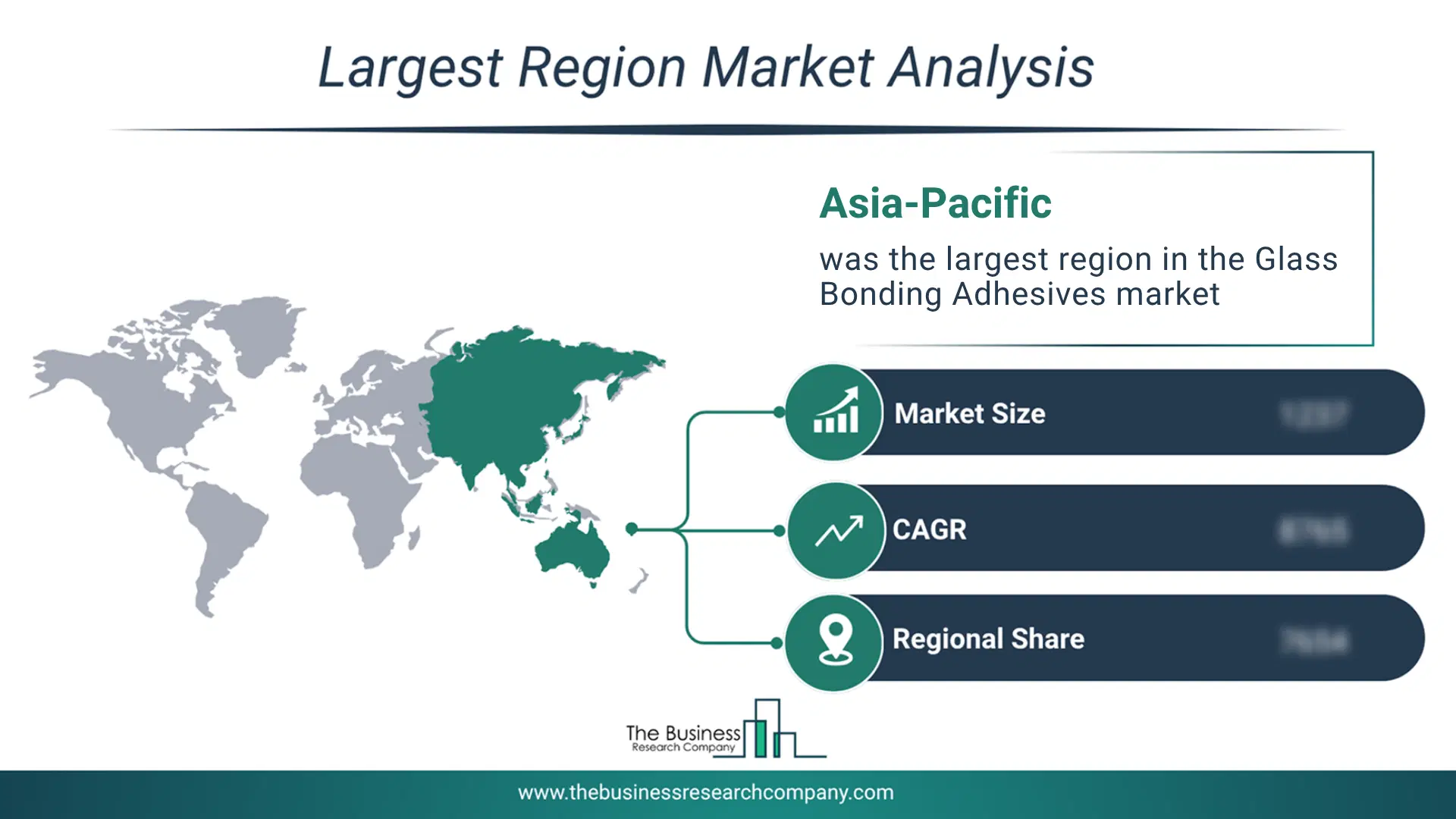
Regional Insights
Asia-Pacific was the largest region in the glass bonding adhesives market in 2025. The regions covered in this market report are Asia-Pacific, South East Asia, Western Europe, Eastern Europe, North America, South America, Middle East, Africa The countries covered in this market report are Australia, Brazil, China, France, Germany, India, Indonesia, Japan, Taiwan, Russia, South Korea, UK, USA, Canada, Italy, SpainWhat Defines the Glass Bonding Adhesives Market?
The glass bonding adhesives market consists of sales of hot-melt adhesives, non-melt adhesives, reactive hot melt, thermosetting adhesives, pressure sensitive, and contact adhesive adhesives. Values in this market are ‘factory gate’ values, that is the value of goods sold by the manufacturers or creators of the goods, whether to other entities (including downstream manufacturers, wholesalers, distributors and retailers) or directly to end customers. The value of goods in this market includes related services sold by the creators of the goods.How is Market Value Defined and Measured?
The market value is defined as the revenues that enterprises gain from the sale of goods and/or services within the specified market and geography through sales, grants, or donations in terms of the currency (in USD unless otherwise specified). The revenues for a specified geography are consumption values that are revenues generated by organizations in the specified geography within the market, irrespective of where they are produced. It does not include revenues from resales along the supply chain, either further along the supply chain or as part of other products.
This chart presents market attractiveness based on a quantitative evaluation of growth, competition, strategic alignment, and risk, offering a clear view of opportunity areas for decision-making. This chart is for illustrative purposes; the full report contains the complete analysis.

This chart highlights the Total Addressable Market (TAM) by estimating the maximum revenue opportunity using an assumption-driven approach, supporting strategic planning and opportunity sizing across markets. The chart is illustrative; the full report provides a more comprehensive analysis.
What Key Data and Analysis Are Included in the Glass Bonding Adhesives Market Report 2026?
The glass bonding adhesives market research report is one of a series of new reports from The Business Research Company that provides market statistics, including industry global market size, regional shares, competitors with the market share, detailed market segments, market trends and opportunities, and any further data you may need to thrive in the glass bonding adhesives industry. The market research report delivers a complete perspective of everything you need, with an in-depth analysis of the current and future state of the industry.Glass Bonding Adhesives Market Report Forecast Analysis
| Report Attribute | Details |
|---|---|
| Market Size Value In 2026 | $3.94 billion |
| Revenue Forecast In 2030 | $5.44 billion |
| Growth Rate | CAGR of 9.0% from 2026 to 2030 |
| Base Year For Estimation | 2025 |
| Actual Estimates/Historical Data | 2020-2025 |
| Forecast Period | 2026 - 2030 |
| Market Representation | Revenue in USD Billion and CAGR from 2026 to 2030 |
| Segments Covered | Type, Application, End-Use Industry |
| Regional Scope | Asia-Pacific, Western Europe, Eastern Europe, North America, South America, Middle East, Africa |
| Country Scope | The countries covered in this market report are Australia, Brazil, China, France, Germany, India, Indonesia, Japan, Taiwan, Russia, South Korea, UK, USA, Canada, Italy, Spain |
| Key Companies Profiled | Arkema SA, Ashland Global Holdings Inc., Bohle AG, Chemence Ltd., Collano Adhesives AG, DELO Industrie Klebstoffe GmbH & Co KGaA, DIC Corporation, Dow Inc., DuPont de Nemours Inc., Dymax Corporation, Evonik Industries AG, Harvey Benjamin Fuller, Henkel AG & Co KGaA, Hexion Inc., Huntsman Corporation, Jowat SE, Kiwo Inc., Mapei SpA, Master Bond Inc., Minnesota Mining and Manufacturing Company, Momentive Performance Materials Inc., Permabond LLC, Pidilite Industries Limited, Scott Bader Company Ltd., Sika AG, Solvay SA, ThreeBond Group, Wacker Chemie AG |
| Customization Scope | Request for Customization |
| Pricing And Purchase Options | Explore Purchase Options |