
Contact Us
  Search
The Business Research Company Logo
Bioprocess Automation Global Market Opportunities And Strategies To 2035
Published :June 2026
Pages :390
Format :PDF
Delivery Time :2-3 Business Days
Why 2-3 days? We update the report with the latest data and news before delivery. Let us know if you need us to expedite.
Report Price :$4,490.00

Bioprocess Automation Global Market Opportunities And Strategies To 2035

By Component Of Process Control System (Sensors, Actuators, Controllers), By Scale Of Operation (Preclinical Operations, Clinical Operations, Commercial Operations), By Mode Of Operation (Batch, Fed-Batch, Perfusion), By Compatibility With Bioprocessing Systems (Single-Use Systems, Stainless Steel, Other Bioprocessing Systems), And By Region, Opportunities And Strategies – Global Forecast To 2035

Bioprocess Automation Market Definition

Bioprocess automation refers to the use of advanced control systems, sensors, robotics and software to monitor, manage and optimize biological manufacturing processes. These processes include cell culture, fermentation, purification and formulation in the production of biopharmaceuticals, vaccines and other biotechnology products. The primary purpose of bioprocess automation is to enhance process efficiency, consistency and product quality while reducing human error and operational costs. The bioprocess automation market consists of sales, by entities (organizations, sole traders, or partnerships), of bioprocess automation that is used whenever there is a need to control critical process parameters such as pH, temperature, dissolved oxygen and nutrient levels. It is commonly applied in cleanroom and Good Manufacturing Practices (GMP)-compliant manufacturing environments. The main complementary products to bioprocess automation include process analytical technologies (PAT), digital twin models and manufacturing execution systems (MES), while substitute products may include manual or semi-automated control systems.
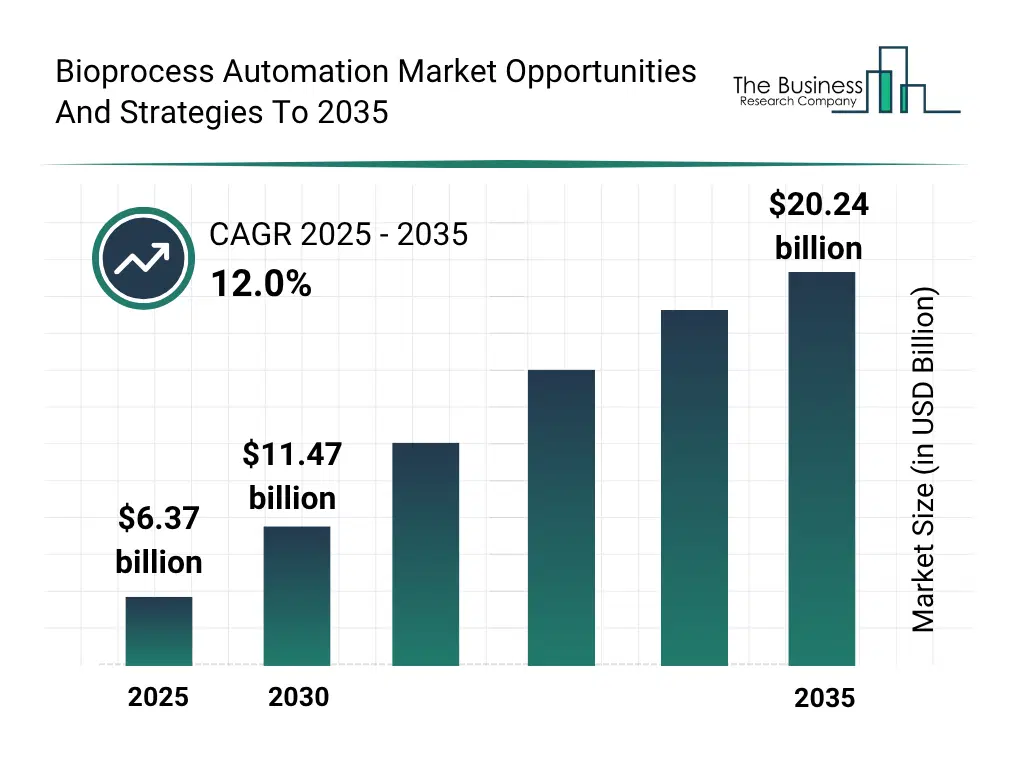
Bioprocess Automation Global Market Opportunities And Strategies To 2035 Market Size and growth rate 2026 to 2030: Graph

Bioprocess Automation Market Size

The global bioprocess automation market reached a value of nearly $6,365.0 million in 2025, having grown at a compound annual growth rate (CAGR) of 13.2% since 2020. The market is expected to grow from $6,365.0 million in 2025 to $11,466.2 million in 2030 at a rate of 12.5%. The market is then expected to grow at a CAGR of 12.0% from 2030 and reach $20,244.2 million in 2035. Growth in the historic period resulted from growing demand for personalized medicine, rising global demand for biologics, growth of cell and gene therapies and shortage of skilled workforce. Factors that negatively affected growth in the historic period were data security and cybersecurity concerns and limited standardization across platforms. Going forward, increasing prevalence of chronic diseases, expansion of contract development and manufacturing organizations (CDMOs) and outsourcing, rising investments in biotech research and development (R&D) and expansion of vaccine production will drive the growth. Factors that could hinder the growth of the bioprocess automation market in the future include high capital investment requirement, complexity in system integration and impact of trade war and tariff.
Research Expert

Book your 30 minutes free consultation with our research experts

Bioprocess Automation Market Segmentation The bioprocess automation market is segmented by component of process control system, by scale of operation, by mode of operation and by compatibility with bioprocessing systems.

By Component Of Process Control System –
The bioprocess automation market is segmented by component of process control system into:
    • a) Sensors
    • b) Actuators
    • c) Controllers
The controllers market was the largest segment of the bioprocess automation market segmented by component of process control system, accounting for 39.9% or $2,539.1 million of the total in 2025. Going forward, the sensors segment is expected to be the fastest-growing segment in the bioprocess automation market segmented by component of process control system, at a CAGR of 13.8% during 2025-2030.

By Scale Of Operation –
The bioprocess automation market is segmented by scale of operation into:
    • a) Preclinical Operations
    • b) Clinical Operations
    • c) Commercial Operations
The commercial operations was the largest segment of the bioprocess automation market segmented by scale of operation, accounting for 65.7% or $4,178.7 million of the total in 2025. Going forward, the preclinical operations segment is expected to be the fastest-growing segment in the bioprocess automation market segmented by scale of operation, at a CAGR of 14.0% during 2025-2030.

By Mode Of Operation –
The bioprocess automation market is segmented by mode of operation into:
    • a) Batch
    • b) Fed-Batch
    • c) Perfusion
The fed-batch market was the largest segment of the bioprocess automation market segmented by mode of operation, accounting for 46.5% or $2,960.1 million of the total in 2025. Going forward, the perfusion segment is expected to be the fastest-growing segment in the bioprocess automation market segmented by mode of operation, at a CAGR of 18.7% during 2025-2030.

By Compatibility With Bioprocessing Systems –
The bioprocess automation market is segmented by compatibility with bioprocessing systems into:
    • a) Single-Use Systems
    • b) Stainless Steel
    • c) Other Bioprocessing Systems
The single-use systems market was the largest segment of the bioprocess automation market segmented by compatibility with bioprocessing systems, accounting for 46.4% or $2,951.9 million of the total in 2025. Going forward, the single-use systems segment is expected to be the fastest-growing segment in the bioprocess automation market segmented by compatibility with bioprocessing systems, at a CAGR of 15.9% during 2025-2030.

By Geography - The bioprocess automation market is segmented by geography into:
      o Asia Pacific
      • China
      • India
      • Japan
      • Australia
      • Indonesia
      • South Korea
      o North America
      • USA
      • Canada
      o South America
      • Brazil
      o Western Europe
      • France
      • Germany
      • UK
      • Italy
      • Spain
      o Eastern Europe
      • Russia
      o Middle East
      o Africa
North America was the largest region in the bioprocess automation market, accounting for 42.0% or $2,670.2 million of the total in 2025. It was followed by Asia Pacific, Western Europe and then the other regions. Going forward, the fastest-growing regions in the bioprocess automation market will be Asia Pacific and Middle Eastwhere growth will be at CAGRs of 14.0% and 13.5% respectively. These will be followed by North America and South America where the markets are expected to grow at CAGRs of 12.0% and 11.9% respectively.

Bioprocess Automation Market Drivers

The key drivers of the bioprocess automation market include: Increasing Prevalence Of Chronic Diseases Increasing prevalence of chronic diseases is expected to be a key driver of the growth of the bioprocess automation market in the forecast period. The growing burden of chronic diseases such as diabetes, cardiovascular disorders, autoimmune conditions and cancers is driving demand for biologic therapies, including insulin, monoclonal antibodies, recombinant proteins and cell and gene therapies. These biologics are highly complex to manufacture and require precise control of living systems, which cannot be reliably achieved through manual processes alone. Bioprocess automation ensures reproducibility, reduces variability and maintains compliance with stringent regulatory standards, making it a critical enabler of scalable production. The growth in increasing prevalence of chronic diseases growth contribution during the forecast period in 2025 is 1.3%.

Bioprocess Automation Market Restraints

The key restraints on the bioprocess automation market include: High Capital Investment Requirements High capital investment requirements are restricting the growth of the bioprocess automation market during the forecast period. Bioprocess automation systems involve significant upfront costs for equipment, software, integration and validation. Many biopharmaceutical manufacturers, especially smaller firms or those in emerging markets, may struggle to allocate such resources. This financial barrier can slow adoption and limit broader market penetration, particularly when balancing investment against uncertain product pipelines. In addition, long return-on-investment timelines can make stakeholders hesitant to commit funds. This creates a gap where larger global players adopt faster while smaller players lag behind. Growth affected by high capital investment requirements during the forecast period in 2025 is -2.0%.

Bioprocess Automation Market Competitive Landscape

Major Competitors are:

  • Thermo Fisher Scientific Inc.
  • Danaher Corporation (Cytia)
  • Sartorius AG
  • Lonza Group AG
  • Merck KGaA (MilliporeSigma)
  • Other Competitors Include:

  • F. Hoffmann-La Roche Ltd.
  • Siemens AG
  • Rockwell Automation Inc.
  • Emerson Electric Co.
  • Waters Corporation
  • WuXi Biologics
  • Sino-Biocan (Shanghai) Biotech Ltd.
  • Körber AG
  • Bailun Biotechnology Co., Ltd.
  • Shanghai Baoxing Bio-Engineering Equipment (BXBIO)
  • MIKEBIO (Jiangsu Mike Biotechnology)
  • Jichen Bio
  • Nanjing BioWill Biological Engineering
  • TIANGEN Biotech (TEasy lab automation)
  • Marubishi Bioengineering Co. Ltd.
  • BIOTEC Co., Ltd.
  • Yokogawa Electric Corporation
  • ABB Robotics
  • Ajinomoto Co. Inc.
  • Micro Digital Co.
  • BioSystemENG Co. Ltd.
  • Biostream Co. Ltd.
  • Leadgene Biosolutions Co., Ltd.
  • Mycenax Biotech Inc.
  • Amaran Biotechnology Inc.
  • AstraZeneca
  • Eppendorf SE
  • Syntegon
  • Solaris Biotech
  • BIONET
  • Parker-Hannifin Corporation
  • Infors AG
  • DISTek Integration
  • SyVento Biotech
  • ILS Automation LLC
  • Curi Bio, Inc.
  • Repligen Corporation
  • Flotek Industries Inc.
  • Automated Control Concepts Inc.
  • Flownamics Analytical Instruments Inc.
  • Beckman Coulter Life Sciences
  • Molecular Devices
  • Nirrin Technologies
  • New Wave Biotech
  • Bio-Rad Laboratories, Inc.
  • Pall Corporation
  • Bruker Corporation
  • ATS Life Sciences
  • Everest Automation
  • Amgen
  • Pharmaconex
  • Anasia Process Automation
  • INTECH Process Automation Nigeria LTD
  • Need data on a specific region in this market?

    Opportunities And Recommendations In The Bioprocess Automation Market

    Opportunities – The top opportunities in the bioprocess automation market segmented by component of process control system will arise in the sensors segment, which will gain $2,019.4 million of global annual sales by 2030. The top opportunities in the bioprocess automation market segmented by scale of operation will arise in the commercial operations segment, which will gain $3,207.4 million of global annual sales by 2030. The top opportunities in the bioprocess automation market segmented by mode of operation will arise in the fed-batch segment, which will gain $2,558.6 million of global annual sales by 2030. The top opportunities in the bioprocess automation market segmented by compatibility with bioprocessing systems will arise in the single-use systems segment, which will gain $3,210.2 million of global annual sales by 2030. The bioprocess automation market size will gain the most in the USA at $1,863.4 million. Recommendations- To take advantage of the opportunities, The Business Research Company recommends the bioprocess automation companies to focus on AI-driven bioprocess control integration, focus on AI-enabled multi-channel biosensing platforms, focus on intelligent closed-loop cell processing systems, focus on high-throughput automated bioprocess development platforms, focus on distributed control systems for integrated bioprocess automation, focus on fastest growing sensors segment in bioprocess automation, focus on preclinical operations in bioprocess automation, focus on perfusion-based continuous bioprocess automation, expand in emerging markets, focus on hybrid distribution networks for bioprocess automation expansion, focus on value based and modular pricing strategies in bioprocess automation, focus on digital first technical promotion and thought leadership, focus on strategic industry partnerships and event driven promotion and focus on single-use systems for scalable bioprocess automation.
    Chat with us