

Carbon Dioxide Enhanced Oil Recovery (CO₂ EOR) Market Report 2026
Global Outlook – By Source (Natural CO2, Anthropogenic (Man-Made) CO2, Captured CO2), By Technology (Cyclic CO2 Injection, Continuous CO2 Injection, CO2 Flooding), By Application (Conventional Oil Fields, Unconventional Oil And Gas Reservoirs, Mature Or Declining Oil Fields), By End-User (Oil And Gas Business, Independent Operators) – Market Size, Trends, Strategies, and Forecast to 2030
Carbon Dioxide Enhanced Oil Recovery (CO? EOR) Market Overview
• Carbon Dioxide Enhanced Oil Recovery (CO? EOR) market size has reached to $2.38 billion in 2025 • Expected to grow to $3.33 billion in 2030 at a compound annual growth rate (CAGR) of 6.9% • Growth Driver: Increase In Crude Oil Production Fueling The Growth Of The Market Due To Higher Demand For Enhanced Recovery Technologies • Market Trend: Innovative CO? EOR Pilot Deployments Accelerating Efficiency And Low-Carbon Recovery In Mature Oil Fields • North America was the largest region in 2025 and Asia-Pacific is the fastest growing region.Market Gains By 2030 – Top Opportunities By Segment
Market Gain identifies the most promising market opportunities by highlighting the segments or products expected to generate the highest incremental revenue growth over the next five years.
What Is Covered Under Carbon Dioxide Enhanced Oil Recovery (CO₂ EOR) Market?
Carbon dioxide enhanced oil recovery (CO₂ EOR) is a petroleum extraction technique that involves injecting carbon dioxide into depleted or mature oil reservoirs to increase pressure and reduce the viscosity of remaining oil, allowing it to flow more easily to production wells. It is widely used to improve recovery rates from existing fields while also offering the potential for long-term underground CO₂ storage. The main sources of carbon dioxide enhanced oil recovery (CO₂ EOR) are natural CO₂, anthropogenic (man-made) CO₂, and captured CO₂. Natural CO₂ refers to carbon dioxide that occurs in the environment without human intervention. It is typically released from geological sources such as volcanic eruptions, hot springs, and natural underground reservoirs. The multiple technologies involved are cyclic CO₂ injection, continuous CO₂ injection, and CO₂ flooding. The various applications include conventional oil fields, unconventional oil and gas reservoirs, and mature or declining oil fields and are used by several end-users such as oil and gas businesses and independent operators.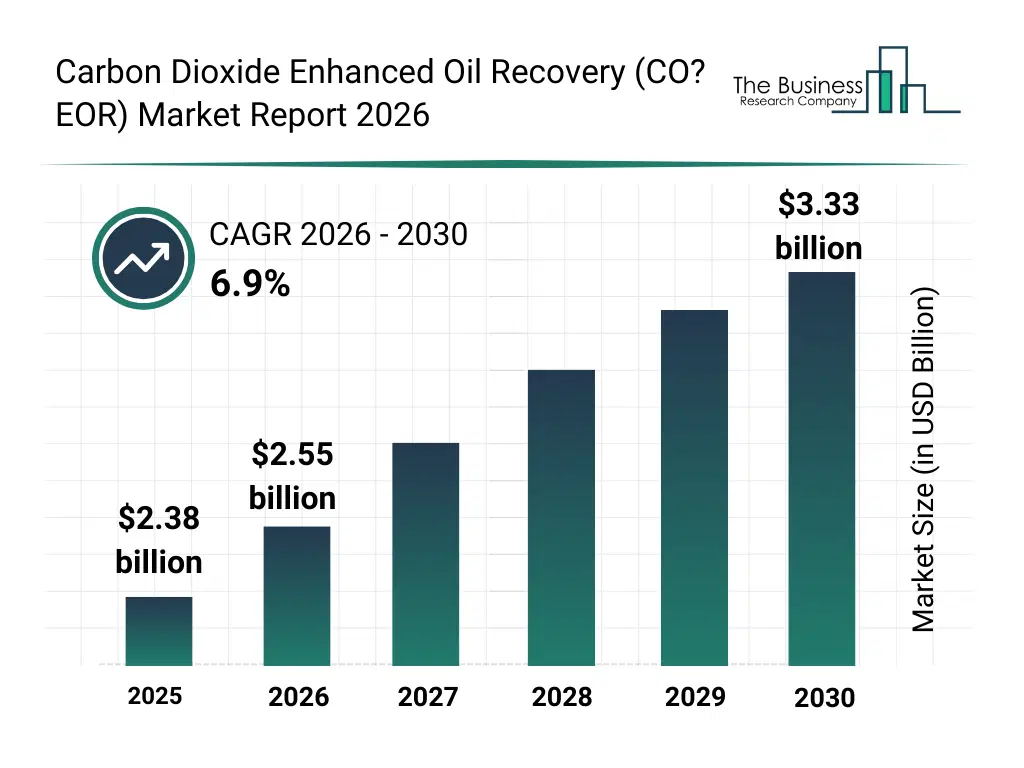
What Is The Carbon Dioxide Enhanced Oil Recovery (CO₂ EOR) Market Size and Share 2026?
The carbon dioxide enhanced oil recovery (co₂ eor) market size has grown strongly in recent years. It will grow from $2.38 billion in 2025 to $2.55 billion in 2026 at a compound annual growth rate (CAGR) of 7.2%. The growth in the historic period can be attributed to declining production from mature oil fields, need for enhanced recovery methods, availability of natural CO₂ sources, oil price volatility, infrastructure development for CO₂ transport.What Is The Carbon Dioxide Enhanced Oil Recovery (CO₂ EOR) Market Growth Forecast?
The carbon dioxide enhanced oil recovery (co₂ eor) market size is expected to see strong growth in the next few years. It will grow to $3.33 billion in 2030 at a compound annual growth rate (CAGR) of 6.9%. The growth in the forecast period can be attributed to carbon emission reduction initiatives, expansion of CCUS projects, increasing focus on low carbon oil production, government incentives for CO₂ utilization, demand for improved recovery efficiency. Major trends in the forecast period include rising adoption of CO₂ injection techniques, integration of carbon capture with EOR, expansion of mature field recovery projects, growth in CO₂ storage linked EOR, focus on maximizing recovery from existing fields.
Global Carbon Dioxide Enhanced Oil Recovery (CO₂ EOR) Market Segmentation
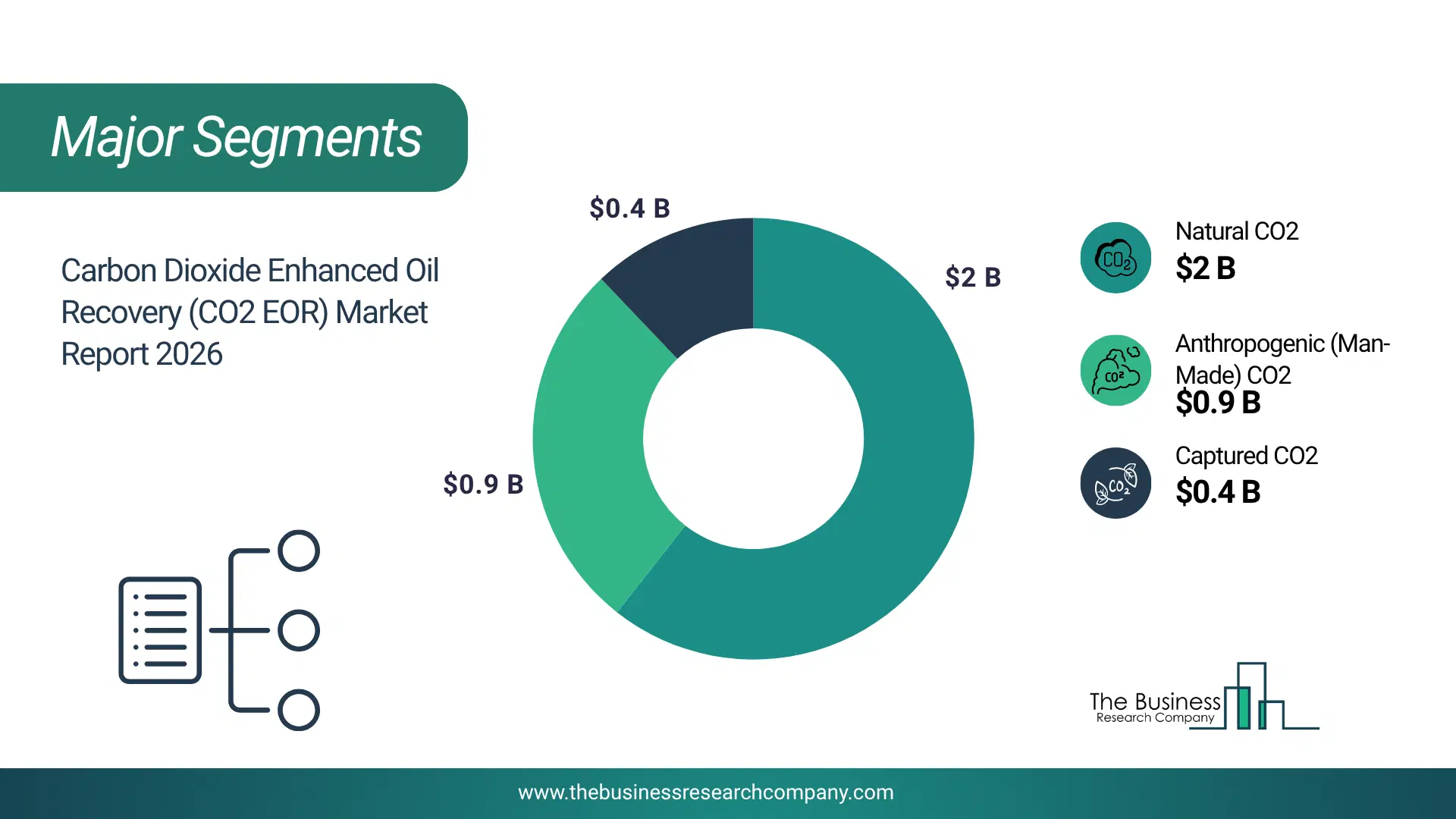
1) By Source: Natural CO2, Anthropogenic (Man-Made) CO2, Captured CO2 2) By Technology: Cyclic CO2 Injection, Continuous CO2 Injection, CO2 Flooding 3) By Application: Conventional Oil Fields, Unconventional Oil And Gas Reservoirs, Mature Or Declining Oil Fields 4) By End-User: Oil And Gas Business, Independent Operators Subsegments: 1) By Natural CO2: Mined CO₂ Reservoirs, Naturally Occurring Underground CO₂ Domes, Volcanic-Origin CO₂ Sources 2) By Anthropogenic (Man-Made) CO2: CO₂ From Power Generation Plants, CO₂ From Industrial Manufacturing Facilities, CO₂ From Refineries And Petrochemical Plants, CO₂ From Fertilizer And Ammonia Production 3) By Captured CO2: Post-Combustion Captured CO₂, Pre-Combustion Captured CO₂, Oxy-Fuel Combustion Captured CO₂, Direct Air Capture (DAC) CO₂ The top segments in the carbon dioxide enhanced oil recovery (co2 eor) market will be: • Natural CO2 will reach $1.79 Billion by 2030. • Anthropogenic (Man-Made) CO2 will reach $0.87 Billion by 2030. • Captured CO2 will reach $0.41 Billion by 2030.What Is The Driver Of The Carbon Dioxide Enhanced Oil Recovery (CO₂ EOR) Market?
The increasing crude oil production is expected to propel the growth of the carbon dioxide enhanced oil recovery (CO₂ EOR) market going forward. Crude oil production refers to the process of extracting unrefined petroleum from underground reservoirs through drilling and other extraction techniques. Crude oil production is increasing due to intensified drilling activity, which is enabling higher extraction rates and boosting overall output. Carbon dioxide enhanced oil recovery increases crude oil production by injecting CO₂ into reservoirs to mobilize trapped hydrocarbons, improve sweep efficiency, and boost the overall recovery rate from mature fields. For instance, in November 2025, according to the International Energy Agency, a France-based intergovernmental organization, the global oil supply is expected to increase by an average of 3.1 mb/d in 2025 and 2.5 mb/d in 2026, reaching 108.7 mb/d. Therefore, the increasing crude oil production is driving the growth of the carbon dioxide enhanced oil recovery (CO₂ EOR) industry.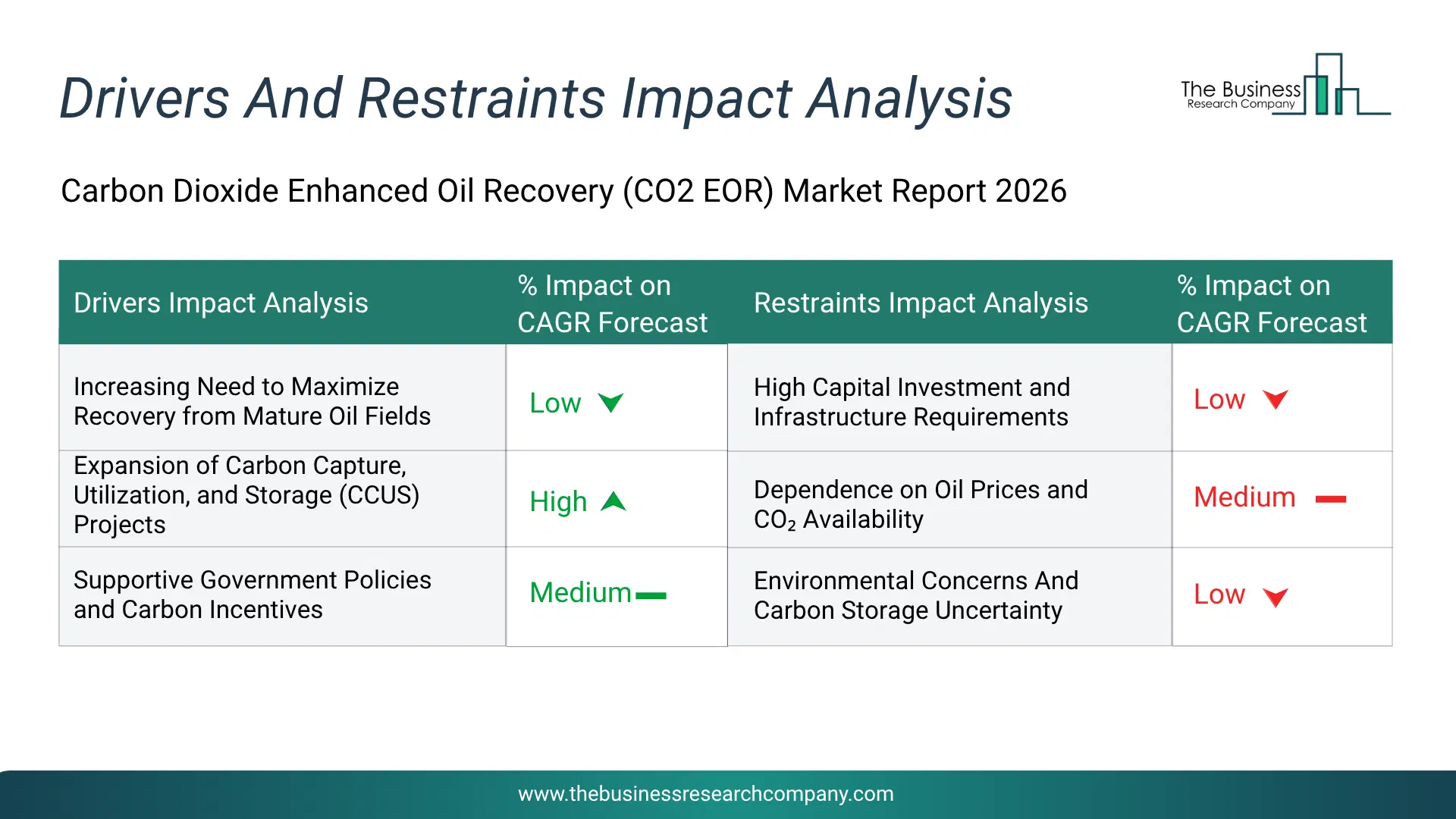
Infographic Chart Showing Key Market Drivers Analysis And Restraints For Carbon Dioxide Enhanced Oil Recovery (Co₂ Eor) Market
The chart presents an impact analysis of key drivers and restraints, quantifying their relative influence on the market's growth rate and helping assess the balance between growth enablers and limiting factors. This chart offers a high-level perspective; the full report contains more detailed insights.
How Will The Drivers Impact Growth In The Global Carbon Dioxide Enhanced Oil Recovery (CO2 EOR) Market?
• Increasing Need to Maximize Recovery from Mature Oil Fields (Low) – During the forecast period, the increasing need to maximize recovery from mature oil fields is expected to become a key growth driver for the carbon dioxide enhanced oil recovery (CO2 EOR) market by 2030. A significant share of global oil production comes from mature reservoirs with declining natural pressure. CO?-EOR enables operators to recover an additional 10-20% of original oil in place, extending the productive life of existing fields. This improves asset utilization while delaying the need for new field development. As conventional reserves mature worldwide, demand for CO?-EOR services continues to rise. • Expansion of Carbon Capture, Utilization, and Storage (CCUS) Projects (High) – During the forecast period, the expansion of carbon capture, utilization, and storage (CCUS) projects is expected to emerge as a major factor driving the expansion of the carbon dioxide enhanced oil recovery (CO2 EOR) market by 2030. Governments and energy companies are investing heavily in CCUS to reduce industrial carbon emissions. CO?-EOR provides a commercially viable utilization pathway for captured carbon dioxide while enabling long-term geological storage. The integration of CCUS with EOR improves project economics by generating oil revenues alongside emissions reduction. This dual benefit is accelerating adoption globally. • Supportive Government Policies and Carbon Incentives (Medium) – During the forecast period, the supportive government policies and carbon incentives is expected to act as a key growth catalyst for the carbon dioxide enhanced oil recovery (CO2 EOR) market by 2030. Several countries have introduced tax credits, grants, and regulatory incentives to encourage carbon capture and storage projects. Policies supporting emissions reduction improve the financial viability of CO?-EOR operations using captured CO?. These incentives encourage operators to invest in carbon management infrastructure and enhanced recovery technologies.How Will The Restraints Impact Growth In The Global Carbon Dioxide Enhanced Oil Recovery (CO2 EOR) Market?
• High Capital Investment and Infrastructure Requirements (Low) – During the forecast period, the cO₂-EOR projects require substantial investment in CO₂ capture facilities, compression systems, transportation pipelines, injection wells, and monitoring infrastructure. These high upfront costs can limit adoption, particularly in regions lacking existing CO₂ transport networks. Long project payback periods further increase investment risk. Consequently, commercialization remains concentrated in established oil-producing regions. • Dependence on Oil Prices and CO₂ Availability (High) – During the forecast period, the the economic feasibility of CO₂-EOR is highly sensitive to crude oil prices because project revenues depend on incremental oil production. During periods of low oil prices, operators often postpone or cancel EOR investments. In addition, limited access to reliable and affordable CO₂ supplies can restrict project development. These factors create uncertainty in long-term market growth. • Environmental Concerns And Carbon Storage Uncertainty (Medium) – During the forecast period, the environmental concerns and carbon storage uncertainty act as a restraint on the Carbon Dioxide Enhanced Oil Recovery (CO2 EOR) market because questions remain regarding the long-term effectiveness of CO₂ storage and the potential environmental impact of injection activities. Leakage risks, monitoring requirements, and concerns about underground carbon movement can create regulatory and public acceptance challenges. Operators must invest in advanced monitoring systems and verification processes to ensure safe CO₂ management. These additional requirements increase project complexity and operational costs. Concerns regarding environmental performance may also influence investor confidence and regulatory approvals. As a result, carbon storage uncertainties can limit broader adoption of CO₂-EOR projects.Key Players In The Global Carbon Dioxide Enhanced Oil Recovery (CO₂ EOR) Market
Major companies operating in the carbon dioxide enhanced oil recovery (co₂ eor) market are ExxonMobil Corporation, Shell plc, BP plc, Chevron Corporation, Equinor ASA, Schlumberger Limited, Linde plc, Baker Hughes Company, Halliburton Company, Fluor Corporation, National Oilwell Varco, TechnipFMC plc, Weatherford International, SNF Group, Expro International Group, Aker Carbon Capture ASA, PanTerra Geoconsultants BV, Carbon Engineering Ltd., Ryder Scott Co. LPP, Occidental Petroleum Corporation, Denbury Inc., Kinder Morgan Inc., Mitsubishi Heavy Industries Ltd., Air Products And Chemicals Inc.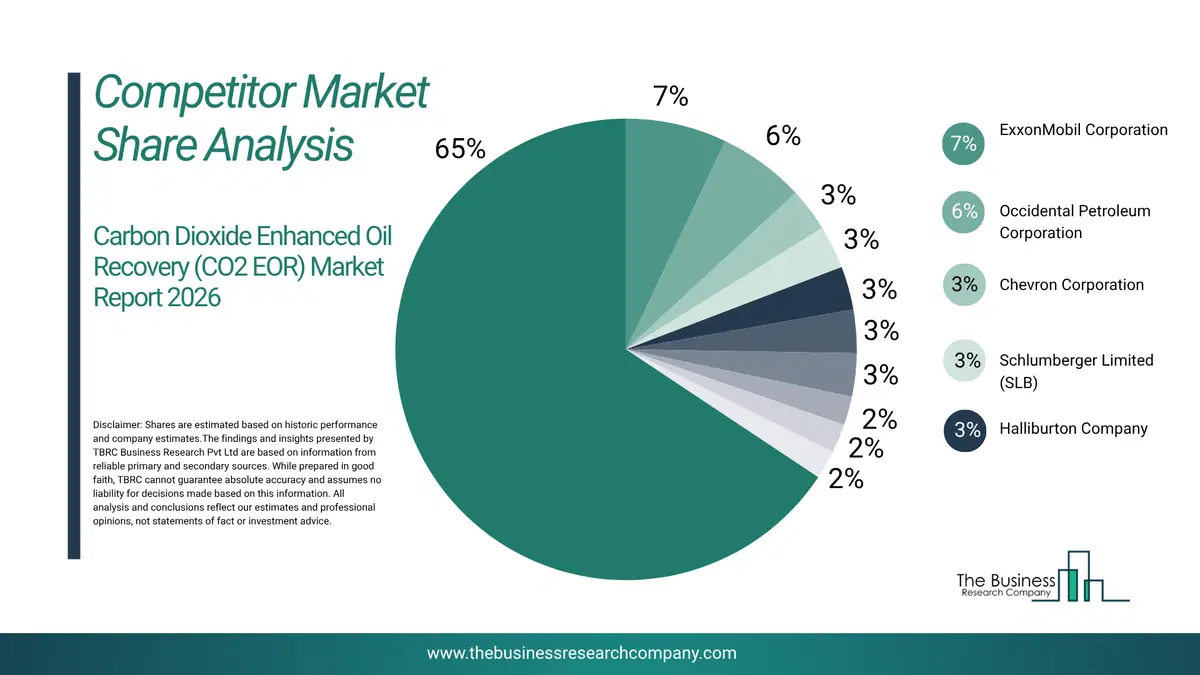
This chart is for illustrative purposes; the full report includes a detailed competitor analysis and comprehensive overview of the top 10 companies in the market.
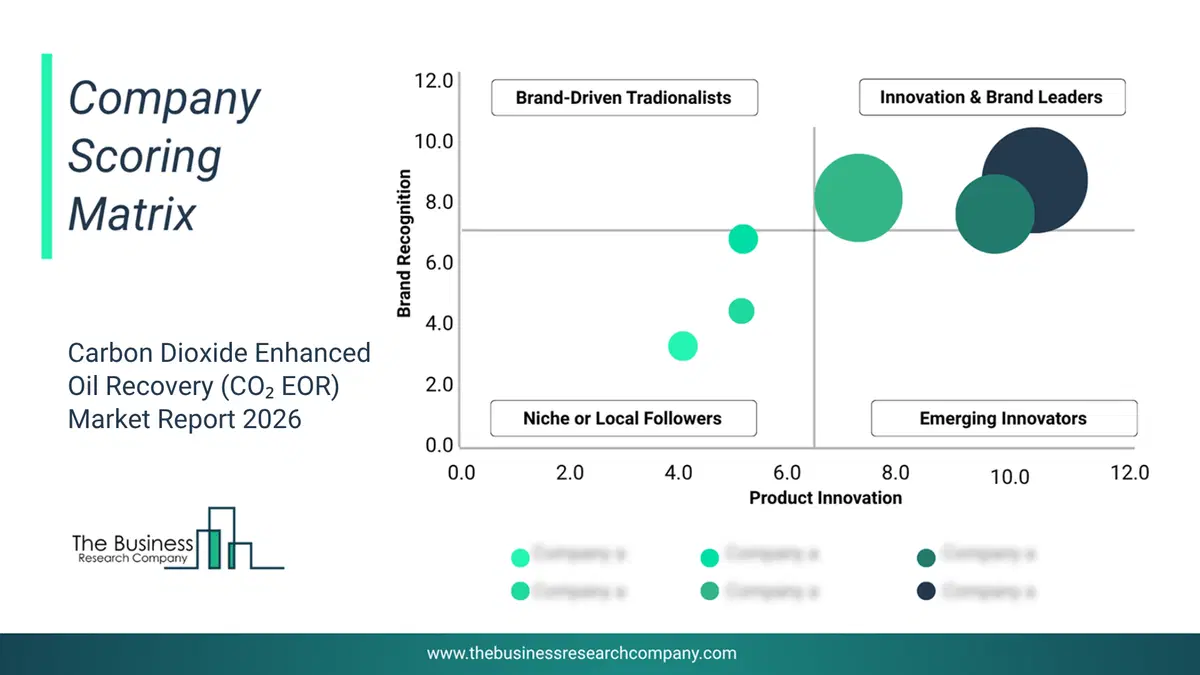
This chart maps companies by product innovation and brand strength, with bubble size indicating relative revenue, helping identify market leaders, challengers, and niche players. This is an illustrative chart; the full report provides a complete and accurate competitive analysis.
Global Carbon Dioxide Enhanced Oil Recovery (CO₂ EOR) Market Trends and Insights
Major companies operating in the carbon dioxide enhanced oil recovery (CO₂ EOR) market are focusing on developing innovative solutions, such as CO₂ EOR pilot deployment, to validate reservoir performance, optimize CO₂ utilization, and enhance recovery efficiency in mature oil fields. CO₂ EOR pilot deployment refers to a small-scale, controlled implementation of carbon dioxide injection into a mature oil reservoir to evaluate the technical and economic feasibility of using CO₂ enhanced oil recovery. For instance, in November 2023, Petroleum Development Oman, an Oman based crude oil industry company, launched the CO₂ Enhanced Oil Recovery Project in Oman. It incorporates advanced monitoring technologies, including continuous sensor-based surveillance of CO₂ movement and reservoir pressure, ensuring precise control and optimized injection performance. The project also demonstrates the use of existing gas-processing infrastructure for CO₂ handling, enhancing efficiency and reducing development costs. This initiative supports Oman’s broader sustainability strategy by coupling enhanced production with a long-term carbon-management approach, positioning it as a pioneering step toward low-carbon oil extraction in the region.What Are Latest Mergers And Acquisitions In The Carbon Dioxide Enhanced Oil Recovery (CO₂ EOR) Market?
In July 2023, ExxonMobil Corporation, a US-based oil and gas company, acquired Denbury Inc. for $4.9 billion. With this acquisition, ExxonMobil aims to expand its carbon capture and storage network and strengthen its leadership in low-carbon solutions. Denbury Inc. is a US-based company that specializes in conducting enhanced oil recovery (EOR) operations using carbon dioxide (CO₂) injection.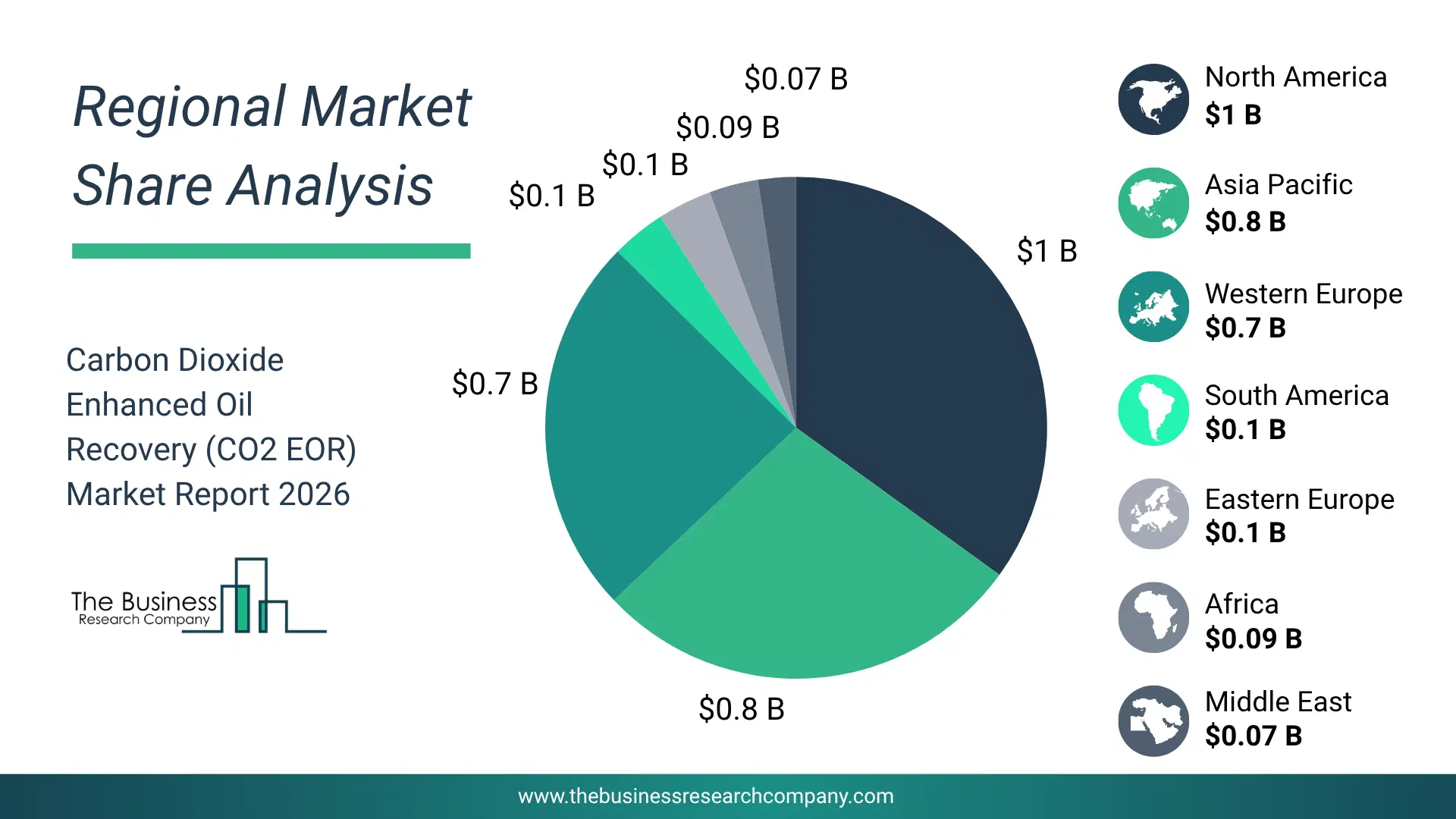
Regional Outlook
North America was the largest region in the carbon dioxide enhanced oil recovery (CO₂ EOR) market in 2025. Asia-Pacific is expected to be the fastest-growing region in the forecast period. The regions covered in the carbon dioxide enhanced oil recovery (co₂ eor) market report are Asia-Pacific, South East Asia, Western Europe, Eastern Europe, North America, South America, Middle East, Africa. The countries covered in the carbon dioxide enhanced oil recovery (co₂ eor) market report are Australia, Brazil, China, France, Germany, India, Indonesia, Japan, Taiwan, Russia, South Korea, UK, USA, Canada, Italy, SpainWhat Defines the Carbon Dioxide Enhanced Oil Recovery (CO₂ EOR) Market?
The carbon dioxide enhanced oil recovery (CO₂ EOR) market includes revenues earned by entities by providing services such as reservoir evaluation and modeling, CO₂ injection services, enhanced oil recovery operations management, and carbon storage and verification services. The market value includes the value of related goods sold by the service provider or included within the service offering. Only goods and services traded between entities or sold to end consumers are included.How is Market Value Defined and Measured?
The market value is defined as the revenues that enterprises gain from the sale of goods and/or services within the specified market and geography through sales, grants, or donations in terms of the currency (in USD unless otherwise specified). The revenues for a specified geography are consumption values that are revenues generated by organizations in the specified geography within the market, irrespective of where they are produced. It does not include revenues from resales along the supply chain, either further along the supply chain or as part of other products.
This chart presents market attractiveness based on a quantitative evaluation of growth, competition, strategic alignment, and risk, offering a clear view of opportunity areas for decision-making. This chart is for illustrative purposes; the full report contains the complete analysis.

This chart highlights the Total Addressable Market (TAM) by estimating the maximum revenue opportunity using an assumption-driven approach, supporting strategic planning and opportunity sizing across markets. The chart is illustrative; the full report provides a more comprehensive analysis.
What Key Data and Analysis Are Included in the Carbon Dioxide Enhanced Oil Recovery (CO₂ EOR) Market Report 2026?
The carbon dioxide enhanced oil recovery (co₂ eor) market research report is one of a series of new reports from The Business Research Company that provides market statistics, including industry global market size, regional shares, competitors with the market share, detailed market segments, market trends and opportunities, and any further data you may need to thrive in the carbon dioxide enhanced oil recovery (co₂ eor) industry. The market research report delivers a complete perspective of everything you need, with an in-depth analysis of the current and future state of the industry.Carbon Dioxide Enhanced Oil Recovery (CO₂ EOR) Market Report Forecast Analysis
| Report Attribute | Details |
|---|---|
| Market Size Value In 2026 | $2.55 billion |
| Revenue Forecast In 2030 | $3.33 billion |
| Growth Rate | CAGR of 6.9% from 2026 to 2030 |
| Base Year For Estimation | 2025 |
| Actual Estimates/Historical Data | 2020-2025 |
| Forecast Period | 2026 - 2030 |
| Market Representation | Revenue in USD Billion and CAGR from 2026 to 2030 |
| Segments Covered | Source, Technology, Application, End-User |
| Regional Scope | Asia-Pacific, Western Europe, Eastern Europe, North America, South America, Middle East, Africa |
| Country Scope | The countries covered in the report are Australia, Brazil, China, France, Germany, India, ... |
| Key Companies Profiled | ExxonMobil Corporation, Shell plc, BP plc, Chevron Corporation, Equinor ASA, Schlumberger Limited, Linde plc, Baker Hughes Company, Halliburton Company, Fluor Corporation, National Oilwell Varco, TechnipFMC plc, Weatherford International, SNF Group, Expro International Group, Aker Carbon Capture ASA, PanTerra Geoconsultants BV, Carbon Engineering Ltd., Ryder Scott Co. LPP, Occidental Petroleum Corporation, Denbury Inc., Kinder Morgan Inc., Mitsubishi Heavy Industries Ltd., Air Products And Chemicals Inc. |
| Customization Scope | Request for Customization |
| Pricing And Purchase Options | Explore Purchase Options |