
Nano Antibodies Market Report 2026
Global Outlook – By Product (Single-Domain Antibodies, Heavy-Chain Antibodies, Recombinant Nano Antibodies, Conjugated Nano Antibodies, Bispecific And Multispecific Nano Antibodies), By Technology (Phage Display Technology, Recombinant Deoxyribonucleic Acid (DNA) Technology, Molecular Cloning), By Source (Animal-Derived, Recombinant, Plant-Derived), By Application (Disease Detection In Vitro, Non-Invasive Diagnosis In Vivo, Tumor Targeted Therapy, Nervous System Disease, Circulatory Disease, Infectious Disease, Other Applications), By End-User (Pharmaceutical Companies, Biotechnology Firms, Academic And Research Institutions, Hospitals And Diagnostic Laboratories) - Market Size, Trends, Strategies, and Forecast to 2030
Nano Antibodies Market Overview
• Nano Antibodies market size has reached to $1.8 billion in 2025 • Expected to grow to $3.79 billion in 2030 at a compound annual growth rate (CAGR) of 15.9% • Growth Driver: The Rise In Demand For Personalized Medicines Driving The Growth Of The Market Due To Increasing Prevalence Of Chronic And Rare Diseases • Market Trend: Advancing Therapeutic Innovation Through Multispecific And Fully Human Nanobody Development • North America was the largest region in 2025 and Asia-Pacific is the fastest growing region.What Is Covered Under Nano Antibodies Market?
Nano antibodies, also known as single-domain antibodies or nanobodies, are small antibody fragments derived from the unique heavy-chain antibodies found in camelids. They retain the full antigen-binding capacity of conventional antibodies but are more stable, easier to produce, and capable of binding to hidden or hard-to-reach epitopes. The main products of nano antibodies are single-domain antibodies, heavy-chain antibodies, recombinant nano antibodies, conjugated nano antibodies, and bispecific and multispecific nano antibodies. Single-domain antibodies refer to small, stable antibody fragments derived from heavy-chain-only antibodies that retain full antigen-binding capability and are used for therapeutic, diagnostic, and research applications. They are developed using various technologies such as phage display technology, recombinant deoxyribonucleic acid (DNA) technology, and molecular cloning, and developed using sources such as animal-derived, recombinant, and plant-derived origins. These antibodies are used in a wide range of applications, including disease detection in vitro, non-invasive diagnosis in vivo, tumor-targeted therapy, nervous system disease, circulatory disease, infectious disease, and others, and cater to end-users including pharmaceutical companies, biotechnology firms, academic and research institutions, and hospitals and diagnostic laboratories.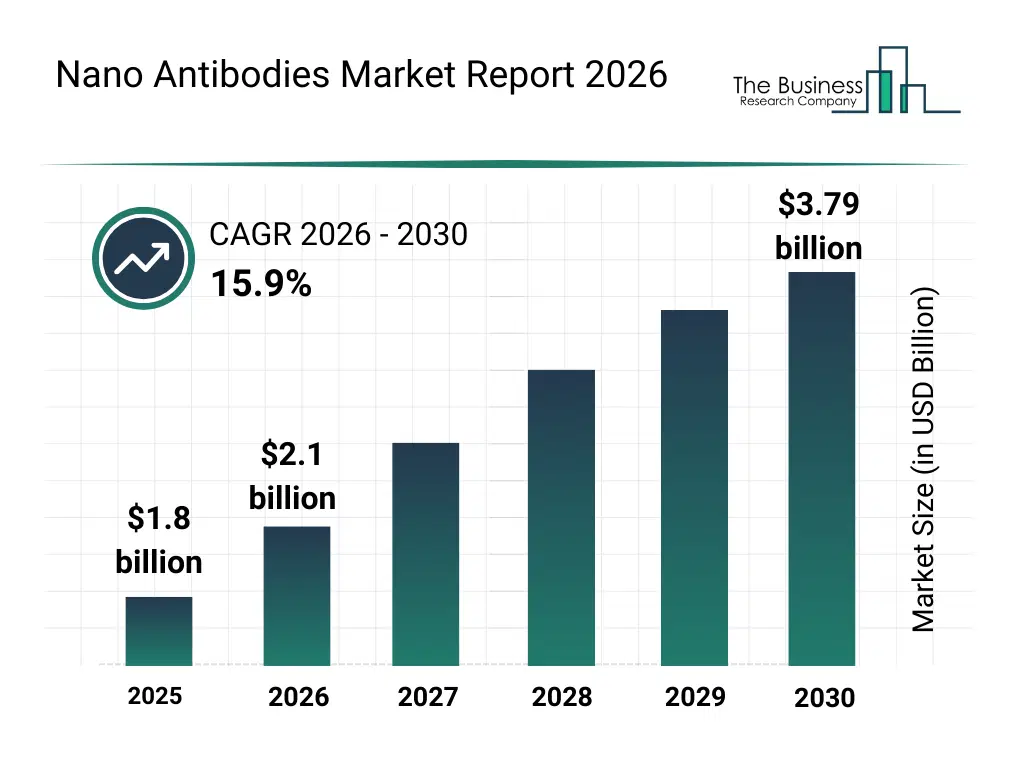
What Is The Nano Antibodies Market Size and Share 2026?
The nano antibodies market size has grown rapidly in recent years. It will grow from $1.8 billion in 2025 to $2.1 billion in 2026 at a compound annual growth rate (CAGR) of 16.2%. The growth in the historic period can be attributed to advances in antibody engineering research, discovery of camelid antibody structures, early clinical validation studies, expansion of biotechnology research funding, improvements in recombinant expression systems.What Is The Nano Antibodies Market Growth Forecast?
The nano antibodies market size is expected to see rapid growth in the next few years. It will grow to $3.79 billion in 2030 at a compound annual growth rate (CAGR) of 15.9%. The growth in the forecast period can be attributed to growing demand for precision therapeutics, increasing investments in biologics development, expansion of oncology and infectious disease pipelines, advancements in molecular targeting technologies, rising interest in next-generation antibody formats. Major trends in the forecast period include increasing development of target-specific nano antibodies, rising use in diagnostic and imaging applications, growing adoption in targeted cancer therapies, expansion of recombinant production platforms, enhanced focus on multispecific antibody engineering.
Global Nano Antibodies Market Segmentation
1) By Product: Single-Domain Antibodies, Heavy-Chain Antibodies, Recombinant Nano Antibodies, Conjugated Nano Antibodies, Bispecific And Multispecific Nano Antibodies 2) By Technology: Phage Display Technology, Recombinant Deoxyribonucleic Acid (DNA) Technology, Molecular Cloning 3) By Source: Animal-Derived, Recombinant, Plant-Derived 4) By Application: Disease Detection In Vitro, Non-Invasive Diagnosis In Vivo, Tumor Targeted Therapy, Nervous System Disease, Circulatory Disease, Infectious Disease, Other Applications 5) By End-User: Pharmaceutical Companies, Biotechnology Firms, Academic And Research Institutions, Hospitals And Diagnostic Laboratories Subsegments: 1) By Single-Domain Antibodies: Human Single-Domain Antibodies, Camelid Single-Domain Antibodies, Synthetic Single-Domain Antibodies, Shark-Derived Single-Domain Antibodies 2) By Heavy-Chain Antibodies: Camelid Heavy-Chain Antibodies, Shark Heavy-Chain Antibodies, Engineered Heavy-Chain Antibodies, Chimeric Heavy-Chain Antibodies 3) By Recombinant Nano Antibodies: Bacterial Expression Nano Antibodies, Yeast Expression Nano Antibodies, Mammalian Expression Nano Antibodies, Cell-Free Expression Nano Antibodies 4) By Conjugated Nano Antibodies: Drug-Conjugated Nano Antibodies, Fluorescent-Conjugated Nano Antibodies, Enzyme-Conjugated Nano Antibodies, Radiolabeled Nano Antibodies 5) By Bispecific And Multispecific Nano Antibodies: Dual-Target Nano Antibodies, Tri-Specific Nano Antibodies, Tetravalent Nano Antibodies, Multifunctional Nano AntibodiesWhat Is The Driver Of The Nano Antibodies Market?
The increasing demand for personalized medicines is expected to propel the growth of the nano antibodies market going forward. Personalized medicines refer to medical treatments that are tailored to an individual’s genetic makeup, lifestyle, and environment to ensure the most effective therapy for that specific patient. The increasing demand for personalized medicines is due to the rising prevalence of chronic and rare diseases, which necessitate targeted, patient-specific therapies for more effective treatment outcomes. Nano antibodies enable personalized medicine by offering highly specific, customizable, and targeted therapeutic solutions tailored to individual patient profiles and disease mechanisms. For instance, in February 2024, according to the Personalized Medicine Coalition, a US-based non-profit organization, in 2023, the FDA approved 16 new personalized therapies for patients with rare diseases, marking a substantial rise from the six approvals recorded in 2022. Therefore, increasing demand for personalized medicines is driving the growth of the nano antibodies industry.Key Players In The Global Nano Antibodies Market
Major companies operating in the nano antibodies market are Sanofi S.A., AstraZeneca plc, Bio-Rad Laboratories Inc., Bio-Techne Corporation, Innovent Biologics Inc., GenScript Biotech Corporation, Biocytogen Pharmaceuticals Co. Ltd., Beroni Group Limited., Cusabio Technology LLC, Harbour BioMed Co. Ltd., MoonLake Immunotherapeutics Co. Ltd., Alphamab Oncology Co. Ltd., Santa Cruz Biotechnology Inc., Rockland Immunochemicals Inc., Creative Biolabs Inc., Promab Biotechnologies Inc., ExeVir Bio N.V., Isogenica Ltd., Allele Biotechnology And Pharmaceuticals Inc., Gulliver Biomed Inc., Capralogics Inc.
This chart is for illustrative purposes; the full report includes a detailed competitor analysis and comprehensive overview of the top 10 companies in the market.
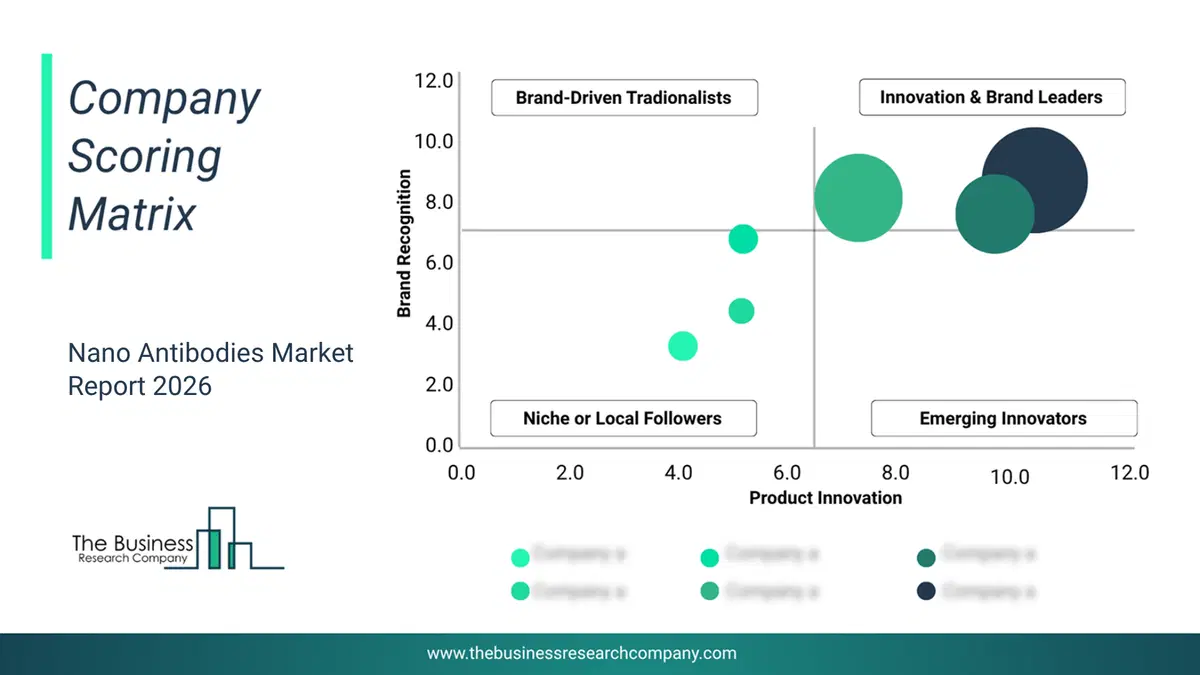
This chart maps companies by product innovation and brand strength, with bubble size indicating relative revenue, helping identify market leaders, challengers, and niche players. This is an illustrative chart; the full report provides a complete and accurate competitive analysis.
Global Nano Antibodies Market Trends and Insights
Major companies operating in the nanoantibodies market are focusing on developing innovative solutions such as fully multispecific therapeutics to enhance disease targeting and treatment efficacy. Fully multispecific therapeutics are advanced biologic drugs designed to simultaneously bind to two or more different targets, enabling more precise and effective treatment of complex diseases. For instance, in February 2023, Biocytogen Pharmaceuticals (Beijing) Co., Ltd., a China-based biopharmaceutical company, launched the Nano 100 Project to develop fully human nanobody therapeutics for more than 100 targets. The initiative utilizes Biocytogen’s proprietary RenNan mouse platform, which generates fully human nanobodies without requiring humanization. By integrating high-throughput in vitro and in vivo screening technologies, the project aims to accelerate target coverage and nanobody drug discovery. These nanobodies feature strong tissue penetration, stability, and engineering flexibility, making them well-suited for advanced therapeutic modalities such as cell therapies, bispecific antibodies, antibody-drug conjugates (ADCs), and radionuclide antibody conjugates. Ultimately, the Nano 100 Project seeks to streamline the development of novel therapeutics and deliver a broad range of high-affinity nanobody candidates for treating cancer, immune disorders, and neurological diseases.What Are Latest Mergers And Acquisitions In The Nano Antibodies Market?
In September 2024, Valerion Therapeutics LLC, a France-based biotechnology company, acquired Emglev Therapeutics for an undisclosed amount. With this acquisition, Valerio aimed to enhance its technological capabilities in antibody therapeutics and accelerate its pipeline expansion into next-generation immunotherapies. Emglev Therapeutics is a France-based company that specializes in single-domain antibodies (sdAbs), also commonly called nanobodies.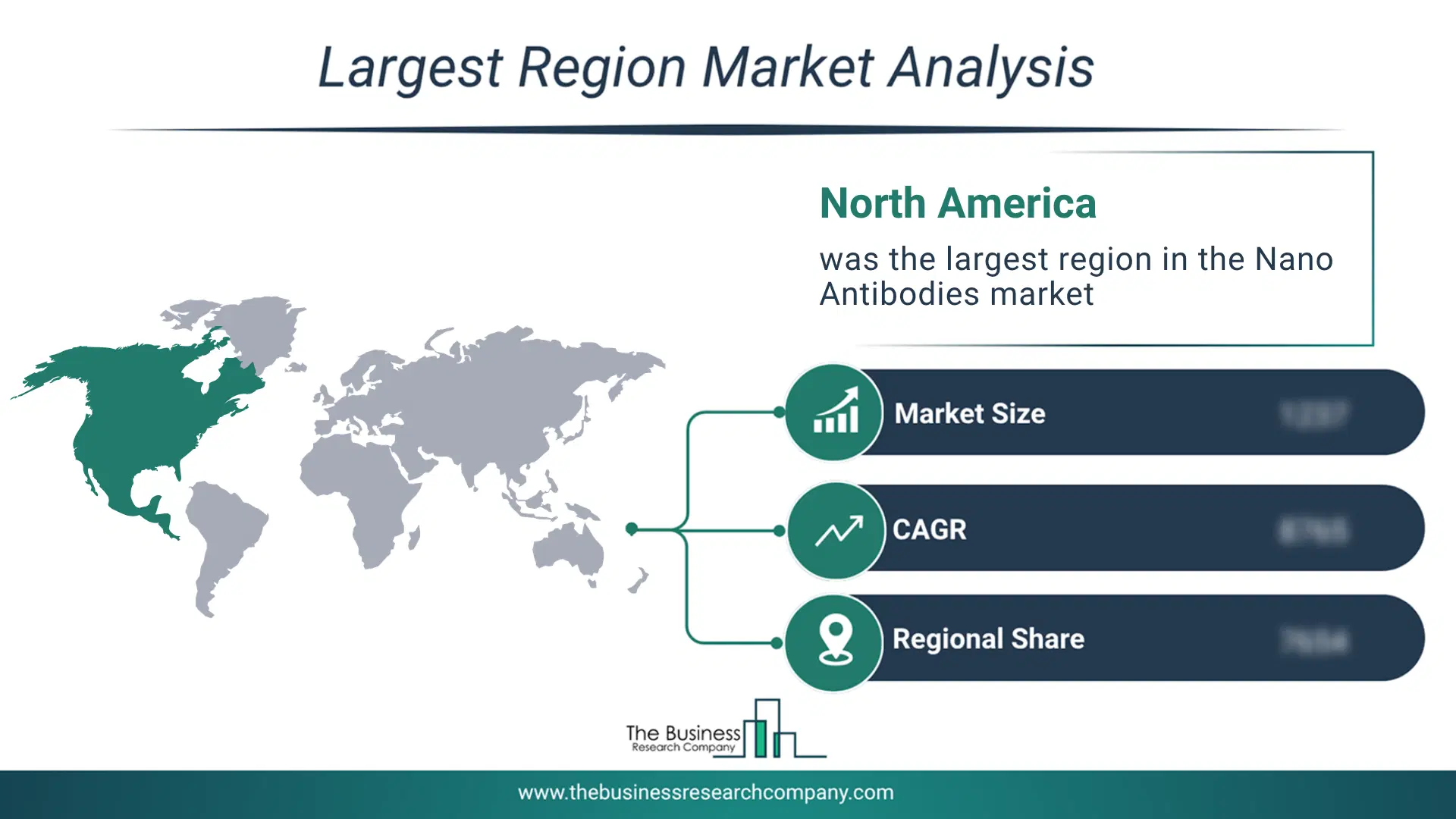
Regional Outlook
North America was the largest region in the nano antibodies market in 2025. Asia-Pacific is expected to be the fastest-growing region in the forecast period. The regions covered in this market report are Asia-Pacific, South East Asia, Western Europe, Eastern Europe, North America, South America, Middle East, Africa. The countries covered in this market report are Australia, Brazil, China, France, Germany, India, Indonesia, Japan, Taiwan, Russia, South Korea, UK, USA, Canada, Italy, Spain.What Defines the Nano Antibodies Market?
The nano antibodies market consists of sales of nano antibody constructs, diagnostic reagents, therapeutic formulations, assay kits, and research-grade antibody products. Values in this market are ‘factory gate’ values, that is the value of goods sold by the manufacturers or creators of the goods, whether to other entities (including downstream manufacturers, wholesalers, distributors and retailers) or directly to end customers. The value of goods in this market includes related services sold by the creators of the goods.How is Market Value Defined and Measured?
The market value is defined as the revenues that enterprises gain from the sale of goods and/or services within the specified market and geography through sales, grants, or donations in terms of the currency (in USD unless otherwise specified). The revenues for a specified geography are consumption values that are revenues generated by organizations in the specified geography within the market, irrespective of where they are produced. It does not include revenues from resales along the supply chain, either further along the supply chain or as part of other products.
This chart presents market attractiveness based on a quantitative evaluation of growth, competition, strategic alignment, and risk, offering a clear view of opportunity areas for decision-making. This chart is for illustrative purposes; the full report contains the complete analysis.

This chart highlights the Total Addressable Market (TAM) by estimating the maximum revenue opportunity using an assumption-driven approach, supporting strategic planning and opportunity sizing across markets. The chart is illustrative; the full report provides a more comprehensive analysis.
What Key Data and Analysis Are Included in the Nano Antibodies Market Report 2026?
The nano antibodies market research report is one of a series of new reports from The Business Research Company that provides market statistics, including industry global market size, regional shares, competitors with the market share, detailed market segments, market trends and opportunities, and any further data you may need to thrive in the nano antibodies industry. The market research report delivers a complete perspective of everything you need, with an in-depth analysis of the current and future state of the industry.Nano Antibodies Market Report Forecast Analysis
| Report Attribute | Details |
|---|---|
| Market Size Value In 2026 | $2.1 billion |
| Revenue Forecast In 2030 | $3.79 billion |
| Growth Rate | CAGR of 15.9% from 2026 to 2030 |
| Base Year For Estimation | 2025 |
| Actual Estimates/Historical Data | 2020-2025 |
| Forecast Period | 2026 - 2030 |
| Market Representation | Revenue in USD Billion and CAGR from 2026 to 2030 |
| Segments Covered | Product, Technology, Source, Application, End-User |
| Regional Scope | Asia-Pacific, Western Europe, Eastern Europe, North America, South America, Middle East, Africa |
| Country Scope | The countries covered in the report are Australia, Brazil, China, France, Germany, India, Indonesia, Japan, Taiwan, Russia, South Korea, UK, USA, Canada, Italy, Spain |
| Key Companies Profiled | Sanofi S.A., AstraZeneca plc, Bio-Rad Laboratories Inc., Bio-Techne Corporation, Innovent Biologics Inc., GenScript Biotech Corporation, Biocytogen Pharmaceuticals Co. Ltd., Beroni Group Limited., Cusabio Technology LLC, Harbour BioMed Co. Ltd., MoonLake Immunotherapeutics Co. Ltd., Alphamab Oncology Co. Ltd., Santa Cruz Biotechnology Inc., Rockland Immunochemicals Inc., Creative Biolabs Inc., Promab Biotechnologies Inc., ExeVir Bio N.V., Isogenica Ltd., Allele Biotechnology And Pharmaceuticals Inc., Gulliver Biomed Inc., Capralogics Inc. |
| Customization Scope | Request for Customization |
| Pricing And Purchase Options | Explore Purchase Options |