
Global Navigation Satellite System (GNSS)-Independent Positioning, Navigation, And Timing (PNT) Constellation Market Report 2026
Global Outlook – By Technology (Terrestrial, Space-Based, Quantum, Inertial, Other Technologies), By Platform (Ground, Airborne, Naval, Space), By Application (Defense, Aviation, Maritime, Automotive, Critical Infrastructure, Other Applications), By End-User (Government, Commercial, Military, Other End-Users) – Market Size, Trends, Strategies, and Forecast to 2030
Global Navigation Satellite System (GNSS)-Independent Positioning, Navigation, And Timing (PNT) Constellation Market Overview
• Global Navigation Satellite System (GNSS)-Independent Positioning, Navigation, And Timing (PNT) Constellation market size has reached to $2.9 billion in 2025 • Expected to grow to $5.53 billion in 2030 at a compound annual growth rate (CAGR) of 13.8% • Growth Driver: Surge In Prevalence Of Cyber Threats Fueling The Growth Of The Market Due To Rising Need For Secure And Resilient Positioning Systems • Market Trend: Advancements In Microsatellite Technology Enhance Global Positioning And Timing Services • North America was the largest region in 2025 and Asia-Pacific is the fastest growing region.What Is Covered Under Global Navigation Satellite System (GNSS)-Independent Positioning, Navigation, And Timing (PNT) Constellation Market?
A global navigation satellite system (GNSS)-independent positioning, navigation, and timing (PNT) constellation is a system that provides positioning, navigation, and timing (PNT) information without relying on GPS or other traditional satellite services. It acts as an alternative source to maintain these functions when standard GNSS signals are weak, blocked, or disrupted. By offering a backup, it enhances reliability, safety, and security for navigation, communication, and other critical operations, ensuring accurate location and timing even in challenging environments. The main technologies of global navigation satellite system (GNSS)-independent positioning, navigation, and timing (PNT) constellation are terrestrial, space-based, quantum, inertial, and others. emerging technologies. Terrestrial refers to anything related to or living on the land or Earth, as opposed to water or air. The multiple platforms include ground, airborne, naval, and space. The various applications involved are defense, aviation, maritime, automotive, critical infrastructure, and others, and they are used by several end-users such as government, commercial, military, and others.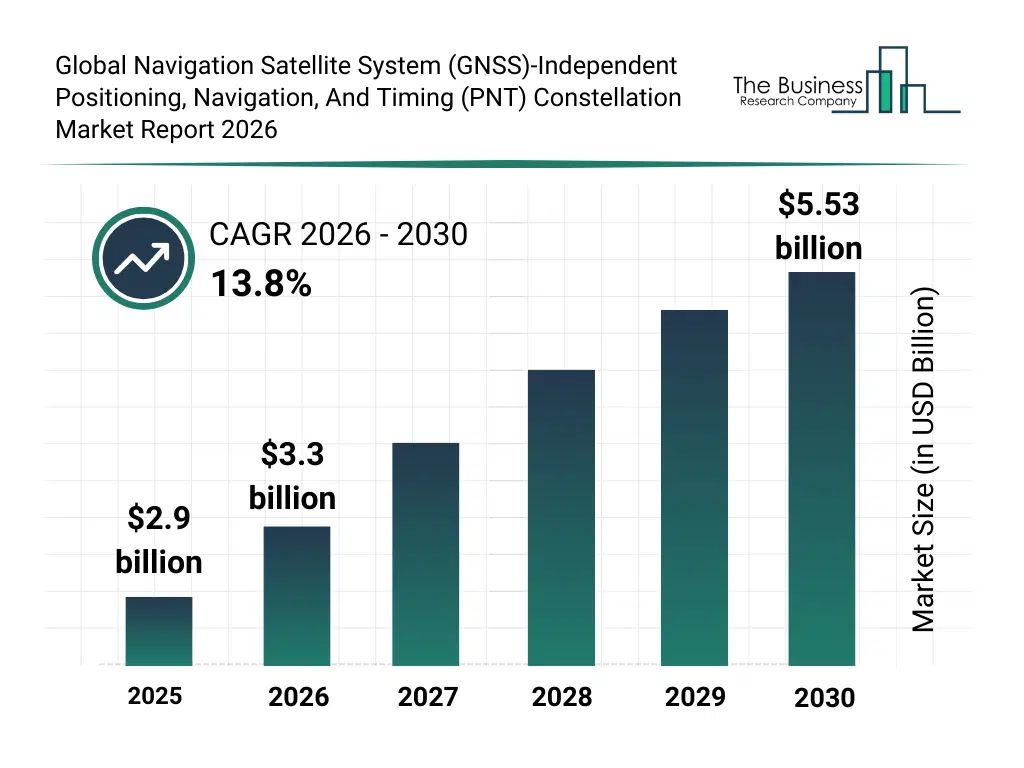
What Is The Global Navigation Satellite System (GNSS)-Independent Positioning, Navigation, And Timing (PNT) Constellation Market Size and Share 2026?
The global navigation satellite system (gnss)-independent positioning, navigation, and timing (pnt) constellation market size has grown rapidly in recent years. It will grow from $2.9 billion in 2025 to $3.3 billion in 2026 at a compound annual growth rate (CAGR) of 13.8%. The growth in the historic period can be attributed to increasing reliance on gnss for critical navigation and timing, rising military and defense interest in gnss-independent systems, development of ground-based transmitters and pseudolites, growth in commercial applications requiring high-precision timing, advancements in inertial navigation and synchronization technologies.What Is The Global Navigation Satellite System (GNSS)-Independent Positioning, Navigation, And Timing (PNT) Constellation Market Growth Forecast?
The global navigation satellite system (gnss)-independent positioning, navigation, and timing (pnt) constellation market size is expected to see rapid growth in the next few years. It will grow to $5.53 billion in 2030 at a compound annual growth rate (CAGR) of 13.8%. The growth in the forecast period can be attributed to expansion of gnss-independent navigation services for resilient operations, integration with ai-driven positioning and timing analytics, adoption in sectors vulnerable to signal jamming or disruption, rising investments in ground-based infrastructure and pseudolite networks, collaborations between technology providers and defense agencies for enhanced pnt solutions. Major trends in the forecast period include deployment of hybrid multi-sensor navigation systems, integration of pseudolite networks for urban and indoor navigation, advanced inertial navigation system (ins) adoption for gnss-denied environments, expansion of quantum navigation technologies, growth in ground-based alternative positioning and timing networks.
Global Global Navigation Satellite System (GNSS)-Independent Positioning, Navigation, And Timing (PNT) Constellation Market Segmentation
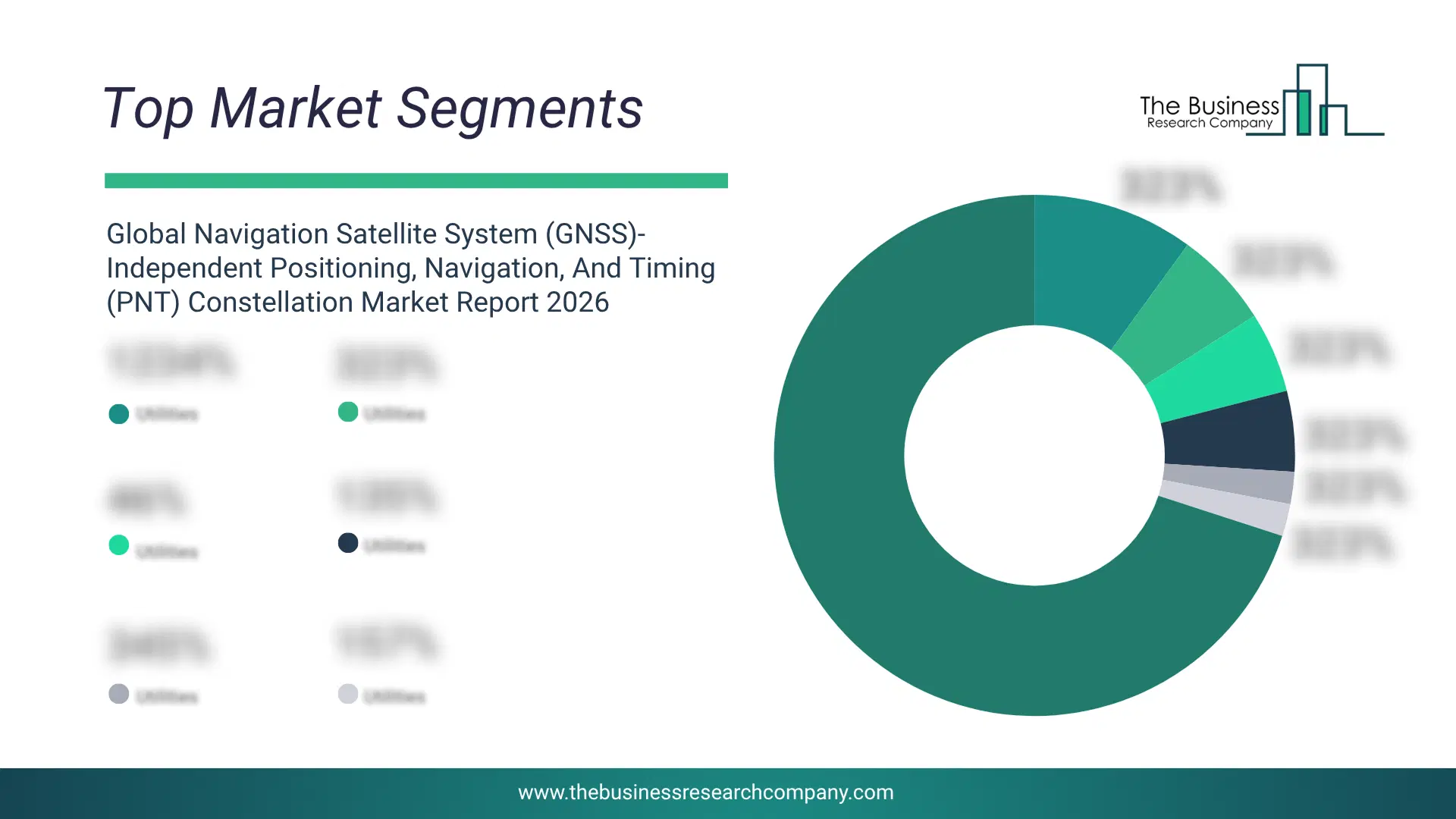
1) By Technology: Terrestrial, Space-Based, Quantum, Inertial, Other Technologies 2) By Platform: Ground, Airborne, Naval, Space 3) By Application: Defense, Aviation, Maritime, Automotive, Critical Infrastructure, Other Applications 4) By End-User: Government, Commercial, Military, Other End-Users Subsegments: 1) By Terrestrial: Long Range Navigation, Enhanced Long Range Navigation, Ground-Based Radio Navigation Systems, Pseudolite Systems 2) By Space-Based: Low Earth Orbit (LEO) Satellites, Medium Earth Orbit (MEO) Satellites, Geostationary Earth Orbit (GEO) Satellites, Hybrid Satellite Systems 3) By Quantum: Quantum Accelerometers, Quantum Gyroscopes, Quantum Gravimeters 4) By Inertial: Strapdown Inertial Navigation Systems (SINS), Ring Laser Gyroscope (RLG) Systems, Fiber Optic Gyroscope (FOG) Systems, Micro-Electro-Mechanical Systems (MEMS) Inertial Navigation System (INS) 5) By Other Technologies: Visual Odometry Systems, Magnetic-Based Navigation Systems, Acoustic-Based Navigation Systems, Hybrid Multi-Sensor SystemsWhat Is Driver Of The Global Navigation Satellite System (GNSS)-Independent Positioning, Navigation, And Timing (PNT) Constellation Market?
The increasing prevalence of cyber threats is expected to propel the growth of the global navigation satellite system (GNSS)-independent positioning, navigation, and timing (PNT) constellation market going forward. Cyber threats refer to malicious activities such as hacking, spoofing, data manipulation, or denial-of-service (DoS) attacks that target positioning, navigation, and timing systems. The rise in cyber threats is due to increasing dependence on digital networks and critical infrastructure, making secure and resilient positioning solutions essential. GNSS-independent PNT systems support mitigating cyber threats by offering reliable navigation and timing even when traditional GNSS signals are jammed, spoofed, or otherwise compromised. For instance, in November 2024, according to the Australian Signals Directorate’s Australian Cyber Security Centre, the Australia-based technical authority on cyber security, reported that in March 2024, in FY2023–24, the ASD received over 36,700 calls to the Australian Cyber Security Hotline, marking a 12% rise from the previous financial year. Therefore, the increasing prevalence of cyber threats is driving the growth of the global navigation satellite system (GNSS)-independent positioning, navigation, and timing (PNT) constellation industry.Key Players In The Global Global Navigation Satellite System (GNSS)-Independent Positioning, Navigation, And Timing (PNT) Constellation Market
Major companies operating in the global navigation satellite system (gnss)-independent positioning, navigation, and timing (pnt) constellation market are RTX Corporation, General Dynamics Corporation, Honeywell International Inc., BAE Systems Plc, Safran S.A., Thales S.A., Equinix Inc., Trimble Inc., Adtran Inc., Iridium Communications Inc., Spirent Communications Plc, OneWeb Ltd., Telehouse Corp., HawkEye 360 Inc., UrsaNav Inc., NextNav Inc., Locata Corporation, Hoptroff London Ltd., Satelles Inc., OPNT B.V.
This chart is for illustrative purposes; the full report includes a detailed competitor analysis and comprehensive overview of the top 10 companies in the market.

This chart maps companies by product innovation and brand strength, with bubble size indicating relative revenue, helping identify market leaders, challengers, and niche players. This is an illustrative chart; the full report provides a complete and accurate competitive analysis.
Global Global Navigation Satellite System (GNSS)-Independent Positioning, Navigation, And Timing (PNT) Constellation Market Trends and Insights
Major companies operating in the global navigation satellite system (GNSS)-independent positioning, navigation, and timing (PNT) constellation market are focusing on developing advanced solutions, such as positioning, navigation, and timing (PNT) microsatellites, to enhance positioning, navigation, and timing capabilities for a wide range of applications. Positioning, navigation, and timing (PNT) microsatellites refer to compact, low-cost satellites designed to provide accurate location and timing information, even in environments where traditional GNSS signals are weak or unavailable. For instance, in April 2023, TrustPoint, a US-based global positioning system (GPS) technology company, launched its positioning, navigation, and timing (PNT) microsatellite constellation. These microsatellites offer unique features such as high-precision positioning, low-latency signal transmission, and resilience against signal interference, making them ideal for defense, autonomous vehicles, and critical infrastructure monitoring. Designed for flexibility, the microsatellites can be deployed quickly and integrated with existing systems, providing reliable, independent, and continuous positioning, navigation, and timing (PNT) services across diverse operational environments.What Are Latest Mergers And Acquisitions In The Global Navigation Satellite System (GNSS)-Independent Positioning, Navigation, And Timing (PNT) Constellation Market? Septentrio Partners With Xona To Advance Resilient GNSS Receiver Technology
In June 2023, Septentrio N.V., a Belgium-based manufacturer of high-end, multi-frequency, multi-constellation GNSS receivers, partnered with Xona Space Systems to develop an experimental receiver that is compatible with Xona multi-frequency PULSAR signals. Through this partnership, Septentrio aims to integrate Xona’s low-Earth orbit (LEO) PNT satellite signals into Septentrio’s high-performance receiver technology, enhancing resilient positioning, navigation, and timing (PNT) solutions for critical applications. Xona Space Systems Inc. is a US-based aerospace startup that is developing the Pulsar constellation, a commercial high-performance GNSS-independent PNT service in Low Earth Orbit (LEO).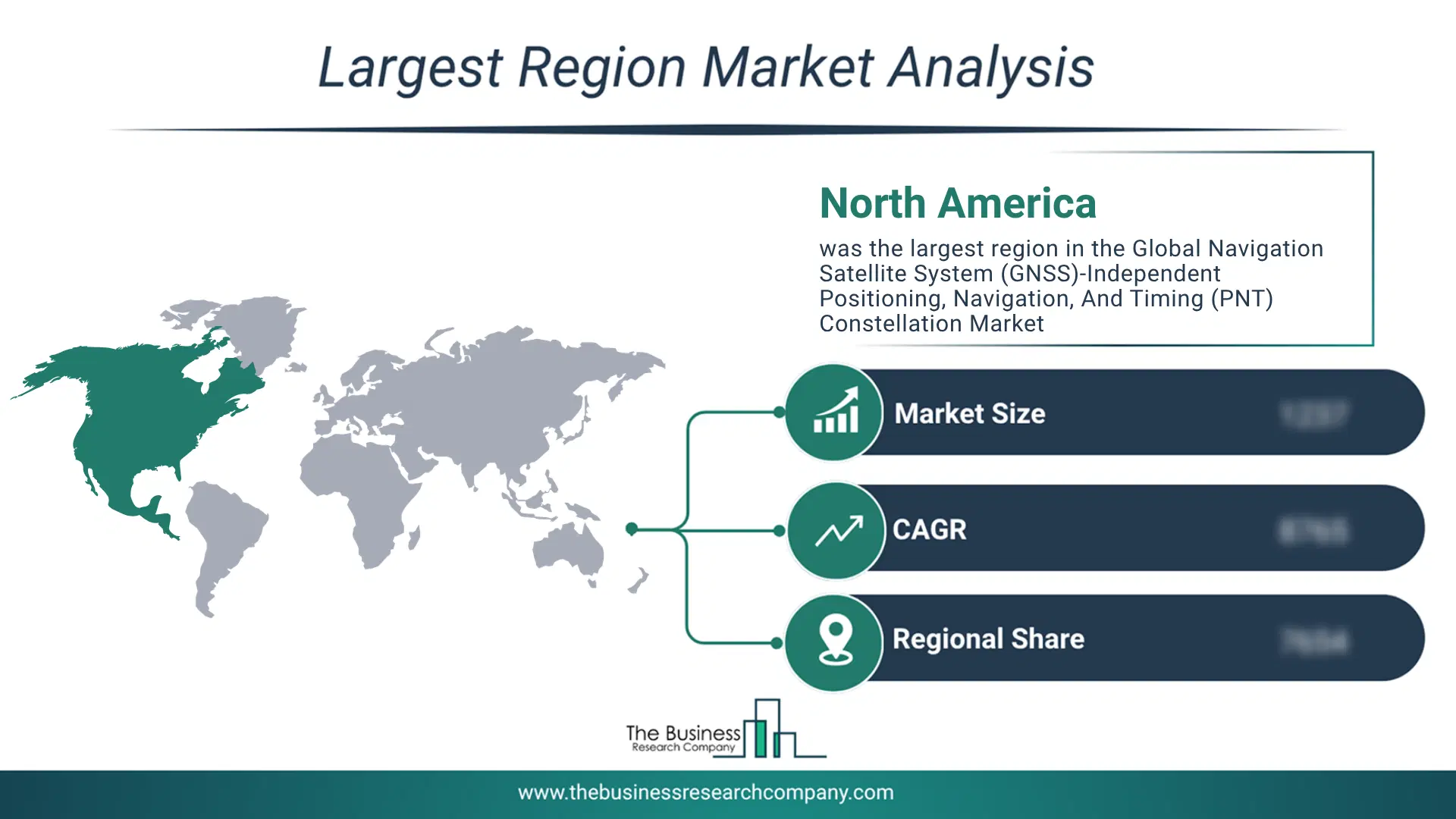
Regional Insights
North America was the largest region in the global navigation satellite system (GNSS)-independent positioning, navigation, and timing (PNT) constellation market in 2025. Asia-Pacific is expected to be the fastest-growing region in the forecast period. The regions covered in this market report are Asia-Pacific, South East Asia, Western Europe, Eastern Europe, North America, South America, Middle East, Africa. The countries covered in this market report are Australia, Brazil, China, France, Germany, India, Indonesia, Japan, Taiwan, Russia, South Korea, UK, USA, Canada, Italy, SpainWhat Defines the Global Navigation Satellite System (GNSS)-Independent Positioning, Navigation, And Timing (PNT) Constellation Market?
The global navigation satellite system (GNSS)-independent positioning, navigation, and timing (PNT) constellation market consists of revenues earned by entities by providing services such as alternative positioning services, timing and synchronization services, navigation services, and consulting services. The market value includes the value of related goods sold by the service provider or included within the service offering. The global navigation satellite system (GNSS)-independent positioning, navigation, and timing (PNT) constellation market also includes sales of ground-based transmitters, pseudolites, inertial navigation systems, and synchronization equipment. Values in this market are ‘factory gate’ values, that is, the value of goods sold by the manufacturers or creators of the goods, whether to other entities (including downstream manufacturers, wholesalers, distributors, and retailers) or directly to end customers. The value of goods in this market includes related services sold by the creators of the goods.How is Market Value Defined and Measured?
The market value is defined as the revenues that enterprises gain from the sale of goods and/or services within the specified market and geography through sales, grants, or donations in terms of the currency (in USD unless otherwise specified). The revenues for a specified geography are consumption values that are revenues generated by organizations in the specified geography within the market, irrespective of where they are produced. It does not include revenues from resales along the supply chain, either further along the supply chain or as part of other products.
This chart presents market attractiveness based on a quantitative evaluation of growth, competition, strategic alignment, and risk, offering a clear view of opportunity areas for decision-making. This chart is for illustrative purposes; the full report contains the complete analysis.

This chart highlights the Total Addressable Market (TAM) by estimating the maximum revenue opportunity using an assumption-driven approach, supporting strategic planning and opportunity sizing across markets. The chart is illustrative; the full report provides a more comprehensive analysis.
What Key Data and Analysis Are Included in the Global Navigation Satellite System (GNSS)-Independent Positioning, Navigation, And Timing (PNT) Constellation Market Report 2026?
The global navigation satellite system (gnss)-independent positioning, navigation, and timing (pnt) constellation market research report is one of a series of new reports from The Business Research Company that provides market statistics, including industry global market size, regional shares, competitors with the market share, detailed market segments, market trends and opportunities, and any further data you may need to thrive in the global navigation satellite system (gnss)-independent positioning, navigation, and timing (pnt) constellation industry. The market research report delivers a complete perspective of everything you need, with an in-depth analysis of the current and future state of the industry.Global Navigation Satellite System (GNSS)-Independent Positioning, Navigation, And Timing (PNT) Constellation Market Report Forecast Analysis
| Report Attribute | Details |
|---|---|
| Market Size Value In 2026 | $3.3 billion |
| Revenue Forecast In 2030 | $5.53 billion |
| Growth Rate | CAGR of 13.8% from 2026 to 2030 |
| Base Year For Estimation | 2025 |
| Actual Estimates/Historical Data | 2020-2025 |
| Forecast Period | 2026 - 2030 |
| Market Representation | Revenue in USD Billion and CAGR from 2026 to 2030 |
| Segments Covered | Technology, Platform, Application, End-User |
| Regional Scope | Asia-Pacific, Western Europe, Eastern Europe, North America, South America, Middle East, Africa |
| Country Scope | The countries covered in the global navigation satellite system (gnss)-independent positioning, navigation, and timing (pnt) constellation market report are Australia, Brazil, China, France, Germany, India, Indonesia, Japan, Taiwan, Russia, South Korea, UK, USA, Canada, Italy, Spain |
| Key Companies Profiled | RTX Corporation, General Dynamics Corporation, Honeywell International Inc., BAE Systems Plc, Safran S.A., Thales S.A., Equinix Inc., Trimble Inc., Adtran Inc., Iridium Communications Inc., Spirent Communications Plc, OneWeb Ltd., Telehouse Corp., HawkEye 360 Inc., UrsaNav Inc., NextNav Inc., Locata Corporation, Hoptroff London Ltd., Satelles Inc., OPNT B.V. |
| Customization Scope | Request for Customization |
| Pricing And Purchase Options | Explore Purchase Options |