
Negative Carbon Portland Cement Market Report 2026
Global Outlook – By Type (Magnesium Oxide, Iron Oxide, Fly Ash, Calcium Carbonate), By Raw Or Feed Material Type (Natural Raw Materials, Industrial‑Waste Raw Materials, Alternative Calcium Sources Or Novel Binders), By Application (Textiles, Chemical, Construction, Other Applications), By End‑Use Sector (Residential Construction, Commercial Construction, Infrastructure Development, Environmental Services) – Market Size, Trends, Strategies, and Forecast to 2030
Negative Carbon Portland Cement Market Overview
• Negative Carbon Portland Cement market size has reached to $0.79 billion in 2025 • Expected to grow to $2.29 billion in 2030 at a compound annual growth rate (CAGR) of 23.6% • Growth Driver: Rising Adoption Of Green Building Certifications Driving The Growth Of The Market Due To Increasing Focus On Low-carbon And Sustainable Construction Materials • Market Trend: Innovative CO2 Utilization Technologies Accelerate Transition Toward Carbon-Negative Manufacturing • Europe was the largest region and fastest growing region.What Is Covered Under Negative Carbon Portland Cement Market?
Negative carbon portland cement is a type of cement engineered to capture and store more carbon dioxide than is emitted during its production, effectively resulting in a net reduction of atmospheric CO2. This cement is produced using innovative materials and processes that enhance carbonation and minimize clinker content. It contributes to sustainable construction by actively reducing greenhouse gas levels while providing the same structural performance as conventional Portland cement. The main types of negative carbon portland cement are magnesium oxide, iron oxide, fly ash, and calcium carbonate. Magnesium oxide refers to a key component used in the formulation of negative carbon Portland cement that actively absorbs carbon dioxide during curing, helping to achieve carbon-negative performance while maintaining structural integrity. The key raw or feed material types include natural raw materials, industrial-waste raw materials, and alternative calcium sources or novel binders. Major applications include textiles, chemicals, and construction industries, with primary end-use sectors being residential construction, commercial construction, infrastructure development, and environmental services.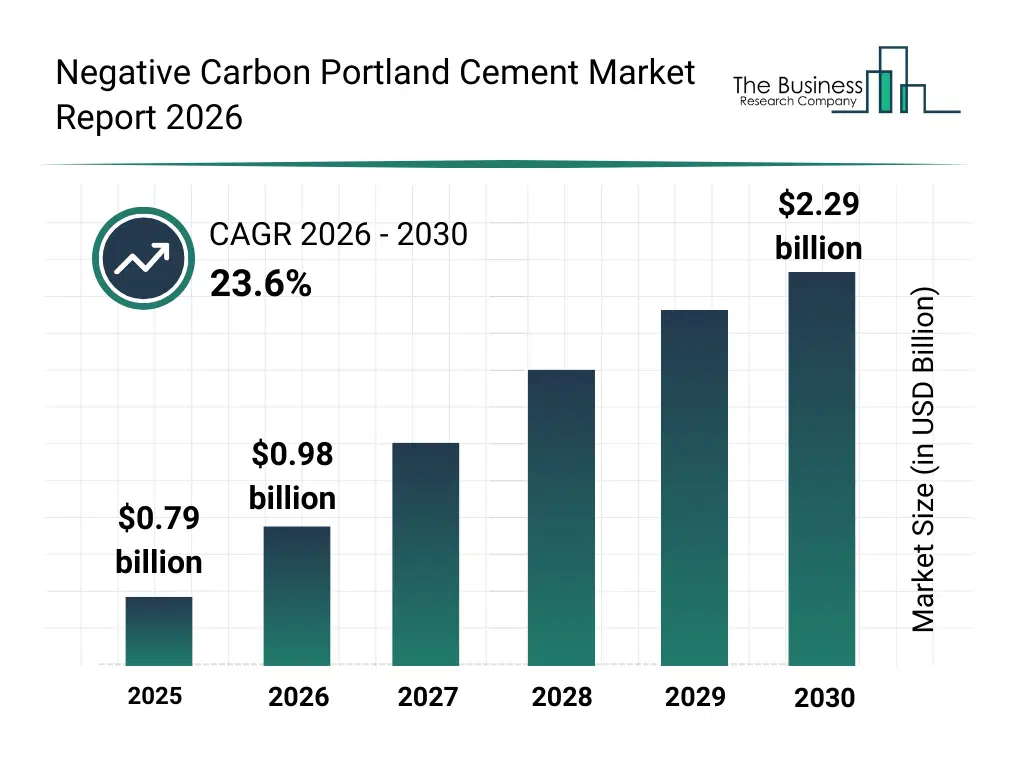
What Is The Negative Carbon Portland Cement Market Size and Share 2026?
The negative carbon portland cement market size has grown exponentially in recent years. It will grow from $0.79 billion in 2025 to $0.98 billion in 2026 at a compound annual growth rate (CAGR) of 23.9%. The growth in the historic period can be attributed to rising focus on carbon reduction in cement production, increasing use of industrial by-products, growing demand for eco-friendly construction, expansion of sustainable infrastructure projects, development of low-clinker cement formulations.What Is The Negative Carbon Portland Cement Market Growth Forecast?
The negative carbon portland cement market size is expected to see exponential growth in the next few years. It will grow to $2.29 billion in 2030 at a compound annual growth rate (CAGR) of 23.6%. The growth in the forecast period can be attributed to increasing deployment of carbon-capturing cement technologies, rising adoption of smart production monitoring, development of advanced supplementary cementitious materials, expansion in commercial and residential construction, innovation in negative emission additives. Major trends in the forecast period include adoption of carbon-capturing portland cement, integration of supplementary cementitious materials, deployment of negative emission additives, implementation of smart production monitoring, expansion of eco-friendly cement formulations.
Global Negative Carbon Portland Cement Market Segmentation
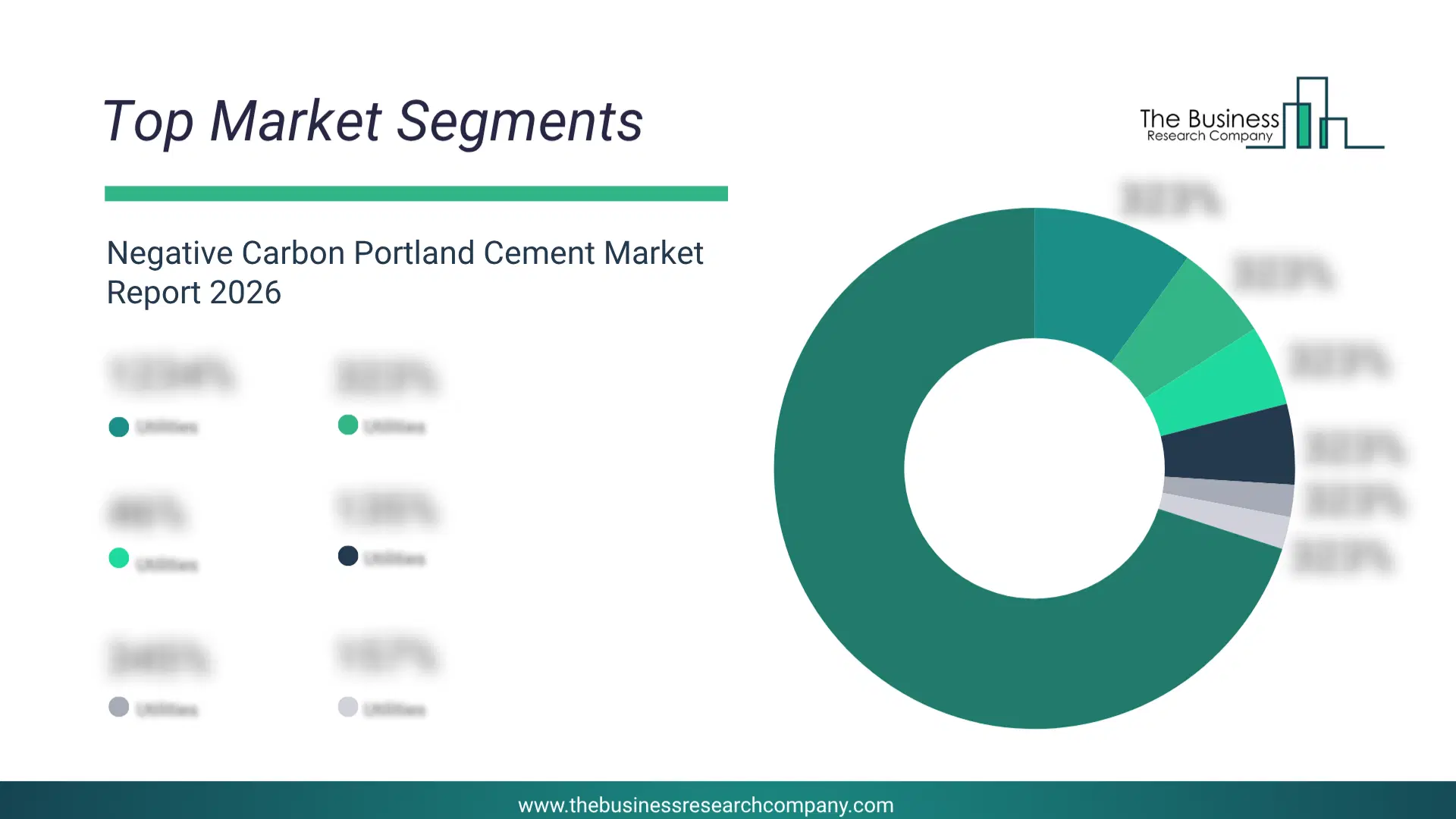
1) By Type: Magnesium Oxide, Iron Oxide, Fly Ash, Calcium Carbonate 2) By Raw Or Feed Material Type: Natural Raw Materials, Industrial-Waste Raw Materials, Alternative Calcium Sources Or Novel Binders 3) By Application: Textiles, Chemical, Construction, Other Applications 4) By End-Use Sector: Residential Construction, Commercial Construction, Infrastructure Development, Environmental Services Subsegments: 1) By Magnesium Oxide: Reactive Magnesium Oxide, Dead-Burned Magnesium Oxide, Fused Magnesium Oxide, Caustic-Calcined Magnesium Oxide 2) By Iron Oxide: Red Iron Oxide (Fe2O3), Black Iron Oxide (Fe3O4), Yellow Iron Oxide (FeOOH), Brown Iron Oxide 3) By Fly Ash: Class F Fly Ash (Low Calcium), Class C Fly Ash (High Calcium), Processed Fly Ash, Blended Fly Ash 4) By Calcium Carbonate: Ground Calcium Carbonate (GCC), Precipitated Calcium Carbonate (PCC), Nano Calcium Carbonate, Coated Calcium CarbonateWhat Is The Driver Of The Negative Carbon Portland Cement Market?
The rising adoption of green building certifications is expected to propel the growth of the negative carbon portland cement market going forward. Green building certifications are official recognitions that a building meets established standards for environmental sustainability, energy efficiency, and occupant well-being. The growth in green building certifications is driven by energy efficiency, as they reduce resource consumption and lower operational costs. Negative carbon portland cement is used in green building certifications to reduce embodied carbon in construction materials, helping projects earn sustainability credits and meet low-carbon certification standards. For instance, in February 2024, according to the US Green Building Council, a US-based non-profit organization that promotes eco-friendly building and created the Leadership in Energy and Environmental Design (LEED) certification system for green construction, in 2023, there was a 9% rise in LEED certifications from the previous year, along with 21 additional certifications for single-family homes. New LEED project registrations jumped by 51%, showing remarkable growth. Therefore, the rising adoption of green building certifications is driving the growth of the negative carbon portland cement additive market.Key Players In The Global Negative Carbon Portland Cement Market
Major companies operating in the negative carbon portland cement market are Dalmia Bharat Limited, Sublime Systems, Solidia Technologies Inc., CarbiCrete, Carbon8 Systems Limited, Blue Planet Systems Corporation, Prometheus Materials, GreenJams, CarbonBuilt, Partanna, Travertine Technologies, Brimstone Energy, Carbon Re, EMC Cement Co., Zeobond, Geopolymer Solutions LLC, Carbonaide, Low Carbon Materials (LCM Tree), Calix Ltd, IronKast Technologies.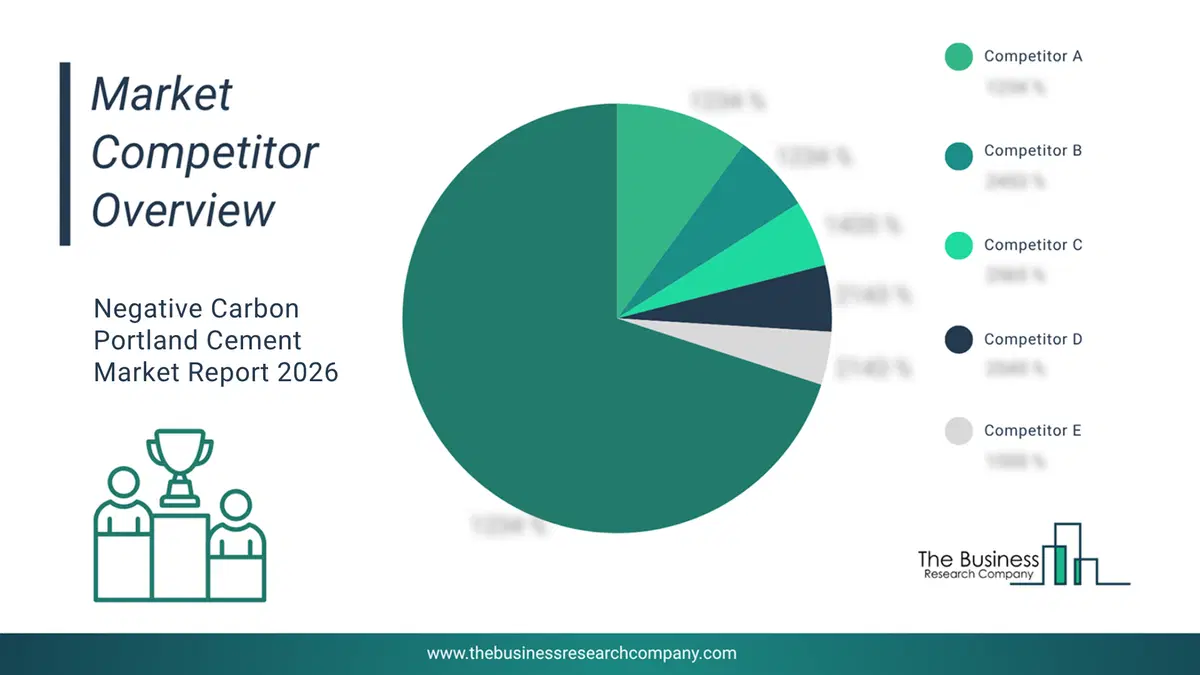
This chart is for illustrative purposes; the full report includes a detailed competitor analysis and comprehensive overview of the top 10 companies in the market.
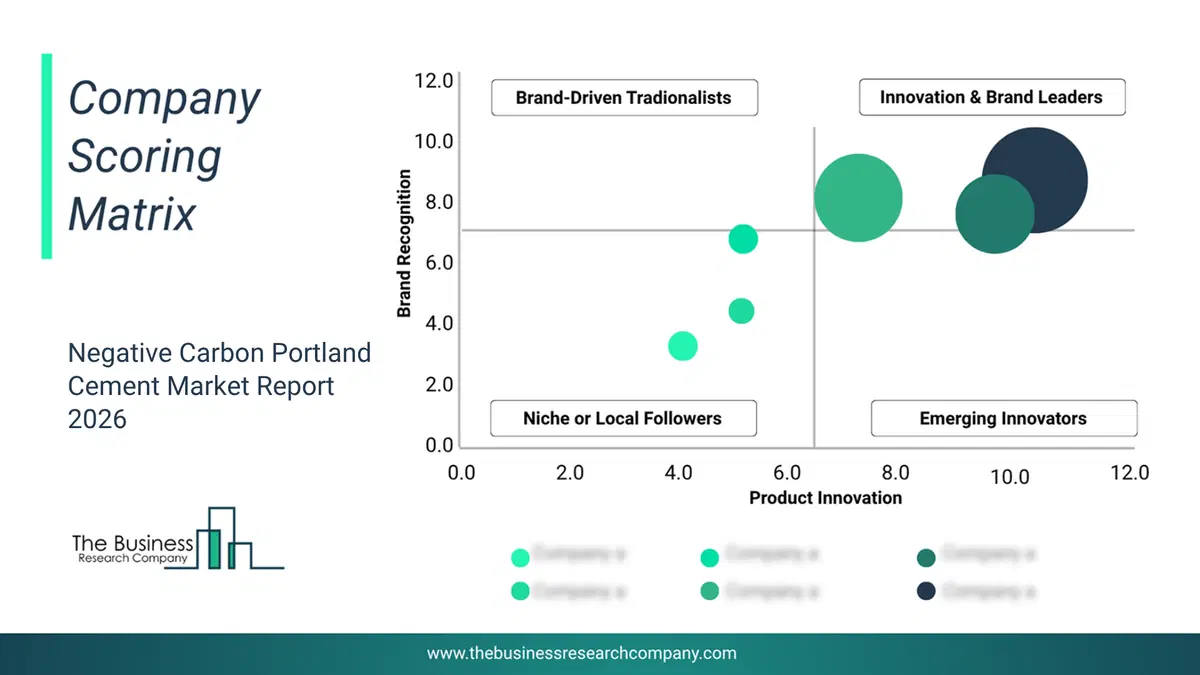
This chart maps companies by product innovation and brand strength, with bubble size indicating relative revenue, helping identify market leaders, challengers, and niche players. This is an illustrative chart; the full report provides a complete and accurate competitive analysis.
Global Negative Carbon Portland Cement Market Trends and Insights
Major companies operating in the negative carbon portland cement market are focusing on technological advancements, such as CO₂-cured precast concrete solutions, to enable large-scale carbon mineralization and reduce reliance on clinker-based cement. CO₂-cured precast concrete refers to a production method where captured carbon dioxide is directly injected into the curing chamber during concrete hardening, permanently storing CO₂ as stable carbonates and enhancing material strength while lowering the carbon footprint. For instance, in May 2025, Elematic Oyj, a Finland-based precast concrete technology company, and Carbonaide, a Finland-based materials technology firm, jointly launched the world’s first commercial CO₂-cured precast concrete solution. This innovative system integrates carbon dioxide into the curing process of hollow-core slabs and wall panels, reducing cement consumption by up to 20% and achieving permanent CO₂ storage within the concrete matrix. The solution is compatible with existing precast production lines, requires minimal retrofitting, and enables manufacturers to produce carbon-negative concrete elements at scale, marking a major step toward industrial decarbonization in the cement sector. By integrating automated CO₂-curing systems with adaptable precast manufacturing technology, the Elematic and Carbonaide solution represents a highly scalable and energy-efficient approach to producing carbon-negative concrete elements in the cement industry.What Are Latest Mergers And Acquisitions In The Negative Carbon Portland Cement Market?
In December 2023, Lafarge Canada Inc., a Canada-based subsidiary of a building materials company, partnered with CarbiCrete Inc. to advance the production of carbon-negative concrete by repurposing steel slag by-product as a key feedstock for decarbonized concrete blocks. Through this partnership, Lafarge Canada will process and supply finely ground steel slag from its St. Constant manufacturing cluster near Montreal, enabling CarbiCrete’s patented cement-free technology to integrate the slag into block production, sequester carbon dioxide during curing, enhance compressive strength compared with traditional concrete, reduce reliance on conventional cement, and accelerate sustainable construction practices across their Canadian supply chains. CarbiCrete Inc. is a Canada-based climate tech firm specializing in cement-free concrete.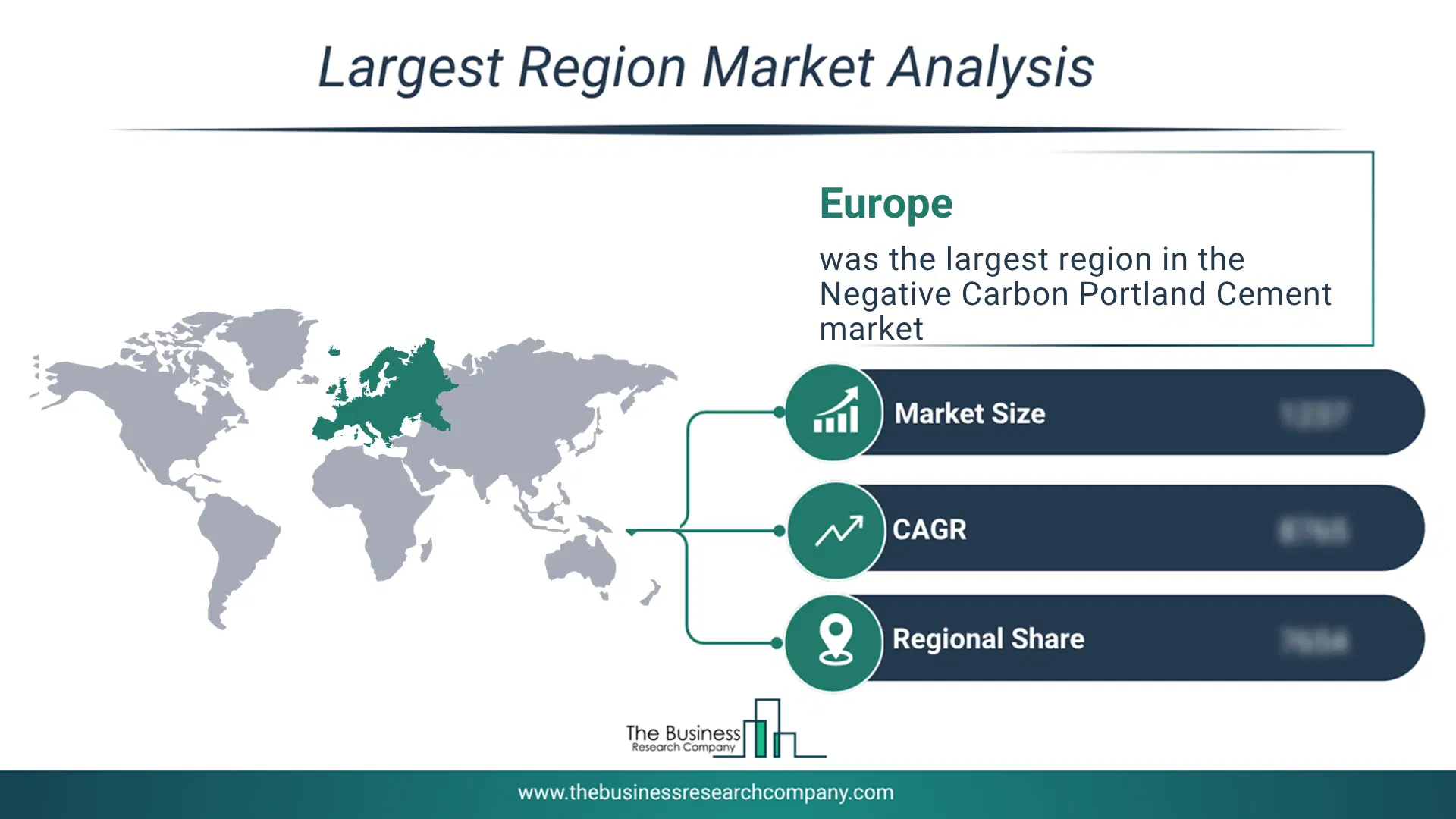
Regional Insights
Europe was the largest region in the negative carbon portland cement market in 2025. The regions covered in this market report are Asia-Pacific, South East Asia, Western Europe, Eastern Europe, North America, South America, Middle East, Africa. The countries covered in this market report are Australia, Brazil, China, France, Germany, India, Indonesia, Japan, Taiwan, Russia, South Korea, UK, USA, Canada, Italy, Spain.What Defines the Negative Carbon Portland Cement Market?
The negative carbon portland cement market consists of sales of carbon-capturing portland cement, supplementary cementitious materials, and related additives. Values in this market are ‘factory gate’ values, that is, the value of goods sold by the manufacturers or creators of the cement, whether to other entities (including downstream manufacturers, wholesalers, distributors, and retailers) or directly to construction projects or end customers. The value of goods in this market includes related services sold by the creators of the goods.How is Market Value Defined and Measured?
The market value is defined as the revenues that enterprises gain from the sale of goods and/or services within the specified market and geography through sales, grants, or donations in terms of the currency (in USD unless otherwise specified). The revenues for a specified geography are consumption values that are revenues generated by organizations in the specified geography within the market, irrespective of where they are produced. It does not include revenues from resales along the supply chain, either further along the supply chain or as part of other products.
This chart presents market attractiveness based on a quantitative evaluation of growth, competition, strategic alignment, and risk, offering a clear view of opportunity areas for decision-making. This chart is for illustrative purposes; the full report contains the complete analysis.

This chart highlights the Total Addressable Market (TAM) by estimating the maximum revenue opportunity using an assumption-driven approach, supporting strategic planning and opportunity sizing across markets. The chart is illustrative; the full report provides a more comprehensive analysis.
What Key Data and Analysis Are Included in theNegative Carbon Portland Cement Market Report 2026?
The negative carbon portland cement market research report is one of a series of new reports from The Business Research Company that provides market statistics, including industry global market size, regional shares, competitors with the market share, detailed market segments, market trends and opportunities, and any further data you may need to thrive in the negative carbon portland cement industry. The market research report delivers a complete perspective of everything you need, with an in-depth analysis of the current and future state of the industry.Negative Carbon Portland Cement Market Report Forecast Analysis
| Report Attribute | Details |
|---|---|
| Market Size Value In 2026 | $0.98 billion |
| Revenue Forecast In 2030 | $2.29 billion |
| Growth Rate | CAGR of 23.9% from 2026 to 2030 |
| Base Year For Estimation | 2025 |
| Actual Estimates/Historical Data | 2020-2025 |
| Forecast Period | 2026 - 2030 |
| Market Representation | Revenue in USD Billion and CAGR from 2026 to 2030 |
| Segments Covered | Type, Raw Or Feed Material Type, Application, End‑Use Sector |
| Regional Scope | Asia-Pacific, Western Europe, Eastern Europe, North America, South America, Middle East, Africa |
| Country Scope | The countries covered in this market report are Australia, Brazil, China, France, Germany, India, Indonesia, Japan, Taiwan, Russia, South Korea, UK, USA, Canada, Italy, Spain |
| Key Companies Profiled | Dalmia Bharat Limited, Sublime Systems, Solidia Technologies Inc., CarbiCrete, Carbon8 Systems Limited, Blue Planet Systems Corporation, Prometheus Materials, GreenJams, CarbonBuilt, Partanna, Travertine Technologies, Brimstone Energy, Carbon Re, EMC Cement Co., Zeobond, Geopolymer Solutions LLC, Carbonaide, Low Carbon Materials (LCM Tree), Calix Ltd, IronKast Technologies. |
| Customization Scope | Request for Customization |
| Pricing And Purchase Options | Explore Purchase Options |