
Pericarditis Drugs Market Report 2026
Global Outlook – By Drug Class (Nonsteroidal Anti-Inflammatory Drugs (NSAIDs), Colchicine, Corticosteroids, Other Drug Class), By Route Of Administration (Oral, Intravenous, Intramuscular, Topical), By Distribution Channel (Hospital Pharmacies, Retail Pharmacies, Online Pharmacies, Other Distribution Channels), By Therapeutic Application (Acute Pericarditis Treatment, Recurrent Pericarditis Management, Post-Cardiac Surgery, Pericardial Effusion Management), By End User (Hospitals, Homecare, Specialty Clinics, Other End Users) – Market Size, Trends, Strategies, and Forecast to 2030
Pericarditis Drugs Market Overview
• Pericarditis Drugs market size has reached to $3.31 billion in 2025 • Expected to grow to $5.1 billion in 2030 at a compound annual growth rate (CAGR) of 9% • Growth Driver: Increasing Prevalence Of Autoimmune Diseases Driving The Market Due To Rising Cases Triggering Heart Inflammation • Market Trend: Advancing Oral Therapies To Transform Recurrent Pericarditis Treatment Landscape • North America was the largest region in 2025 and Asia-Pacific is the fastest growing region.What Is Covered Under Pericarditis Drugs Market?
Pericarditis drugs are medications developed to manage inflammation and pain that occur in the pericardium, the membrane enclosing the heart. They act by controlling inflammatory responses and easing discomfort, helping to maintain normal heart activity and prevent further complications. These drugs are prescribed and monitored by healthcare professionals to ensure effective treatment and minimize potential side effects. The main drug classes in pericarditis drugs are nonsteroidal anti-inflammatory drugs (NSAIDs), colchicine, corticosteroids, and others. Nonsteroidal anti-inflammatory drugs (NSAIDs) are medications used to reduce inflammation, alleviate pain, and lower fever in pericarditis by inhibiting cyclooxygenase enzymes involved in prostaglandin synthesis. The routes of administration of these are oral, intravenous, intramuscular, and topical, which are distributed through various channels, including hospital pharmacies, retail pharmacies, online pharmacies, and others, and utilized in therapeutic applications such as acute pericarditis treatment, recurrent pericarditis management, post-cardiac surgery, and pericardial effusion management. Various end users include hospitals, homecare, specialty clinics, and others.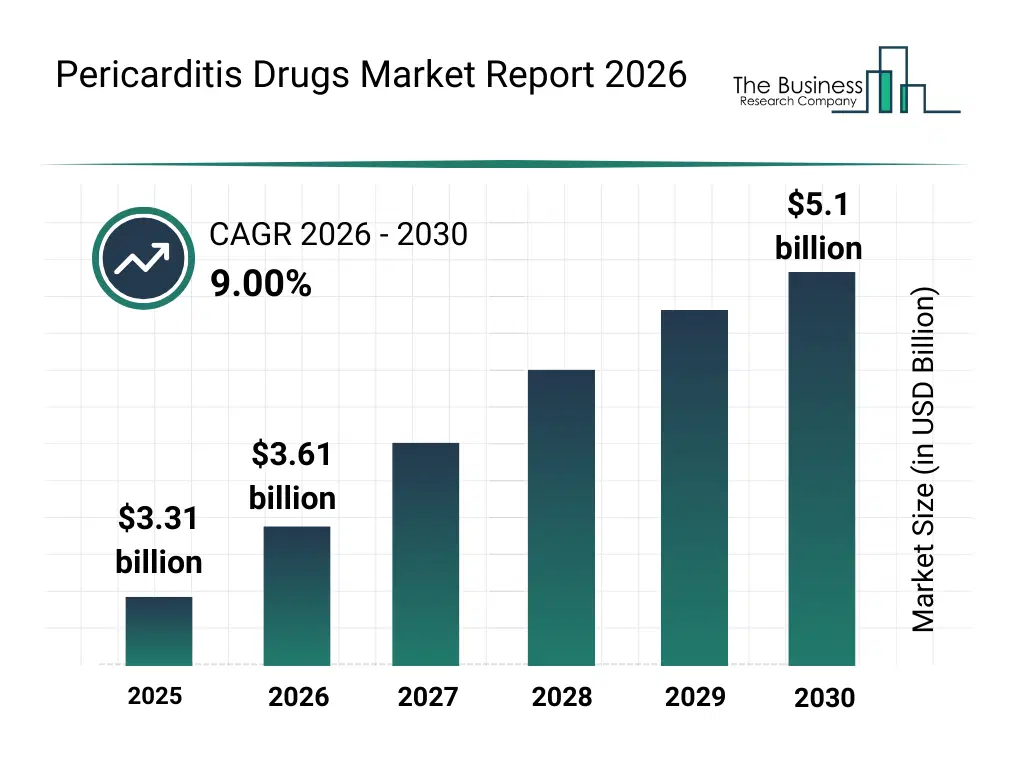
What Is The Pericarditis Drugs Market Size and Share 2026?
The pericarditis drugs market size has grown strongly in recent years. It will grow from $3.31 billion in 2025 to $3.61 billion in 2026 at a compound annual growth rate (CAGR) of 9.3%. The growth in the historic period can be attributed to increasing diagnosis rates of inflammatory cardiac conditions, availability of established NSAID therapies, expansion of cardiology care infrastructure, growing use of colchicine-based treatments, improved clinical guidelines.What Is The Pericarditis Drugs Market Growth Forecast?
The pericarditis drugs market size is expected to see strong growth in the next few years. It will grow to $5.1 billion in 2030 at a compound annual growth rate (CAGR) of 9.0%. The growth in the forecast period can be attributed to increasing development of biologic and immunomodulatory drugs, rising focus on personalized cardiac care, expansion of outpatient and homecare treatment models, growing investment in cardiovascular research, increasing awareness of rare inflammatory heart diseases. Major trends in the forecast period include increasing adoption of targeted anti-inflammatory therapies, rising use of combination drug regimens, growing focus on recurrent pericarditis management, expansion of hospital-based treatment protocols, enhanced monitoring of treatment outcomes.
Global Pericarditis Drugs Market Segmentation
1) By Drug Class: Nonsteroidal Anti-Inflammatory Drugs (NSAIDs), Colchicine, Corticosteroids, Other Drug Class 2) By Route Of Administration: Oral, Intravenous, Intramuscular, Topical 3) By Distribution Channel: Hospital Pharmacies, Retail Pharmacies, Online Pharmacies, Other Distribution Channels 4) By Therapeutic Application: Acute Pericarditis Treatment, Recurrent Pericarditis Management, Post-Cardiac Surgery, Pericardial Effusion Management 5) By End User: Hospitals, Homecare, Specialty Clinics, Other End Users Subsegments: 1) By Nonsteroidal Anti-Inflammatory Drugs: Ibuprofen, Aspirin, Indomethacin, Naproxen, Diclofenac 2) By Colchicine: Oral Colchicine, Intravenous Colchicine 3) By Corticosteroids: Prednisone, Methylprednisolone, Hydrocortisone, Dexamethasone 4) By Other Drug Class: Immunosuppressive Agents, Biologic Agents, Analgesics, AntibioticsWhat Are The Drivers Of The Pericarditis Drugs Market?
The increasing prevalence of autoimmune diseases is expected to propel the growth of the pericarditis drugs market going forward. Autoimmune diseases are conditions in which the immune system mistakenly attacks the body’s own healthy cells and tissues. The rising prevalence of autoimmune diseases is primarily driven by environmental changes that disrupt the immune system, causing it to mistakenly attack healthy tissues. Pericarditis drugs are useful in the context of the increasing prevalence of autoimmune diseases as many autoimmune conditions can trigger pericarditis, an inflammation of the heart’s lining. These drugs help reduce inflammation, relieve symptoms, and prevent complications, thereby managing pericarditis that arises as a consequence of autoimmune activity. For instance, in September 2023, according to the Inflammatory Bowel Disease (IBD) Clinical and Research Centre, a Canada-based organization that aims to improve the lives of patients with Crohn's disease and ulcerative colitis, with a prevalence of 825 per 100,000 in 2023, over 320,000 people in Canada have inflammatory bowel disease (IBD), and as the prevalence is expected to increase by 2.44% annually, 1.1% of the population, or 470,000 Canadians, is projected to be living with IBD by 2035. Therefore, the increasing prevalence of autoimmune diseases is driving the growth of the pericarditis drugs industry. The rising demand for personalized medicine is expected to propel the growth of the pericarditis drugs market going forward. Personalized medicine is a healthcare approach that customizes disease prevention and treatment based on an individual’s specific genes, behaviors, and environment. Rising demand for personalized treatments is driving the growth of personalized medicine, as patients and healthcare providers increasingly seek therapies tailored to individual genetic and lifestyle profiles for improved effectiveness and reduced side effects. The demand for personalized medicine necessitates the demand for pericarditis drugs as it enables the development of targeted therapies tailored to an individual’s genetic and biological profile, leading to more effective and precise treatment of pericardial inflammation. For instance, in February 2024, according to the Personalized Medicine Coalition, a US-based nonprofit organization, the FDA granted approval for 16 personalized therapies targeting rare diseases in 2023, a notable rise compared to the six approvals issued in 2022. Therefore, the rising demand for personalized medicine is driving the growth of the pericarditis drugs industry.Key Players In The Global Pericarditis Drugs Market
Major companies operating in the pericarditis drugs market are Merck & Co. Inc., Pfizer Inc., Bayer AG, Novartis AG, Bristol-Myers Squibb Company, Takeda Pharmaceutical Company Limited, Teva Pharmaceutical Industries Ltd., Sun Pharmaceutical Industries Ltd., Aurobindo Pharma Limited, Hikma Pharmaceuticals USA Inc., Zydus Lifesciences Limited, Kiniksa Pharmaceuticals, Camber Pharmaceuticals Inc., Scilex Holding Company, Solara Active Pharma Sciences, Alkaloids Bioactives Pvt. Ltd., Alchem International Pvt. Ltd., Sarv Biolabs Pvt. Ltd., Midas Pharma GmbH, AdvaCare Pharma, Actavis GmbH, Enomark LLC, Honour Lab Limited.
This chart is for illustrative purposes; the full report includes a detailed competitor analysis and comprehensive overview of the top 10 companies in the market.
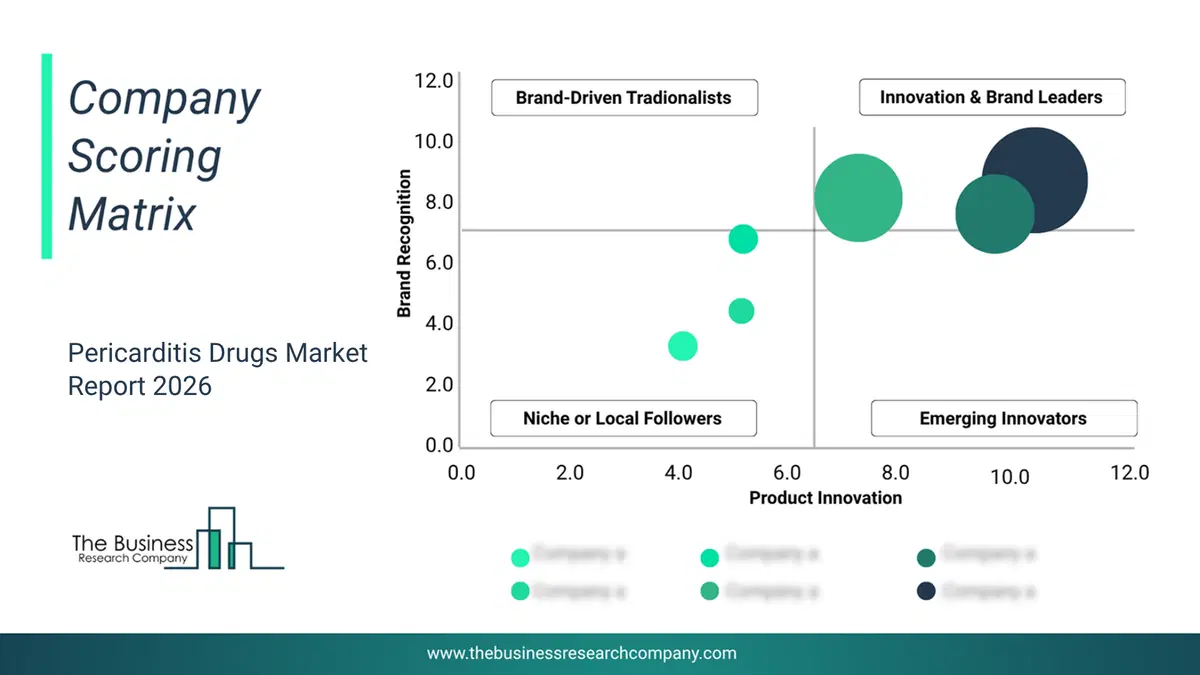
This chart maps companies by product innovation and brand strength, with bubble size indicating relative revenue, helping identify market leaders, challengers, and niche players. This is an illustrative chart; the full report provides a complete and accurate competitive analysis.
Global Pericarditis Drugs Market Trends and Insights
Major companies operating in the pericarditis drugs market are focusing on developing innovative products, such as oral anti-inflammatory therapies to enhance treatment accessibility and reduce recurrence rates in patients with recurrent pericarditis. An oral anti-inflammatory therapy is a small-molecule formulation designed to modulate inflammatory pathways and prevent disease relapse through systemic, non-injectable administration. For instance, in April 2025, Cardiol Therapeutics Inc., a Canada-based clinical-stage life sciences company specializing in anti-inflammatory and anti-fibrotic therapies for heart diseases, initiated a Phase III clinical trial for CardiolRx. The investigational therapy is designed to target inflammasome pathway activation, a central mechanism in pericarditis-related inflammation and fibrosis. Its development marks progress toward offering a convenient, oral, non-immunosuppressive treatment option that could broaden therapeutic choices for recurrent pericarditis patients.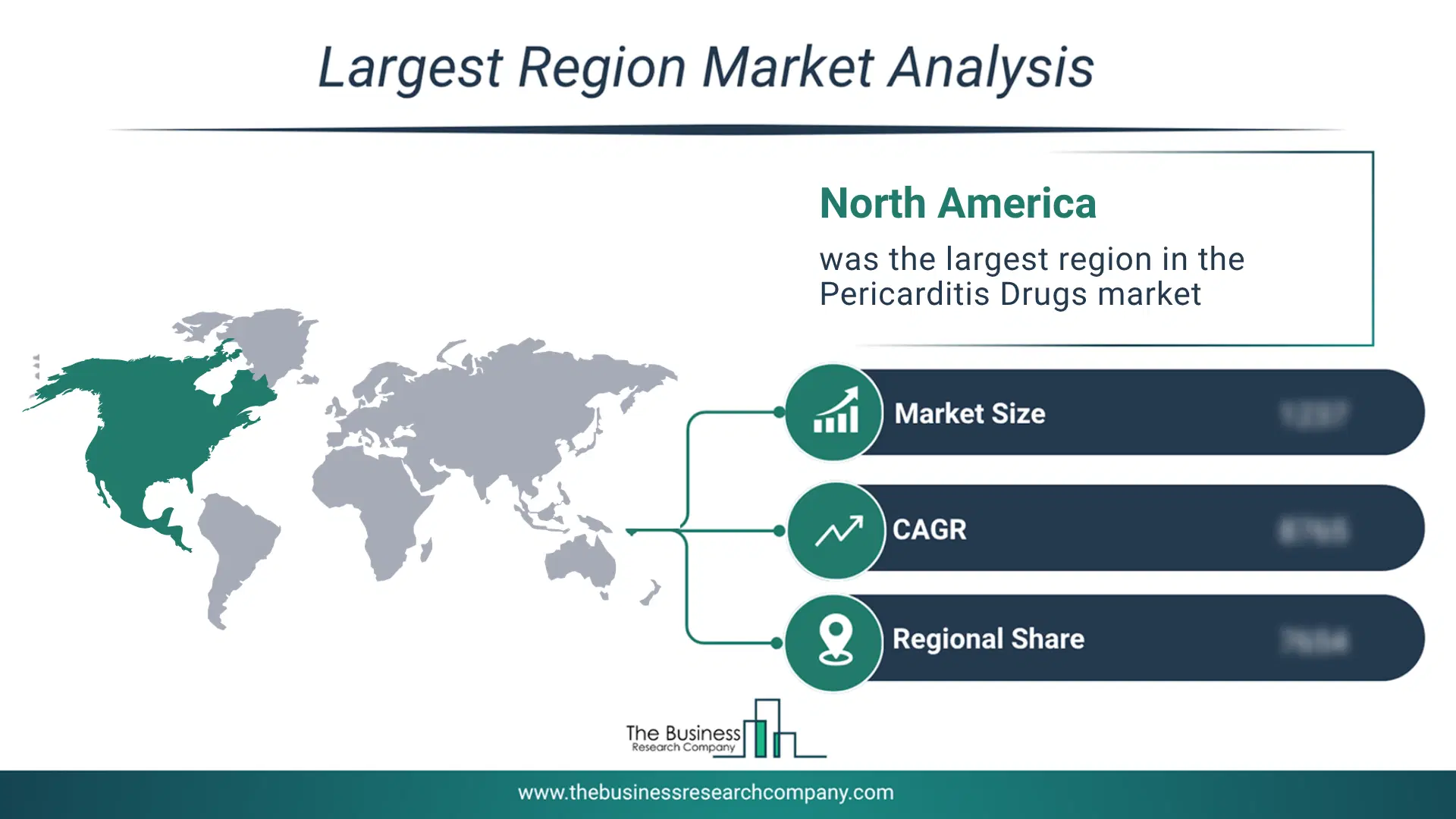
Regional Insights
North America was the largest region in the pericarditis drugs market in 2025. Asia-Pacific is expected to be the fastest-growing region in the forecast period. The regions covered in this market report are Asia-Pacific, South East Asia, Western Europe, Eastern Europe, North America, South America, Middle East, Africa. The countries covered in this market report are Australia, Brazil, China, France, Germany, India, Indonesia, Japan, Taiwan, Russia, South Korea, UK, USA, Canada, Italy, Spain.What Defines the Pericarditis Drugs Market?
The pericarditis drugs market consists of sales of antitubercular drugs, receptor antagonists, rilonacept, antibiotics or antifungals. Values in this market are ‘factory gate’ values, that is the value of goods sold by the manufacturers or creators of the goods, whether to other entities (including downstream manufacturers, wholesalers, distributors and retailers) or directly to end customers. The value of goods in this market includes related services sold by the creators of the goods.How is Market Value Defined and Measured?
The market value is defined as the revenues that enterprises gain from the sale of goods and/or services within the specified market and geography through sales, grants, or donations in terms of the currency (in USD unless otherwise specified). The revenues for a specified geography are consumption values that are revenues generated by organizations in the specified geography within the market, irrespective of where they are produced. It does not include revenues from resales along the supply chain, either further along the supply chain or as part of other products.
This chart presents market attractiveness based on a quantitative evaluation of growth, competition, strategic alignment, and risk, offering a clear view of opportunity areas for decision-making. This chart is for illustrative purposes; the full report contains the complete analysis.

This chart highlights the Total Addressable Market (TAM) by estimating the maximum revenue opportunity using an assumption-driven approach, supporting strategic planning and opportunity sizing across markets. The chart is illustrative; the full report provides a more comprehensive analysis.
What Key Data and Analysis Are Included in the Pericarditis Drugs Market Report 2026?
The pericarditis drugs market research report is one of a series of new reports from The Business Research Company that provides market statistics, including industry global market size, regional shares, competitors with the market share, detailed market segments, market trends and opportunities, and any further data you may need to thrive in the pericarditis drugs industry. The market research report delivers a complete perspective of everything you need, with an in-depth analysis of the current and future state of the industry.Pericarditis Drugs Market Report Forecast Analysis
| Report Attribute | Details |
|---|---|
| Market Size Value In 2026 | $3.61 billion |
| Revenue Forecast In 2030 | $5.1 billion |
| Growth Rate | CAGR of 9.3% from 2026 to 2030 |
| Base Year For Estimation | 2025 |
| Actual Estimates/Historical Data | 2020-2025 |
| Forecast Period | 2026 - 2030 |
| Market Representation | Revenue in USD Billion and CAGR from 2026 to 2030 |
| Segments Covered | Drug Class, Route Of Administration, Distribution Channel, Therapeutic Application, End User |
| Regional Scope | Asia-Pacific, Western Europe, Eastern Europe, North America, South America, Middle East, Africa |
| Country Scope | The countries covered in the report are Australia, Brazil, China, France, Germany, India, Indonesia, Japan, Taiwan, Russia, South Korea, UK, USA, Canada, Italy, Spain. |
| Key Companies Profiled | Merck & Co. Inc., Pfizer Inc., Bayer AG, Novartis AG, Bristol-Myers Squibb Company, Takeda Pharmaceutical Company Limited, Teva Pharmaceutical Industries Ltd., Sun Pharmaceutical Industries Ltd., Aurobindo Pharma Limited, Hikma Pharmaceuticals USA Inc., Zydus Lifesciences Limited, Kiniksa Pharmaceuticals, Camber Pharmaceuticals Inc., Scilex Holding Company, Solara Active Pharma Sciences, Alkaloids Bioactives Pvt. Ltd., Alchem International Pvt. Ltd., Sarv Biolabs Pvt. Ltd., Midas Pharma GmbH, AdvaCare Pharma, Actavis GmbH, Enomark LLC, Honour Lab Limited. |
| Customization Scope | Request for Customization |
| Pricing And Purchase Options | Explore Purchase Options |