

Prismatic Cell Assembly Automation Market Report 2026
Global Outlook – By Component (Robots, Conveyors, Vision Systems, Control Systems, Software, Other Components), By Automation Level (Fully Automated, Semi-Automated), By Application (Electric Vehicles, Consumer Electronics, Energy Storage Systems, Industrial Equipment, Other Applications), By End-User (Automotive, Electronics, Energy And Power, Industrial, Other End-Users) – Market Size, Trends, Strategies, and Forecast to 2030
Prismatic Cell Assembly Automation Market Overview
• Prismatic Cell Assembly Automation market size has reached to $2.32 billion in 2025 • Expected to grow to $4.25 billion in 2030 at a compound annual growth rate (CAGR) of 12.8% • Growth Driver: Surge In Consumer Electronics Fueling The Growth Of The Market Due To Increasing Demand For High-Performance Battery Production • Market Trend: Innovative Automation Solutions Transforming Prismatic Cell Production • North America was the largest region in 2025.What Is Covered Under Prismatic Cell Assembly Automation Market?
Prismatic cell assembly automation is the use of advanced machinery and robotic systems to carry out the entire manufacturing process of prismatic battery cells. It includes precise operations such as electrode stacking, electrolyte injection, welding, and cell sealing to ensure consistent quality and performance. Automation enhances production efficiency, reduces errors, and maintains uniformity across all cells. The main components of prismatic cell assembly automation are robots, conveyors, vision systems, control systems, software, and other components. Robots refer to programmable machines capable of performing tasks autonomously or semi-autonomously, often executing repetitive, precise, or complex operations in place of humans. The automation level includes fully automated and semi-automated systems. These components are used for applications such as electric vehicles, consumer electronics, energy storage systems, and industrial equipment, and are utilized by end-users including automotive, electronics, energy and power, industrial sectors, and others.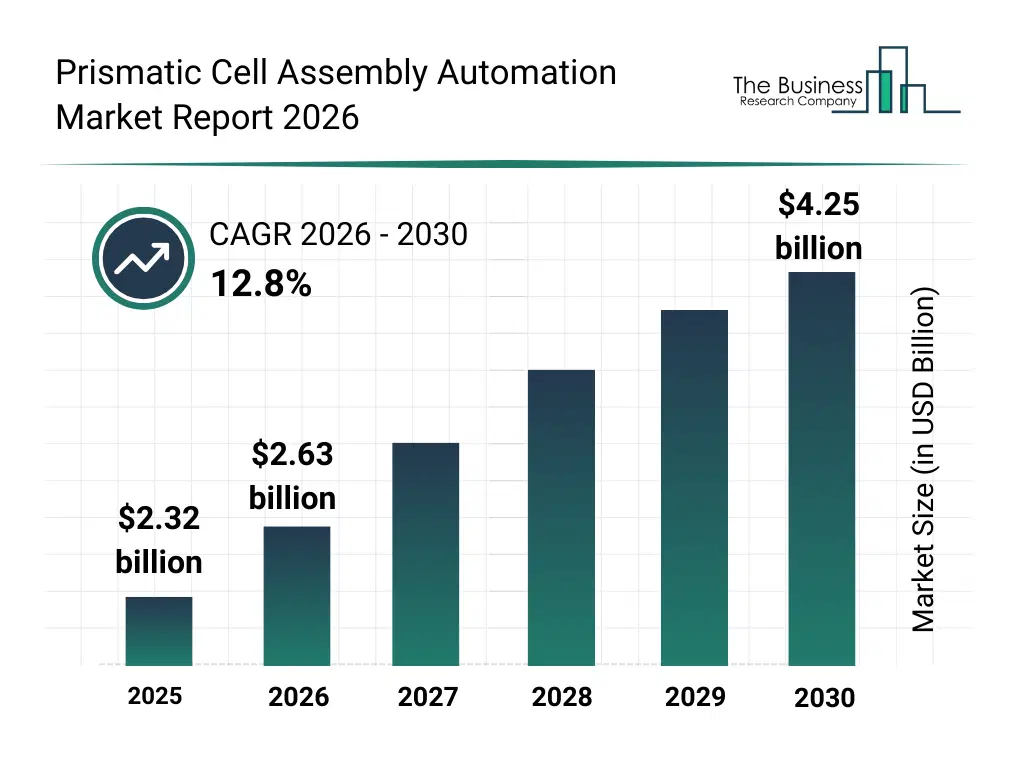
What Is The Prismatic Cell Assembly Automation Market Size and Share 2026?
The prismatic cell assembly automation market size has grown rapidly in recent years. It will grow from $2.32 billion in 2025 to $2.63 billion in 2026 at a compound annual growth rate (CAGR) of 13.0%. The growth in the historic period can be attributed to expansion of lithium-ion battery manufacturing capacity, growth in prismatic cell adoption, increasing automation in battery production, availability of advanced robotic systems, rising demand for consistent cell quality.What Is The Prismatic Cell Assembly Automation Market Growth Forecast?
The prismatic cell assembly automation market size is expected to see rapid growth in the next few years. It will grow to $4.25 billion in 2030 at a compound annual growth rate (CAGR) of 12.8%. The growth in the forecast period can be attributed to scaling up of electric vehicle production, increasing investments in battery gigafactories, rising demand for standardized battery formats, growing adoption of digital twins in manufacturing, integration of ai-driven quality monitoring. Major trends in the forecast period include increasing adoption of fully automated prismatic cell lines, rising integration of vision-guided assembly systems, growing use of robotics for precision stacking and welding, expansion of high-throughput battery assembly plants, enhanced quality control through software analytics.Tariff Impact On Prismatic Cell Assembly Automation Market
Tariffs are affecting the prismatic cell assembly automation market by increasing the cost of imported robots, precision conveyors, machine vision systems, motion controllers, and automation software platforms. Battery manufacturing hubs in Asia-Pacific and Europe are particularly impacted due to heavy dependence on imported high-precision automation components. These tariffs are increasing capital investment requirements and extending factory commissioning timelines. At the same time, they are accelerating local automation system integration, regional robotics manufacturing, and development of modular and scalable battery assembly solutions.
Global Prismatic Cell Assembly Automation Market Segmentation
1) By Component: Robots, Conveyors, Vision Systems, Control Systems, Software, Other Components 2) By Automation Level: Fully Automated, Semi-Automated 3) By Application: Electric Vehicles, Consumer Electronics, Energy Storage Systems, Industrial Equipment, Other Applications 4) By End-User: Automotive, Electronics, Energy And Power, Industrial, Other End-Users Subsegments: 1) By Robots: Articulated Robots, Selective Compliance Assembly Robot Arm (SCARA) Robots, Delta Robots, Collaborative Robots (Cobots) 2) By Conveyors: Belt Conveyors, Roller Conveyors, Chain Conveyors, Modular Conveyors 3) By Vision Systems: Two-Dimensional (2D) Vision Systems, Three-Dimensional (3D) Vision Systems, Laser Vision Systems, Multi-Camera Vision Systems 4) By Control Systems: Programmable Logic Controllers (PLC), Human-Machine Interfaces (HMI), Distributed Control Systems (DCS), Motion Controllers 5) By Software: Assembly Automation Software, Process Monitoring Software, Quality Control Software, Analytics And Reporting Software 6) By Other Components: End Effectors, Grippers, Sensors, Safety SystemsWhat Is The Driver Of The Prismatic Cell Assembly Automation Market?
The rising demand for consumer electronics is expected to propel the growth of the prismatic cell assembly automation market going forward. Consumer electronics refer to electronic devices designed for everyday use by individuals, including smartphones, laptops, tablets, and wearable devices. The demand for consumer electronics is increasing due to the development of faster and more powerful processors, which enhance device performance and enable new features that encourage consumers to upgrade more frequently. The growing demand for consumer electronics supports the need for prismatic cell assembly automation, as these devices require high-capacity, efficient batteries that can only be produced at scale through automated manufacturing processes. For instance, in February 2024, according to the Japan Electronics and Information Technology Industries Association, a Japan-based trade organization, consumer electronic equipment production reached $201.91 million (¥31,685 million), up from $149.27 million (¥23,425 million) in January 2023. Therefore, the rising demand for consumer electronics is driving the growth of the prismatic cell assembly automation industry.Key Players In The Global Prismatic Cell Assembly Automation Market
Major companies operating in the prismatic cell assembly automation market are Siemens AG, Mitsubishi Electric Corporation, Schneider Electric SE, Rockwell Automation Inc., FANUC Corporation, Yaskawa Electric Corporation, Comau S.p.A., Manz AG, Dürr AG, Wuxi Lead Intelligent Equipment Co. Ltd., Shenzhen Yinghe Technology Co. Ltd., Guangdong Lyric Robot Automation Co. Ltd., CKD Corporation, Schuler Group GmbH, Hitachi Ltd., Thyssenkrupp AG, Honeywell International Inc., KUKA AG, ABB Ltd., Bosch Rexroth AG, SFA Engineering S.p.A., Koerber AG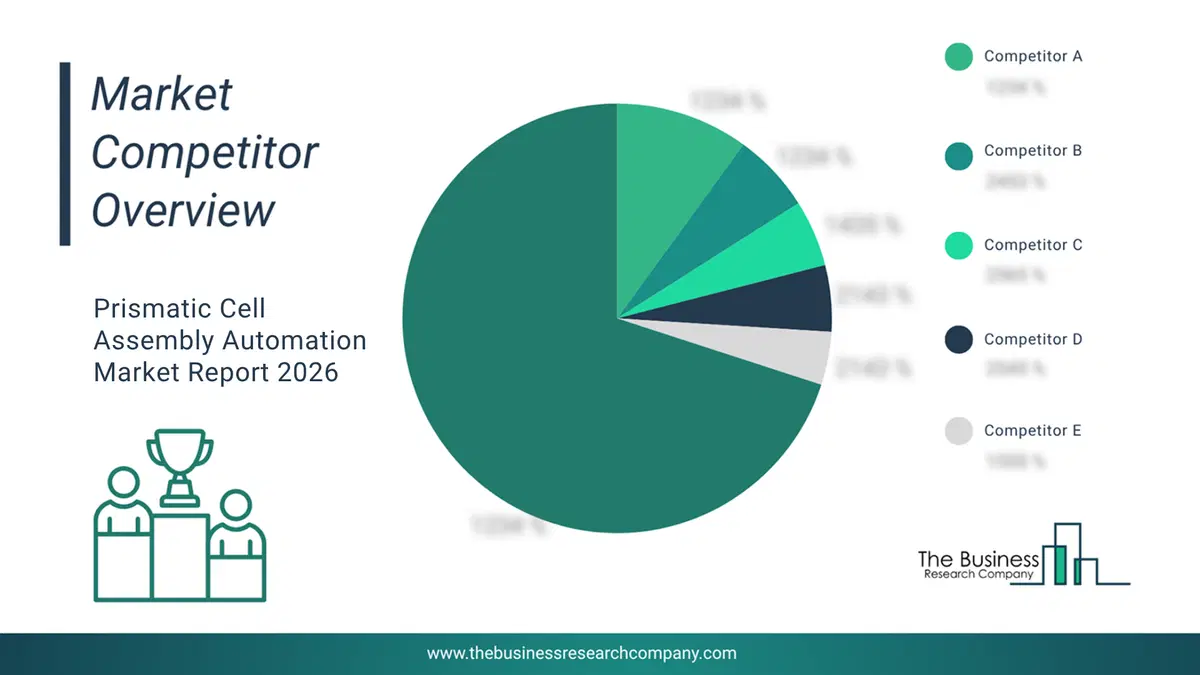
This chart is for illustrative purposes; the full report includes a detailed competitor analysis and comprehensive overview of the top 10 companies in the market.
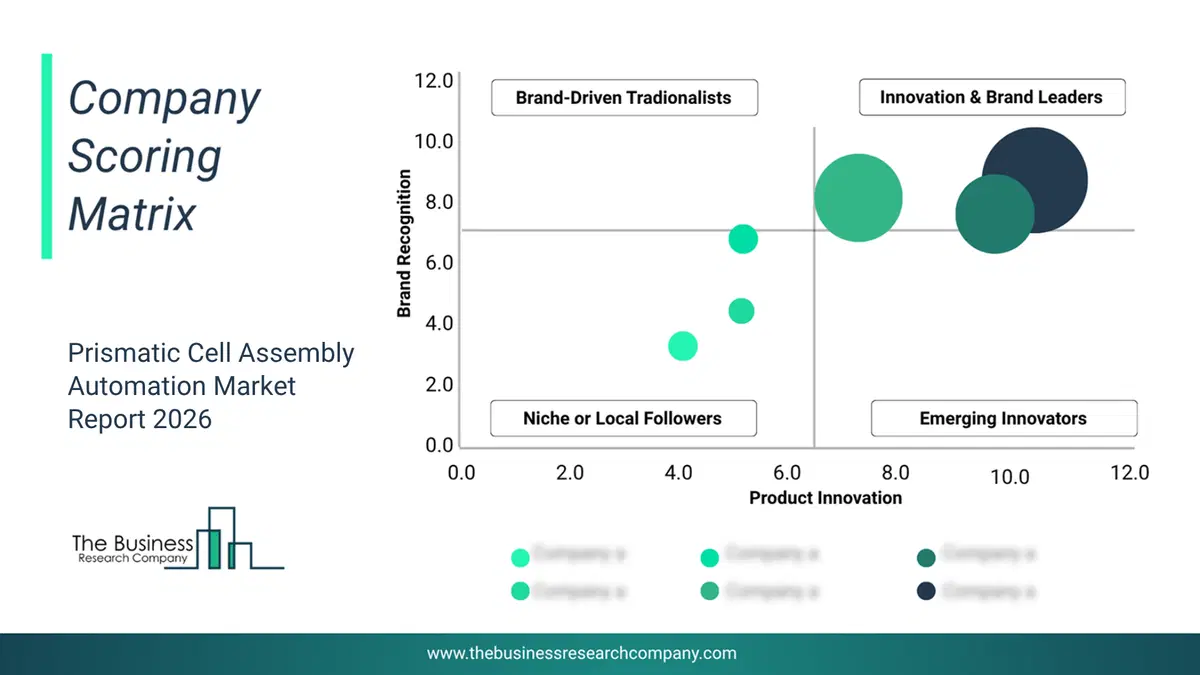
This chart maps companies by product innovation and brand strength, with bubble size indicating relative revenue, helping identify market leaders, challengers, and niche players. This is an illustrative chart; the full report provides a complete and accurate competitive analysis.
Global Prismatic Cell Assembly Automation Market Trends and Insights
Major companies operating in the prismatic cell assembly automation market are focusing on developing innovative solutions such as fully automated assembly lines to increase production efficiency, ensure quality, and meet growing demand for advanced energy storage. Fully automated assembly lines are production systems where machines and robotics perform all manufacturing tasks with minimal human intervention, helping increase efficiency, reduce errors, lower labor costs, and ensure consistent high-quality battery production. For instance, in January 2025, The Lithium Battery Company, a US-based manufacturing company, launched a state-of-the-art 60,000 sq ft automated manufacturing facility in Tampa, Florida, featuring fully automated large prismatic and cylindrical battery assembly lines, as well as semi-automated pack assembly lines, designed to support defense contracts, AI data center energy storage, and OEM partnerships. The facility enables the company to scale production, enhance quality control, and accelerate the deployment of advanced energy storage solutions. Equipped with clean room environments, advanced testing and validation laboratories, climate-controlled storage, and comprehensive quality control systems, the plant ensures high reliability and safety standards for all battery products.What Are Latest Mergers And Acquisitions In The Prismatic Cell Assembly Automation Market?
In August 2023, Dürr AG, a Germany-based mechanical and plant engineering company, acquired BBS Automation GmbH for an undisclosed amount. With this acquisition, Dürr AG aims to expand its position in the high-growth industrial automation market, enhance its technological portfolio, and form a powerhouse in automation solutions alongside its subsidiaries Teamtechnik and Hekuma, while broadening its customer base, increasing its presence across key international markets, and accelerating its growth in intelligent manufacturing and e-mobility solutions. BBS Automation GmbH is a Germany-based automation technology company that provides automated production systems for industries such as e-mobility, automotive, pharmaceuticals, and consumer goods.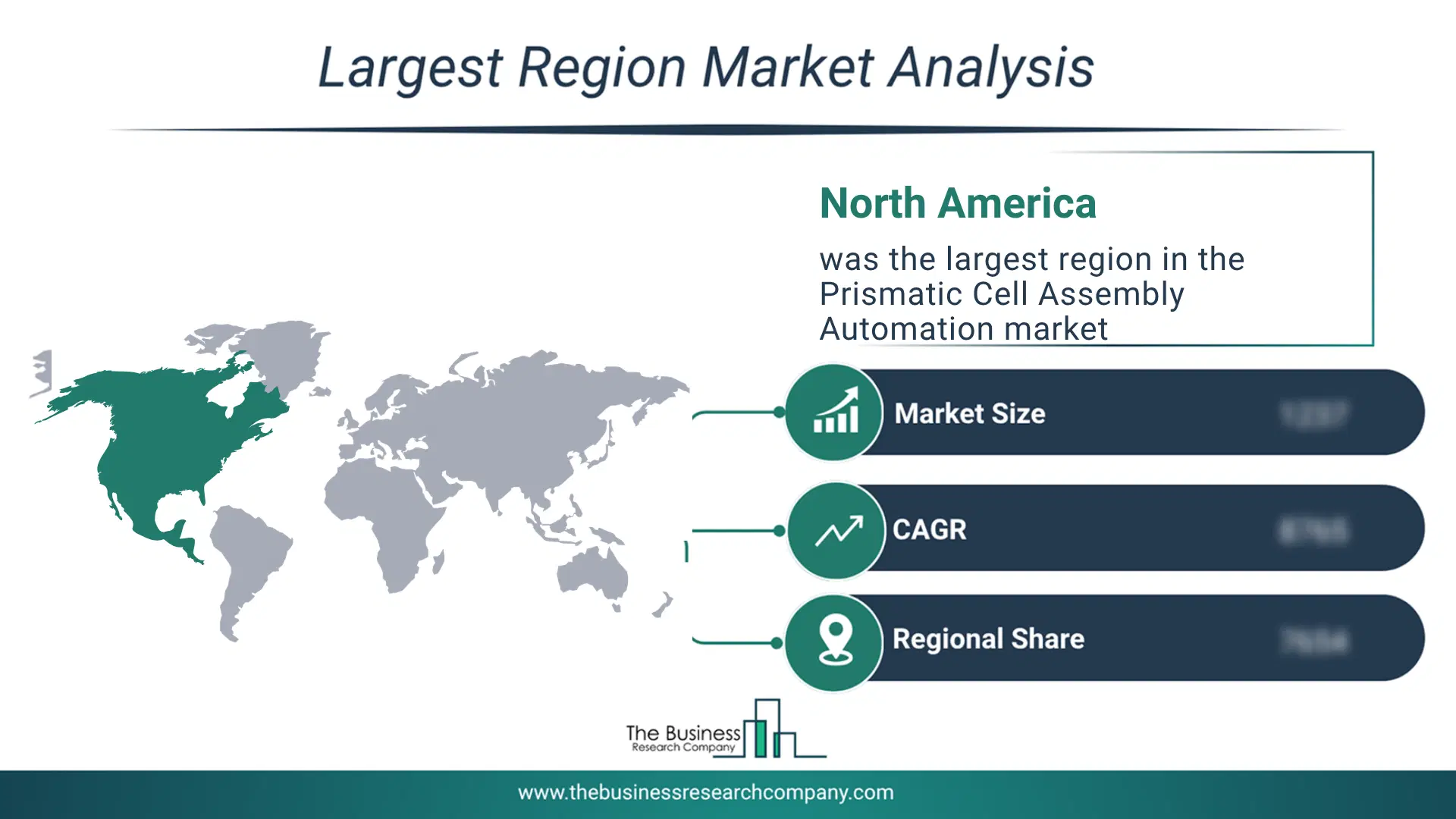
Regional Outlook
North America was the largest region in the prismatic cell assembly automation market in 2025. The regions covered in this market report are Asia-Pacific, South East Asia, Western Europe, Eastern Europe, North America, South America, Middle East, Africa The countries covered in this market report are Australia, Brazil, China, France, Germany, India, Indonesia, Japan, Taiwan, Russia, South Korea, UK, USA, Canada, Italy, Spain.What Defines the Prismatic Cell Assembly Automation Market?
The prismatic cell assembly automation market consists of sales of electrolyte filling machines, vacuum drying systems, module housing assembly stations, thermal management integration systems, cell tab welding machines, insulation and sealing equipment, automated labeling and packaging stations, and aging or formation testing systems. Values in this market are ‘factory gate’s values, that is, the value of goods sold by the manufacturers or creators of the goods, whether to other entities (including downstream manufacturers, wholesalers, distributors, and retailers) or directly to end customers. The value of goods in this market includes related services sold by the creators of the goods.How is Market Value Defined and Measured?
The market value is defined as the revenues that enterprises gain from the sale of goods and/or services within the specified market and geography through sales, grants, or donations in terms of the currency (in USD unless otherwise specified). The revenues for a specified geography are consumption values that are revenues generated by organizations in the specified geography within the market, irrespective of where they are produced. It does not include revenues from resales along the supply chain, either further along the supply chain or as part of other products.
This chart presents market attractiveness based on a quantitative evaluation of growth, competition, strategic alignment, and risk, offering a clear view of opportunity areas for decision-making. This chart is for illustrative purposes; the full report contains the complete analysis.

This chart highlights the Total Addressable Market (TAM) by estimating the maximum revenue opportunity using an assumption-driven approach, supporting strategic planning and opportunity sizing across markets. The chart is illustrative; the full report provides a more comprehensive analysis.
What Key Data and Analysis Are Included in the Prismatic Cell Assembly Automation Market Report 2026?
The prismatic cell assembly automation market research report is one of a series of new reports from The Business Research Company that provides market statistics, including industry global market size, regional shares, competitors with the market share, detailed market segments, market trends and opportunities, and any further data you may need to thrive in the prismatic cell assembly automation industry. The market research report delivers a complete perspective of everything you need, with an in-depth analysis of the current and future state of the industry.Prismatic Cell Assembly Automation Market Report Forecast Analysis
| Report Attribute | Details |
|---|---|
| Market Size Value In 2026 | $2.63 billion |
| Revenue Forecast In 2030 | $4.25 billion |
| Growth Rate | CAGR of 12.8% from 2026 to 2030 |
| Base Year For Estimation | 2025 |
| Actual Estimates/Historical Data | 2020-2025 |
| Forecast Period | 2026 - 2030 |
| Market Representation | Revenue in USD Billion and CAGR from 2026 to 2030 |
| Segments Covered | Component, Automation Level, Application, End-User |
| Regional Scope | Asia-Pacific, Western Europe, Eastern Europe, North America, South America, Middle East, Africa |
| Key Companies Profiled | Siemens AG, Mitsubishi Electric Corporation, Schneider Electric SE, Rockwell Automation Inc., FANUC Corporation, Yaskawa Electric Corporation, Comau S.p.A., Manz AG, Dürr AG, Wuxi Lead Intelligent Equipment Co. Ltd., Shenzhen Yinghe Technology Co. Ltd., Guangdong Lyric Robot Automation Co. Ltd., CKD Corporation, Schuler Group GmbH, Hitachi Ltd., Thyssenkrupp AG, Honeywell International Inc., KUKA AG, ABB Ltd., Bosch Rexroth AG, SFA Engineering S.p.A., Koerber AG |
| Customization Scope | Request for Customization |
| Pricing And Purchase Options | Explore Purchase Options |