
Regenerative Xenograft Market Report 2026
Global Outlook – By Type Of Xenograft (Bone Xenografts, Cartilage Xenografts, Dermal Xenografts, Dental Xenografts, Vascular Xenografts), By Formulation (Powdered Form, Liquid Form, Gel Form, Sheet Form, Composite Form), By Source Of Donor (Porcine Xenografts, Bovine Xenografts, Equine Xenografts, Canine Xenografts), By Application (Orthopedic Surgery, Dental Surgery, Cardiovascular Surgery, Wound Healing, Cosmetic Surgery), By End-User (Hospitals, Ambulatory Surgical Centers, Specialty Clinics, Research Institutes, Other End-Users) - Market Size, Trends, Strategies, and Forecast to 2030
Regenerative Xenograft Market Overview
• Regenerative Xenograft market size has reached to $1.4 billion in 2025 • Expected to grow to $2.3 billion in 2030 at a compound annual growth rate (CAGR) of 10.5% • Growth Driver: Rising Orthopedic Injuries Driving Growth Of The Market Due To Obesity‑Related Musculoskeletal Disorders • Market Trend: Advancements In Collagen Membranes Driving Next-Generation Regenerative Xenografts • North America was the largest region in 2025 and Asia-Pacific is the fastest growing region.What Is Covered Under Regenerative Xenograft Market?
A regenerative xenograft is a biological graft derived from a different species that is designed to support and promote tissue regeneration in the recipient. It serves as a scaffold that encourages the body’s own cells to grow, repair, or replace damaged tissues. The main objective of a regenerative xenograft is to facilitate natural healing and tissue restoration while eventually being integrated into or replaced by the patient’s own tissue. The main types of xenografts in regenerative xenograft are bone xenografts, cartilage xenografts, dermal xenografts, dental xenografts, and vascular xenografts. Bone xenografts are regenerative biomaterials derived from animal bone, primarily bovine or porcine sources, used to promote bone regeneration and repair in human orthopedic and dental procedures. These are having formulations including powdered form, liquid form, gel form, sheet form, and composite form, obtained from sources such as donor porcine xenografts, bovine xenografts, equine xenografts, and canine xenografts, used in applications such as orthopedic surgery, dental surgery, cardiovascular surgery, wound healing, and cosmetic surgery, in the end-users including hospitals, ambulatory surgical centers, specialty clinics, research institutes, and others.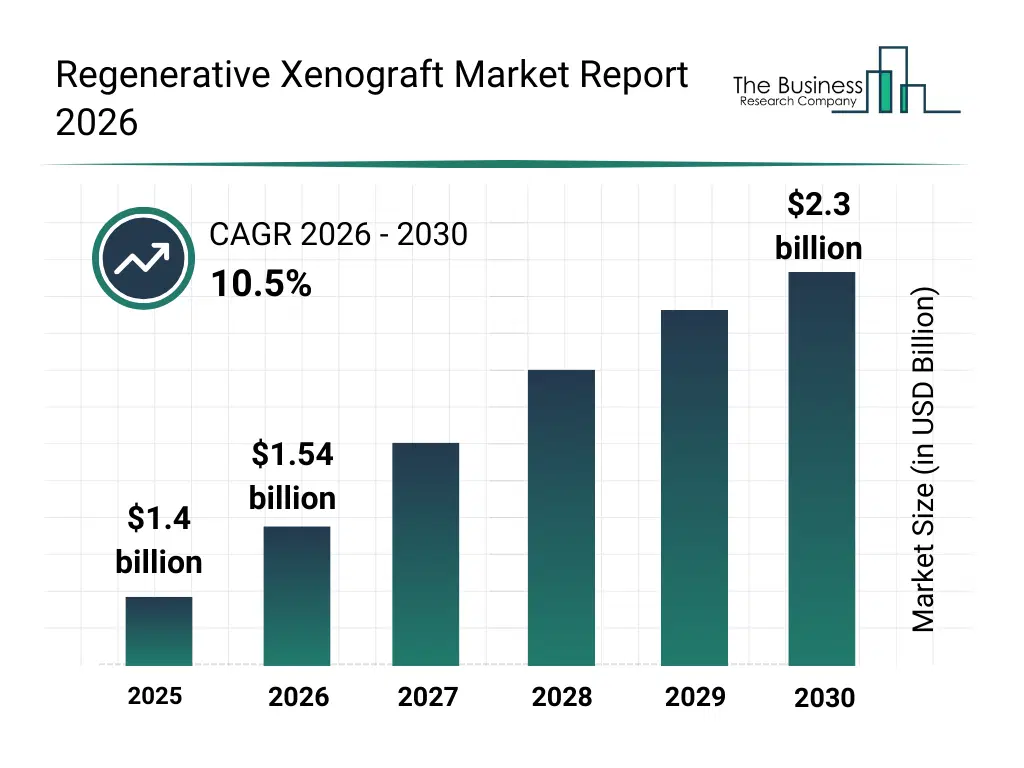
What Is The Regenerative Xenograft Market Size and Share 2026?
The regenerative xenograft market size has grown rapidly in recent years. It will grow from $1.4 billion in 2025 to $1.54 billion in 2026 at a compound annual growth rate (CAGR) of 10.6%. The growth in the historic period can be attributed to growth in reconstructive and orthopedic surgeries, increasing use of biologic graft materials, advancements in tissue preservation technologies, rising demand for dental bone substitutes, expansion of surgical treatment volumes.What Is The Regenerative Xenograft Market Growth Forecast?
The regenerative xenograft market size is expected to see rapid growth in the next few years. It will grow to $2.3 billion in 2030 at a compound annual growth rate (CAGR) of 10.5%. The growth in the forecast period can be attributed to increasing preference for biologic graft solutions, rising investments in regenerative surgery, expansion of cosmetic and reconstructive procedures, growing focus on improved healing outcomes, innovation in xenograft sourcing and processing. Major trends in the forecast period include increasing adoption of advanced xenograft processing techniques, rising demand for dental and orthopedic xenografts, growing focus on biocompatibility and integration, expansion of ready-to-use xenograft formulations, enhanced standardization of xenograft products.
Global Regenerative Xenograft Market Segmentation
1) By Type Of Xenograft: Bone Xenografts, Cartilage Xenografts, Dermal Xenografts, Dental Xenografts, Vascular Xenografts 2) By Formulation: Powdered Form, Liquid Form, Gel Form, Sheet Form, Composite Form 3) By Source Of Donor: Porcine Xenografts, Bovine Xenografts, Equine Xenografts, Canine Xenografts 4) By Application: Orthopedic Surgery, Dental Surgery, Cardiovascular Surgery, Wound Healing, Cosmetic Surgery 5) By End-User: Hospitals, Ambulatory Surgical Centers, Specialty Clinics, Research Institutes, Other End-Users Subsegments: 1) By Bone Xenografts: Cortical Bone, Cancellous Bone, Demineralized Bone Matrix, Bone Blocks, Bone Chips 2) By Cartilage Xenografts: Articular Cartilage, Meniscal Cartilage, Nasal Cartilage, Auricular Cartilage 3) By Dermal Xenografts: Acellular Dermal Matrix, Crosslinked Dermal Scaffold, Non-Crosslinked Dermal Scaffold, Composite Dermal Grafts 4) By Dental Xenografts: Bone Substitute Granules, Membranes And Barriers, Block Grafts, Socket Preservation Materials 5) By Vascular Xenografts: Vascular Patches, Vascular Grafts, Heart Valve Xenografts, Pericardial PatchesWhat Is The Driver Of The Regenerative Xenograft Market?
The rising incidence of orthopedic injuries is expected to propel the growth of the regenerative xenograft market going forward. Orthopedic injuries refer to injuries of the musculoskeletal system, including bones, joints, muscles, tendons, and ligaments, and typically involve fractures, dislocations, sprains, or tears. The increase in orthopedic injuries is largely attributed to obesity and excess body weight, which place additional mechanical stress on bones and joints, accelerating wear and tear and elevating the risk of fractures and joint degeneration. Regenerative xenografts address the growing incidence of orthopedic injuries by providing advanced animal-derived biomaterials that promote bone and joint repair, enhance tissue regeneration, and restore musculoskeletal function. For instance, in November 2024, according to the Health and Safety Executive (HSE), a UK-based national regulator for workplace health, safety, and welfare, approximately 543,000 workers experienced a work-related musculoskeletal disorder (MSD) in 2024, up from 473,000 in 2023. Therefore, the rising prevalence of orthopedic injuries is driving the growth of the regenerative xenograft industry.Key Players In The Global Regenerative Xenograft Market
Major companies operating in the regenerative xenograft market are Stryker Corporation, Zimmer Biomet Holdings Inc., Smith & Nephew plc, Dentsply Sirona, Arthrex Inc., Integra LifeSciences Corporation, Nobel Biocare, Organogenesis Holdings Inc., Osstem Implant, MiMedx Group Inc., Vericel Corporation, LifeNet Health, BioTissue Holdings Inc., Geistlich Pharma AG, RTI Surgical Holdings Inc., Tissue Regenix Group plc, Viscus Biologics, Botiss Biomaterials GmbH, Revivicor Inc., Genoss Co. Ltd.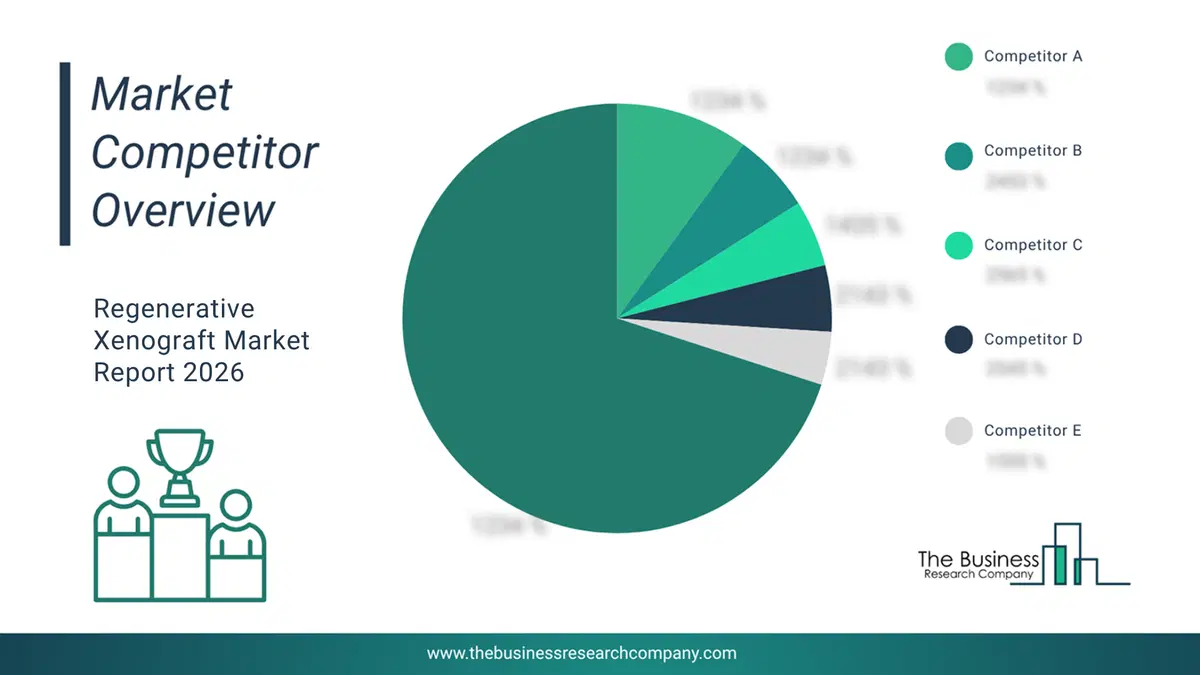
This chart is for illustrative purposes; the full report includes a detailed competitor analysis and comprehensive overview of the top 10 companies in the market.
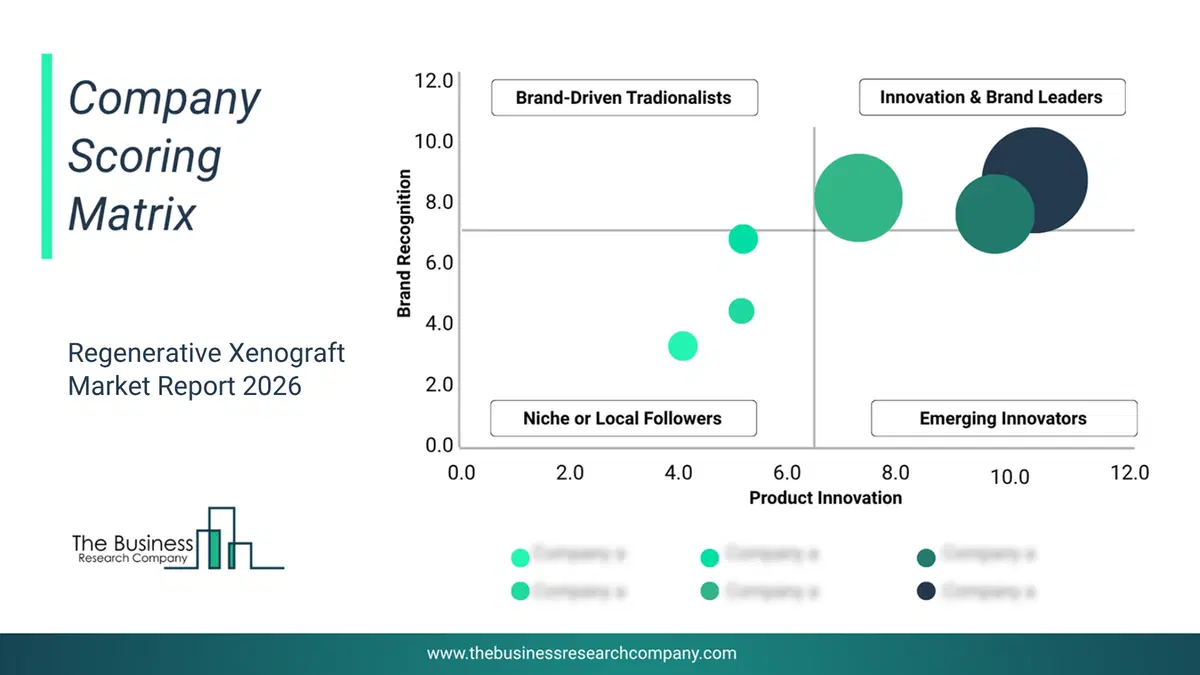
This chart maps companies by product innovation and brand strength, with bubble size indicating relative revenue, helping identify market leaders, challengers, and niche players. This is an illustrative chart; the full report provides a complete and accurate competitive analysis.
Global Regenerative Xenograft Market Trends and Insights
Major companies operating in the regenerative xenograft market are focusing on technological advancements, such as the development of advanced collagen membranes, to meet the rising demand for reliable bone regeneration, improved implant survival, and optimal tissue integration. Advanced collagen membranes are biocompatible, resorbable materials engineered to support bone and soft tissue healing, offering superior handling, adaptability, and stability compared to traditional non-resorbable membranes that often require secondary removal surgery. For instance, in October 2025, Geistlich Pharma, a Switzerland-based regenerative biomaterials company, launched Geistlich Bio-Gide Forte, an advanced collagen membrane building on its proven Bio-Gide technology. Geistlich Bio-Gide Forte features enhanced strength and stability, unfolds easily, adapts flexibly to defect sites, and can be precisely cut even when hydrated, facilitating complex clinical procedures. Its unique design supports faster and more reliable bone and tissue regeneration, improves implant survival rates, and is suitable for applications in periodontal, implantology, and reconstructive surgeries. The membrane is currently available in North America, with European market introduction underway, and offered in multiple sizes to accommodate diverse surgical needs.What Are Latest Mergers And Acquisitions In The Regenerative Xenograft Market?
In November 2024, RTI Surgical, a U.S.-based provider of contract development and manufacturing (CDMO) services, acquired Collagen Solutions for an undisclosed amount. Through this acquisition, RTI Surgical aimed to expand its portfolio of soft-tissue and xenograft biomaterials by leveraging Collagen Solutions’ expertise in bovine and porcine collagen to accelerate access to high-growth therapeutic areas such as cardiac, sports medicine, orthopedic, and reconstructive surgery. Collagen Solutions is a US-based provider of engineered medical-grade collagen and xenograft tissue products for original equipment manufacturers (OEMs).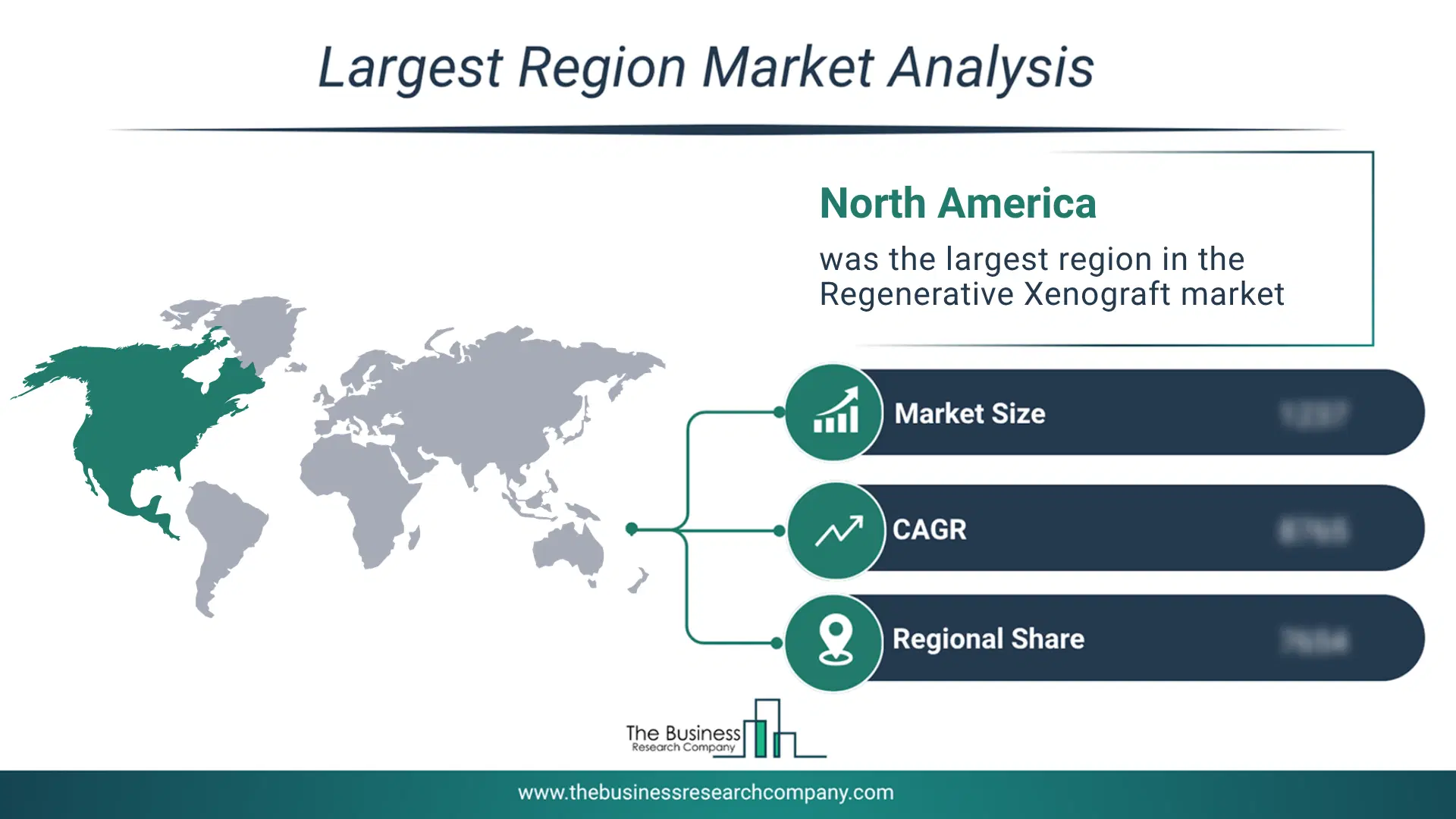
Regional Outlook
North America was the largest region in the regenerative xenograft market in 2025. Asia-Pacific is expected to be the fastest-growing region in the forecast period. The regions covered in this market report are Asia-Pacific, South East Asia, Western Europe, Eastern Europe, North America, South America, Middle East, Africa. The countries covered in this market report are Australia, Brazil, China, France, Germany, India, Indonesia, Japan, Taiwan, Russia, South Korea, UK, USA, Canada, Italy, Spain.What Defines the Regenerative Xenograft Market?
The regenerative xenograft market consists of sales of products such as dermal xenografts for skin repair, bone and dental xenografts for orthopedic and dental reconstruction, cartilage and meniscus xenografts for joint restoration, vascular xenografts for blood vessel replacement, and cardiac xenografts, including heart valves and pericardial tissues. Values in this market are ‘factory gate’ values, that is, the value of goods sold by the manufacturers or creators of the goods, whether to other entities (including downstream manufacturers, wholesalers, distributors, and retailers) or directly to end customers. The value of goods in this market includes related services sold by the creators of the goods.How is Market Value Defined and Measured?
The market value is defined as the revenues that enterprises gain from the sale of goods and/or services within the specified market and geography through sales, grants, or donations in terms of the currency (in USD unless otherwise specified). The revenues for a specified geography are consumption values that are revenues generated by organizations in the specified geography within the market, irrespective of where they are produced. It does not include revenues from resales along the supply chain, either further along the supply chain or as part of other products.
This chart presents market attractiveness based on a quantitative evaluation of growth, competition, strategic alignment, and risk, offering a clear view of opportunity areas for decision-making. This chart is for illustrative purposes; the full report contains the complete analysis.

This chart highlights the Total Addressable Market (TAM) by estimating the maximum revenue opportunity using an assumption-driven approach, supporting strategic planning and opportunity sizing across markets. The chart is illustrative; the full report provides a more comprehensive analysis.
What Key Data and Analysis Are Included in the Regenerative Xenograft Market Report 2026?
The regenerative xenograft market research report is one of a series of new reports from The Business Research Company that provides market statistics, including industry global market size, regional shares, competitors with the market share, detailed market segments, market trends and opportunities, and any further data you may need to thrive in the regenerative xenograft industry. The market research report delivers a complete perspective of everything you need, with an in-depth analysis of the current and future state of the industry.Regenerative Xenograft Market Report Forecast Analysis
| Report Attribute | Details |
|---|---|
| Market Size Value In 2026 | $1.54 billion |
| Revenue Forecast In 2030 | $2.3 billion |
| Growth Rate | CAGR of 10.5% from 2026 to 2030 |
| Base Year For Estimation | 2025 |
| Actual Estimates/Historical Data | 2020-2025 |
| Forecast Period | 2026 - 2030 |
| Market Representation | Revenue in USD Billion and CAGR from 2026 to 2030 |
| Segments Covered | Type Of Xenograft, Formulation, Source Of Donor, Application, End-User |
| Regional Scope | Asia-Pacific, Western Europe, Eastern Europe, North America, South America, Middle East, Africa |
| Country Scope | The countries covered in the report are Australia, Brazil, China, France, Germany, India, Indonesia, Japan, Taiwan, Russia, South Korea, UK, USA, Canada, Italy, Spain |
| Key Companies Profiled | Stryker Corporation, Zimmer Biomet Holdings Inc., Smith & Nephew plc, Dentsply Sirona, Arthrex Inc., Integra LifeSciences Corporation, Nobel Biocare, Organogenesis Holdings Inc., Osstem Implant, MiMedx Group Inc., Vericel Corporation, LifeNet Health, BioTissue Holdings Inc., Geistlich Pharma AG, RTI Surgical Holdings Inc., Tissue Regenix Group plc, Viscus Biologics, Botiss Biomaterials GmbH, Revivicor Inc., Genoss Co. Ltd. |
| Customization Scope | Request for Customization |
| Pricing And Purchase Options | Explore Purchase Options |