

Robot Ultrasonic Staking Cells Market Report 2026
Global Outlook – By Product Type (Standalone Ultrasonic Staking Cells, Integrated Ultrasonic Staking Cells), By Distribution Channel (Direct Sales, Distributors), By Application (Automotive, Electronics, Medical Devices, Consumer Goods, Other Applications), By End-User (Automotive Manufacturers, Electronics Manufacturers, Medical Device Manufacturers, Other End Users) – Market Size, Trends, Strategies, and Forecast to 2030
Robot Ultrasonic Staking Cells Market Overview
• Robot Ultrasonic Staking Cells market size has reached to $1.3 billion in 2025 • Expected to grow to $2.23 billion in 2030 at a compound annual growth rate (CAGR) of 11.3% • Growth Driver: Rising Automation Driving Growth In The Market Due To Increasing Efficiency, Consistency, And Reduced Labor Costs • Market Trend: Technological Advancements In Flexible Robotic Assembly Hubs For Enhanced Industrial Automation • North America was the largest region in 2025 and Asia-Pacific is the fastest growing region.What Is Covered Under Robot Ultrasonic Staking Cells Market?
Robot ultrasonic staking cells refer to integrated automated systems that use ultrasonic vibrations and robotic handling to join plastic components by forming precise, high-strength stakes. These cells combine an ultrasonic welding unit with a robotic arm to deliver consistent pressure, accurate positioning, and repeatable thermal-mechanical bonding for complex assemblies in industries such as automotive, electronics, and medical devices. The main product types of robot ultrasonic staking cells are standalone ultrasonic staking cells and integrated ultrasonic staking cells. Standalone ultrasonic staking cells are independent robotic units capable of performing ultrasonic staking operations without being part of a larger production line. These products are distributed through direct sales, distributors, and online sales. They find applications across automotive, electronics, medical devices, consumer goods, and others, serving end-users including automotive manufacturers, electronics manufacturers, medical device manufacturers, and others.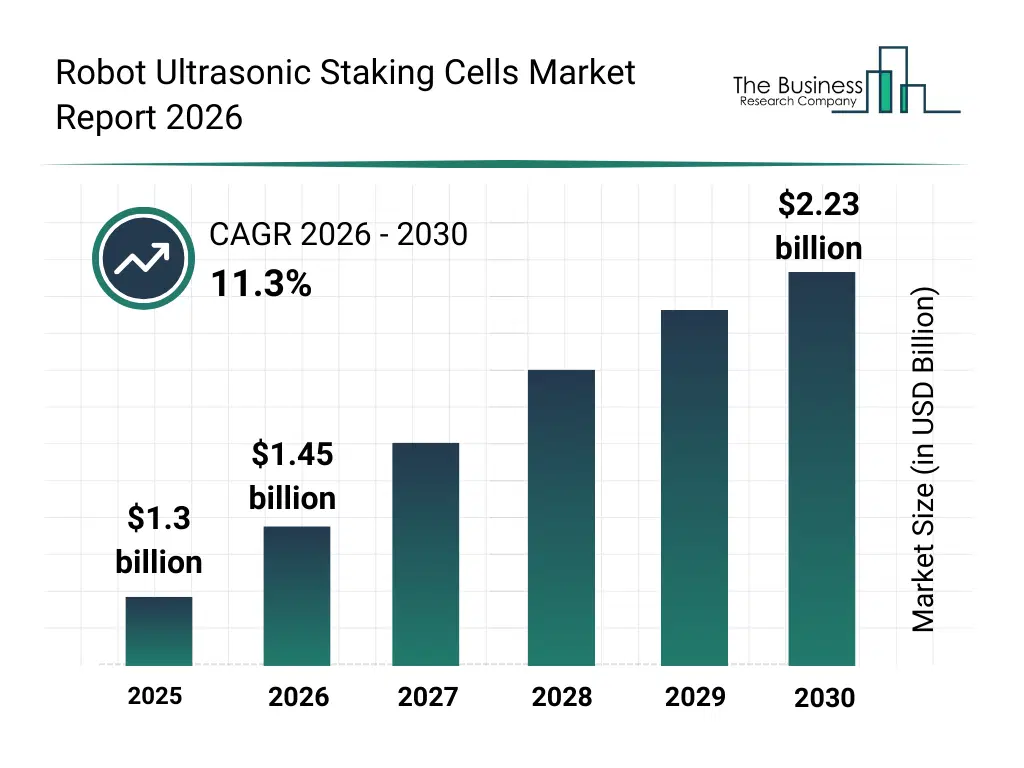
What Is The Robot Ultrasonic Staking Cells Market Size and Share 2026?
The robot ultrasonic staking cells market size has grown rapidly in recent years. It will grow from $1.3 billion in 2025 to $1.45 billion in 2026 at a compound annual growth rate (CAGR) of 11.6%. The growth in the historic period can be attributed to expansion of plastic component usage in automotive interiors, growth in electronics assembly automation, increasing demand for reliable joining techniques, availability of ultrasonic welding technology, rising focus on production consistency.What Is The Robot Ultrasonic Staking Cells Market Growth Forecast?
The robot ultrasonic staking cells market size is expected to see rapid growth in the next few years. It will grow to $2.23 billion in 2030 at a compound annual growth rate (CAGR) of 11.3%. The growth in the forecast period can be attributed to expansion of lightweight material adoption, increasing automation in medical device manufacturing, rising demand for defect-free plastic assemblies, integration of smart factory systems, growing use of collaborative robots. Major trends in the forecast period include increasing adoption of integrated ultrasonic staking cells, rising demand for high-precision plastic joining, growing use in multi-component assemblies, expansion of robotic handling integration, enhanced process repeatability and control.Tariff Impact On Robot Ultrasonic Staking Cells Market
Tariffs are impacting the robot ultrasonic staking cells market by increasing the cost of imported ultrasonic generators, robotic arms, control units, precision fixtures, and automation components. Manufacturers in North America and Europe are most affected due to reliance on specialized ultrasonic and robotic technologies sourced globally. These tariffs are increasing system costs and slowing capital equipment upgrades. However, they are also encouraging domestic system integration, local sourcing of components, and innovation in compact and cost-efficient ultrasonic staking solutions.
Global Robot Ultrasonic Staking Cells Market Segmentation
1) By Product Type: Standalone Ultrasonic Staking Cells, Integrated Ultrasonic Staking Cells 2) By Distribution Channel: Direct Sales, Distributors 3) By Application: Automotive, Electronics, Medical Devices, Consumer Goods, Other Applications 4) By End-User: Automotive Manufacturers, Electronics Manufacturers, Medical Device Manufacturers, Other End Users Subsegments: 1) By Standalone Ultrasonic Staking Cells: Manual Configuration, Semi-Automated Setup 2) By Integrated Ultrasonic Staking Cells: Robotic Assembly Line Integration, Fully Automated Production SystemWhat Are The Drivers Of The Robot Ultrasonic Staking Cells Market?
The increasing adoption of automation is expected to propel the growth of the robot ultrasonic staking cells market going forward. Automation refers to the use of technology and systems to perform tasks with minimal human intervention to improve efficiency and accuracy. Automation is increasing because it boosts productivity by performing tasks faster and more consistently than humans. Robot ultrasonic staking cells help automation by enabling precise, high-speed joining of components without manual intervention, ensuring consistent quality, reducing assembly time, and lowering labor costs in manufacturing processes. For instance, in April 2024, according to the International Federation of Robotics, a Germany-based international organization, in the United States, manufacturing companies have significantly increased their automation efforts, with total industrial robot installations rising 12% to 44,303 units in 2023. Therefore, the increasing adoption of automation is driving the growth of the robot ultrasonic staking cells industry. The growing Industry 4.0 adoption is expected to propel the growth of the robot ultrasonic staking cells market going forward. Industry 4.0 adoption involves implementing connected, intelligent, and automated manufacturing technologies to improve efficiency, flexibility, and decision-making. Industry 4.0 increasing adoption is driven by the ability of smart technologies to optimize processes, minimize downtime, and enhance overall operational performance. Robot ultrasonic staking cells contribute to Industry 4.0 by combining robotic automation with real-time monitoring and control, which improves production accuracy, operational efficiency, and integration within smart manufacturing systems. For instance, in April 2024, according to Rockwell Automation, Inc., a US-based automation company, in 2024, 95% of manufacturers are either using or evaluating smart manufacturing technology, up from 84% in 2023. Therefore, the growing Industry 4.0 adoption is driving the growth of the robot ultrasonic staking cells industry.Key Players In The Global Robot Ultrasonic Staking Cells Market
Major companies operating in the robot ultrasonic staking cells market are Emerson Electric Co., KUKA AG, Unisonic Engineers, MS Ultrasonic Technology Group, Dukane Corporation, Herrmann Ultrasonics GmbH & Co. KG, Telsonic AG, Sonotronic Nagel GmbH, Schunk Sonosystems GmbH, Rychiger, Sonics & Materials Inc., Sonitek Corporation, Crest Group, JSK Ultrasonics Ltd., Mecasonic, Rinco Ultrasonics AG, Sonic Italia Srl, TESPA Robotics, Weber Ultrasonics AG, Shanghai Chenfeng Ultrasonic Equipment Co. Ltd.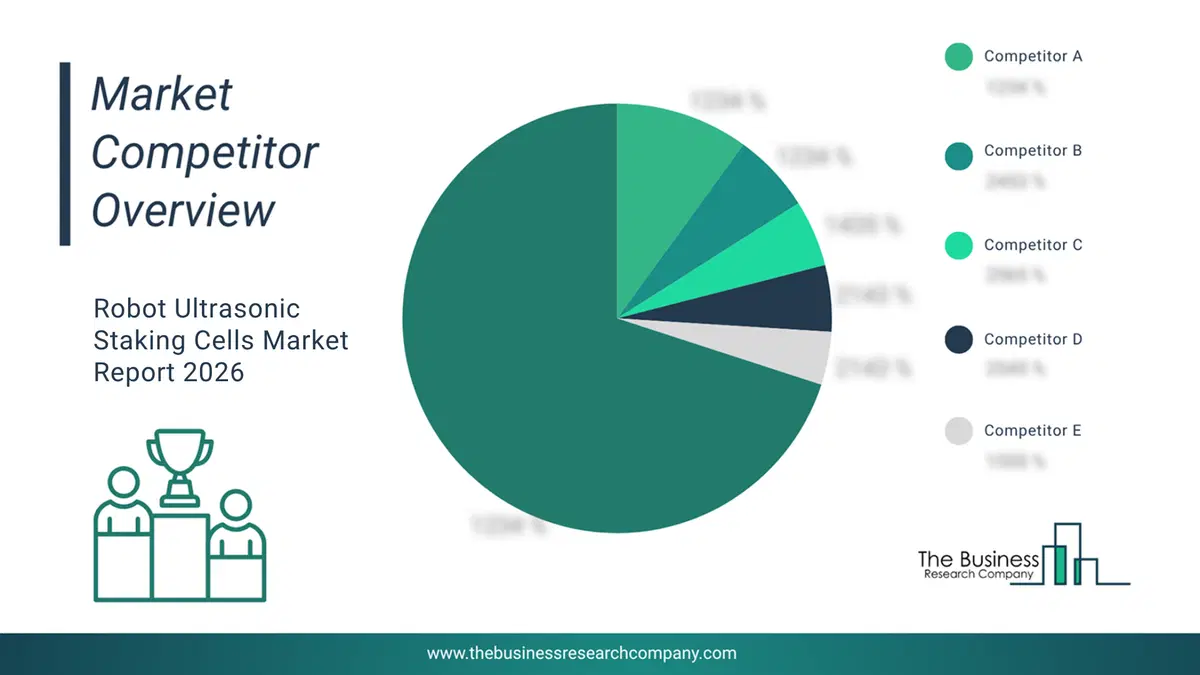
This chart is for illustrative purposes; the full report includes a detailed competitor analysis and comprehensive overview of the top 10 companies in the market.
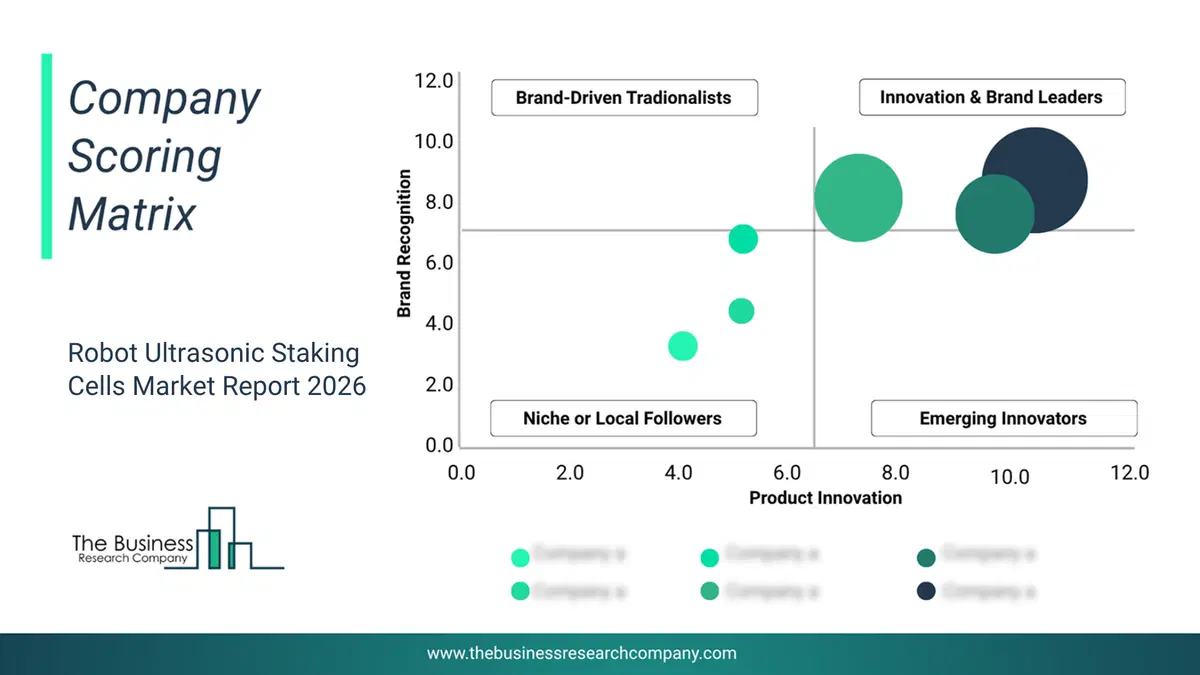
This chart maps companies by product innovation and brand strength, with bubble size indicating relative revenue, helping identify market leaders, challengers, and niche players. This is an illustrative chart; the full report provides a complete and accurate competitive analysis.
Global Robot Ultrasonic Staking Cells Market Trends and Insights
Major companies operating in the robot ultrasonic staking cells market are focusing on developing flexible robotic assembly hubs to enhance production efficiency, precision, and scalability in industrial applications. Flexible robotic assembly hubs refer to reconfigurable production units that use robotic arms and ultrasonic staking systems to perform precise, high-speed component assembly with minimal human intervention. For instance, in September 2024, JOT, a Finland-based industrial automation company, introduced its modular automated micro factory concept, designed to streamline ultrasonic staking operations across automotive, electronics, and consumer goods sectors. These incorporate robotic arms, ultrasonic staking heads, and real-time monitoring systems, that allow rapid deployment, scalable production, and reduced operational costs, significantly boosting automation and efficiency in component assembly processes.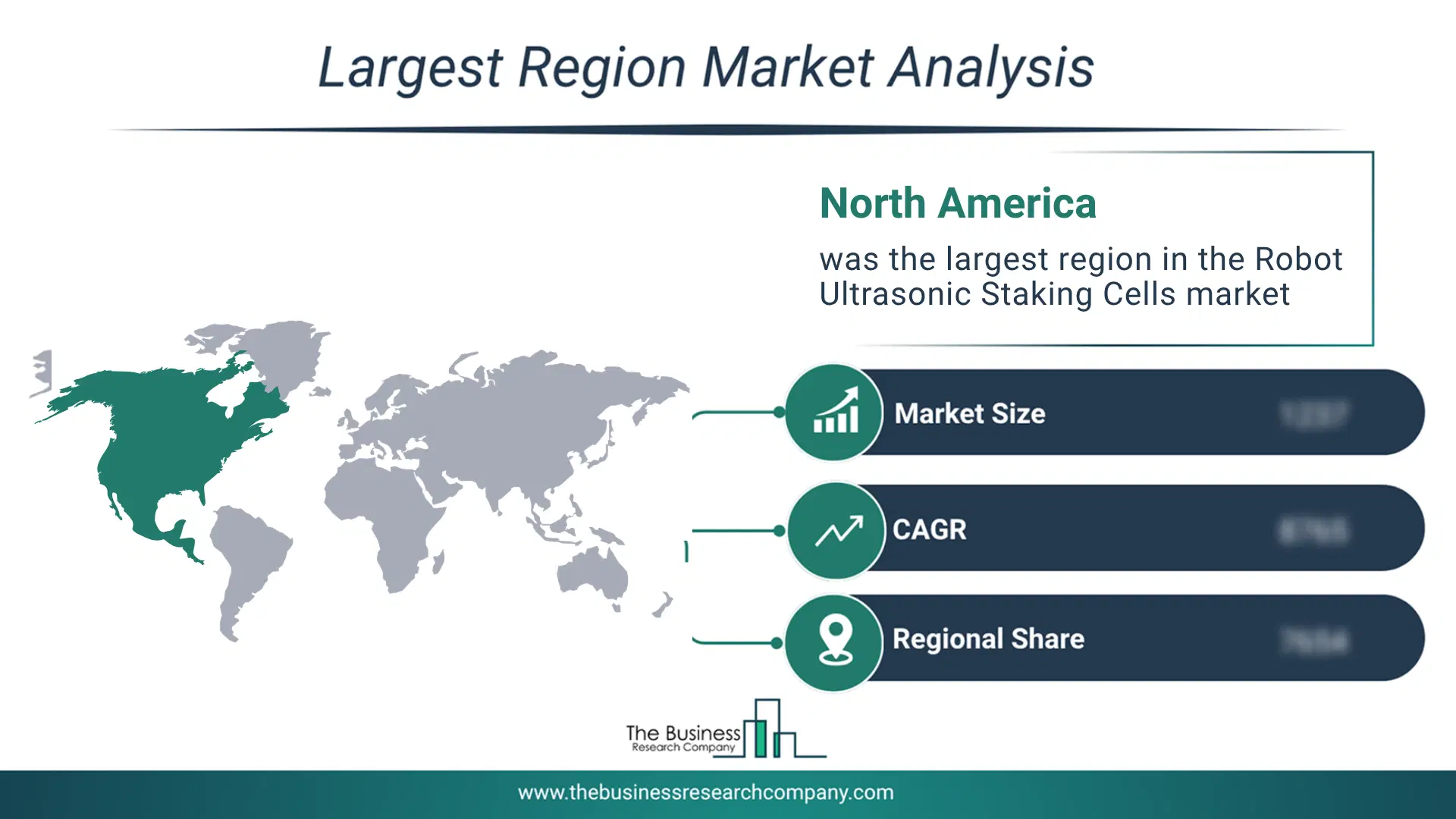
Regional Outlook
North America was the largest region in the robot ultrasonic staking cells market in 2025. Asia-Pacific is expected to be the fastest-growing region in the forecast period. The regions covered in this market report are Asia-Pacific, South East Asia, Western Europe, Eastern Europe, North America, South America, Middle East, Africa The countries covered in this market report are Australia, Brazil, China, France, Germany, India, Indonesia, Japan, Taiwan, Russia, South Korea, UK, USA, Canada, Italy, Spain.What Defines the Robot Ultrasonic Staking Cells Market?
The robot ultrasonic staking cells market consists of sales of automotive interior assemblies, automotive electronic modules, and consumer electronics housings. Values in this market are ‘factory gate’ values, that is, the value of goods sold by the manufacturers or creators of the goods, whether to other entities (including downstream manufacturers, wholesalers, distributors, and retailers) or directly to end customers. The value of goods in this market includes related services sold by the creators of the goods.How is Market Value Defined and Measured?
The market value is defined as the revenues that enterprises gain from the sale of goods and/or services within the specified market and geography through sales, grants, or donations in terms of the currency (in USD unless otherwise specified). The revenues for a specified geography are consumption values that are revenues generated by organizations in the specified geography within the market, irrespective of where they are produced. It does not include revenues from resales along the supply chain, either further along the supply chain or as part of other products.
This chart presents market attractiveness based on a quantitative evaluation of growth, competition, strategic alignment, and risk, offering a clear view of opportunity areas for decision-making. This chart is for illustrative purposes; the full report contains the complete analysis.

This chart highlights the Total Addressable Market (TAM) by estimating the maximum revenue opportunity using an assumption-driven approach, supporting strategic planning and opportunity sizing across markets. The chart is illustrative; the full report provides a more comprehensive analysis.
What Key Data and Analysis Are Included in the Robot Ultrasonic Staking Cells Market Report 2026?
The robot ultrasonic staking cells market research report is one of a series of new reports from The Business Research Company that provides market statistics, including industry global market size, regional shares, competitors with the market share, detailed market segments, market trends and opportunities, and any further data you may need to thrive in the robot ultrasonic staking cells industry. The market research report delivers a complete perspective of everything you need, with an in-depth analysis of the current and future state of the industry.Robot Ultrasonic Staking Cells Market Report Forecast Analysis
| Report Attribute | Details |
|---|---|
| Market Size Value In 2026 | $1.45 billion |
| Revenue Forecast In 2030 | $2.23 billion |
| Growth Rate | CAGR of 11.3% from 2026 to 2030 |
| Base Year For Estimation | 2025 |
| Actual Estimates/Historical Data | 2020-2025 |
| Forecast Period | 2026 - 2030 |
| Market Representation | Revenue in USD Billion and CAGR from 2026 to 2030 |
| Segments Covered | Product Type, Distribution Channel, Application, End-User |
| Regional Scope | Asia-Pacific, Western Europe, Eastern Europe, North America, South America, Middle East, Africa |
| Key Companies Profiled | Emerson Electric Co., KUKA AG, Unisonic Engineers, MS Ultrasonic Technology Group, Dukane Corporation, Herrmann Ultrasonics GmbH & Co. KG, Telsonic AG, Sonotronic Nagel GmbH, Schunk Sonosystems GmbH, Rychiger, Sonics & Materials Inc., Sonitek Corporation, Crest Group, JSK Ultrasonics Ltd., Mecasonic, Rinco Ultrasonics AG, Sonic Italia Srl, TESPA Robotics, Weber Ultrasonics AG, Shanghai Chenfeng Ultrasonic Equipment Co. Ltd. |
| Customization Scope | Request for Customization |
| Pricing And Purchase Options | Explore Purchase Options |