
Robotic Welding Fume Extraction System Market Report 2026
Global Outlook – By Product Type (Portable Fume Extractors, Centralized Fume Extraction Systems, Filtration Units, Fume Extraction Arms, Electrostatic Precipitators), By Technology (Mechanical Filtration, High Efficiency Particulate Air (HEPA) Filtration, Electrostatic Precipitators), By Filtration Efficiency (Medium Efficiency, High Efficiency), By Operation Mode (Automated Systems, Hybrid Systems), By End-User Industry (Aerospace, Automotive, Shipbuilding, Metal Fabrication) – Market Size, Trends, Strategies, and Forecast to 2030
Robotic Welding Fume Extraction System Market Overview
• Robotic Welding Fume Extraction System market size has reached to $0.52 billion in 2025 • Expected to grow to $0.89 billion in 2030 at a compound annual growth rate (CAGR) of 11.3% • Growth Driver: Increasing Industrial Automation Driving The Growth Of The Market Due To Rising Need For Safe And Efficient Automated Manufacturing Environments • Market Trend: Advancements In Automated Extraction Technologies Enhancing Efficiency And Workplace Air Quality • North America was the largest region in 2025 and Asia-Pacific is the fastest growing region.What Is Covered Under Robotic Welding Fume Extraction System Market?
A robotic welding fume extraction system is an advanced air filtration solution designed to capture and remove harmful fumes, gases, and particulate matter generated during automated welding processes. It integrates directly with robotic welding cells to extract contaminants at the source, ensuring cleaner air and a safer working environment. These systems enhance operational efficiency, reduce maintenance needs, and help industries comply with stringent occupational health and environmental standards. The main product types of robotic welding fume extraction systems are portable fume extractors, centralized fume extraction systems, filtration units, fume extraction arms, and electrostatic precipitators. Portable fume extractors refer to compact, movable systems designed to capture and filter hazardous fumes, gases, and particulates generated during robotic welding operations, ensuring cleaner air and a safer work environment. The key technologies include mechanical filtration, chemical filtration, high efficiency particulate air (HEPA) filtration, activated carbon filters, and electrostatic precipitators. These systems offer varying filtration efficiencies from low, medium, and high and operate in manual, automated, or hybrid modes. Major end-user industries include aerospace, automotive, shipbuilding, construction, metal fabrication, and electronics.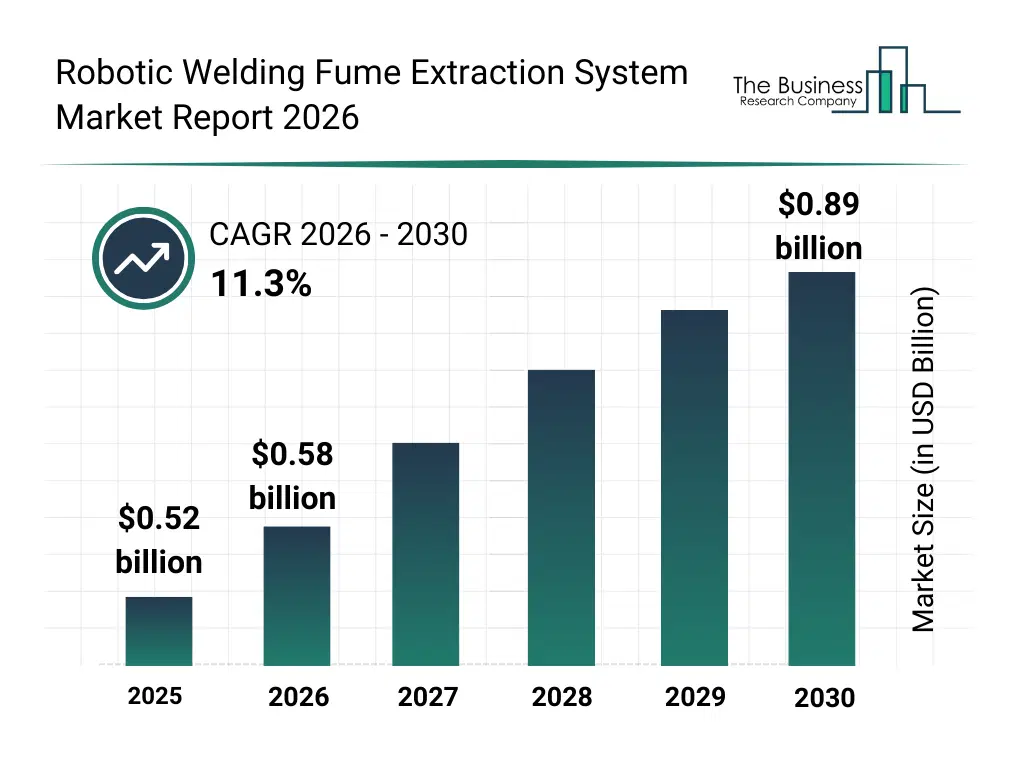
What Is The Robotic Welding Fume Extraction System Market Size and Share 2026?
The robotic welding fume extraction system market size has grown rapidly in recent years. It will grow from $0.52 billion in 2025 to $0.58 billion in 2026 at a compound annual growth rate (CAGR) of 11.6%. The growth in the historic period can be attributed to implementation of occupational health regulations, growth in automated welding operations, rising awareness of welding fume hazards, availability of industrial air filtration technologies, increasing factory automation.What Is The Robotic Welding Fume Extraction System Market Growth Forecast?
The robotic welding fume extraction system market size is expected to see rapid growth in the next few years. It will grow to $0.89 billion in 2030 at a compound annual growth rate (CAGR) of 11.3%. The growth in the forecast period can be attributed to expansion of smart manufacturing facilities, tightening environmental and worker safety regulations, rising investments in clean production environments, integration of predictive maintenance in filtration systems, growing use of automated welding cells. Major trends in the forecast period include increasing integration of fume extraction with robotic welding cells, rising adoption of high-efficiency filtration systems, growing demand for source-capture extraction solutions, expansion of automated air quality monitoring, enhanced compliance with workplace safety regulations.Tariff Impact On Robotic Welding Fume Extraction System Market
Tariffs are impacting the robotic welding fume extraction system market by raising the cost of imported filtration units, fans, motors, sensors, control electronics, and specialized filter media used in advanced extraction systems. Manufacturing sectors in Europe and North America are most affected due to reliance on globally sourced high-efficiency filtration technologies and components. These tariffs are increasing system installation costs and extending procurement timelines for large welding facilities. However, they are also supporting domestic production of fume extraction equipment, regional sourcing of filters and components, and innovation in compact, energy-efficient, and modular extraction solutions aligned with local regulatory requirements.
Global Robotic Welding Fume Extraction System Market Segmentation
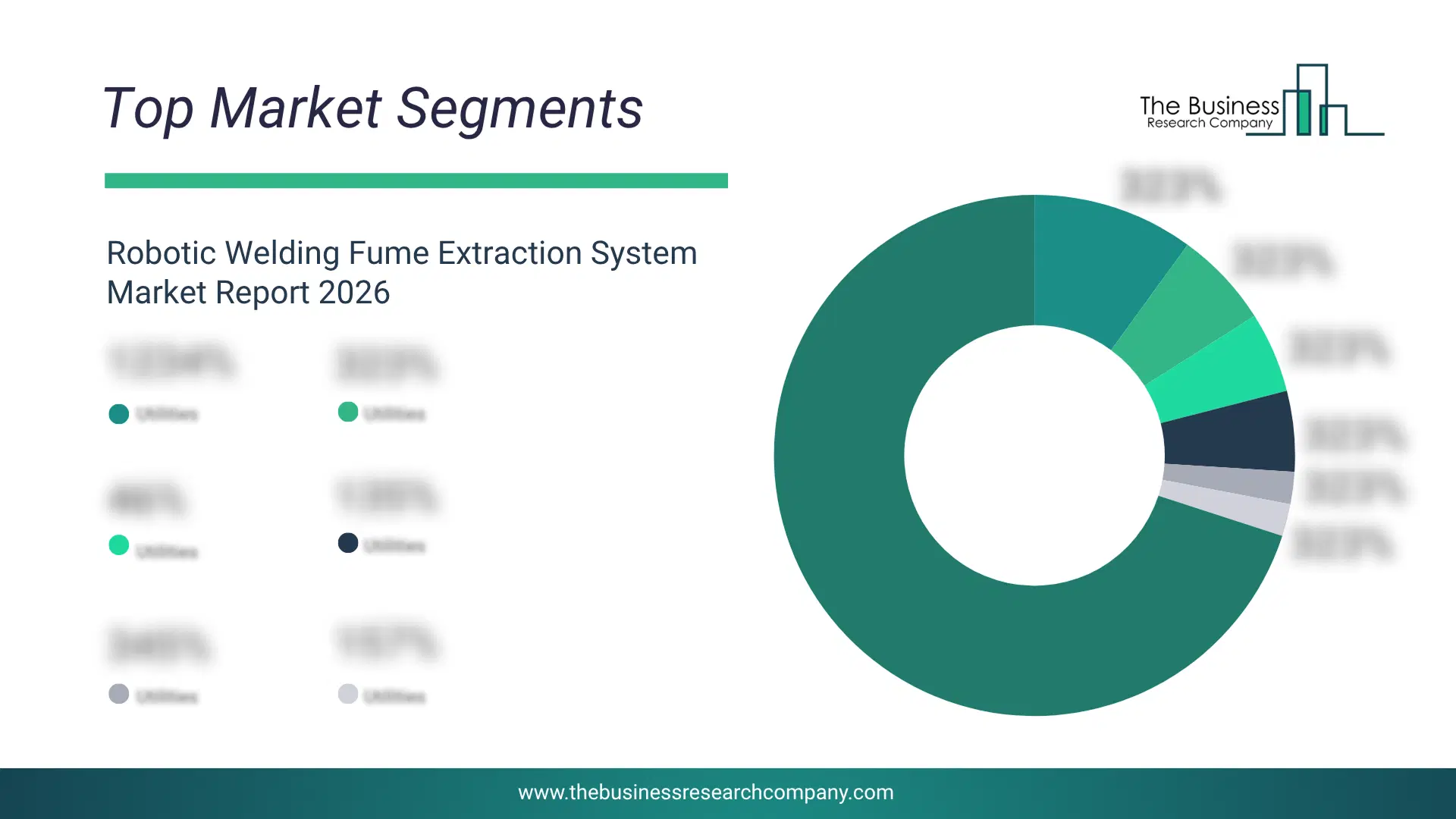
1) By Product Type: Portable Fume Extractors, Centralized Fume Extraction Systems, Filtration Units, Fume Extraction Arms, Electrostatic Precipitators 2) By Technology: Mechanical Filtration, High Efficiency Particulate Air (HEPA) Filtration, Electrostatic Precipitators 3) By Filtration Efficiency: Medium Efficiency, High Efficiency 4) By Operation Mode: Automated Systems, Hybrid Systems 5) By End-User Industry: Aerospace, Automotive, Shipbuilding, Metal Fabrication Subsegments: 1) By Portable Fume Extractors: Handheld Extractors, Mobile Cart-Mounted Extractors, Benchtop Extractors, Gun-Mounted Extractors 2) By Centralized Fume Extraction Systems: Single-Point Centralized Systems, Multi-Point Centralized Systems, Modular Centralized Systems, Ducted Fixed Installations 3) By Filtration Units: Pre-Filter Units, High Efficiency Particulate Air (HEPA) Filtration Units, Activated Carbon Filtration Units, Multi-Stage Filter Units 4) By Fume Extraction Arms: Articulated Extraction Arms, Telescopic Extraction Arms, Wall-Mounted Extraction Arms, Ceiling-Mounted Extraction Arms 5) By Electrostatic Precipitators: Dry Electrostatic Precipitators, Wet Electrostatic Precipitators, Plate-Type Electrostatic Precipitators, Tube-Type Electrostatic PrecipitatorsWhat Is The Driver Of The Robotic Welding Fume Extraction System Market?
The increasing industrial automation is expected to propel the growth of the robotic welding fume extraction system market going forward. Industrial automation refers to the use of control systems, robotics, and information technologies to operate and monitor industrial processes with minimal human intervention. Industrial automation is rising due to the growing need for enhanced productivity and operational efficiency across manufacturing sectors. Robotic welding fume extraction systems are used in industrial automation to safely capture and remove hazardous fumes generated during automated welding processes, ensuring a cleaner and compliant work environment. For instance, in September 2024, according to the International Federation of Robotics (IFR), a Germany-based industry association promoting the research, development, and use of robotics, industrial robot installations in Europe increased by 9%, reaching a record high of 92,393 units, with 80% of these deployments, totaling 73,534 units, occurring within the European Union, marking a 2% year-on-year growth. Therefore, the increasing industrial automation is driving the growth of the robotic welding fume extraction system industry.Key Players In The Global Robotic Welding Fume Extraction System Market
Major companies operating in the robotic welding fume extraction system market are Lincoln Electric Holdings Inc., Nederman Holding AB, RoboVent Products Group Inc., Donaldson Company Inc., Imperial Systems Inc., ESTA Apparatebau GmbH & Co. KG, Miller Electric Mfg. LLC, Alexander Binzel Schweißtechnik GmbH & Co. KG, Motovent Technologies Inc., Air Cleaning Specialists Inc., LEV Engineering Ltd., Eurovac Inc., Henlex Environmental Technologies Ltd., DeGatec GmbH, Welldone Environmental Equipment Guangzhou Co. Ltd., Senvac Extraction System Pvt. Ltd., AirTech Systems Inc., Diversitech Inc., Plymovent Group B.V., Absolent Group AB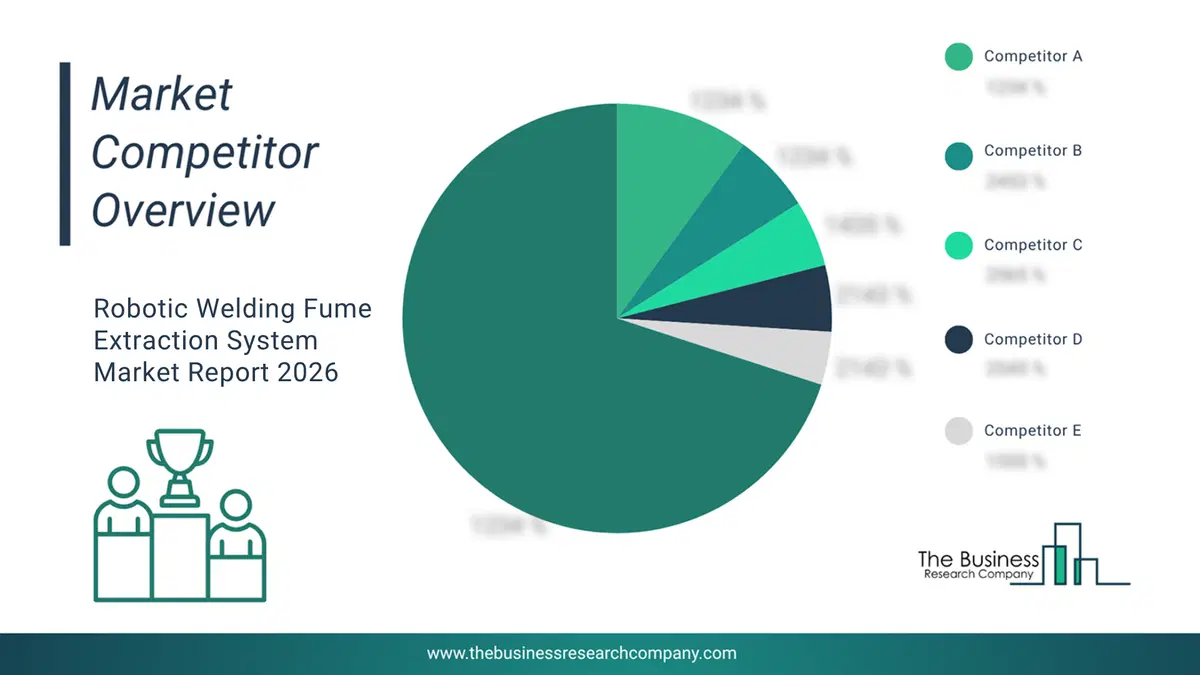
This chart is for illustrative purposes; the full report includes a detailed competitor analysis and comprehensive overview of the top 10 companies in the market.
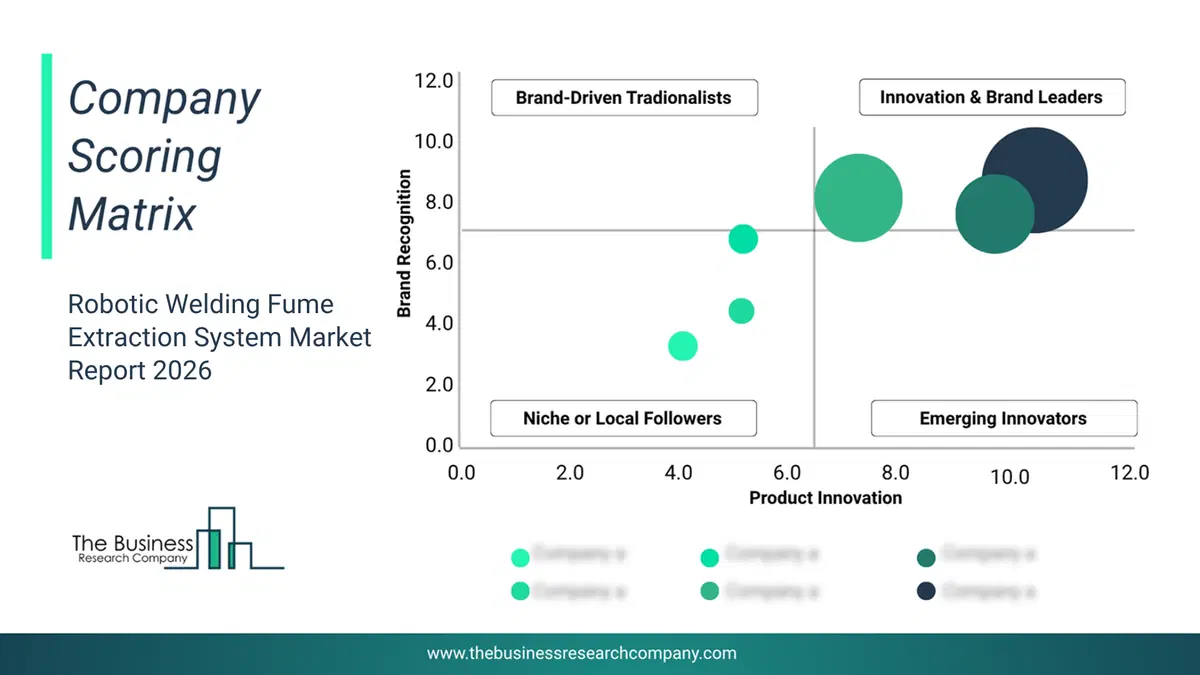
This chart maps companies by product innovation and brand strength, with bubble size indicating relative revenue, helping identify market leaders, challengers, and niche players. This is an illustrative chart; the full report provides a complete and accurate competitive analysis.
Global Robotic Welding Fume Extraction System Market Trends and Insights
Major companies operating in the robotic welding fume extraction system market are focusing on advancements in source-level automated extraction systems, such as on-torch extraction units and integrated robotic cell hoods, to enhance fume capture efficiency, reduce operator exposure, and ensure compliance with stringent workplace air quality standards while improving overall production productivity and energy efficiency. On-torch extraction units and integrated robotic cell hoods refer to technologies that capture welding fumes at the point of generation (on the torch) or enclose the welding zone (robotic hoods) and route contaminated air through filtration and exhaust control systems. For instance, in December 2023, RoboVent, a US-based industrial ventilation company, introduced the updated Spire robotic weld fume extractor series, offering three CFM ratings for different airflow needs, a compact 36 × 36 in footprint for tight cell layouts, and configurable filter heights to match application requirements. Designed specifically for robotic weld fume collection, RoboVent Spire is one of RoboVent’s most popular dust collectors. With three sizes, the new Spire series allows manufacturers to tailor their dust collection system to their exact needs for greater energy savings and lower overall operating and maintenance costs.What Are Latest Mergers And Acquisitions In The Robotic Welding Fume Extraction System Market?
In October 2025, Precision Welding Group, a US-based company that supplies advanced welding solutions, partnered with TEKA fume extraction and exhaust products to deliver high-performance air filtration solutions to fabrication shops, manufacturing facilities, and educational institutions focused on welding safety and compliance. Through this partnership, Precision Welding Group aims to expand access to advanced fume extraction technologies, enhancing workplace air quality and supporting safer, more compliant welding environments across the United States. TEKA GmbH is a Germany-based company specializing in air filtration and extraction systems for industrial processes such as welding, grinding, and laser applications.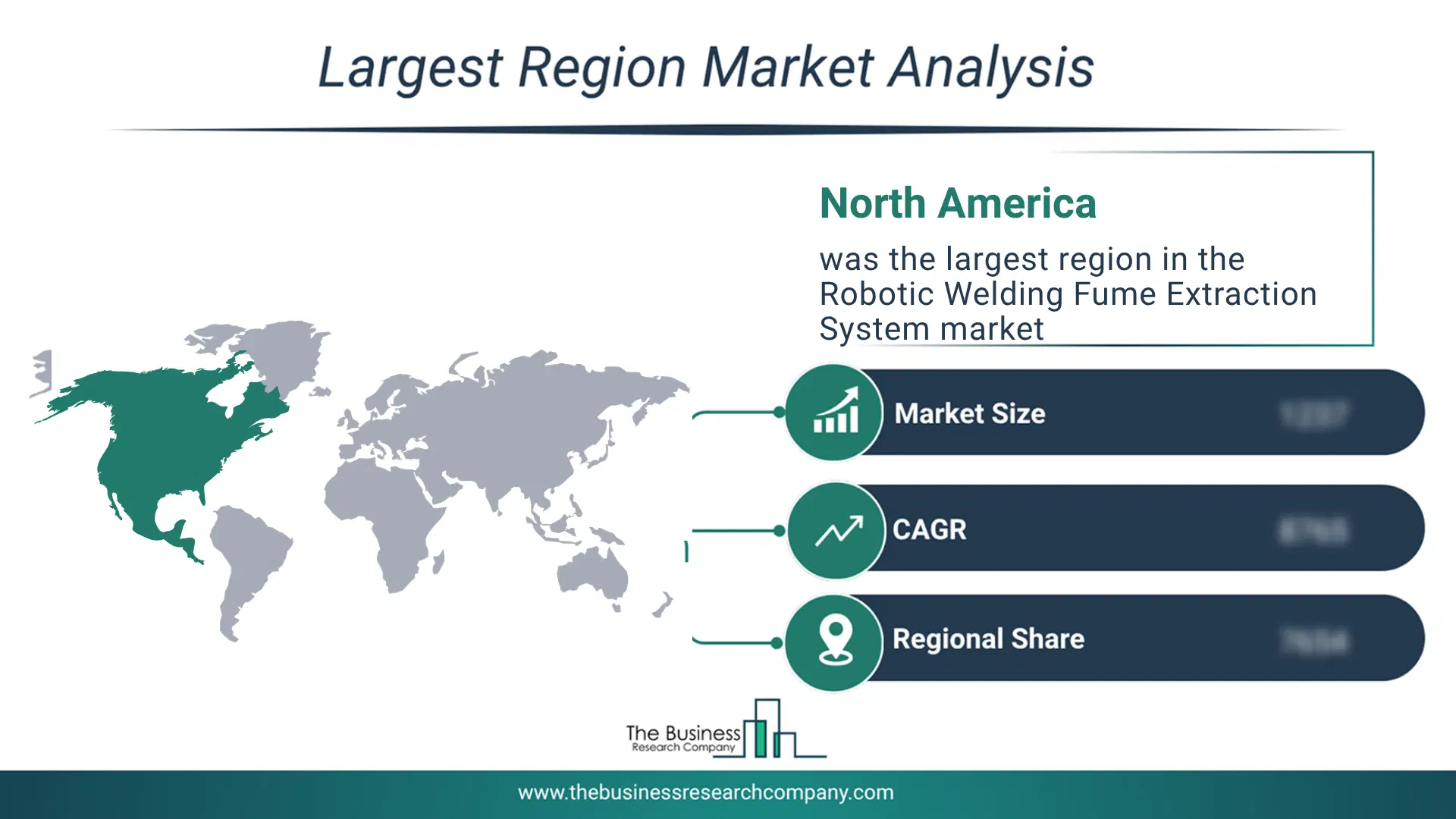
Regional Outlook
North America was the largest region in the robotic welding fume extraction system market in 2025. Asia-Pacific is expected to be the fastest-growing region in the forecast period. The regions covered in this market report are Asia-Pacific, South East Asia, Western Europe, Eastern Europe, North America, South America, Middle East, Africa The countries covered in this market report are Australia, Brazil, China, France, Germany, India, Indonesia, Japan, Taiwan, Russia, South Korea, UK, USA, Canada, Italy, Spain.What Defines the Robotic Welding Fume Extraction System Market?
The robotic welding fume extraction system market consists of sales of ducting systems, fan units, filter cartridges, extraction hoods, and welding booths. Values in this market are ‘factory gate’ values; that is, the value of goods sold by the manufacturers or creators of the goods, whether to other entities (including downstream manufacturers, wholesalers, distributors, and retailers) or directly to end customers. The value of goods in this market includes related services sold by the creators of the goods.How is Market Value Defined and Measured?
The market value is defined as the revenues that enterprises gain from the sale of goods and/or services within the specified market and geography through sales, grants, or donations in terms of the currency (in USD unless otherwise specified). The revenues for a specified geography are consumption values that are revenues generated by organizations in the specified geography within the market, irrespective of where they are produced. It does not include revenues from resales along the supply chain, either further along the supply chain or as part of other products.
This chart presents market attractiveness based on a quantitative evaluation of growth, competition, strategic alignment, and risk, offering a clear view of opportunity areas for decision-making. This chart is for illustrative purposes; the full report contains the complete analysis.

This chart highlights the Total Addressable Market (TAM) by estimating the maximum revenue opportunity using an assumption-driven approach, supporting strategic planning and opportunity sizing across markets. The chart is illustrative; the full report provides a more comprehensive analysis.
What Key Data and Analysis Are Included in the Robotic Welding Fume Extraction System Market Report 2026?
The robotic welding fume extraction system market research report is one of a series of new reports from The Business Research Company that provides market statistics, including industry global market size, regional shares, competitors with the market share, detailed market segments, market trends and opportunities, and any further data you may need to thrive in the robotic welding fume extraction system industry. The market research report delivers a complete perspective of everything you need, with an in-depth analysis of the current and future state of the industry.Robotic Welding Fume Extraction System Market Report Forecast Analysis
| Report Attribute | Details |
|---|---|
| Market Size Value In 2026 | $0.58 billion |
| Revenue Forecast In 2030 | $0.89 billion |
| Growth Rate | CAGR of 11.3% from 2026 to 2030 |
| Base Year For Estimation | 2025 |
| Actual Estimates/Historical Data | 2020-2025 |
| Forecast Period | 2026 - 2030 |
| Market Representation | Revenue in USD Billion and CAGR from 2026 to 2030 |
| Segments Covered | Product Type, Technology, Filtration Efficiency, Operation Mode, End-User Industry |
| Regional Scope | Asia-Pacific, Western Europe, Eastern Europe, North America, South America, Middle East, Africa |
| Key Companies Profiled | Lincoln Electric Holdings Inc., Nederman Holding AB, RoboVent Products Group Inc., Donaldson Company Inc., Imperial Systems Inc., ESTA Apparatebau GmbH & Co. KG, Miller Electric Mfg. LLC, Alexander Binzel Schweißtechnik GmbH & Co. KG, Motovent Technologies Inc., Air Cleaning Specialists Inc., LEV Engineering Ltd., Eurovac Inc., Henlex Environmental Technologies Ltd., DeGatec GmbH, Welldone Environmental Equipment Guangzhou Co. Ltd., Senvac Extraction System Pvt. Ltd., AirTech Systems Inc., Diversitech Inc., Plymovent Group B.V., Absolent Group AB |
| Customization Scope | Request for Customization |
| Pricing And Purchase Options | Explore Purchase Options |