
Smart Food Logistics Market Report 2026
Global Outlook – By Component (Hardware; Software), By Technology (Internet Of Things (IoT); Artificial Intelligence (AI) And Machine Learning; Blockchain Technology; Warehouse Management Systems (WMS); Transportation Management Systems (TMS)), By Type Of Service (Transportation; Warehousing; Inventory Management; Order Fulfillment; Distribution And Delivery Services), By Mode Of Transport (Road Freight; Air Freight; Sea Freight; Rail Freight), By End-User (Food And Beverage Industry; Pharmaceuticals; Retail; Consumer Goods; Agriculture ) – Market Size, Trends, Strategies, and Forecast to 2030
Smart Food Logistics Market Overview
• Smart Food Logistics market size has reached to $15.59 billion in 2025 • Expected to grow to $33 billion in 2030 at a compound annual growth rate (CAGR) of 16.1% • Growth Driver: Rise In E-Commerce And Online Grocery Platforms Fueling The Growth Of The Market Due To Increasing Demand For Fast And Convenient Home Delivery • Market Trend: Technological Advancements In Autonomous Food Delivery Robots Driving Smart Food Logistics Growth • North America was the largest region in 2025 and Asia-Pacific is the fastest growing region.Market Gains By 2030 – Top Opportunities By Segment
Market Gain identifies the most promising market opportunities by highlighting the segments or products expected to generate the highest incremental revenue growth over the next five years.
What Is Covered Under Smart Food Logistics Market?
Smart food logistics refers to the integration of digital technologies such as internet of things (IoT), artificial intelligence (AI), sensors, and data analytics to optimize the transportation, storage, and distribution of food products. It enables real-time monitoring of temperature, location, and quality throughout the supply chain. It helps to enhance food safety, reduce waste, and improve efficiency and transparency in food supply chain operations. The main components of smart food logistics are hardware and software. Hardware refers to physical devices like sensors, RFID tags, scanners, IoT devices, GPS units, and temperature-monitoring equipment used to track, monitor, and manage food movement and safety. It utilizes technologies such as internet of things (IoT), artificial intelligence (AI) and machine learning, blockchain technology, warehouse management systems (WMS), and transportation management systems (TMS), and delivers various services, such as transportation, warehousing, inventory management, order fulfillment, and distribution and delivery services. These operations are supported through multiple modes of transport, including road freight, air freight, sea freight, and rail freight, and cater to diverse end-users, such as the food and beverage industry, pharmaceuticals, retail, consumer goods, and agriculture.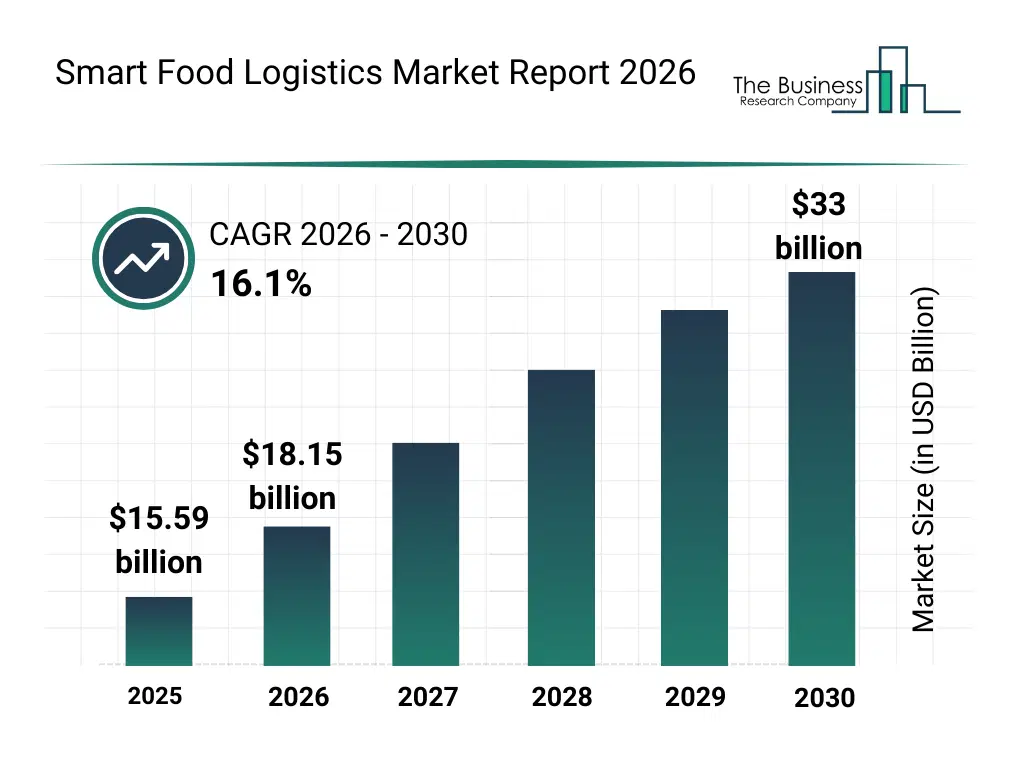
What Is The Smart Food Logistics Market Size and Share 2026?
The smart food logistics market size has grown rapidly in recent years. It will grow from $15.59 billion in 2025 to $18.15 billion in 2026 at a compound annual growth rate (CAGR) of 16.4%. The growth in the historic period can be attributed to expansion of global food trade, rising demand for cold chain logistics, increased regulatory focus on food safety, growth in organized retail food distribution, adoption of digital logistics platforms.What Is The Smart Food Logistics Market Growth Forecast?
The smart food logistics market size is expected to see rapid growth in the next few years. It will grow to $33 billion in 2030 at a compound annual growth rate (CAGR) of 16.1%. The growth in the forecast period can be attributed to increasing investments in smart cold chain infrastructure, rising focus on food waste reduction, expansion of predictive logistics analytics, growing demand for traceable food supply chains, increased adoption of autonomous logistics solutions. Major trends in the forecast period include increasing adoption of real-time temperature monitoring solutions, rising deployment of iot-enabled cold chain systems, growing use of ai-based demand forecasting tools, expansion of smart warehousing for perishables, enhanced focus on end-to-end supply chain visibility.
Global Smart Food Logistics Market Segmentation
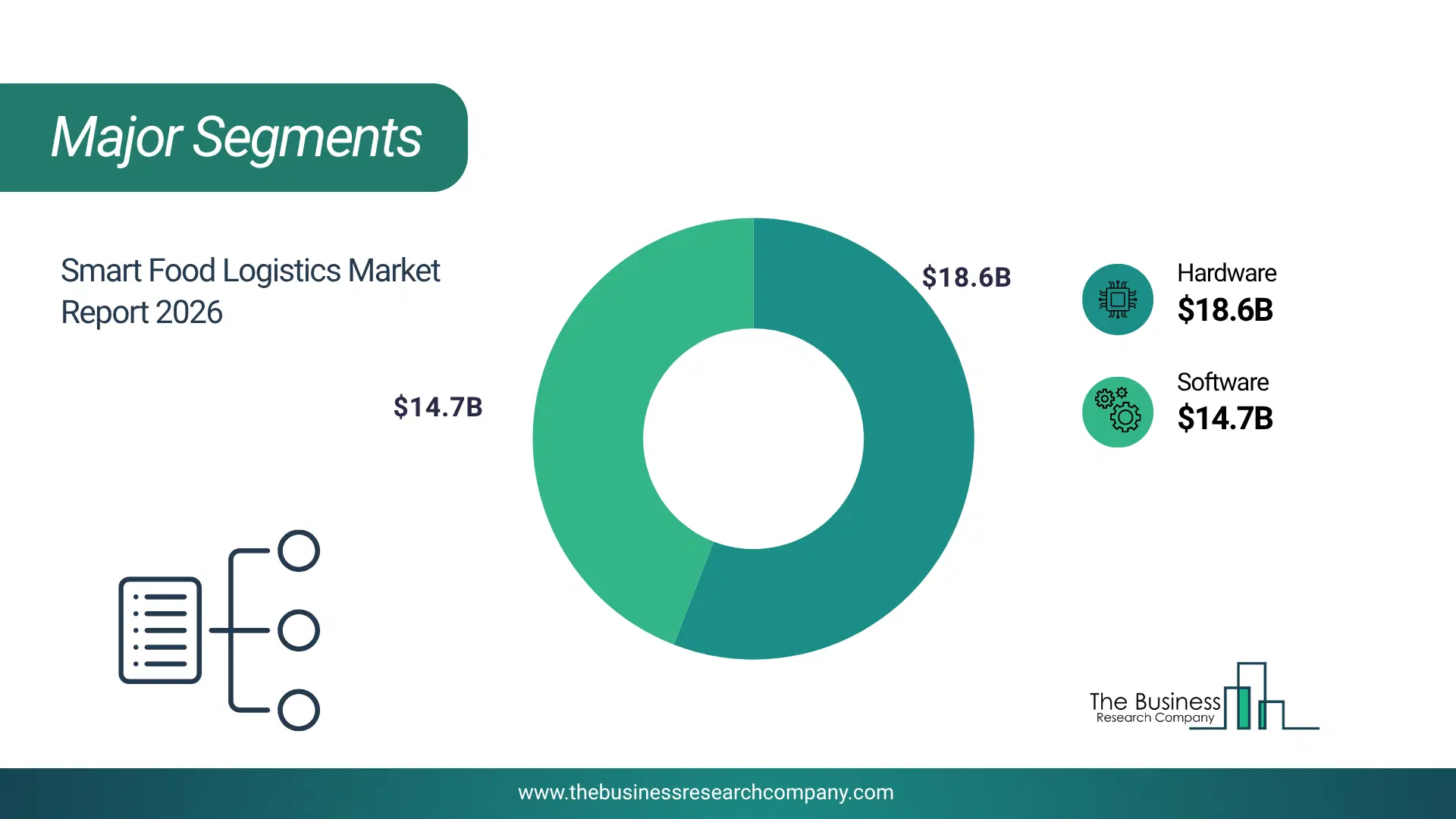
1) By Component: Hardware, Software 2) By Technology: Internet Of Things (IoT), Artificial Intelligence (AI) And Machine Learning, Blockchain Technology, Warehouse Management Systems (WMS), Transportation Management Systems (TMS) 3) By Type Of Service: Transportation, Warehousing, Inventory Management, Order Fulfillment, Distribution And Delivery Services 4) By Mode Of Transport: Road Freight, Air Freight, Sea Freight, Rail Freight 5) By End-User: Food And Beverage Industry, Pharmaceuticals, Retail, Consumer Goods, Agriculture Subsegments: By Hardware: Tracking Devices, Temperature Monitoring Systems, Refrigeration Units, Packaging Equipment By Software: Fleet Management, Inventory Management, Route Optimization, Data Analytics, Supply Chain Visibility The top segments in the smart food logistics market will be: • Hardware will reach $18.51 billion by 2030. • Software will reach $14.68 billion by 2030.What Is The Driver Of The Smart Food Logistics Market?
The rising e-commerce and online grocery platforms are expected to propel the growth of the smart food logistics market going forward. E-commerce and online grocery platforms refer to digital marketplaces that enable consumers to purchase food and grocery products online and have them delivered directly to their homes. The rise of e-commerce and online grocery platforms is largely driven by growing consumer demand for convenience, as people increasingly prefer quick, doorstep delivery over time-consuming in-store shopping. Smart food logistics support e-commerce and online grocery platforms by improving storage efficiency, delivery routing, and cold-chain management, enabling faster, safer, and more cost-effective delivery of fresh products to customers. For instance, in August 2025, according to the U.S. Census Bureau, a US-based government agency, e-commerce sales in the second quarter of 2025 rose by an estimated 5.3% (±1.2%) compared to the same quarter in 2024. Therefore, the rising e-commerce and online grocery platforms is driving the growth of the smart food logistics industry.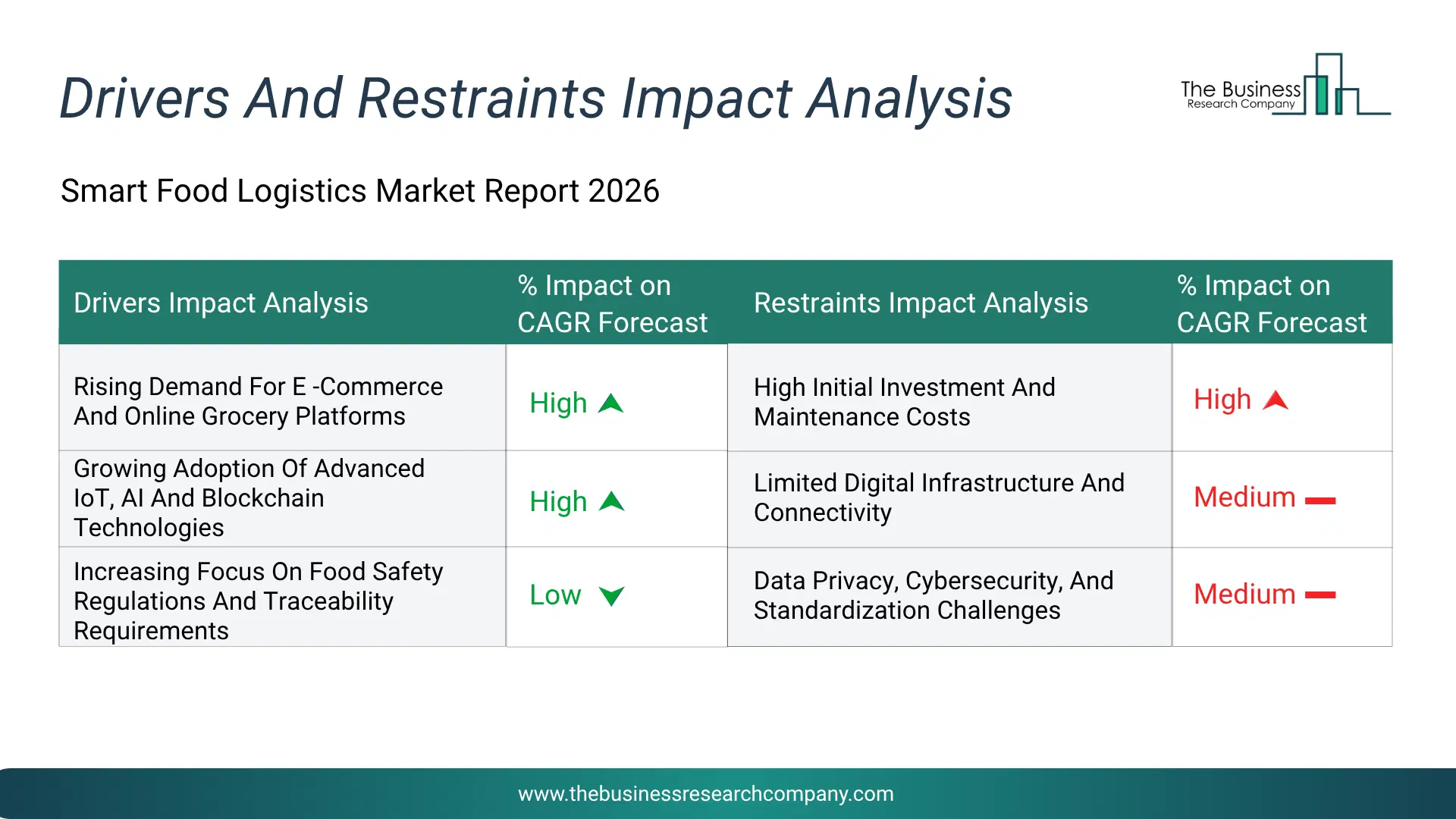
Infographic Chart Showing Key Market Drivers Analysis And Restraints For Smart Food Logistics Market
The chart presents an impact analysis of key drivers and restraints, quantifying their relative influence on the market's growth rate and helping assess the balance between growth enablers and limiting factors. This chart offers a high-level perspective; the full report contains more detailed insights.
How Will The Drivers Impact Growth In The Global Smart Food Logistics Market?
• Rising Demand For E -Commerce And Online Grocery Platforms (High) – During the forecast period, the rising demand for e -commerce and online grocery platforms is expected to become a key growth driver for the smart food logistics market by 2030. The increasing consumer preference for doorstep delivery of fresh and perishable food products is accelerating the need for efficient, real -time, and temperature -controlled logistics systems. Logistics providers are investing in advanced tracking, route optimization, and last -mile delivery solutions to meet growing demand. This shift toward digital food purchasing is strengthening the need for responsive and transparent supply chains. • Growing Adoption Of Advanced IoT, AI And Blockchain Technologies (High) – During the forecast period, the growing adoption of advanced iot, ai, and blockchain technologies is expected to emerge as a major factor driving the expansion of the smart food logistics market by 2030. These technologies enable real-time monitoring, predictive analytics, automated decision-making, and enhanced traceability across the supply chain. Companies are leveraging connected sensors, intelligent platforms, and secure data-sharing systems to improve efficiency, reduce spoilage, and ensure compliance. • Increasing Focus On Food Safety Regulations And Traceability Requirements (Low) – During the forecast period, the increasing focus on food safety regulations and traceability requirements is expected to act as a key growth catalyst for the smart food logistics market by 2030. Governments and regulatory bodies are enforcing strict standards for temperature control, product tracking, and supply chain transparency to ensure consumer safety. Companies are implementing advanced monitoring and reporting systems to comply with these regulations and maintain product integrity. As regulatory scrutiny intensifies globally, the adoption of smart logistics solutions is expected to rise.How Will The Restraints Impact Growth In The Global Smart Food Logistics Market?
• High Initial Investment And Maintenance Costs (High) – During the forecast period, the high initial investment and maintenance costs act as major restraints for the smart food logistics market by increasing the capital required to deploy advanced digital technologies such as iot devices, ai systems, and cold chain equipment. These costs slow adoption among small and medium-sized food companies and logistics providers. Frequent maintenance and software updates further add to operational expenses, limiting scalability. As a result, overall market growth and widespread implementation are significantly constrained. • Limited Digital Infrastructure And Connectivity (Medium) – During the forecast period, the limited digital infrastructure and connectivity act as major restraints for the smart food logistics market by restricting the seamless operation of iot devices, sensors, and real-time monitoring systems. Poor network coverage or unreliable internet in remote areas creates data gaps and reduces supply chain visibility. This limits the ability of companies to optimize routes, monitor temperature, and ensure food quality. Consequently, efficiency improvements and large-scale adoption of smart logistics solutions are negatively impacted. • Data Privacy, Cybersecurity, And Standardization Challenges (Medium) – During the forecast period, the data privacy, cybersecurity, and standardization challenges act as major restraints for the smart food logistics market by creating risks in the collection, storage, and sharing of sensitive supply chain data. Lack of unified standards for devices and platforms complicates integration across stakeholders. Cybersecurity threats and regulatory requirements increase compliance costs and operational complexity. As a result, companies may hesitate to fully adopt digital solutions, limiting market expansion and innovation.Key Players In The Global Smart Food Logistics Market
Major companies operating in the smart food logistics market are Zebra Technologies Corporation, Samsara Inc., Geotab, Digi International Inc., Telit Cinterion, Nippon Express Co. Ltd., ORBCOMM Inc., Controlant, Americold Logistics LLC., Lineage Inc., Teletrac Navman, Savi Technology, NewCold, Tive Inc., Roambee, Traxens, Testo SE & Co. KGaA, Monnit Corporation, Berlinger & Co. AG, Cooltrax, Yusen Logistics Co. Ltd., ELPRO-BUCHS AG, Kii Corporation, Infratab, Sonicu, LYNA LOGICS Inc., and Nuvizz.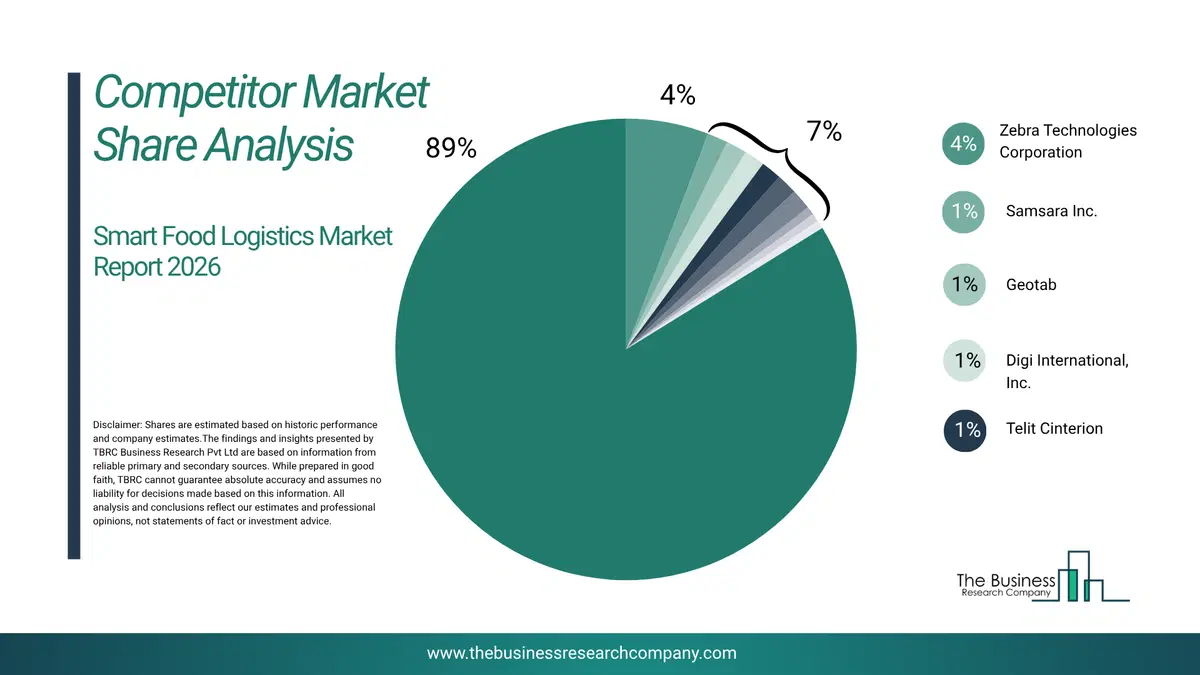
This chart is for illustrative purposes; the full report includes a detailed competitor analysis and comprehensive overview of the top 10 companies in the market.
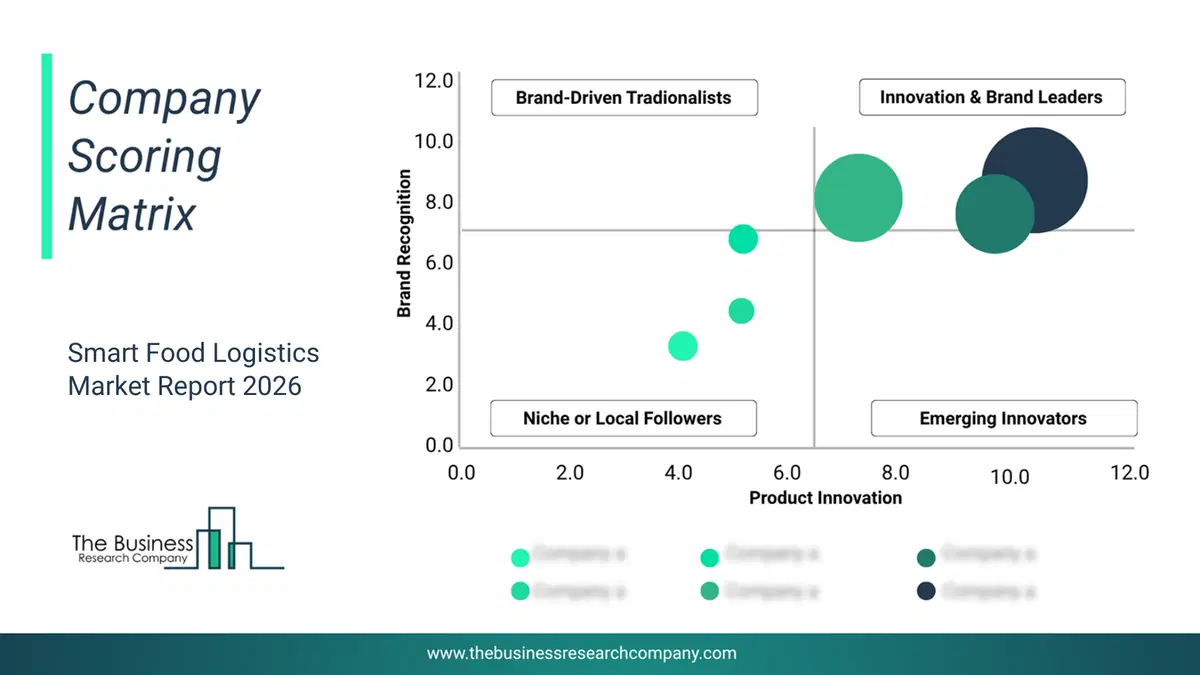
This chart maps companies by product innovation and brand strength, with bubble size indicating relative revenue, helping identify market leaders, challengers, and niche players. This is an illustrative chart; the full report provides a complete and accurate competitive analysis.
Global Smart Food Logistics Market Trends and Insights
Major companies operating in the smart food logistics market are focusing on developing technologically advanced solutions, such as autonomous food delivery robots, to speed up last-mile deliveries, cut labour costs, reduce food spoilage through temperature-controlled routing, and scale on-demand fulfilment for e-commerce and grocery platforms. Autonomous food delivery robots refers to self-navigating ground or aerial vehicles equipped with sensors, navigation software, and insulated storage that deliver prepared meals or groceries to customers without a human driver. For instance, in May 2025, Yango Group Ltd., UAE-based provides technology-driven services, launched a pilot program for autonomous food delivery using AI-powered, fully electric delivery robots. These robots navigate Expo City to deliver meals from selected restaurants to users, starting with the Al Wasl 3 office building. The silent, emission-free robots independently plan routes, avoid obstacles, and prioritize pedestrian safety. Users order food through the Expo City Eats app, and the robots deliver it to designated spots. This initiative supports Dubai’s smart city and sustainability goals by reducing traffic and noise pollution, with plans to expand the service across Expo City after the initial four-month trial.What Are Latest Mergers And Acquisitions In The Smart Food Logistics Market?
In July 2024, Kaleris, Inc., a US-based provider of supply chain execution and visibility technology solutions, acquired CAMS Software Corporation for an undisclosed amount. With this acquisition, Kaleris aims to expand its portfolio by integrating advanced transportation management solutions and strengthening its presence in the grocery, food & beverage, retail, and consumer packaged goods sectors. CAMS Software Corporation is a US-based provider of transportation management software designed for large-scale grocery distribution, offers software solutions that enable smart food logistics.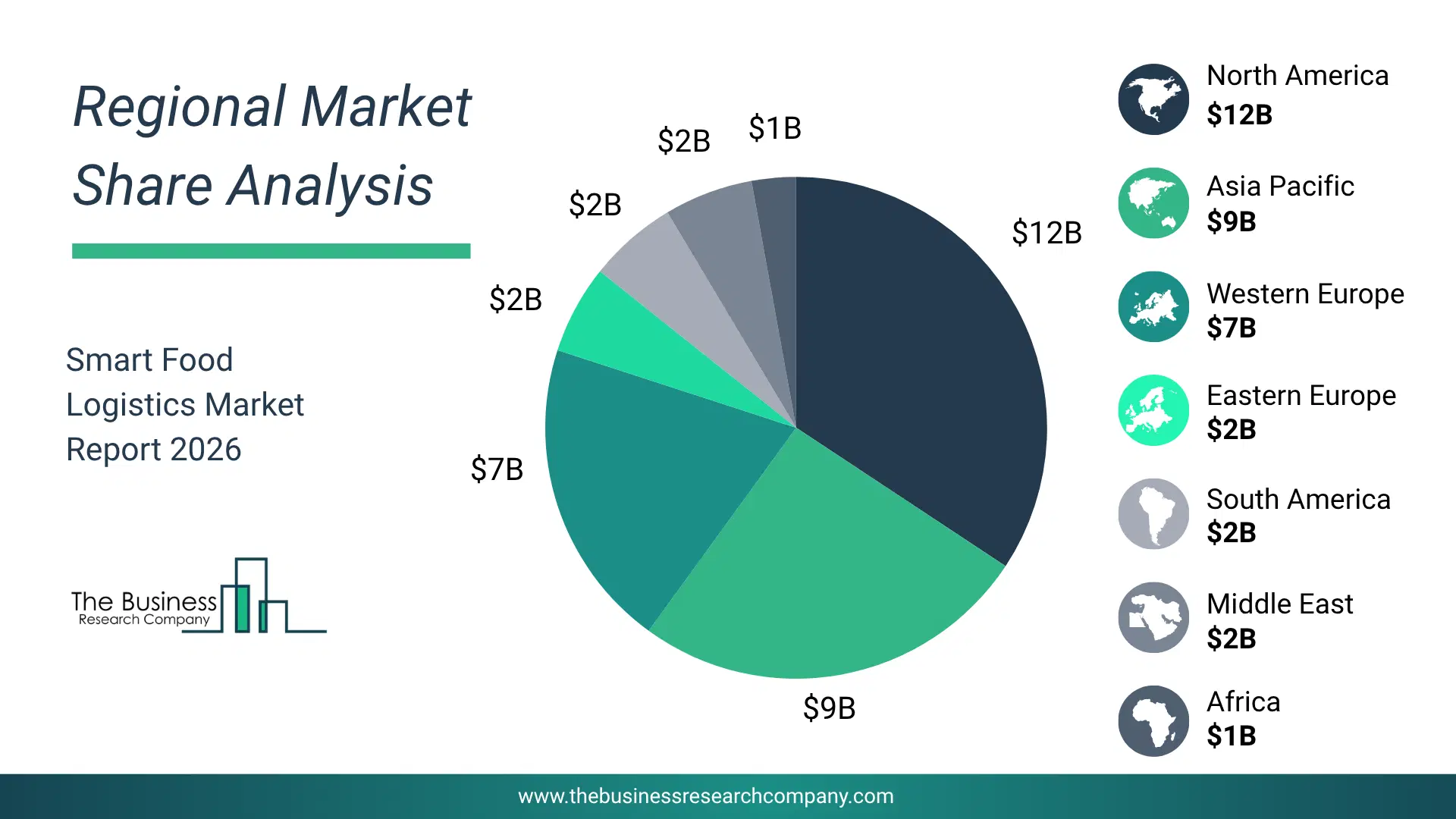
Regional Outlook
North America was the largest region in the smart food logistics market in 2025. Asia-Pacific is expected to be the fastest-growing region in the forecast period. The regions covered in this market report are Asia-Pacific, South East Asia, Western Europe, Eastern Europe, North America, South America, Middle East, Africa. The countries covered in this market report are Australia; Brazil; China; France; Germany; India; Indonesia; Japan; Taiwan; Russia; South Korea; UK; USA; Canada; Italy; Spain.What Defines the Smart Food Logistics Market?
The smart food logistics market includes revenues earned by entities through route optimization, cold chain monitoring, predictive maintenance, data analytics and reporting, supply chain visibility, fleet management, and packaging and labeling services. The market value includes the value of related goods sold by the service provider or included within the service offering. Only goods and services traded between entities or sold to end consumers are included.How is Market Value Defined and Measured?
The market value is defined as the revenues that enterprises gain from the sale of goods and/or services within the specified market and geography through sales, grants, or donations in terms of the currency (in USD unless otherwise specified). The revenues for a specified geography are consumption values that are revenues generated by organizations in the specified geography within the market, irrespective of where they are produced. It does not include revenues from resales along the supply chain, either further along the supply chain or as part of other products.
This chart presents market attractiveness based on a quantitative evaluation of growth, competition, strategic alignment, and risk, offering a clear view of opportunity areas for decision-making. This chart is for illustrative purposes; the full report contains the complete analysis.

This chart highlights the Total Addressable Market (TAM) by estimating the maximum revenue opportunity using an assumption-driven approach, supporting strategic planning and opportunity sizing across markets. The chart is illustrative; the full report provides a more comprehensive analysis.
What Key Data and Analysis Are Included in the Smart Food Logistics Market Report 2026?
The smart food logistics market research report is one of a series of new reports from The Business Research Company that provides market statistics, including Market Report 2026?global market size, regional shares, competitors with the market share, detailed market segments, market trends and opportunities, and any further data you may need to thrive in the smart food logistics Market Report 2026? The market research report delivers a complete perspective of everything you need, with an in-depth analysis of the current and future state of the Market Report 2026?Smart Food Logistics Market Report Forecast Analysis
| Report Attribute | Details |
|---|---|
| Market Size Value In 2026 | $18.15 billion |
| Revenue Forecast In 2030 | $33 billion |
| Growth Rate | CAGR of 16.1% from 2026 to 2030 |
| Base Year For Estimation | 2025 |
| Actual Estimates/Historical Data | 2020-2025 |
| Forecast Period | 2026 - 2030 |
| Market Representation | Revenue in USD Billion and CAGR from 2026 to 2030 |
| Segments Covered | Component, Technology, Type Of Service, Mode Of Transport, End-User |
| Regional Scope | Asia-Pacific, Western Europe, Eastern Europe, North America, South America, Middle East, Africa |
| Country Scope | The countries covered in the report are Australia, Brazil, China, France, Germany, India, ... |
| Key Companies Profiled | Zebra Technologies Corporation, Samsara Inc., Geotab, Digi International Inc., Telit Cinterion, Nippon Express Co. Ltd., ORBCOMM Inc., Controlant, Americold Logistics LLC., Lineage Inc., Teletrac Navman, Savi Technology, NewCold, Tive Inc., Roambee, Traxens, Testo SE & Co. KGaA, Monnit Corporation, Berlinger & Co. AG, Cooltrax, Yusen Logistics Co. Ltd., ELPRO-BUCHS AG, Kii Corporation, Infratab, Sonicu, LYNA LOGICS Inc., and Nuvizz. </b> |
| Customization Scope | Request for Customization |
| Pricing And Purchase Options | Explore Purchase Options |