
Wearable Heart Rate Sensor Market Report 2026
Global Outlook – By Type (Photoplethysmography Sensor, Electrocardiography Sensor), By Distribution Channel (Offline, Online), By Application (Consumer Electronics, Medical Equipment, Other applications), By End User (Hospitals And Clinics, Homecare, Athletes, Other End Users) – Market Size, Trends, Strategies, and Forecast to 2030
Wearable Heart Rate Sensor Market Overview
• Wearable Heart Rate Sensor market size has reached to $4.74 billion in 2025 • Expected to grow to $10.79 billion in 2030 at a compound annual growth rate (CAGR) of 17.9% • Growth Driver: Surge In Personalized Healthcare Driving The Growth Of The Market Due To Advancements In Wearable Technology And Real-Time Health Monitoring • Market Trend: Neuranics Introduces Continuous Heart Monitoring Development Kit At Global Technology Exhibition • North America was the largest region in 2025 and Asia-Pacific is the fastest growing region.What Is Covered Under Wearable Heart Rate Sensor Market?
A wearable heart-rate sensor is a non-invasive device worn on the body that measures heart rate in real time using optical (PPG) or electrical (ECG) methods. Its main purpose is to provide continuous, convenient monitoring of cardiovascular activity, supporting applications such as fitness tracking, stress and sleep assessment, early detection of irregular heart patterns, and remote health monitoring. The main types of wearable heart rate sensor are photoplethysmography sensors and electrocardiography sensors, which enable accurate heart rate monitoring. Photoplethysmography (PPG) sensors are non-invasive optical sensors that measure changes in blood volume beneath the skin by emitting light usually LED and detecting the amount of light reflected or absorbed as blood pulses through blood vessels. These sensors are distributed through both offline and online channels, making them accessible to a wide range of consumers. Wearable heart rate sensors find applications in consumer electronics, medical equipment, and other areas, serving end users such as hospitals and clinics, homecare settings, athletes, and other end users.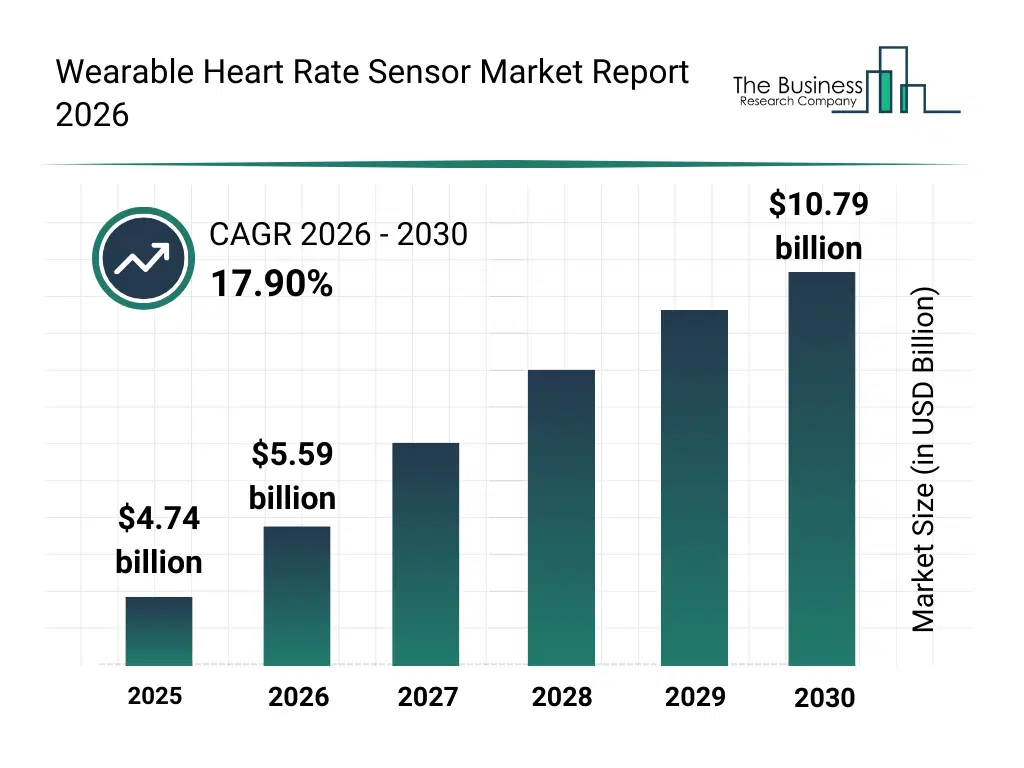
What Is The Wearable Heart Rate Sensor Market Size and Share 2026?
The wearable heart rate sensor market size has grown rapidly in recent years. It will grow from $4.74 billion in 2025 to $5.59 billion in 2026 at a compound annual growth rate (CAGR) of 18.0%. The growth in the historic period can be attributed to growth of fitness wearables, rising cardiovascular diseases, consumer health awareness, miniaturization of sensors, mobile health adoption.What Is The Wearable Heart Rate Sensor Market Growth Forecast?
The wearable heart rate sensor market size is expected to see rapid growth in the next few years. It will grow to $10.79 billion in 2030 at a compound annual growth rate (CAGR) of 17.9%. The growth in the forecast period can be attributed to AI-based arrhythmia detection, expansion in telehealth, insurance-backed monitoring programs, hospital-at-home models, data-driven preventive care. Major trends in the forecast period include continuous cardiovascular monitoring, integration with fitness ecosystems, medical-grade wearable sensors, stress and sleep tracking, remote patient monitoring.
Global Wearable Heart Rate Sensor Market Segmentation
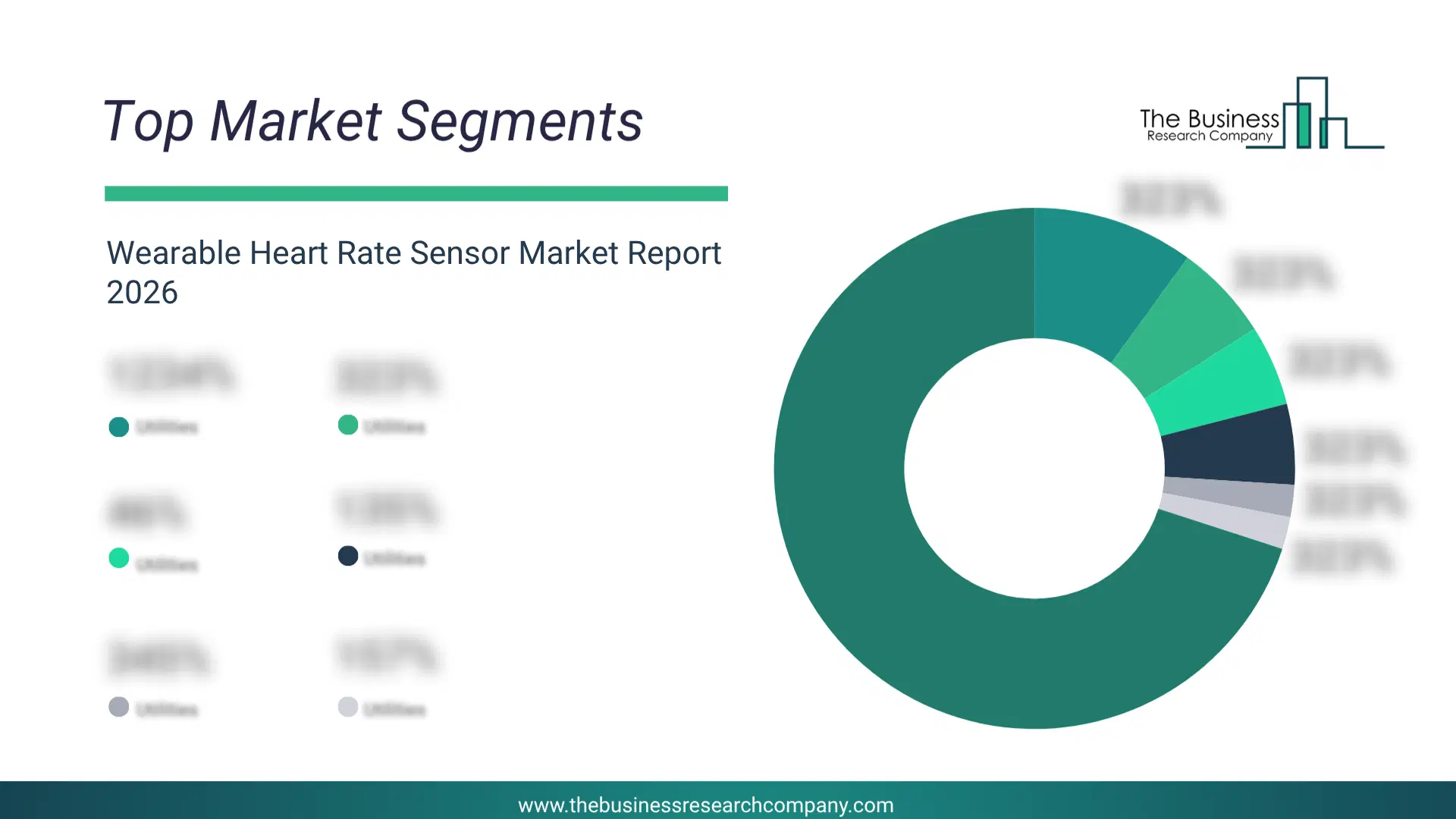
1) By Type: Photoplethysmography Sensor, Electrocardiography Sensor 2) By Distribution Channel: Offline, Online 3) By Application: Consumer Electronics, Medical Equipment, Other applications 4) By End User: Hospitals And Clinics, Homecare, Athletes, Other End Users Subsegments: 1) By Photoplethysmography (PPG) Sensor: Wrist-Based PPG sensors, Finger-Based PPG sensors, Ear-Based PPG sensors, Arm-Based PPG sensors, Clothing-Integrated PPG sensors 2) By Electrocardiography (ECG) Sensor: Chest Strap ECG Sensors, Patch-Based ECG Sensors, Hand-held Or Touch-Based ECG Sensors, Clothing-Integrated ECG Sensors, Clinical Wearable ECG MonitorsWhat Is The Driver Of The Wearable Heart Rate Sensor Market?
The rising focus on personalized healthcare is expected to propel the growth of the wearable heart rate sensor market going forward. Personalized healthcare refers to a medical approach that tailors prevention, diagnosis, and treatment strategies to an individual’s unique genetic makeup, lifestyle, and health data. Factors that support the expansion of personalized healthcare include advancements in wearable technology. Advancements in wearable technology are driving the evolution of the wearable heart rate sensor market by enabling more accurate, compact, and energy-efficient monitoring solutions. These innovations enhance real-time health-tracking capabilities, expanding applications across fitness, medical diagnostics, and personalized care. For instance, in July 2024, according to Aiprm, a US-based prompt management tool and community-driven prompt library, global wearable device shipments surpassed 500 million units in 2023, reflecting rising consumer adoption of health-monitoring devices and greater emphasis on continuous personal health insights. Therefore, the rising focus on personalized healthcare is driving the growth of the wearable heart rate sensor market. Therefore, the rising focus of personalized healthcare is driving the growth of the wearable heart rate sensor industry.Key Players In The Global Wearable Heart Rate Sensor Market
Major companies operating in the wearable heart rate sensor market are Apple Inc., Samsung Electronics Co. Ltd., Huawei Technologies Co. Ltd., Xiaomi Corporation, Garmin Ltd., Oura Health Oy, Whoop Inc., Suunto Oy, Withings S.A., Polar Electro Oy, Empatica Inc., iRhythm Technologies Inc., Biobeat Ltd., Fitbit Inc., Omron Healthcare Inc., Zepp Health Corporation, Amazfit Global, Fossil Group Inc., AliveCor Inc., Cardiac Insight Inc.
This chart is for illustrative purposes; the full report includes a detailed competitor analysis and comprehensive overview of the top 10 companies in the market.
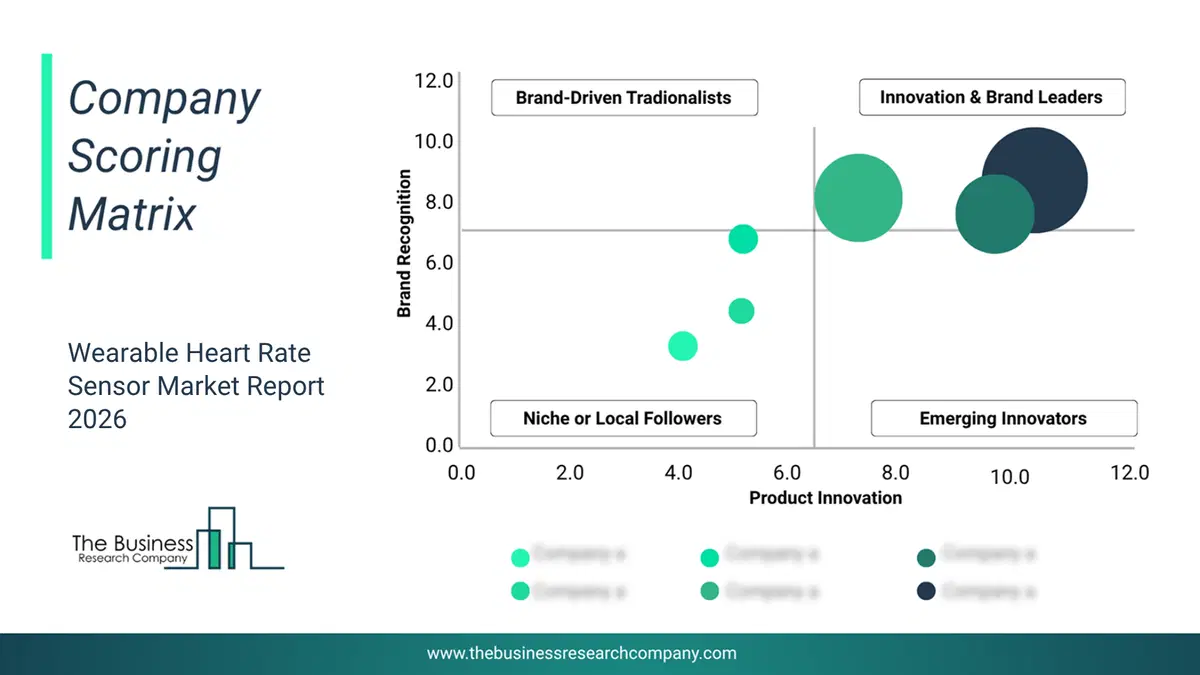
This chart maps companies by product innovation and brand strength, with bubble size indicating relative revenue, helping identify market leaders, challengers, and niche players. This is an illustrative chart; the full report provides a complete and accurate competitive analysis.
Global Wearable Heart Rate Sensor Market Trends and Insights
Major companies operating in the wearable heart rate sensor market are focusing on developing advanced solutions, such as magnetic sensor–based continuous monitoring, to enhance and modernize traditional heart-monitoring methods. A continuous monitoring solution refers to a wearable technology that enables real-time, non-invasive tracking of heart activity, capturing cardiac signals 24/7 for health, fitness, and research applications. For instance, in December 2023, Neuranics, a UK-based medical technology company, launched a 24/7 Heart Monitoring Development Kit. This innovation introduces magnetic-based heart monitoring as an alternative to conventional three-lead electrocardiography and existing wearable devices by recording and wirelessly transmitting cardiac data continuously without requiring multiple sensors. It delivers real-time signal acquisition, analysis, and alerts while enabling developers to integrate the technology into their own wearable applications with minimal hardware adjustments. Integrated with Neuranics’ software platform, it offers a scalable solution for developers and healthcare providers. The development kit enhances heart-signal detection capabilities, streamlines prototype development, and supports the advancement of next-generation wearable cardiovascular devices.What Are Latest Mergers And Acquisitions In The Wearable Heart Rate Sensor Market?
In May 2024, WearLinq, a US-based provider of wearable cardiac monitoring solutions and digital health technologies, acquired AMI Cardiac Monitoring, LLC for an undisclosed amount. With this acquisition, WearLinq aims to expand its clinical service footprint across the United States and enhance its end-to-end cardiac monitoring capabilities using its FDA 510(k)-cleared 6-lead ECG wearable device. AMI Cardiac Monitoring is a US-based manufacturer specializing in wearable heart monitoring devices.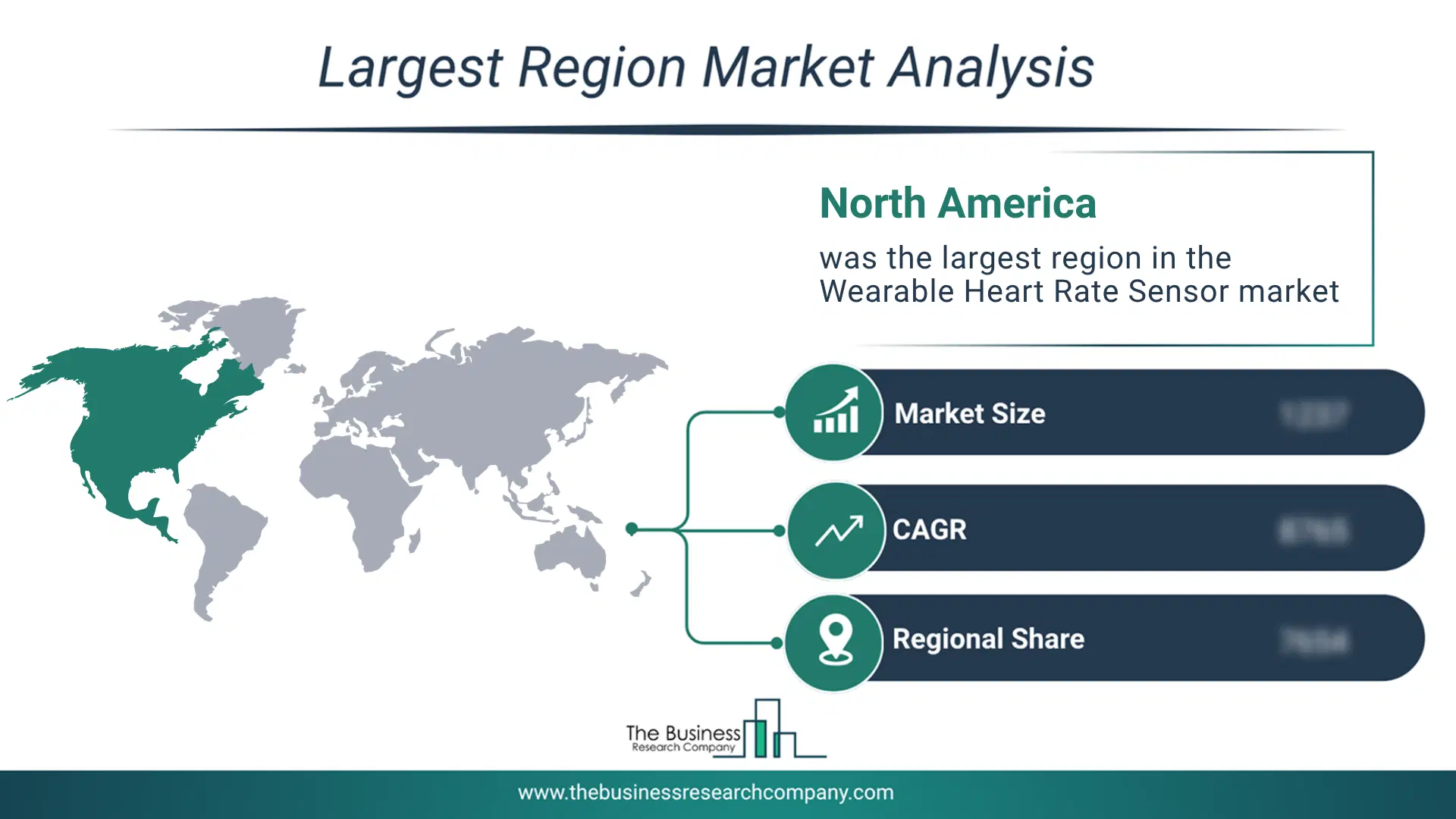
Regional Outlook
North America was the largest region in the wearable heart rate sensor market in 2025. Asia-Pacific is expected to be the fastest-growing region in the forecast period. The regions covered in this market report are Asia-Pacific, South East Asia, Western Europe, Eastern Europe, North America, South America, Middle East, Africa. The countries covered in this market report are Australia, Brazil, China, France, Germany, India, Indonesia, Japan, Taiwan, Russia, South Korea, UK, USA, Canada, Italy, SpainWhat Defines the Wearable Heart Rate Sensor Market?
The wearable heart rate sensor market consists of sales of optical biosensing smartwatch, electrocardiography (ECG)-integrated fitness chest band, in-ear heart rate monitoring earbuds, artificial intelligence (AI)-powered wrist pulse tracker, and adhesive patch heart rate sensor. Values in this market are ‘factory gate’ values, that is the value of goods sold by the manufacturers or creators of the goods, whether to other entities (including downstream manufacturers, wholesalers, distributors and retailers) or directly to end customers. The value of goods in this market includes related services sold by the creators of the goods.How is Market Value Defined and Measured?
The market value is defined as the revenues that enterprises gain from the sale of goods and/or services within the specified market and geography through sales, grants, or donations in terms of the currency (in USD unless otherwise specified). The revenues for a specified geography are consumption values that are revenues generated by organizations in the specified geography within the market, irrespective of where they are produced. It does not include revenues from resales along the supply chain, either further along the supply chain or as part of other products.
This chart presents market attractiveness based on a quantitative evaluation of growth, competition, strategic alignment, and risk, offering a clear view of opportunity areas for decision-making. This chart is for illustrative purposes; the full report contains the complete analysis.

This chart highlights the Total Addressable Market (TAM) by estimating the maximum revenue opportunity using an assumption-driven approach, supporting strategic planning and opportunity sizing across markets. The chart is illustrative; the full report provides a more comprehensive analysis.
What Key Data and Analysis Are Included in the Wearable Heart Rate Sensor Market Report 2026?
The wearable heart rate sensor market research report is one of a series of new reports from The Business Research Company that provides market statistics, including industry global market size, regional shares, competitors with the market share, detailed market segments, market trends and opportunities, and any further data you may need to thrive in the wearable heart rate sensor industry. The market research report delivers a complete perspective of everything you need, with an in-depth analysis of the current and future state of the industry.Wearable Heart Rate Sensor Market Report Forecast Analysis
| Report Attribute | Details |
|---|---|
| Market Size Value In 2026 | $5.59 billion |
| Revenue Forecast In 2030 | $10.79 billion |
| Growth Rate | CAGR of 17.9% from 2026 to 2030 |
| Base Year For Estimation | 2025 |
| Actual Estimates/Historical Data | 2020-2025 |
| Forecast Period | 2026 - 2030 |
| Market Representation | Revenue in USD Billion and CAGR from 2026 to 2030 |
| Segments Covered | Type, Distribution Channel, Application, End User |
| Regional Scope | Asia-Pacific, Western Europe, Eastern Europe, North America, South America, Middle East, Africa |
| Country Scope | The countries covered in the report are Australia, Brazil, China, France, Germany, India, Indonesia, Japan, Taiwan, Russia, South Korea, UK, USA, Canada, Italy, Spain. |
| Key Companies Profiled | Apple Inc., Samsung Electronics Co. Ltd., Huawei Technologies Co. Ltd., Xiaomi Corporation, Garmin Ltd., Oura Health Oy, Whoop Inc., Suunto Oy, Withings S.A., Polar Electro Oy, Empatica Inc., iRhythm Technologies Inc., Biobeat Ltd., Fitbit Inc., Omron Healthcare Inc., Zepp Health Corporation, Amazfit Global, Fossil Group Inc., AliveCor Inc., Cardiac Insight Inc. |
| Customization Scope | Request for Customization |
| Pricing And Purchase Options | Explore Purchase Options |