

Wind Tunnel Global Market Opportunities And Strategies To 2035
By Solution (Products, Services), By Airspeed (Subsonic, Transonic, Supersonic, Hypersonic), By Alignment (Vertical, Horizontal), By Application (Aerospace And Defense, Transportation, Racing Championship, Building Construction And Wind Energy, Adventure Sports Skydiving, Training And Simulation), And By Region, Opportunities And Strategies – Global Forecast To 2035
Wind Tunnel Market Definition
Wind tunnels are specialized testing environments used to study the effects of air moving past solid objects, most commonly for aerodynamic analysis. These facilities simulate the conditions of air movement around physical models or full-scale objects, allowing engineers and scientists to observe and measure forces such as lift, drag and turbulence. Wind tunnels are integral to research and development in industries such as aerospace, automotive, sports, construction and energy. The primary users of wind tunnels include aerospace and defense contractors, automotive manufacturers, architectural and civil engineering firms, academic research institutions and competitive sports organizations. The wind tunnel market consists of sales by entities (organizations, sole traders and partnerships) of subsonic, transonic, supersonic and hypersonic wind tunnel systems, including related hardware, instrumentation, software and services, used for aerodynamic testing, validation and research across aerospace, automotive, civil engineering, energy and research applications.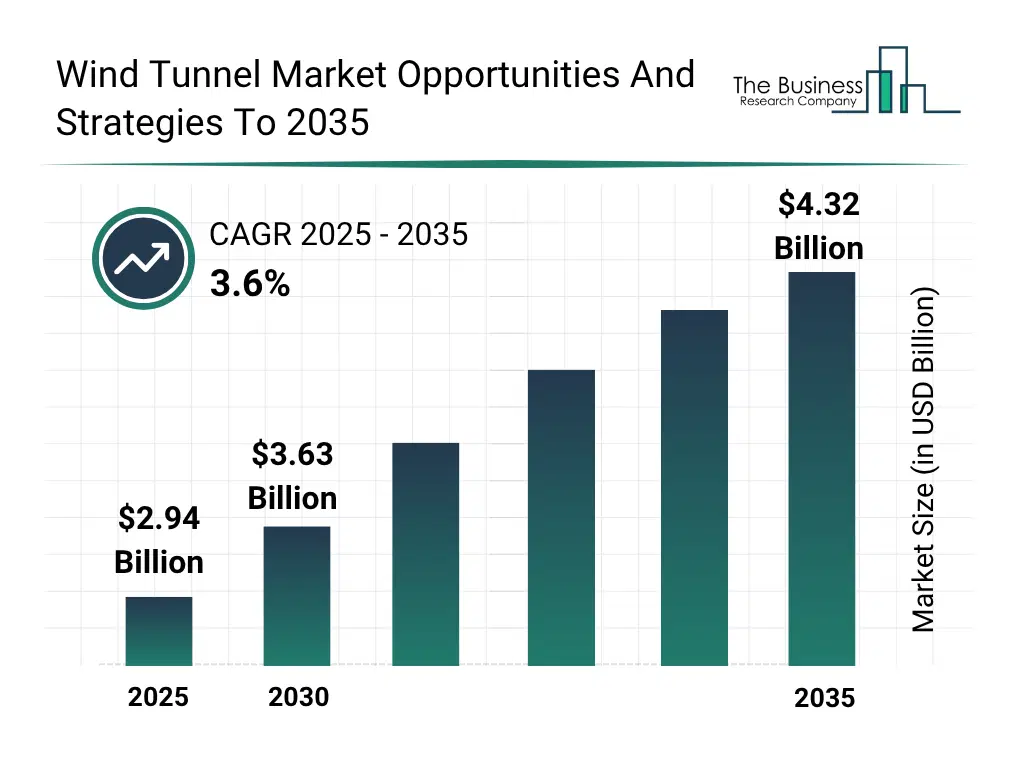
Wind Tunnel Market Size
The global wind tunnel market reached a value of nearly $2,937.9 million in 2025, having grown at a compound annual growth rate (CAGR) of 5.3% since 2020. The market is expected to grow from $2,937.9 million in 2025 to $3,626.3 million in 2030 at a rate of 4.3%. The market is then expected to grow at a CAGR of 3.6% from 2030 and reach $4,319.6 million in 2035. Growth in the historic period resulted from growth in aerospace and defense industry, rising demand for UAV, drone and advanced aircraft testing, expansion of space exploration and satellite launch programs and increasing focus on fuel efficiency and emission reduction. Factors that negatively affected growth in the historic period were delay in wind projects under construction and limited availability of skilled workforce. Going forward, growth in wind energy and renewable power projects, growth of the automotive industry, development of supersonic and hypersonic vehicles and rising demand for infrastructure wind engineering studies will drive the growth. Factors that could hinder the growth of the wind tunnel market in the future include high operating and energy costs, regulatory and environmental compliance challenges and impact of trade war and tariffs.
Wind Tunnel Market Segmentation
The wind tunnel market is segmented by solution, by airspeed, by alignment and by application.By Solution –
The wind tunnel market is segmented by solution into:
- a) Products
- b) Services
By Airspeed –
The wind tunnel market is segmented by airspeed into:
- a) Subsonic
- b) Transonic
- c) Supersonic
- d) Hypersonic
By Alignment –
The wind tunnel market is segmented by alignment into:
- a) Vertical
- b) Horizontal
By Application –
The wind tunnel market is segmented by application into:
- a) Aerospace And Defense
- b) Transportation
- c) Racing Championship
- d) Building Construction And Wind Energy
- e) Adventure Sports Skydiving
- f) Training And Simulation
By Geography - The wind tunnel market is segmented by geography into:
- China
- India
- Japan
- Australia
- Indonesia
- South Korea
- USA
- Canada
- Brazil
- France
- Germany
- UK
- Italy
- Spain
- Russia
-
o Asia Pacific
o Africa