
Glufosinate Global Market Opportunities And Strategies To 2035
By Crop Type (Genetically Modified Crops, Conventional Crops), By Formulation (Aqueous Suspension, Liquid, Suspension Concentrate, Soluble (Liquid) Concentrate, Other Formulations), By Application (Agricultural, Non-Agricultural Applications), And By Region, Opportunities And Strategies – Global Forecast To 2035
Glufosinate Market Definition
Glufosinate is a broad-spectrum, non-selective post-emergence herbicide (commonly used as glufosinate ammonium) that controls a wide range of grasses and broadleaf weeds by inhibiting the plant enzyme glutamine synthetase, leading to toxic ammonia buildup and plant death. Its primary purpose is to effectively eliminate unwanted weeds in agricultural and non-crop areas, thereby protecting crop yields, supporting efficient farm management and helping control herbicide-resistant weed populations, particularly in herbicide-tolerant cropping systems. The glufosinate market consists of revenues generated by entities (organizations, sole traders and partnerships) engaged in the manufacturing, formulation and sale of glufosinate-based herbicides and related products used for weed control. These products are designed to enhance crop yield and quality by minimizing weed competition and are widely utilized in modern agricultural systems. The market encompasses various formulations and applications tailored to different crop types and farming practices, supporting both conventional and biotechnology-driven agriculture.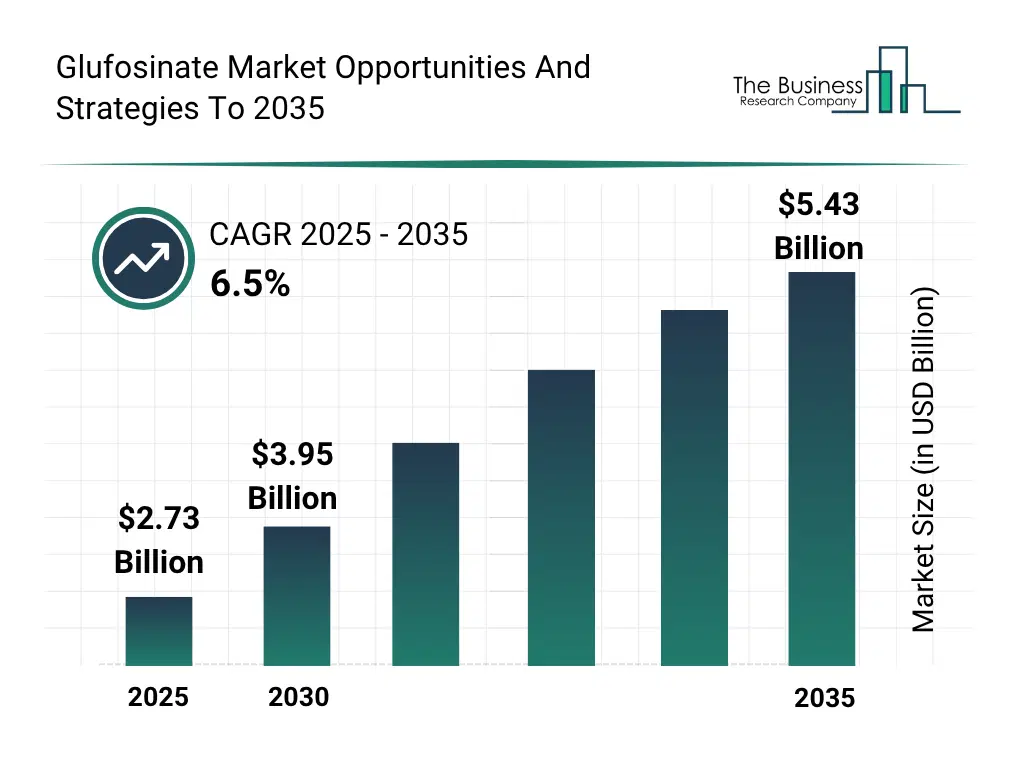
Glufosinate Market Size
The global glufosinate market reached a value of nearly $2,732.9 million in 2025, having grown at a compound annual growth rate (CAGR) of 9.0% since 2020. The market is expected to grow from $2,732.9 million in 2025 to $3,953.7 million in 2030 at a rate of 7.7%. The market is then expected to grow at a CAGR of 6.5% from 2030 and reach $5,428.1 million in 2035. Growth in the historic period resulted from expansion of genetically modified (GM) crops, government initiatives promoting crop protection and productivity enhancement, growing agricultural sector and growth in large-scale commercial farming operations. Factors that negatively affected growth in the historic period were regulatory restrictions and safety concerns and limited systemic activity. Going forward, shift toward integrated weed management (IWM), rising adoption of precision agriculture, increasing food demand and rising use in specialty crops and orchards will drive the growth. Factors that could hinder the growth of the glufosinate market in the future include competition from low-cost generic herbicides, phytotoxicity risk in non-tolerant crops and impact of trade war and tariff.
Glufosinate Market Segmentation
The glufosinate market is segmented by crop type, by formulation and by application.By Crop Type –
The glufosinate market is segmented by crop type into:
- a) Genetically Modified Crops
- b) Conventional Crops
By Formulation –
The glufosinate market is segmented by formulation into:
- a) Aqueous Suspension
- b) Liquid
- c) Suspension Concentrate
- d) Soluble (Liquid) Concentrate
- e) Other Formulations
By Application –
The glufosinate market is segmented by application into:
- a) Agricultural
- b) Non-Agricultural Applications
By Geography - The glufosinate market is segmented by geography into:
- China
- India
- Japan
- Australia
- Indonesia
- South Korea
- USA
- Canada
- Brazil
- France
- Germany
- UK
- Italy
- Spain
- Russia
-
o Asia Pacific
o Africa