
Green Airport Market Report 2026
Global Outlook – By Component (Hardware, Software, Services), By Airport Type (International Airports, Domestic Airports, Regional Airports, Military Airports), By Technology (Renewable Energy Systems, Energy Efficient Lighting Systems, Green Building Systems, Water Management Systems, Waste Management Systems, Smart Airport And Energy Management Systems, Electric Ground Support Equipment, Sustainable Aviation Fuel Infrastructure, Other Technologies), By Infrastructure Development (Terminal Construction, Runway Optimization, Parking Facilities), By End User (Airport Operators, Government And Defense Airports, Airport Infrastructure Developers, Airlines, Ground Handling Service Providers) – Market Size, Trends, Strategies, and Forecast to 2035
Green Airport Market Overview
• Green Airport market size has reached to $5.2 billion in 2025 • Expected to grow to $10.11 billion in 2030 at a compound annual growth rate (CAGR) of 14.1% • Growth Driver: Increasing Focus On Reducing Airport Carbon Emissions Is Driving The Market Due To Rising Investments In Sustainable Infrastructure And The Adoption Of Low-Carbon Airport Operations • Market Trend: Green Technologies Transform Airport Infrastructure For Sustainable Aviation And Trade Growth • North America was the largest region in 2025 and Asia-Pacific is the fastest growing region.What Is Covered Under Green Airport Market?
A green airport is an aviation facility designed, operated, and managed to minimize environmental impact by integrating sustainable infrastructure, resource-efficient technologies, low-carbon operations, responsible waste and water management, biodiversity conservation, and climate resilience while maintaining safe, efficient, and regulatory-compliant air transport activities throughout its lifecycle. It supports the aviation sector's environmental objectives by reducing emissions and resource consumption, improving operational efficiency, strengthening regulatory compliance, advancing long-term sustainability performance, and promoting balanced economic, environmental, and social outcomes across airport development and daily operations. The main components of green airport include hardware, software, and services. Hardware refers to the physical equipment and systems used to support sustainable airport operations, improve resource efficiency, and reduce environmental impact. These components are deployed across international airports, domestic airports, regional airports, and military airports, and incorporate renewable energy systems, energy efficient lighting systems, green building systems, water management systems, waste management systems, smart airport and energy management systems, electric ground support equipment, sustainable aviation fuel infrastructure, and other technologies. They support terminal construction, runway optimization, and parking facilities, and are used end users by airport operators, government and defense airports, airport infrastructure developers, airlines, and ground handling service providers.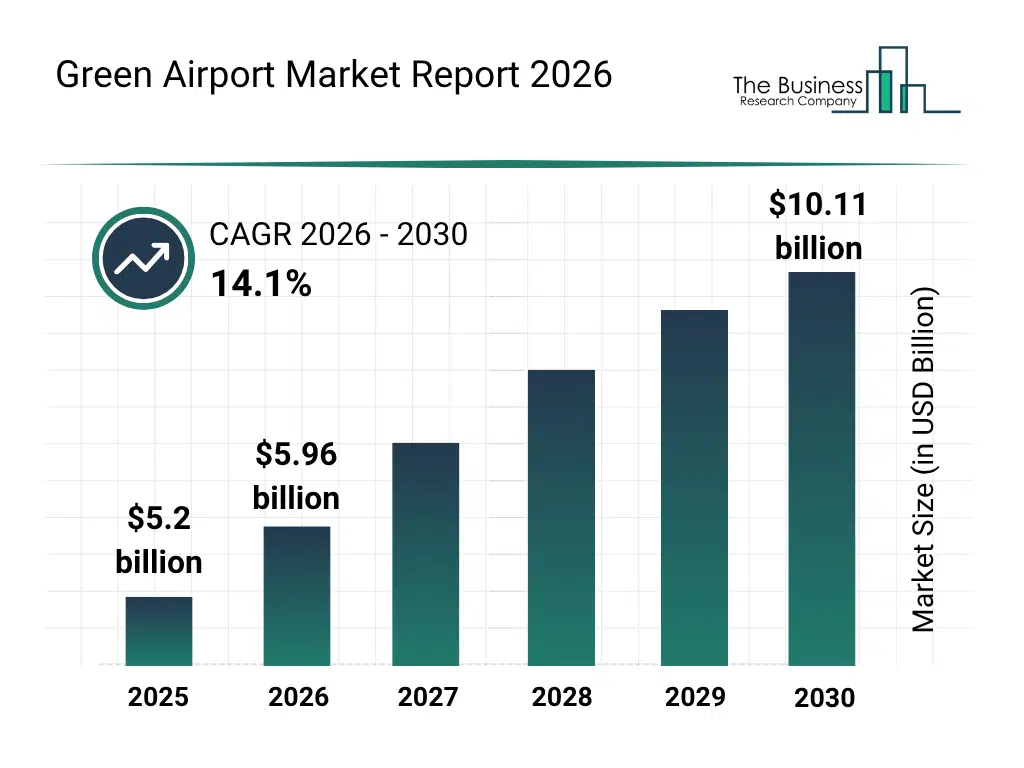
What Is The Green Airport Market Size and Share 2026?
The green airport market size has grown rapidly in recent years. It will grow from $5.2 billion in 2025 to $5.96 billion in 2026 at a compound annual growth rate (CAGR) of 14.5%. The growth in the historic period can be attributed to increasing environmental regulations for airports, growing adoption of renewable energy systems, rising airport energy efficiency initiatives, increasing investment in sustainable airport infrastructure, growing focus on airport waste and water conservation.What Is The Green Airport Market Growth Forecast?
The green airport market size is expected to see rapid growth in the next few years. It will grow to $10.11 billion in 2030 at a compound annual growth rate (CAGR) of 14.1%. The growth in the forecast period can be attributed to rising demand for low-carbon airport operations, increasing deployment of electric ground support equipment, expansion of sustainable aviation fuel infrastructure, growing investment in climate-resilient airport development, increasing adoption of integrated airport energy management systems. Major trends in the forecast period include renewable energy integration in airport operations, airport carbon neutrality initiatives, sustainable water and waste management, climate-resilient airport infrastructure, sustainable aviation fuel infrastructure expansion.Tariff Impact On Green Airport Market
Tariffs are impacting the green airport market by increasing the cost of imported solar panels, battery energy storage systems, electric vehicle charging equipment, smart lighting systems, and other sustainable airport technologies. Airport infrastructure development and renewable energy technology segments may face greater cost pressures, particularly in North America, Europe, and Asia-Pacific due to globally interconnected clean-technology supply chains. Higher equipment costs can delay sustainability projects and increase infrastructure investment requirements, while tariffs may also encourage domestic manufacturing, regional sourcing, and investment in locally produced green airport technologies.
Global Green Airport Market Segmentation
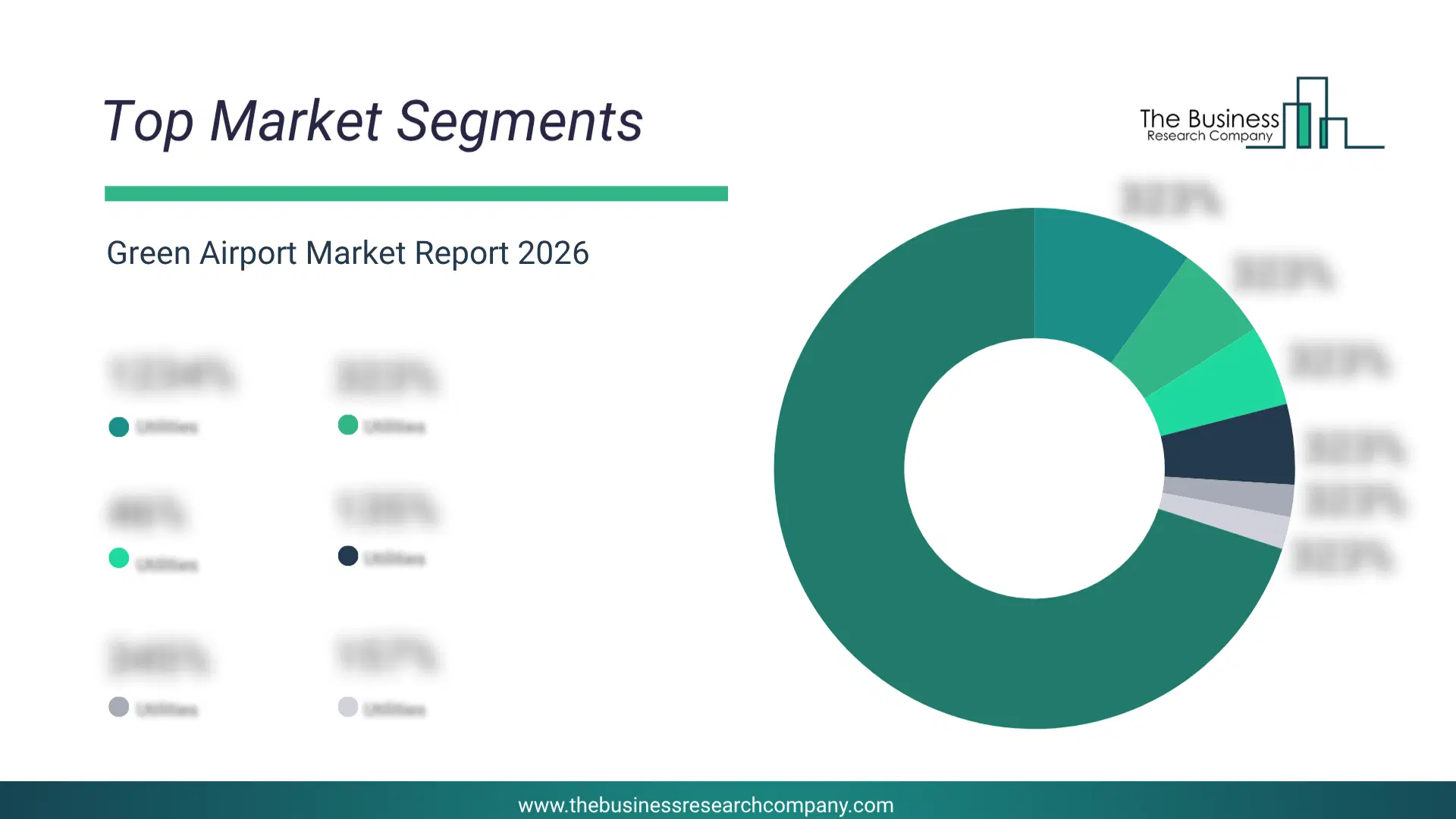
2) By Airport Type: International Airports, Domestic Airports, Regional Airports, Military Airports 3) By Technology: Renewable Energy Systems, Energy Efficient Lighting Systems, Green Building Systems, Water Management Systems, Waste Management Systems, Smart Airport And Energy Management Systems, Electric Ground Support Equipment, Sustainable Aviation Fuel Infrastructure, Other Technologies 4) By Infrastructure Development: Terminal Construction, Runway Optimization, Parking Facilities 5) By End User: Airport Operators, Government And Defense Airports, Airport Infrastructure Developers, Airlines, Ground Handling Service Providers Subsegments: 1) By Hardware: Solar Photovoltaic Panels, Wind Energy Turbines, Battery Energy Storage Systems, Electric Vehicle Charging Stations, Smart Lighting Controllers 2) By Software: Energy Management Software, Carbon Emissions Management Software, Building Management Software, Environmental Monitoring Software, Airport Operations Management Software 3) By Services: Energy Consulting Services, Sustainability Assessment Services, System Integration Services, Installation And Commissioning Services, Maintenance And Support ServicesWhat Is The Driver Of The Green Airport Market?
The increasing focus on reducing airport carbon emissions is expected to propel the growth of the green airport market going forward. Airport carbon emissions refer to the greenhouse gas emissions generated directly and indirectly from airport infrastructure, ground operations, energy consumption, transportation activities, and supporting facilities throughout the operation and maintenance of an airport. The increasing focus on reducing airport carbon emissions is primarily driven by the global transition toward climate sustainability, as governments, regulators, investors, and aviation stakeholders are placing greater emphasis on lowering environmental impacts, encouraging airports to adopt cleaner technologies, improve energy efficiency, and implement low-carbon operational practices to meet evolving environmental expectations and long-term sustainability objectives. Increasing focus on reducing airport carbon emissions is accelerating the adoption of green airport solutions by driving investments in sustainable infrastructure, advanced environmental management solutions, and resource-efficient technologies that enable airports to systematically reduce carbon emissions while enhancing operational performance and environmental stewardship. For instance, in March 2026, according to Airport Carbon Accreditation (ACA), a Belgium-based global, independently verified carbon management certification programme for airports, a total of 590 airports across 91 countries and territories were accredited under the programme during the 2024–2025 reporting period. Therefore, the increasing focus on reducing airport carbon emissions is propelling the growth of the green airport industry.Key Players In The Global Green Airport Market
Major companies operating in the green airport market are Siemens AG, ENGIE SA, Veolia Environnement SA, Schneider Electric SE, Honeywell International Inc, ABB Ltd, Thales Group, Johnson Controls International plc, VINCI, WSP Global Inc, Ferrovial SE, Aéroports de Paris SA, Amadeus IT Group SA, Indra Sistemas SA, Fraport AG, Daifuku Co Ltd, Arup Group Limited, Vanderlande Industries BV, Flughafen München GmbH, SITA, Flughafen Zürich AG, GMR Airports Limited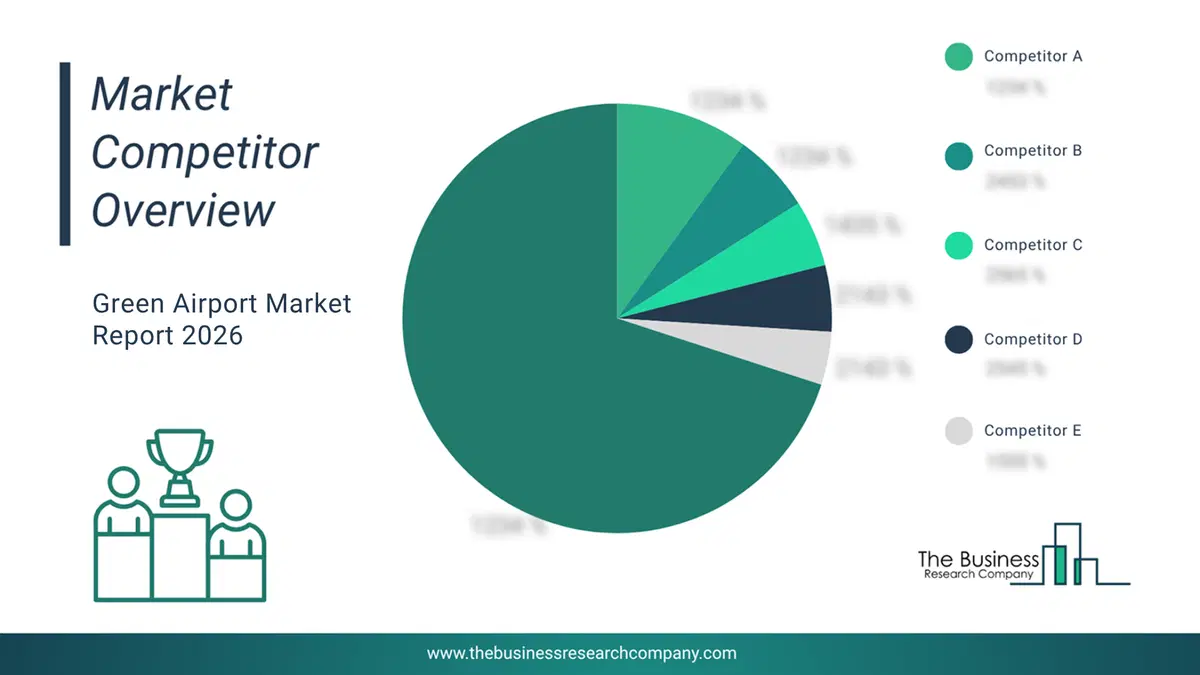
This chart is for illustrative purposes; the full report includes a detailed competitor analysis and comprehensive overview of the top 10 companies in the market.
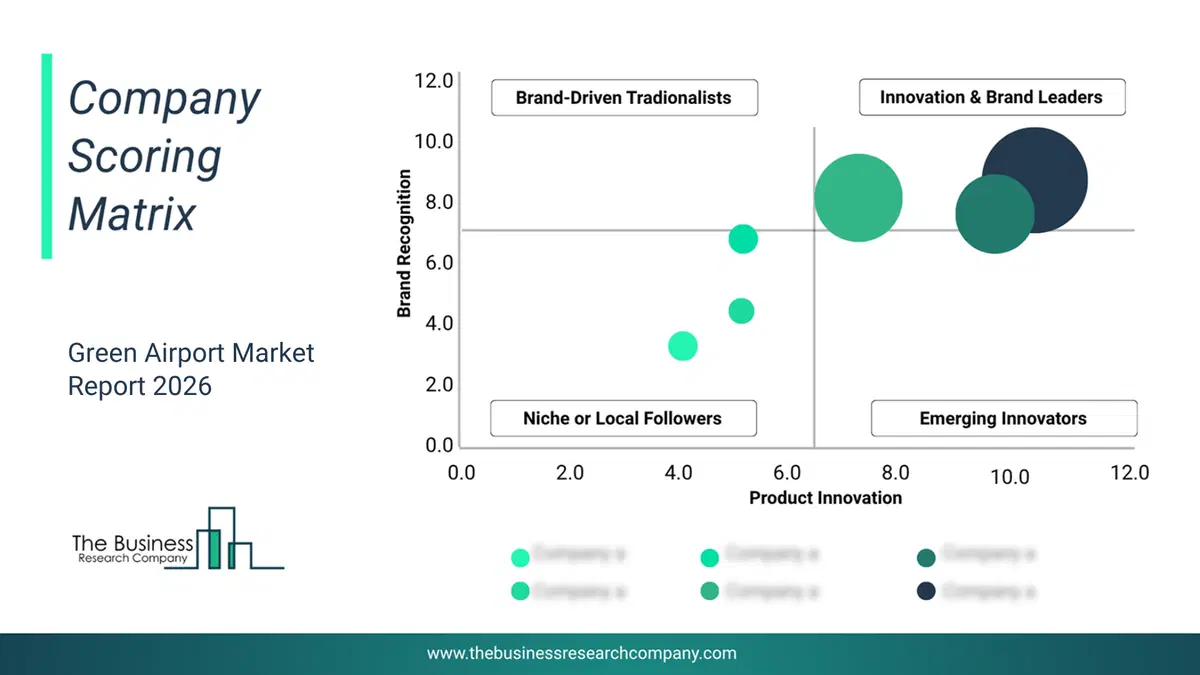
This chart maps companies by product innovation and brand strength, with bubble size indicating relative revenue, helping identify market leaders, challengers, and niche players. This is an illustrative chart; the full report provides a complete and accurate competitive analysis.
Global Green Airport Market Trends and Insights
Major companies operating in the green airport market are focusing on developing technological advancements, such as airport sustainability platforms to improve energy efficiency, reduce carbon emissions, and enable environmentally sustainable airport operations. An airport sustainability platform is an integrated solution combining renewable energy, energy-efficient infrastructure, and digital technologies to improve operational efficiency while reducing environmental impact. For instance, in July 2026, the United Nations Development Programme (UNDP), a US-based international development organization, announced the Japan-Eswatini Green and Digital Transformation Demonstration Project, an airport sustainability platform. The initiative integrates solar energy systems, energy-efficient cargo handling facilities, and digital coordination tools to optimize airport operations while lowering energy consumption and operational costs. It also demonstrates scalable low-carbon aviation infrastructure that strengthens cargo logistics, regional trade connectivity, and long-term sustainable airport development.What Are Latest Mergers And Acquisitions In The Green Airport Market?
In May 2025, Qantas Airways Limited, an Australia-based airline company, partnered with Sydney Airport Limited and Ampol Limited to support the importation, blending, and distribution of sustainable aviation fuel (SAF) through the Sydney Airport fuel supply chain. Through this partnership, Qantas Airways Limited, Sydney Airport Limited, and Ampol Limited aim to increase SAF availability, reduce aviation carbon emissions, support the development of Australia’s domestic SAF industry, and promote the adoption of lower-carbon aviation fuels. Sydney Airport Limited is an Australia-based airport operator that specializes in operating and managing Sydney Kingsford Smith Airport and implementing sustainability initiatives, while Ampol Limited is an Australia-based energy company that specializes in providing fuel, energy, and mobility solutions.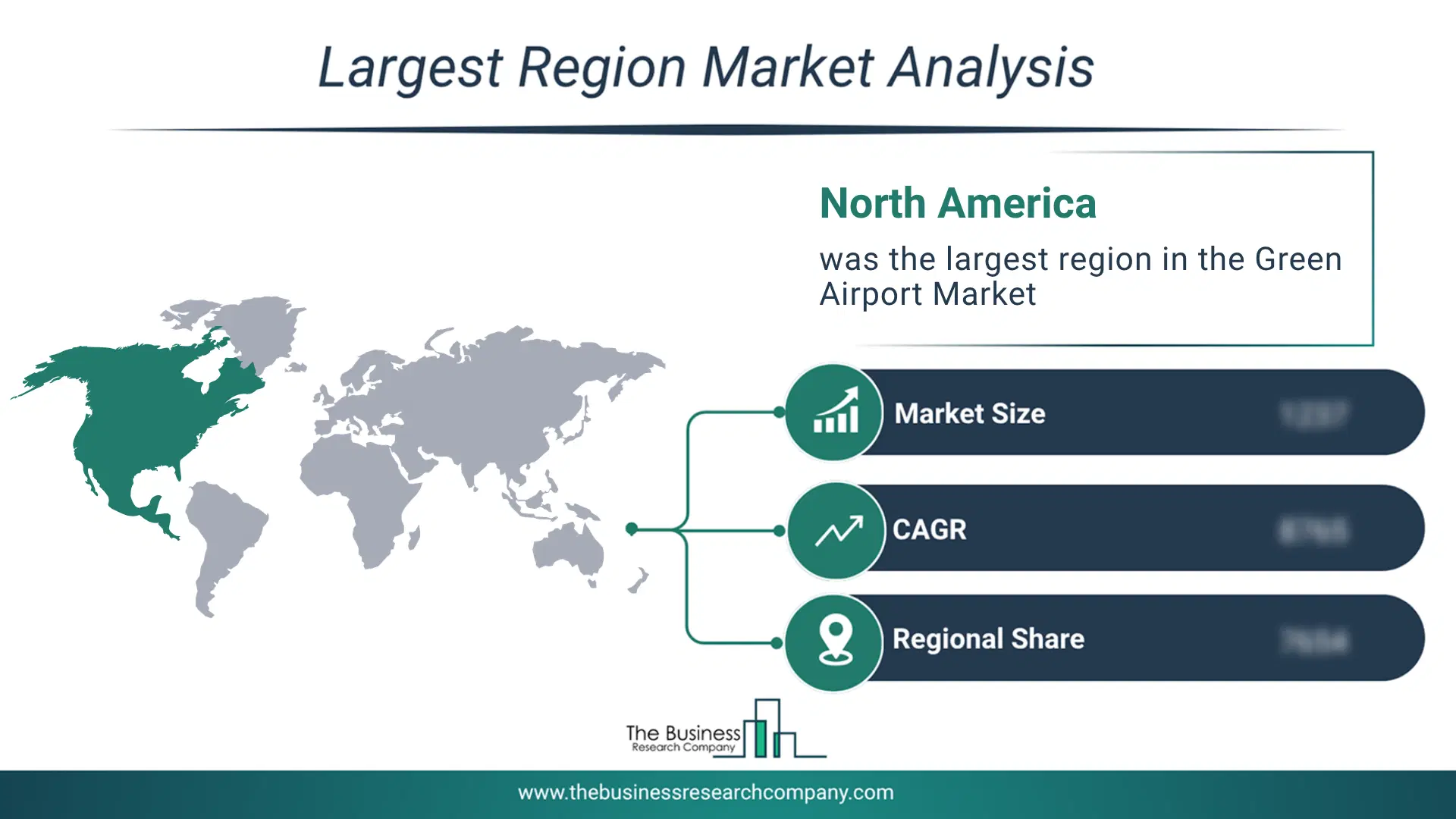
Regional Outlook/Insights
North America was the largest region in the green airport market in 2025. Asia-Pacific is expected to be the fastest growing region in the forecast period. The regions covered in this market report are Asia-Pacific, South East Asia, Western Europe, Eastern Europe, North America, South America, Middle East, Africa. The countries covered in this market report are Australia, Brazil, China, France, Germany, India, Indonesia, Japan, Taiwan, Russia, South Korea, UK, USA, Canada, Italy, Spain.What Defines the Green Airport Market?
The green airport market consists of revenues earned by entities by providing services such as carbon footprint assessment services, environmental impact assessment services, energy auditing services, sustainability certification services, water efficiency assessment services, waste auditing services, climate risk assessment services, environmental compliance services, and green procurement services. The market value includes the value of related goods sold by the service provider or included within the service offering. The green airport market also includes sales of solar photovoltaic modules, battery energy storage systems, rainwater harvesting equipment, greywater recycling equipment, low-flow plumbing fixtures, and sustainable airport construction materials. Values in this market are ‘factory gate’ values, that is, the value of goods sold by the manufacturers or creators of the goods, whether to other entities (including downstream manufacturers, wholesalers, distributors, and retailers) or directly to end customers. The value of goods in this market includes related services sold by the creators of the goods.How is Market Value Defined and Measured?
The market value is defined as the revenues that enterprises gain from the sale of goods and/or services within the specified market and geography through sales, grants, or donations in terms of the currency (in USD unless otherwise specified). The revenues for a specified geography are consumption values that are revenues generated by organizations in the specified geography within the market, irrespective of where they are produced. It does not include revenues from resales along the supply chain, either further along the supply chain or as part of other products.
This chart presents market attractiveness based on a quantitative evaluation of growth, competition, strategic alignment, and risk, offering a clear view of opportunity areas for decision-making. This chart is for illustrative purposes; the full report contains the complete analysis.

This chart highlights the Total Addressable Market (TAM) by estimating the maximum revenue opportunity using an assumption-driven approach, supporting strategic planning and opportunity sizing across markets. The chart is illustrative; the full report provides a more comprehensive analysis.
What Key Data and Analysis Are Included in the Green Airport Market Report 2026?
The green airport market research report is one of a series of new reports from The Business Research Company that provides market statistics, including industry global market size, regional shares, competitors with the market share, detailed market segments, market trends and opportunities, and any further data you may need to thrive in the green airport industry. The market research report delivers a complete perspective of everything you need, with an in-depth analysis of the current and future state of the industry.Green Airport Market Report Forecast Analysis
| Report Attribute | Details |
|---|---|
| Market Size Value In 2026 | $5.96 billion |
| Revenue Forecast In 2030 | $10.11 billion |
| Growth Rate | CAGR of 14.1% from 2026 to 2035 |
| Base Year For Estimation | 2025 |
| Actual Estimates/Historical Data | 2020-2025 |
| Forecast Period | 2026 - 2030 |
| Market Representation | Revenue in USD Billion and CAGR from 2026 to 2030 |
| Segments Covered | Component, Airport Type, Technology, Infrastructure Development, End User |
| Regional Scope | Asia-Pacific, Western Europe, Eastern Europe, North America, South America, Middle East, Africa |
| Country Scope | The countries covered in the report are Australia, Brazil, China, France, Germany, India, Indonesia, Japan, Taiwan, Russia, South Korea, UK, USA, Canada, Italy, Spain. |
| Customization Scope | Request for Customization |
| Pricing And Purchase Options | Explore Purchase Options |