
Greenwashing Detection Artificial Intelligence (AI) Market Report 2026
Global Outlook – By Component (Software, Services), By Deployment Mode (Cloud, On-Premises), By Organization Size (Large Enterprises, Small And Medium Enterprises), By Application (Financial Services, Consumer Goods, Energy And Utilities, Manufacturing, Retail, Transportation, Other Applications), By End-User (Corporates, Regulatory Bodies, NGOs, Investors, Other End-Users) – Market Size, Trends, Strategies, and Forecast to 2030
Greenwashing Detection Artificial Intelligence (AI) Market Overview
• Greenwashing Detection Artificial Intelligence (AI) market size has reached to $0.94 billion in 2025 • Expected to grow to $3.14 billion in 2030 at a compound annual growth rate (CAGR) of 27.2% • Growth Driver: Transparent Environmental Reporting Fueling The Growth Of The Market Due To Rising Regulatory Scrutiny And Investor Demand For Credible Sustainability Disclosures • Market Trend: Companies Advance AI-Driven Sustainability Report Validation To Enhance Transparency And Regulatory Compliance • North America was the largest region in 2025 and Asia-Pacific is the fastest growing region.Market Gains By 2030 – Top Opportunities By Segment
Market Gain identifies the most promising market opportunities by highlighting the segments or products expected to generate the highest incremental revenue growth over the next five years.
What Is Covered Under Greenwashing Detection Artificial Intelligence (AI) Market?
Greenwashing detection artificial intelligence (AI) refers to AI-powered tools that identify and analyze misleading or false environmental claims made by companies about their products, services, or practices. These tools assess marketing materials, reports, and digital content to detect exaggerations or deceptive sustainability messaging. It helps to ensure transparency, promote genuine corporate sustainability, and protect consumers from misleading claims. The main components of greenwashing detection artificial intelligence (AI) include software and services. Software refers to artificial intelligence–driven solutions that analyze sustainability claims, disclosures, marketing content, and data sources to identify misleading or unsubstantiated environmental claims and support transparent reporting. These solutions can be deployed through cloud or on-premises modes. The adoption spans organizations of different sizes, including large enterprises and small and medium enterprises. The various applications involved are financial services, consumer goods, energy and utilities, manufacturing, retail, transportation, and other applications and they are used by several end users such as corporates, regulatory bodies, NGOs, investors, and other end users.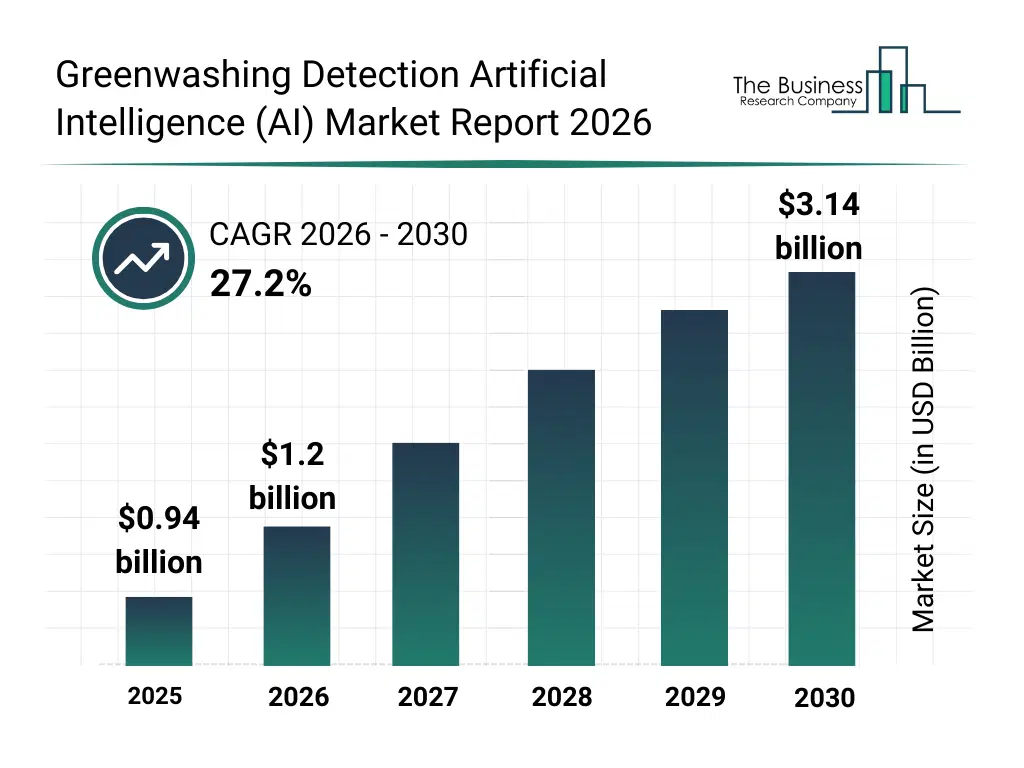
What Is The Greenwashing Detection Artificial Intelligence (AI) Market Size and Share 2026?
The greenwashing detection artificial intelligence (AI) market size has grown exponentially in recent years. It will grow from $0.94 billion in 2025 to $1.2 billion in 2026 at a compound annual growth rate (CAGR) of 26.9%. The growth in the historic period can be attributed to growing awareness of corporate greenwashing, increasing regulatory scrutiny on sustainability claims, adoption of ai-powered analytics tools, rising investor demand for verified esg data, early integration of compliance monitoring solutions.What Is The Greenwashing Detection Artificial Intelligence (AI) Market Growth Forecast?
The greenwashing detection artificial intelligence (AI) market size is expected to see exponential growth in the next few years. It will grow to $3.14 billion in 2030 at a compound annual growth rate (CAGR) of 27.2%. The growth in the forecast period can be attributed to expansion of global esg and sustainability regulations, adoption of advanced ai models for detection, growth in cloud-based greenwashing detection platforms, increasing demand from corporates for automated reporting, enhanced focus on brand trust and reputation management. Major trends in the forecast period include automated sustainability claim analysis, regulatory compliance monitoring, environmental risk scoring, content and disclosure auditing, brand reputation monitoring.
Global Greenwashing Detection Artificial Intelligence (AI) Market Segmentation
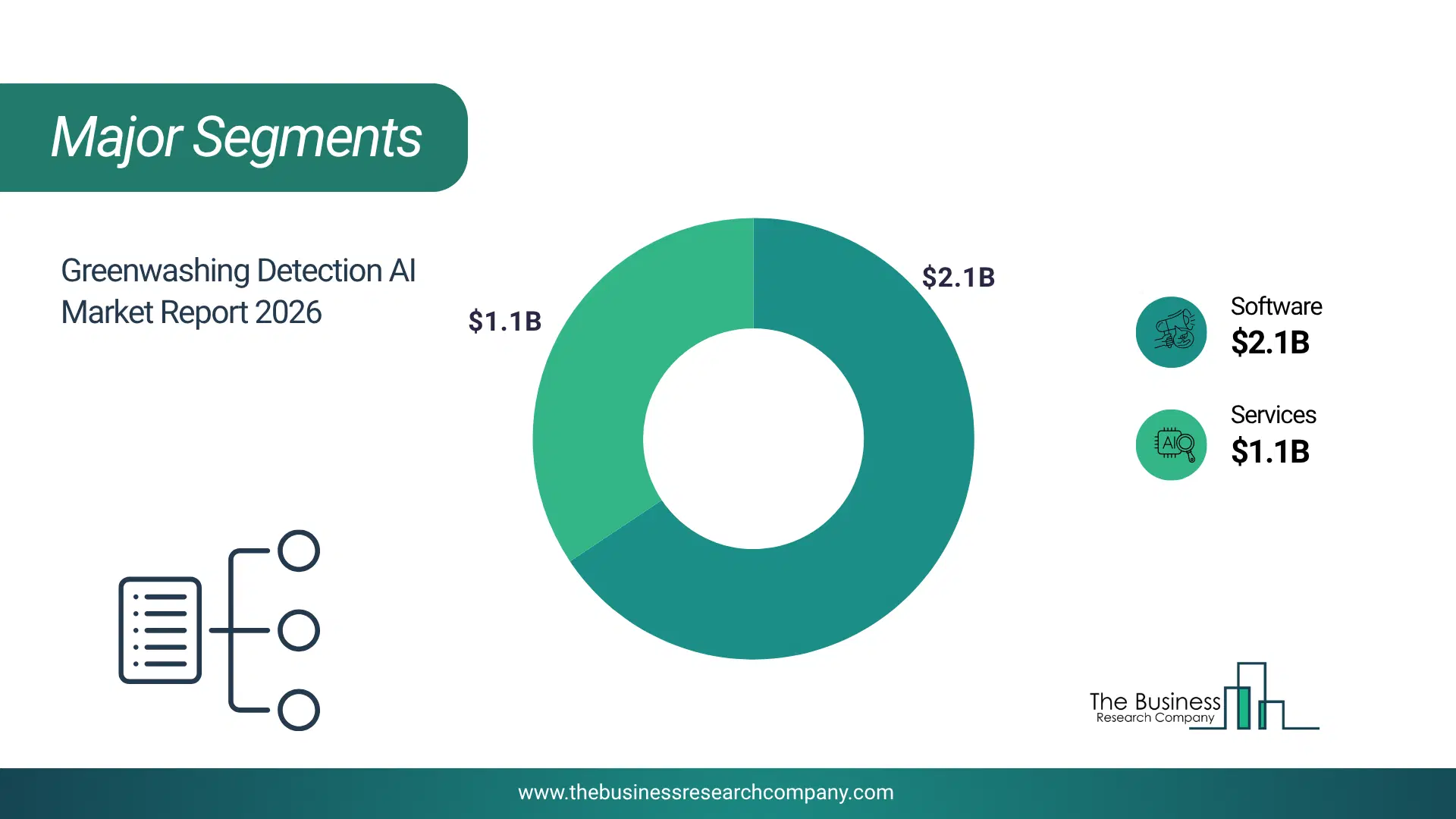
1) By Component: Software, Services 2) By Deployment Mode: Cloud, On-Premises 3) By Organization Size: Large Enterprises, Small And Medium Enterprises 4) By Application: Financial Services, Consumer Goods, Energy And Utilities, Manufacturing, Retail, Transportation, Other Applications 5) By End-User: Corporates, Regulatory Bodies, NGOs, Investors, Other End-Users Subsegments: 1) By Software: Recommendation Engine Software, Customer Analytics Software, Personalization Software, Campaign Management Software, Pricing Optimization Software 2) By Services: Consulting Services, Integration And Deployment Services, Training And Education Services, Support And Maintenance Services, Managed Services The top segments in the greenwashing detection ai market will be: • Software will reach $2.09 billion by 2030. • Services will reach $1.1 billion by 2030.What Is The Driver Of The Greenwashing Detection Artificial Intelligence (AI) Market?
The transparent environmental reporting is expected to propel the growth of the greenwashing detection artificial intelligence (AI) market going forward. Transparent environmental reporting refers to the growing requirement for companies to openly disclose accurate, verifiable, and consistent information about their environmental impact, sustainability practices, and climate-related risks. Transparent environmental reporting is increasing due to tightening environmental regulations and investor pressure, which require organizations to provide standardized and credible sustainability disclosures. The greenwashing detection artificial intelligence (AI) supports transparent environmental reporting by enabling automated analysis, verification, and monitoring of environmental claims, helping organizations identify misleading statements and ensure disclosure credibility at scale. For instance, in April 2025, according to CDP (Carbon Disclosure Project), a UK-based non-profit organization, the number of companies scored for transparent environmental reporting increased from 21,115 in 2023 to 22,777 in 2024, reflecting a 7.9% year-over-year growth in corporate disclosure. Therefore, the transparent environmental reporting is driving the growth of the greenwashing detection artificial intelligence (AI) industry.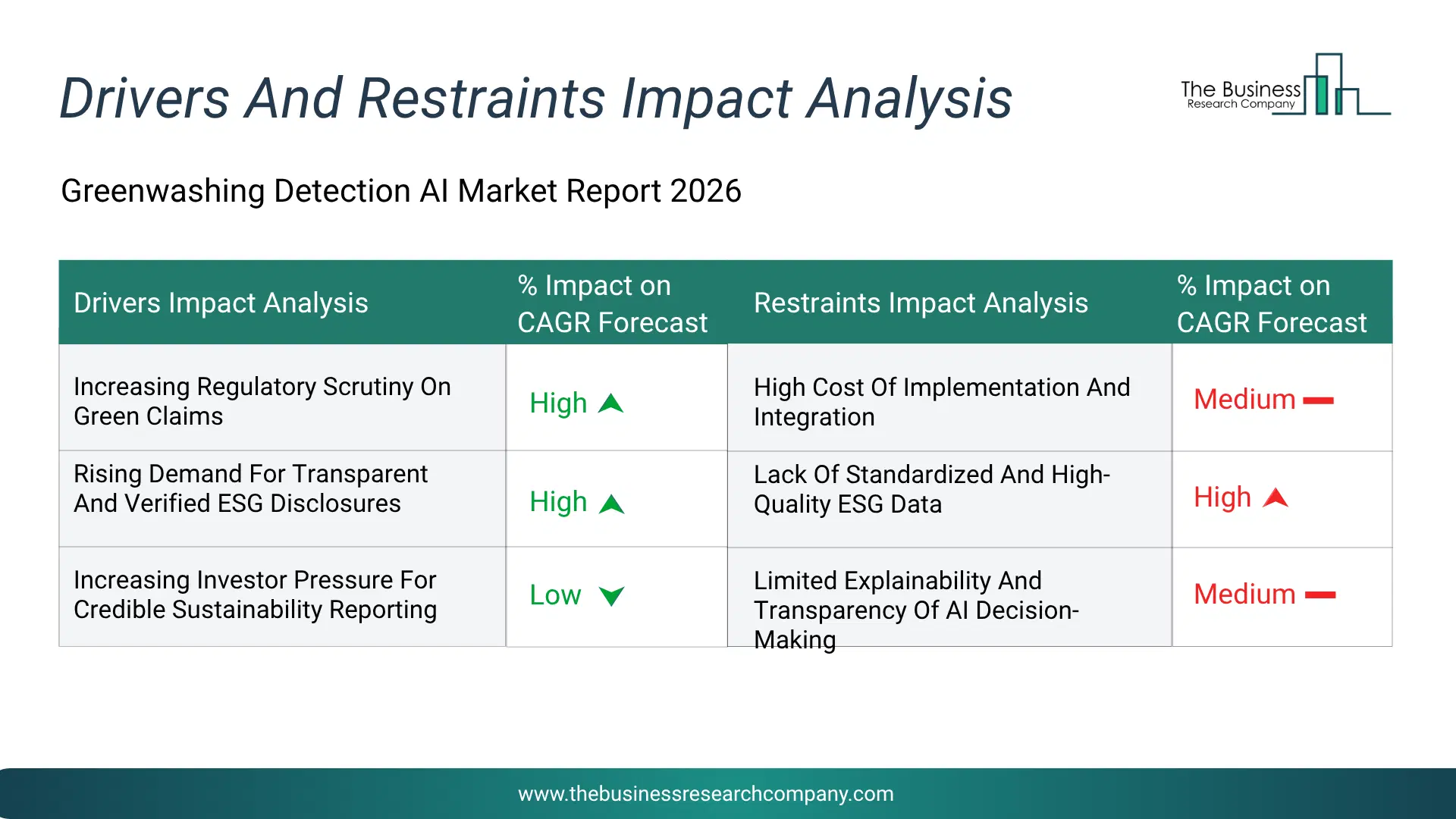
Infographic Chart Showing Key Market Drivers Analysis And Restraints For Greenwashing Detection Artificial Intelligence (Ai) Market
The chart presents an impact analysis of key drivers and restraints, quantifying their relative influence on the market's growth rate and helping assess the balance between growth enablers and limiting factors. This chart offers a high-level perspective; the full report contains more detailed insights.
How Will The Drivers Impact Growth In The Global Greenwashing Detection AI Market?
• Increasing Regulatory Scrutiny On Green Claims (High) – During the forecast period, the increasing regulatory scrutiny on green claims is expected to become a key growth driver for the greenwashing detection ai market by 2030. Governments and regulatory authorities are introducing stricter guidelines and penalties to prevent misleading environmental claims, compelling organizations to adopt advanced verification tools. Ai -based solutions enable automated analysis of sustainability reports, marketing content, and disclosures to ensure compliance with evolving regulations. This growing enforcement environment is accelerating the adoption of greenwashing detection technologies across industries. • Rising Demand For Transparent And Verified ESG Disclosures (High) – During the forecast period, the rising demand for transparent and verified esg disclosures is expected to emerge as a major factor driving the expansion of the greenwashing detection ai market by 2030. Companies are under increasing pressure from stakeholders to provide accurate, data-driven sustainability reports, leading to greater reliance on ai tools for validation and verification. These solutions help organizations ensure credibility in their esg claims while minimizing reputational risks. Additionally, standardization of esg reporting frameworks is further encouraging the adoption of automated verification technologies. • Increasing Investor Pressure For Credible Sustainability Reporting (Low) – During the forecast period, the increasing investor pressure for credible sustainability reporting is expected to act as a key growth catalyst for the greenwashing detection ai market by 2030. Investors are increasingly prioritizing esg performance in decision-making, driving demand for reliable and verifiable sustainability data. Ai-powered greenwashing detection tools enable investors and financial institutions to assess the authenticity of corporate claims and mitigate risks associated with misleading disclosures. This shift toward responsible investing is strengthening the adoption of advanced analytics solutions across financial markets.How Will The Restraints Impact Growth In The Global Greenwashing Detection AI Market?
• High Cost Of Implementation And Integration (Medium) – During the forecast period, the high cost of implementation and integration acts as a key restraint in the greenwashing detection artificial intelligence (ai) market by making adoption financially challenging, especially for small and mid-sized organizations. Deploying these solutions requires significant investment in ai infrastructure, data integration, customization, and ongoing maintenance. Integration with existing esg reporting systems, marketing platforms, and compliance tools further increases complexity and costs. Organizations may also need to invest in employee training and change management to effectively use ai-driven insights. As a result, budget constraints can delay deployment and limit market penetration across price-sensitive regions. • Lack Of Standardized And High-Quality ESG Data (High) – During the forecast period, the lack of standardized and high-quality esg data restrains the market by reducing the accuracy and reliability of ai-based greenwashing detection outcomes. Sustainability disclosures often vary widely in format, metrics, and depth across companies and regions, making consistent analysis difficult. Incomplete, outdated, or self-reported esg data can lead to false positives or missed risks in ai assessments. The absence of universally accepted benchmarks limits model training and cross-company comparability. This data inconsistency undermines trust in ai-driven evaluations and slows enterprise adoption. • Limited Explainability And Transparency Of AI Decision-Making (Medium) – During the forecast period, the limited explainability and transparency of ai decision-making acts as a restraint by creating uncertainty among regulators, enterprises, and end users. Many ai models operate as “black boxes,” making it difficult to clearly justify why a sustainability claim is flagged as misleading. This lack of transparency complicates regulatory compliance, audits, and legal defensibility of ai-generated findings. Organizations may hesitate to rely on ai outputs if they cannot clearly explain decisions to stakeholders or regulators. Consequently, concerns around accountability and trust restrict broader commercial deployment of these solutions.Key Players In The Global Greenwashing Detection Artificial Intelligence (AI) Market
Major companies operating in the greenwashing detection artificial intelligence (AI) market are EcoVadis SAS, Sphera Solutions Inc., Refinitiv Limited, TrueValue Labs Inc., Persefoni AI Inc., Greenly SAS, Sweep SAS, Datamaran Limited, RepRisk AG, Emitwise Ltd., Clarity AI Inc., Diligent Corporation, GreenWatch.ai Limited, ESG Book Limited, Sustain.Life Inc., Diginex Ltd., Sustainalytics, GaiaLens Ltd., ImpactScope Ltd., ecoOops GmbH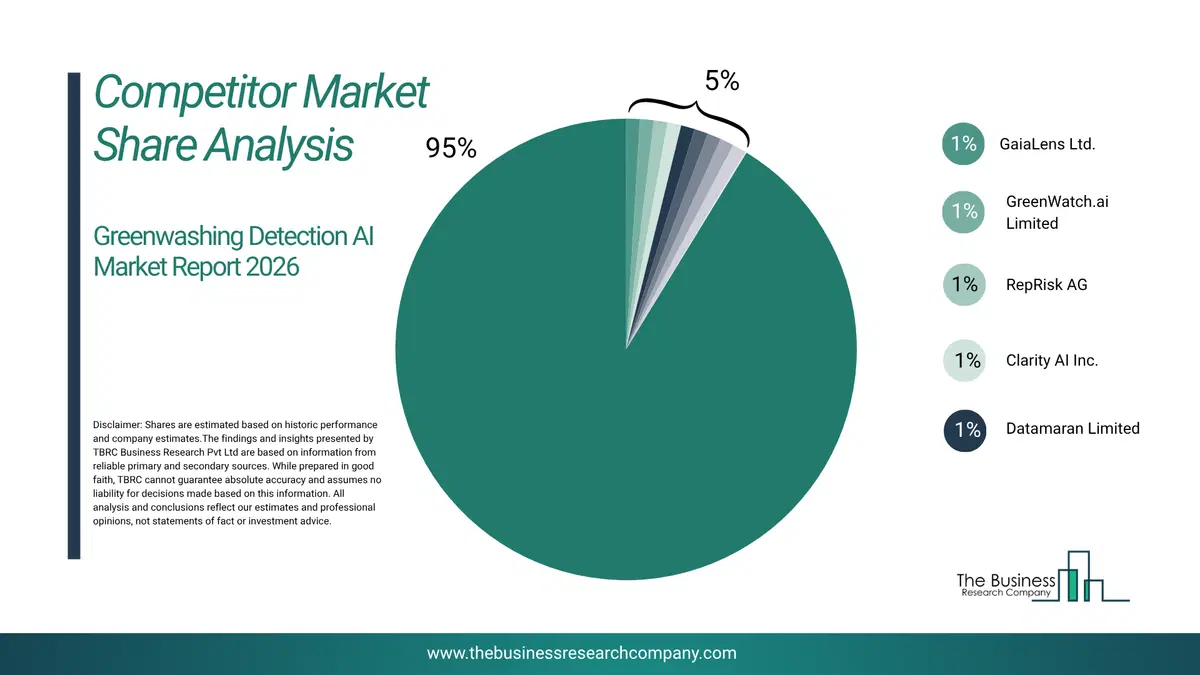
This chart is for illustrative purposes; the full report includes a detailed competitor analysis and comprehensive overview of the top 10 companies in the market.
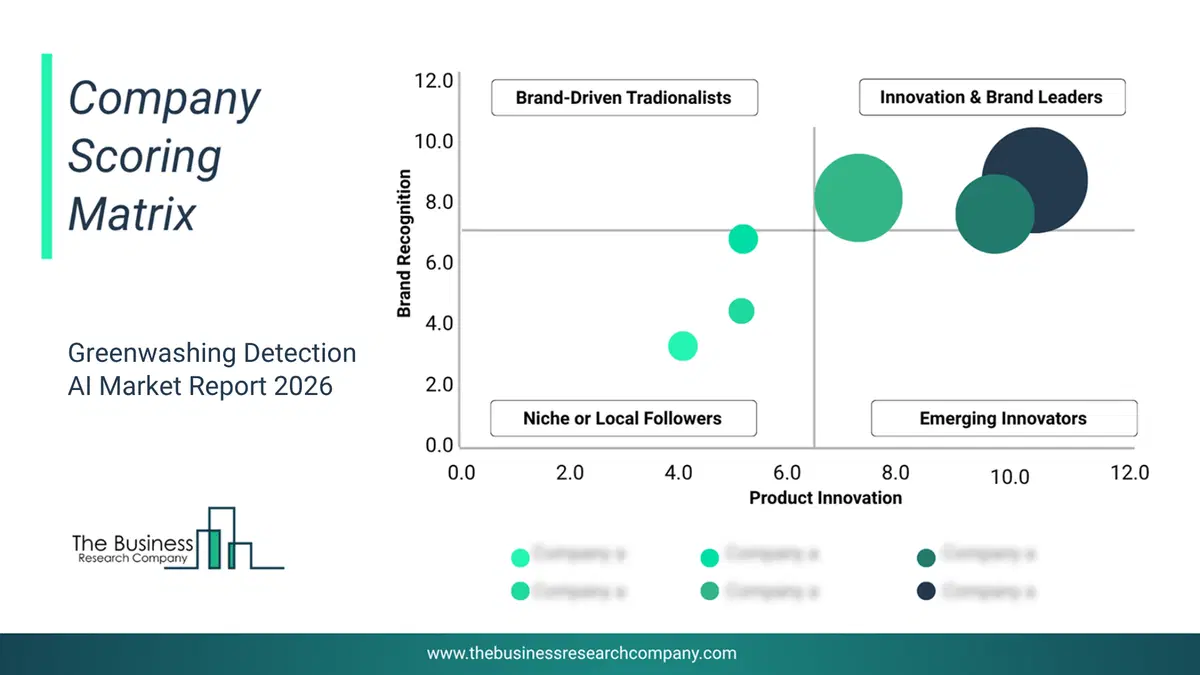
This chart maps companies by product innovation and brand strength, with bubble size indicating relative revenue, helping identify market leaders, challengers, and niche players. This is an illustrative chart; the full report provides a complete and accurate competitive analysis.
Global Greenwashing Detection Artificial Intelligence (AI) Market Trends and Insights
Major companies operating in the greenwashing detection artificial intelligence (AI) market are focusing on developing advanced solutions, such as artificial intelligence (AI)-driven sustainability report validation, to enhance transparency, mitigate risks, and ensure regulatory compliance. Artificial intelligence (AI)-driven sustainability report validation refers to a technological feature that leverages artificial intelligence to analyze corporate sustainability reports, evaluate key performance indicators (KPIs), and identify inconsistencies or potential greenwashing risks, helping prioritize reports that need further review. For instance, in November 2024, MSG Global Solutions, a Switzerland-based technology company, launched the msg Greenwashing Detector, an artificial intelligence (AI)-powered solution available on SAP Store. The solution leverages natural language processing and advanced machine learning models to analyze narrative sustainability statements, identify inconsistencies, risk indicators, and overstatements, and generate transparent, audit-ready insights that support regulatory compliance and stakeholder trust. Its native integration with SAP environments and availability on the SAP Store enable seamless deployment within enterprise workflows, while explainable AI outputs provide clear justification for flagged risks, helping organizations proactively mitigate greenwashing exposure and improve the credibility of their sustainability reporting.What Are Latest Mergers And Acquisitions In The Greenwashing Detection Artificial Intelligence (AI) Market?
In March 2025, GaiaLens Ltd., a UK-based greenwashing detection artificial intelligence (AI) company, partnered with Aberdeen Asset Management plc, to advance artificial intelligence-powered greenwashing risk detection for companies and investment funds. Through this partnership, GaiaLens, Aberdeen Asset Management, and HSBC deployed AI-driven analytics to assess ESG performance, corporate sustainability claims, and climate impact data, enabling investors and asset managers to identify and mitigate potential greenwashing risks more effectively. Aberdeen Asset Management plc is a UK-based company that utilizes environmental, social, and governance (ESG) and sustainability data insights in its investment decision-making processes.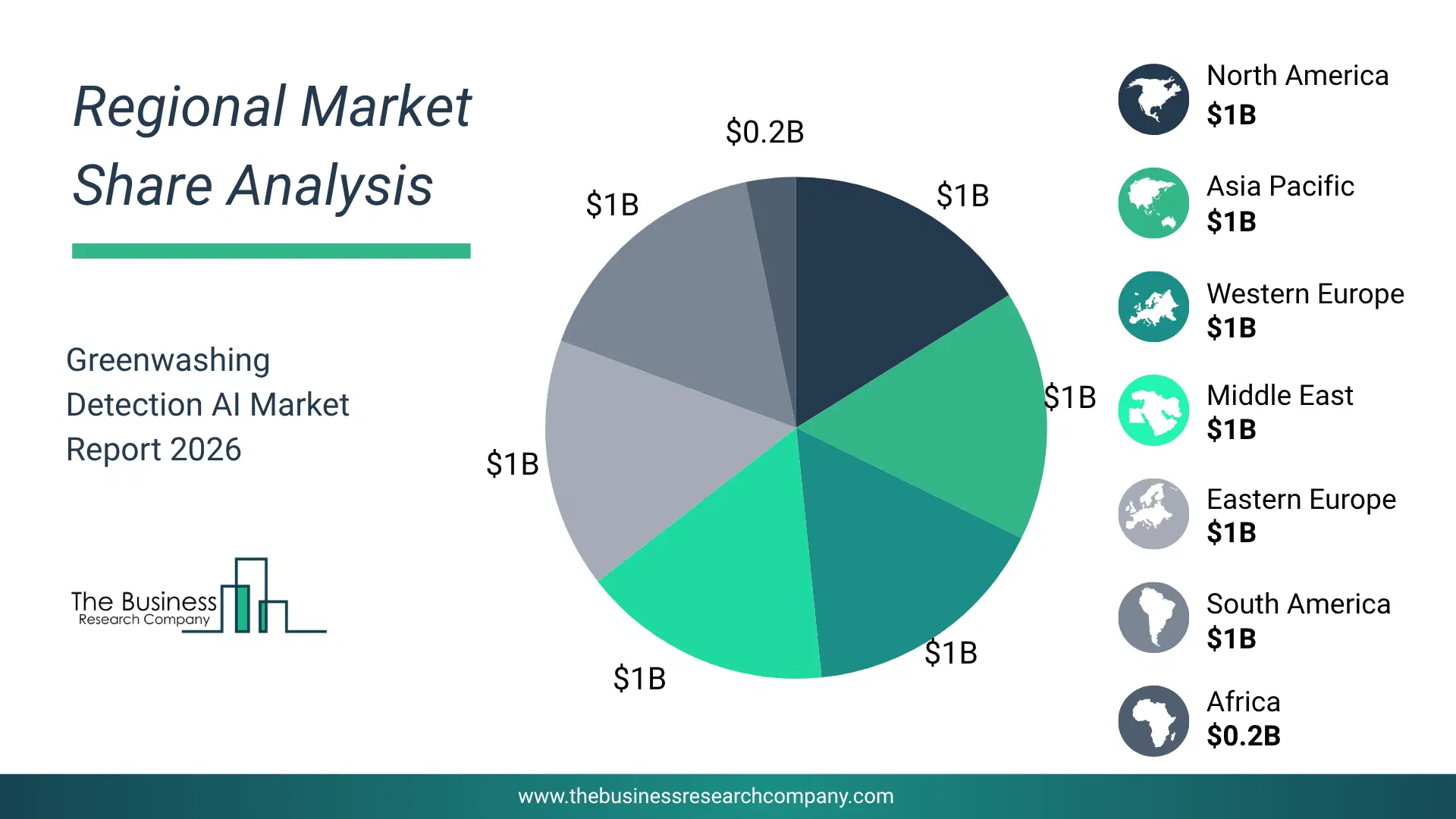
Regional Outlook
North America was the largest region in the greenwashing detection artificial intelligence (AI) market in 2025. Asia-Pacific is expected to be the fastest-growing region in the forecast period. The regions covered in this market report are Asia-Pacific, South East Asia, Western Europe, Eastern Europe, North America, South America, Middle East, Africa. The countries covered in this market report are Australia, Brazil, China, France, Germany, India, Indonesia, Japan, Taiwan, Russia, South Korea, UK, USA, Canada, Italy, Spain.What Defines the Greenwashing Detection Artificial Intelligence (AI) Market?
The greenwashing detection artificial intelligence (AI) market consists of revenues earned by entities by providing services such as sustainability claim analysis, regulatory compliance assessment, environmental risk scoring services, content and disclosure auditing services, reporting and verification services, and brand reputation monitoring services. The market value includes the value of related goods sold by the service provider or included within the service offering. The greenwashing detection artificial intelligence (AI) market includes sales of greenwashing detection software platforms, sustainability analytics tools, disclosure auditing software, environmental risk assessment tools, and compliance monitoring dashboards. Values in this market are ‘factory gate’ values, that is, the value of goods sold by the manufacturers or creators of the goods, whether to other entities (including downstream manufacturers, wholesalers, distributors, and retailers) or directly to end customers. The value of goods in this market includes related services sold by the creators of the goods.How is Market Value Defined and Measured?
The market value is defined as the revenues that enterprises gain from the sale of goods and/or services within the specified market and geography through sales, grants, or donations in terms of the currency (in USD unless otherwise specified). The revenues for a specified geography are consumption values that are revenues generated by organizations in the specified geography within the market, irrespective of where they are produced. It does not include revenues from resales along the supply chain, either further along the supply chain or as part of other products.
This chart presents market attractiveness based on a quantitative evaluation of growth, competition, strategic alignment, and risk, offering a clear view of opportunity areas for decision-making. This chart is for illustrative purposes; the full report contains the complete analysis.

This chart highlights the Total Addressable Market (TAM) by estimating the maximum revenue opportunity using an assumption-driven approach, supporting strategic planning and opportunity sizing across markets. The chart is illustrative; the full report provides a more comprehensive analysis.
What Key Data and Analysis Are Included in the Greenwashing Detection Artificial Intelligence (AI) Market Report 2026?
The greenwashing detection artificial intelligence (ai) market research report is one of a series of new reports from The Business Research Company that provides market statistics, including industry global market size, regional shares, competitors with the market share, detailed market segments, market trends and opportunities, and any further data you may need to thrive in the greenwashing detection artificial intelligence (ai) industry. The market research report delivers a complete perspective of everything you need, with an in-depth analysis of the current and future state of the industry.Greenwashing Detection Artificial Intelligence (AI) Market Report Forecast Analysis
| Report Attribute | Details |
|---|---|
| Market Size Value In 2026 | $1.2 billion |
| Revenue Forecast In 2030 | $3.14 billion |
| Growth Rate | CAGR of 27.2% from 2026 to 2030 |
| Base Year For Estimation | 2025 |
| Actual Estimates/Historical Data | 2020-2025 |
| Forecast Period | 2026 - 2030 |
| Market Representation | Revenue in USD Billion and CAGR from 2026 to 2030 |
| Segments Covered | Component, Deployment Mode, Organization Size, Application, End-User |
| Regional Scope | Asia-Pacific, Western Europe, Eastern Europe, North America, South America, Middle East, Africa |
| Country Scope | The countries covered in the report are Australia, Brazil, China, France, Germany, India, ... |
| Key Companies Profiled | EcoVadis SAS, Sphera Solutions Inc., Refinitiv Limited, TrueValue Labs Inc., Persefoni AI Inc., Greenly SAS, Sweep SAS, Datamaran Limited, RepRisk AG, Emitwise Ltd., Clarity AI Inc., Diligent Corporation, GreenWatch.ai Limited, ESG Book Limited, Sustain.Life Inc., Diginex Ltd., Sustainalytics, GaiaLens Ltd., ImpactScope Ltd., ecoOops GmbH |
| Customization Scope | Request for Customization |
| Pricing And Purchase Options | Explore Purchase Options |