
Ground Station Site Diversity Orchestration Market Report 2026
Global Outlook – By Component (Hardware, Software, Services), By Deployment Mode (On-Premises, Cloud-Based), By Organization Size (Large Enterprises And Government Agencies, Small And Medium Enterprises (SMEs)), By Application (Telecommunications, Earth Observation, Defense And Intelligence, Scientific Research, Other Applications), By End-User (Commercial, Government, Military, Other End-Users) – Market Size, Trends, Strategies, and Forecast to 2035
Ground Station Site Diversity Orchestration Market Overview
• Ground Station Site Diversity Orchestration market size has reached to $1.4 billion in 2025 • Expected to grow to $2.5 billion in 2030 at a compound annual growth rate (CAGR) of 12.3% • Growth Driver: Rising Demand For Uninterrupted Satellite Connectivity Is Fueling The Growth Of The Market Due To The Need For Seamless Ground Station Switching And Continuous Service Availability • Market Trend: Adaptive Space-to-Ground Network Management Enhancing Ground Station Site Diversity Orchestration • North America was the largest region in 2025 and Asia-Pacific is the fastest growing region.What Is Covered Under Ground Station Site Diversity Orchestration Market?
Ground station site diversity orchestration refers to the coordinated management of multiple satellite ground stations to optimize communication, data reception, and mission continuity. Its primary purpose is to ensure reliable and uninterrupted satellite connectivity by dynamically routing signals across geographically dispersed ground stations. It enables efficient scheduling, resource allocation, and redundancy, minimizing data loss and downtime. The main components of ground station site diversity orchestration include hardware, software, and services. Hardware refers to the physical infrastructure used to enable and support site diversity across multiple ground stations, including antennas, Radio frequency equipment, networking systems, and control hardware that ensure reliable and continuous satellite communication. These solutions can be deployed through on-premises or cloud-based modes. The adoption spans organizations of different sizes, including large enterprises and government agencies and small and medium enterprises. The various applications involved include telecommunications, earth observation, defense and intelligence, scientific research, and other applications, with adoption spanning end users such as commercial, government, military, and other end users.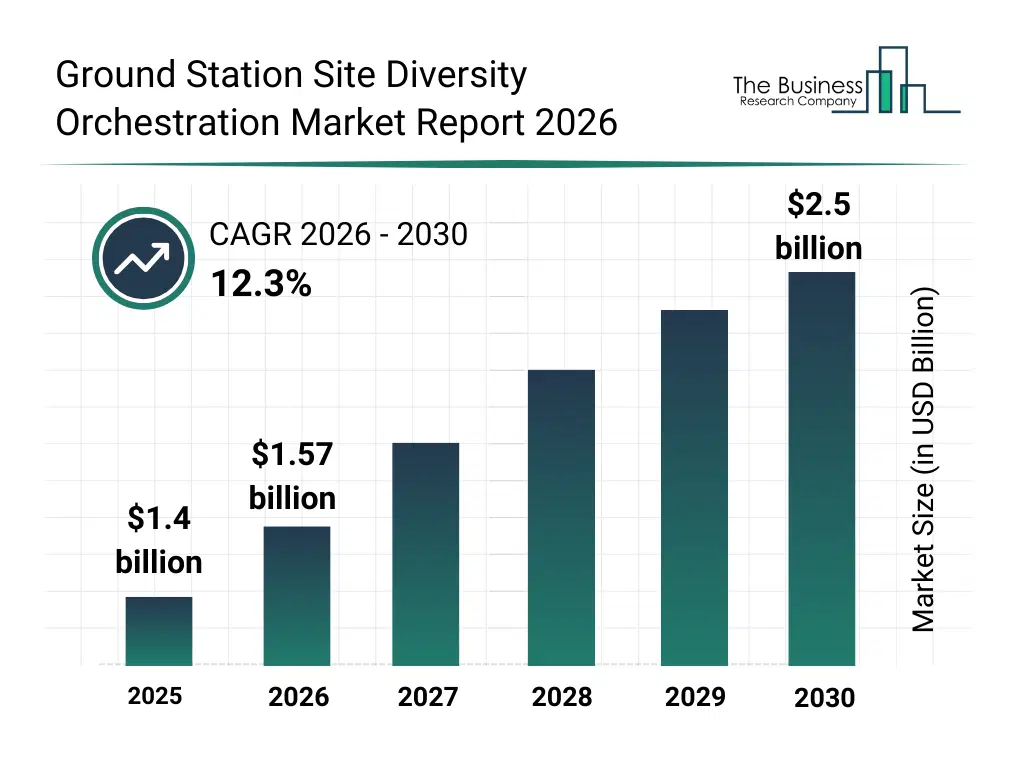
What Is The Ground Station Site Diversity Orchestration Market Size and Share 2026?
The ground station site diversity orchestration market size has grown rapidly in recent years. It will grow from $1.4 billion in 2025 to $1.57 billion in 2026 at a compound annual growth rate (CAGR) of 12.0%. The growth in the historic period can be attributed to increase in satellite launches, growing demand for uninterrupted satellite communication, early adoption of ground station automation, expansion of earth observation missions, rising investment in defense and intelligence satellite networks.What Is The Ground Station Site Diversity Orchestration Market Growth Forecast?
The ground station site diversity orchestration market size is expected to see rapid growth in the next few years. It will grow to $2.5 billion in 2030 at a compound annual growth rate (CAGR) of 12.3%. The growth in the forecast period can be attributed to deployment of mega-constellations, integration of ai-driven network orchestration, expansion of commercial satellite services, adoption of cloud-based ground station management, increasing reliance on multi-mission ground stations. Major trends in the forecast period include real-time ground station switching, automated resource allocation, continuous link monitoring, performance optimization dashboards, redundancy and failover management.
Global Ground Station Site Diversity Orchestration Market Segmentation
1) By Component: Hardware, Software, Services 2) By Deployment Mode: On-Premises, Cloud-Based 3) By Organization Size: Large Enterprises And Government Agencies, Small And Medium Enterprises (SMEs) 4) By Application: Telecommunications, Earth Observation, Defense And Intelligence, Scientific Research, Other Applications 5) By End-User: Commercial, Government, Military, Other End-Users Subsegments: 1) By Hardware: Antenna Systems, Radio Frequency Transceivers, Modems And Signal Processors, Ground Station Servers, Power Supply And Backup Systems, Environmental Monitoring Equipment 2) By Software: Network Orchestration Platforms, Site Diversity Management Software, Link Scheduling And Optimization Tools, Monitoring And Control Software, Data Processing And Analytics Software, Automation And Decision Support Software 3) By Services: System Integration Services, Deployment And Installation Services, Managed Ground Station Services, Maintenance And Support Services, Consulting And Optimization Services, Training And Operational Support ServicesWhat Is The Driver Of The Ground Station Site Diversity Orchestration Market?
The rising demand for uninterrupted satellite connectivity is expected to propel the growth of the ground station site diversity orchestration market going forward. Uninterrupted satellite connectivity refers to the ability of a satellite communication system to maintain continuous, reliable communication between satellites and ground stations (or end users) without any breaks, interruptions, or data loss, regardless of environmental conditions, satellite movement, or network congestion. Uninterrupted satellite connectivity is increasing as millions of users are adopting satellite broadband at a pace that significantly outstrips traditional terrestrial internet growth, driven by the need for connectivity in remote and underserved regions. Ground station site diversity orchestration supports uninterrupted satellite connectivity by enabling seamless transitions between ground stations, minimizing communication disruptions, and maintaining continuous connectivity for satellite internet services. For instance, in November 2025, according to the Office of Communications, a UK-based regulatory body, in the UK, 78% of small and medium-sized enterprises (SMEs) had access to a full-fiber network, representing an increase of 15 percentage points from July 2024, while 84% had access to a gigabit-capable network, up five percentage points over the same period. Therefore, the rising demand for uninterrupted satellite connectivity is driving the growth of the ground station site diversity orchestration industry.Key Players In The Global Ground Station Site Diversity Orchestration Market
Major companies operating in the ground station site diversity orchestration market are Amazon Web Services Inc., Raytheon Technologies Corporation, Lockheed Martin Corporation, L3Harris Technologies Inc., Viasat Inc., Thales Alenia Space, SES S.A., Kratos Defense & Security Solutions Inc., Comtech Telecommunications Corp., Rivada Space Networks Inc., Kongsberg Satellite Services AS, CGI Inc., CONTEC Co. Ltd., Leaf Space S.p.A., Infostellar Inc., Goonhilly Earth Station Ltd., RBC Signals Inc., mBryonics Ltd, Capricorn Space Ltd, RBC Signals Inc.Global Ground Station Site Diversity Orchestration Market Trends and Insights
Major companies operating in the ground station site diversity orchestration market are focusing on developing innovative solutions, such as adaptive space-to-ground network management, to enhance link resilience and ensure uninterrupted satellite communications. Adaptive space-to-ground network management refers to a technological approach that dynamically monitors, controls, and optimizes communication links between satellites and multiple ground stations by automatically selecting the best available sites and routes based on real-time conditions such as weather, signal quality, network congestion, and operational priorities, ensuring resilient and continuous satellite communications. For instance, in November 2025, Viasat Inc., a US-based company that provides communication solutions, introduced the HaloNet capability portfolio to support near-earth and extended space communications. The portfolio supports multi-orbit and multi-mission operations, allowing seamless communication for near-Earth, cislunar, and deep-space applications through a unified, software-defined architecture. It incorporates automated link optimization, resilient redundancy, and scalable ground infrastructure integration, enabling operators to improve availability, reduce latency, and enhance mission reliability while flexibly expanding network capacity as operational demands evolve.What Are Latest Mergers And Acquisitions In The Ground Station Site Diversity Orchestration Market?
In July 2025, York Space Systems LLC, a US‑based aerospace company, acquired ATLAS Space Operations for an undisclosed amount. With this acquisition, York aimed to strengthen its market position by integrating ATLAS’s ground network software capabilities into its satellite mission delivery ecosystem, enhancing end‑to‑end space‑to‑ground communications and accelerating secure, mission‑ready system deployments. ATLAS Space Operations is a US-based company that provides cloud-native ground software as a service for satellite communications through its Freedom platform.Regional Outlook
North America was the largest region in the ground station site diversity orchestration market in 2025. Asia-Pacific is expected to be the fastest-growing region in the forecast period. The regions covered in this market report are Asia-Pacific, South East Asia, Western Europe, Eastern Europe, North America, South America, Middle East, Africa. The countries covered in this market report are Australia, Brazil, China, France, Germany, India, Indonesia, Japan, Taiwan, Russia, South Korea, UK, USA, Canada, Italy, Spain.What Defines the Ground Station Site Diversity Orchestration Market?
The ground station site diversity orchestration market consists of revenues earned by entities by providing services such as real-time ground station switching and failover management, automated scheduling and resource allocation across ground stations, and continuous link monitoring and performance optimization. The market value includes the value of related goods sold by the service provider or included within the service offering. The ground station site diversity orchestration market includes sales of site diversity management tools, network scheduling and coordination systems, monitoring and performance dashboards, integration middleware, communication protocol modules, and application programming interfaces. Values in this market are ‘factory gate’ values, that is, the value of goods sold by the manufacturers or creators of the goods, whether to other entities (including downstream manufacturers, wholesalers, distributors, and retailers) or directly to end customers. The value of goods in this market includes related services sold by the creators of the goods.How is Market Value Defined and Measured?
The market value is defined as the revenues that enterprises gain from the sale of goods and/or services within the specified market and geography through sales, grants, or donations in terms of the currency (in USD unless otherwise specified). The revenues for a specified geography are consumption values that are revenues generated by organizations in the specified geography within the market, irrespective of where they are produced. It does not include revenues from resales along the supply chain, either further along the supply chain or as part of other products.What Key Data and Analysis Are Included in the Ground Station Site Diversity Orchestration Market Report 2026?
The ground station site diversity orchestration market research report is one of a series of new reports from The Business Research Company that provides market statistics, including industry global market size, regional shares, competitors with the market share, detailed market segments, market trends and opportunities, and any further data you may need to thrive in the ground station site diversity orchestration industry. The market research report delivers a complete perspective of everything you need, with an in-depth analysis of the current and future state of the industry.Ground Station Site Diversity Orchestration Market Report Forecast Analysis
| Report Attribute | Details |
|---|---|
| Market Size Value In 2026 | $1.57 billion |
| Revenue Forecast In 2035 | $2.5 billion |
| Growth Rate | CAGR of 12.0% from 2026 to 2035 |
| Base Year For Estimation | 2025 |
| Actual Estimates/Historical Data | 2020-2025 |
| Forecast Period | 2026 - 2030 - 2035 |
| Market Representation | Revenue in USD Billion and CAGR from 2026 to 2035 |
| Segments Covered | Component, Deployment Mode, Organization Size, Application, End-User |
| Regional Scope | Asia-Pacific, Western Europe, Eastern Europe, North America, South America, Middle East, Africa |
| Country Scope | The countries covered in the report are Australia, Brazil, China, France, Germany, India, ... |
| Key Companies Profiled | Amazon Web Services Inc., Raytheon Technologies Corporation, Lockheed Martin Corporation, L3Harris Technologies Inc., Viasat Inc., Thales Alenia Space, SES S.A., Kratos Defense & Security Solutions Inc., Comtech Telecommunications Corp., Rivada Space Networks Inc., Kongsberg Satellite Services AS, CGI Inc., CONTEC Co. Ltd., Leaf Space S.p.A., Infostellar Inc., Goonhilly Earth Station Ltd., RBC Signals Inc., mBryonics Ltd, Capricorn Space Ltd, RBC Signals Inc. |
| Customization Scope | Request for Customization |
| Pricing And Purchase Options | Explore Purchase Options |