

Gut-On-A-Chip Market Report 2026
Global Outlook – By Product Type (Organ On A Chip, Lab On A Chip, Microfluidic Devices, Cell Culture Platforms, Integrated Organ Systems), By Technology (Microfluidics Technology, Three Dimensional Cell Culture Technology, Stem Cell Technology, Biosensor Integration Technology), By Material (Polydimethylsiloxane, Glass, Polymer Based Chips), By Application (Drug Discovery, Personalized Medicine, Toxicity Testing, Microbiome And Gut Microbiota Research, Disease Modeling, Translational Research), By End User (Academic Research, Pharmaceutical Companies, Biotechnology Firms, Contract Research Organizations) – Market Size, Trends, Strategies, and Forecast to 2030
Gut-On-A-Chip Market Report 2026 Market Overview
• Gut-On-A-Chip Market Report 2026 market size has reached to $0.77 billion in 2025 • Expected to grow to $1.38 billion in 2030 at a compound annual growth rate (CAGR) of 12.3% • Growth Driver: Rising Gastrointestinal Disease Cases Fueling The Growth Of The Market Due To Increasing Demand For Advanced Disease Modeling And Drug Development Solutions • Market Trend: Advanced Chip Design Reduces Drug Absorption And Improves Predictive Accuracy In Gut-On-A-Chip Research • North America was the largest region in 2025 and Asia-Pacific is the fastest growing region.What Is Covered Under Gut-On-A-Chip Market?
A gut-on-a-chip is a microfluidic device that replicates the structure and function of the human intestine on a small laboratory chip. It contains living human intestinal cells arranged in tiny channels that mimic the gut environment, including fluid flow and mechanical movements such as peristalsis. This technology helps researchers study digestion, nutrient absorption, gut microbiome interactions, and intestinal diseases under realistic conditions. The main product types of gut-on-a-chip include organ on a chip, lab on a chip, microfluidic devices, cell culture platforms, and integrated organ systems. Organ on a chip refers to a microengineered device designed to simulate the structure and physiological functions of the human gut for research and testing purposes. These products use technologies such as microfluidics technology, three dimensional cell culture technology, stem cell technology, and biosensor integration technology and are made using materials such as polydimethylsiloxane, glass, and polymer based chips. They are used across applications such as drug discovery, personalized medicine, toxicity testing, microbiome and gut microbiota research, disease modeling, and translational research, and they are used by several end users such as academic research, pharmaceutical companies, biotechnology firms, and contract research organizations.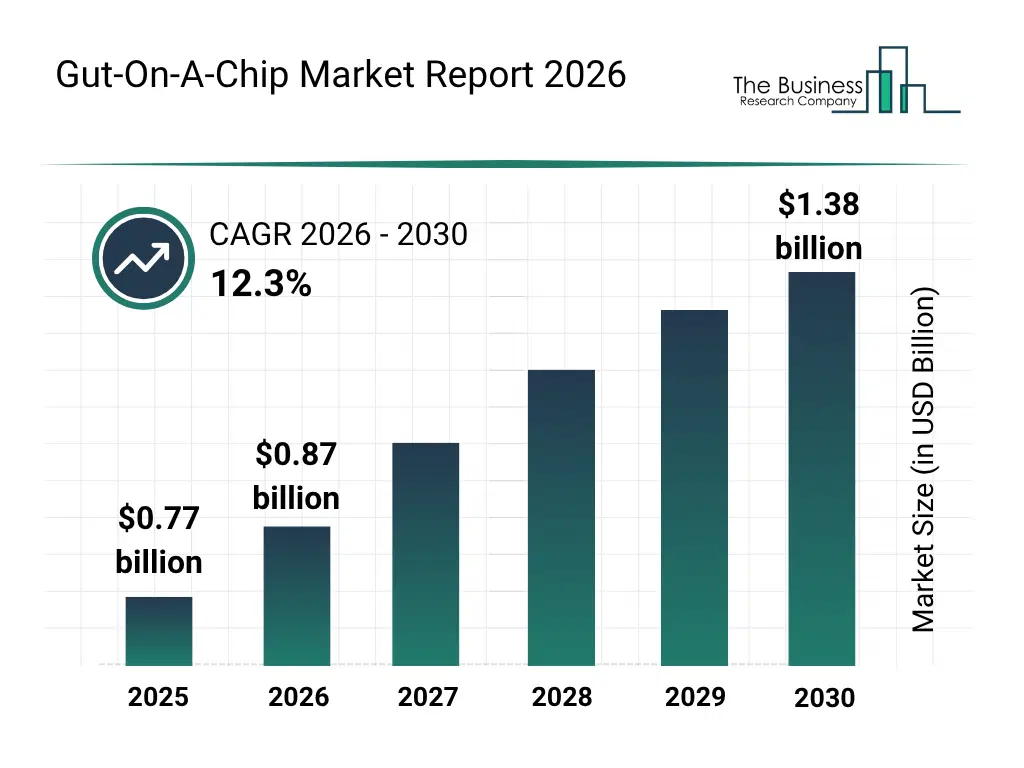
What Is The Gut-On-A-Chip Market Size and Share 2026?
The gut-on-a-chip market size has grown rapidly in recent years. It will grow from $0.77 billion in 2025 to $0.87 billion in 2026 at a compound annual growth rate (CAGR) of 12.7%. The growth in the historic period can be attributed to advancement in microfluidic engineering technologies, increasing research in human cell culture systems, growing demand for alternative animal testing methods, early adoption of organ-on-chip prototypes in academia, rising investment in biotechnology research infrastructure.What Is The Gut-On-A-Chip Market Growth Forecast?
The gut-on-a-chip market size is expected to see rapid growth in the next few years. It will grow to $1.38 billion in 2030 at a compound annual growth rate (CAGR) of 12.3%. The growth in the forecast period can be attributed to expansion of personalized medicine and precision drug testing, increasing pharmaceutical reliance on in-vitro modeling systems, growth in microbiome research and gut health studies, development of multi-organ integrated chip platforms, rising regulatory support for alternative testing technologies. Major trends in the forecast period include microfluidic gut simulation platforms enabling real-time intestinal physiology analysis, organ-on-chip integration for personalized drug response testing, microbiome interaction modeling using advanced gut-on-chip systems, high-throughput toxicity screening using microengineered intestinal models, stem cell based intestinal tissue replication for disease modeling and regenerative research.

Global Gut-On-A-Chip Market Segmentation
1) By Product Type: Organ On A Chip, Lab On A Chip, Microfluidic Devices, Cell Culture Platforms, Integrated Organ Systems 2) By Technology: Microfluidics Technology, Three Dimensional Cell Culture Technology, Stem Cell Technology, Biosensor Integration Technology 3) By Material: Polydimethylsiloxane, Glass, Polymer Based Chips 4) By Application: Drug Discovery, Personalized Medicine, Toxicity Testing, Microbiome And Gut Microbiota Research, Disease Modeling, Translational Research 5) By End User: Academic Research, Pharmaceutical Companies, Biotechnology Firms, Contract Research Organizations Subsegments: 1) By Organ On A Chip: Liver On A Chip, Lung On A Chip, Heart On A Chip, Kidney On A Chip, Gut On A Chip, Brain On A Chip, Skin On A Chip 2) By Lab On A Chip: Diagnostic Lab On A Chip, Polymerase Chain Reaction Chips, Deoxyribonucleic Acid Analysis Chips, Protein Analysis Chips, Point Of Care Testing Chips 3) By Microfluidic Devices: Microfluidic Chips, Micro Pumps, Micro Valves, Droplet Microfluidics, Continuous Flow Microfluidics 4) By Cell Culture Platforms: Two Dimensional Cell Culture Systems, Three Dimensional Cell Culture Systems, Spheroid Culture Platforms, Scaffold Based Platforms, Bioreactors 5) By Integrated Organ Systems: Multi Organ On A Chip, Human On A Chip, Body On A Chip, Interconnected Tissue Platforms, Hybrid Organ SystemsWhat Is The Driver Of The Gut-On-A-Chip Market?
The rising gastrointestinal disease cases are expected to propel the growth of the gut-on-a-chip market going forward. Gastrointestinal diseases refer to disorders affecting the digestive tract, including the stomach, intestines, colon, and rectum, which can lead to chronic inflammation, digestive dysfunction, and severe intestinal complications. The gastrointestinal disease cases are increasing due to unhealthy dietary patterns and growing consumption of processed food products that negatively affect digestive health. Gut-on-a-chip is used in gastrointestinal disease research to simulate human intestinal functions and disease conditions for studying disease mechanisms, drug responses, and therapeutic development. For instance, in January 2024, according to the American Cancer Society, a US-based nonprofit cancer organization, colorectal cancer (CRC) is the second leading cause of cancer-related deaths in the United States, with approximately 53,010 projected deaths in 2024, slightly higher than the estimated 52,550 deaths reported in the previous year. Therefore, the rising gastrointestinal disease cases are driving the growth of the gut-on-a-chip industry.Key Players In The Global Gut-On-A-Chip Market
Major companies operating in the gut-on-a-chip market report are Nederlandse Organisatie voor Toegepast-Natuurwetenschappelijk Onderzoek (TNO), Micronit Microtechnologies B.V., Emulate Inc., CN Bio Innovations Limited, ibidi GmbH, BiomimX S.r.l., TissUse GmbH, MIMETAS B.V., Fluigent S.A., AIM Biotech Pte. Ltd., 4Dcell SAS, Hesperos Inc., Bi/ond Solutions B.V., SynVivo Inc., NETRI SAS, BEOnChip S.L., Dynamic42 GmbH, React4Life S.r.l., Kirkstall Ltd., AlveoliX AG, Nortis Inc., AxoSim Inc., InSphero AG, Altis Biosystems Inc., Organovo Holdings Inc.
This chart is for illustrative purposes; the full report includes a detailed competitor analysis and comprehensive overview of the top 10 companies in the market.
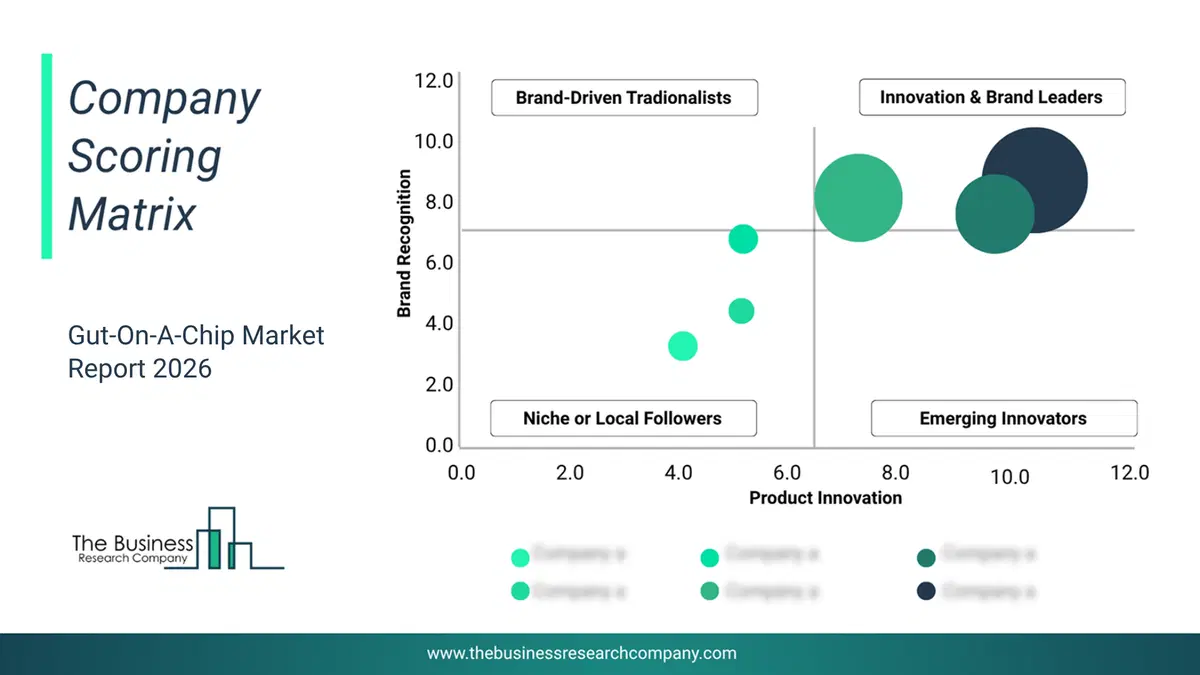
This chart maps companies by product innovation and brand strength, with bubble size indicating relative revenue, helping identify market leaders, challengers, and niche players. This is an illustrative chart; the full report provides a complete and accurate competitive analysis.
Global Gut-On-A-Chip Market Trends and Insights
Major companies operating in the gut-on-a-chip market are focusing on developing advanced solutions, such as low-drug-absorbing rigid microfluidic chips, to improve predictive accuracy in absorption, distribution, metabolism, excretion, and toxicity studies. Low-drug-absorbing rigid microfluidic chips refer to advanced organ-on-chip devices manufactured using specialized plastic materials that minimize compound loss during experiments while maintaining controlled fluid flow and physiologically relevant cellular environments. For instance, in September 2024, Emulate Inc., a US-based biotechnology company specializing in organ-on-a-chip platforms, human tissue models, and microfluidic research technologies, launched the Chip-R1 Rigid Chip for advanced organ-on-chip applications. The platform features low-drug-absorbing plastic construction, improved vascular channel design for physiologically relevant shear stress, and enhanced compatibility for absorption, distribution, metabolism, excretion, and toxicity testing applications in human-relevant tissue models.What Are Latest Mergers And Acquisitions In The Gut-On-A-Chip Market?
In September 2023, CN Bio Innovations Ltd., a UK-based provider of organ-on-a-chip systems, partnered with LifeNet Health LifeSciences to supply validated primary human cells. Through this partnership, CN Bio aimed to strengthen its organ-on-a-chip research capabilities by integrating validated human cells into its PhysioMimix organ-on-a-chip platforms to improve drug discovery and disease modeling applications. LifeNet Health LifeSciences is a US-based provider of human tissue products, primary cells, and research biospecimens for biomedical research applications.
Regional Outlook
North America was the largest region in the gut-on-a-chip market in 2025. Asia-Pacific is expected to be the fastest-growing region in the forecast period. The regions covered in this market report are Asia-Pacific, South East Asia, Western Europe, Eastern Europe, North America, South America, Middle East, Africa. The countries covered in this market report are Australia, Brazil, China, France, Germany, India, Indonesia, Japan, Taiwan, Russia, South Korea, UK, USA, Canada, Italy, Spain.What Defines the Gut-On-A-Chip Market?
The gut-on-a-chip market consists of sales of perfusion systems, biosensors, and integrated organ-on-chip devices. values in this market are ‘factory gate’ values, that is the value of goods sold by the manufacturers or creators of the goods, whether to other entities (including downstream manufacturers, wholesalers, distributors, and retailers) or directly to end customers. The value of goods in this market includes related services sold by the creators of the goods.How is Market Value Defined and Measured?
The market value is defined as the revenues that enterprises gain from the sale of goods and/or services within the specified market and geography through sales, grants, or donations in terms of the currency (in USD unless otherwise specified). The revenues for a specified geography are consumption values that are revenues generated by organizations in the specified geography within the market, irrespective of where they are produced. It does not include revenues from resales along the supply chain, either further along the supply chain or as part of other products.
This chart presents market attractiveness based on a quantitative evaluation of growth, competition, strategic alignment, and risk, offering a clear view of opportunity areas for decision-making. This chart is for illustrative purposes; the full report contains the complete analysis.

This chart highlights the Total Addressable Market (TAM) by estimating the maximum revenue opportunity using an assumption-driven approach, supporting strategic planning and opportunity sizing across markets. The chart is illustrative; the full report provides a more comprehensive analysis.
What Key Data and Analysis Are Included in the Gut-On-A-Chip Market Report 2026?
The gut-on-a-chip market research report is one of a series of new reports from The Business Research Company that provides market statistics, including industry global market size, regional shares, competitors with the market share, detailed market segments, market trends and opportunities, and any further data you may need to thrive in the gut-on-a-chip industry. The market research report delivers a complete perspective of everything you need, with an in-depth analysis of the current and future state of the industry.Gut-On-A-Chip Market Report Forecast Analysis
| Report Attribute | Details |
|---|---|
| Market Size Value In 2026 | $0.87 billion |
| Revenue Forecast In 2030 | $1.38 billion |
| Growth Rate | CAGR of 12.3% from 2026 to 2030 |
| Base Year For Estimation | 2025 |
| Actual Estimates/Historical Data | 2020-2025 |
| Forecast Period | 2026 - 2030 |
| Market Representation | Revenue in USD Billion and CAGR from 2026 to 2030 |
| Segments Covered | Product Type, Technology, Material, Application, End User |
| Regional Scope | Asia-Pacific, Western Europe, Eastern Europe, North America, South America, Middle East, Africa |
| Country Scope | The countries covered in the report are Australia, Brazil, China, France, Germany, India, Indonesia, Japan, Taiwan, Russia, South Korea, UK, USA, Canada, Italy, Spain. |
| Key Companies Profiled | Nederlandse Organisatie voor Toegepast-Natuurwetenschappelijk Onderzoek (TNO), Micronit Microtechnologies B.V., Emulate Inc., CN Bio Innovations Limited, ibidi GmbH, BiomimX S.r.l., TissUse GmbH, MIMETAS B.V., Fluigent S.A., AIM Biotech Pte. Ltd., 4Dcell SAS, Hesperos Inc., Bi/ond Solutions B.V., SynVivo Inc., NETRI SAS, BEOnChip S.L., Dynamic42 GmbH, React4Life S.r.l., Kirkstall Ltd., AlveoliX AG, Nortis Inc., AxoSim Inc., InSphero AG, Altis Biosystems Inc., Organovo Holdings Inc. |
| Customization Scope | Request for Customization |
| Pricing And Purchase Options | Explore Purchase Options |