
Handball Market Report 2026
Global Outlook – By Type (Indoor Handball, Beach Handball), By Demographic (Children (5-12 Years), Teens (13-19 Years), Young Adults (20-35 Years), Adults (36-50 Years)), By Revenue Source (Ticket Sales, Sponsorships And Partnerships, Media Rights, Merchandise Sales, Membership And Subscriptions), By Distribution Channel (Online Stores, Specialty Stores), By End-User (Clubs And Associations, Schools And Colleges, Individual Players, Youth And Junior Handball, Professional Players, Amateur Players) – Market Size, Trends, Strategies, and Forecast to 2030
Handball Market Overview
• Handball market size has reached to $1.27 billion in 2025 • Expected to grow to $1.77 billion in 2030 at a compound annual growth rate (CAGR) of 6.7% • Growth Driver: The Increasing Awareness Of Physical Activity Is Driving The Market Due To Health Education Benefits • Market Trend: Smart Sustainable Handballs Redefine Gameplay Precision And Eco-Friendly Sports Innovation • Europe was the largest region in 2025 and Asia-Pacific is the fastest growing region.What Is Covered Under Handball Market?
Handball is a team sport played on an indoor court where two sides pass and dribble a small ball with their hands to throw it into the opponent’s goal, with seven players per team including a goalkeeper. Its purpose is to outscore the opponent while building fitness, coordination, and teamwork through fast, strategic play. The main types of handball are indoor handball, beach handball, and field handball. Indoor handball is a fast-paced team sport played on an indoor court where two teams aim to score goals by passing and throwing a ball into the opposing team's net. The demographics in this sport are children (5-12 years), teens (13-19 years), young adults (20-35 years), adults (36-50 years), and seniors (50+ years), having revenue sources including ticket sales, sponsorships and partnerships, media rights, merchandise sales, and membership and subscriptions, which are distributed through various channels such as online stores, specialty stores, supermarkets or hypermarkets, and others. It is used by several end-users including clubs and associations, schools and colleges, individual players, youth and junior handball, professional players, and amateur players.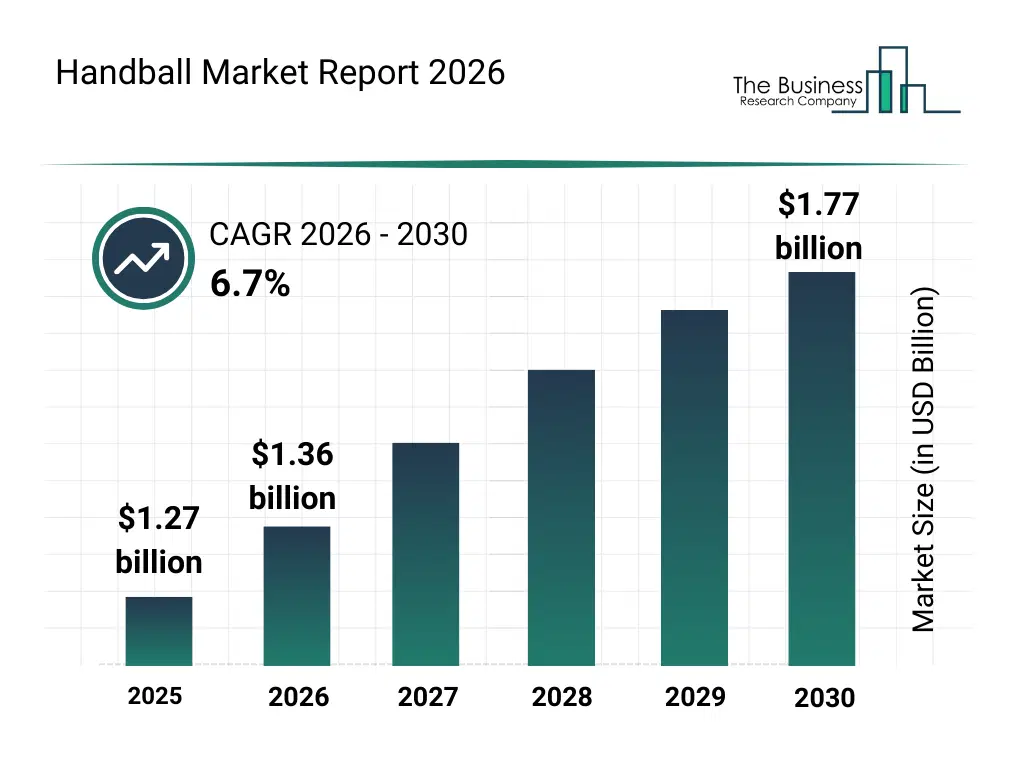
What Is The Handball Market Size and Share 2026?
The handball market size has grown strongly in recent years. It will grow from $1.27 billion in 2025 to $1.36 billion in 2026 at a compound annual growth rate (CAGR) of 7.0%. The growth in the historic period can be attributed to expansion of school and collegiate handball programs, growth of professional handball leagues, rising participation in indoor sports, increased support from sports federations, development of community sports facilities.What Is The Handball Market Growth Forecast?
The handball market size is expected to see strong growth in the next few years. It will grow to $1.77 billion in 2030 at a compound annual growth rate (CAGR) of 6.7%. The growth in the forecast period can be attributed to expansion of digital content distribution, rising investments in grassroots handball development, growing demand for sustainable sports equipment, increased international tournament exposure, expansion of handball in non-traditional regions. Major trends in the forecast period include increasing adoption of digital coaching platforms, rising demand for professional indoor handball equipment, growing popularity of youth handball programs, expansion of media coverage for handball events, enhanced focus on player safety gear.
Global Handball Market Segmentation
1) By Type: Indoor Handball, Beach Handball 2) By Demographic: Children (5-12 Years), Teens (13-19 Years), Young Adults (20-35 Years), Adults (36-50 Years) 3) By Revenue Source: Ticket Sales, Sponsorships And Partnerships, Media Rights, Merchandise Sales, Membership And Subscriptions 4) By Distribution Channel: Online Stores, Specialty Stores 5) By End-User: Clubs And Associations, Schools And Colleges, Individual Players, Youth And Junior Handball, Professional Players, Amateur Players Subsegments: 1) By Indoor Handball: Synthetic Balls, Foldable Goals, Grip Shoes, Knee Pads 2) By Beach Handball: Saltwater Balls, Sand NetsWhat Is The Driver Of The Handball Market?
The increasing awareness of physical activity is expected to drive the growth of the handball market going forward. Physical activity refers to any bodily movement produced by skeletal muscles that requires energy expenditure, encompassing a broad range of activities such as exercise, sports, occupational tasks, and daily functional movements. A key factor driving the increasing awareness of physical activity is the widespread dissemination of health education, as well-informed individuals are more likely to recognize the benefits of regular movement for physical, mental, and social well-being, thereby fostering a cultural emphasis on maintaining an active lifestyle. Handball offers an engaging, team-based sport that not only encourages participation across diverse age groups but also exemplifies the social and health benefits of sustained physical activity. For instance, in June 2024, according to the World Health Organization (WHO), a Switzerland-based United Nations agency, global efforts aim to achieve a 10% relative reduction in physical inactivity among adults and adolescents by 2025, increasing to 15% by 2030. Therefore, the increasing awareness of physical activity is driving the growth of the handball industry.Key Players In The Global Handball Market
Major companies operating in the handball market are Kempa Sports, Hummel International, Molten Corporation, Select Sport, Erima GmbH, Joma Sport, Salming Sports AB, Mizuno Corporation, Asics Corporation, Adidas AG, Nike Inc., Puma SE, Jako AG, Errea, Givova, Stanno, Bison Inc., COSCO Sports Equipment, Mikasa Corporation, Macron S.p.A.
This chart is for illustrative purposes; the full report includes a detailed competitor analysis and comprehensive overview of the top 10 companies in the market.
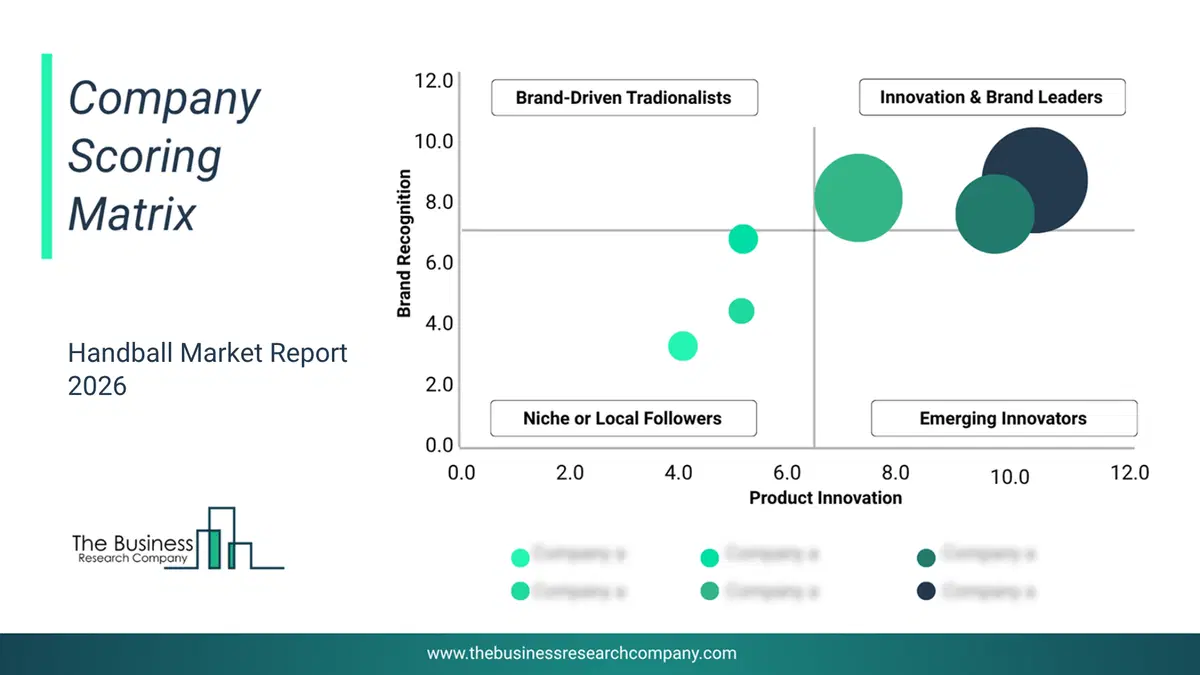
This chart maps companies by product innovation and brand strength, with bubble size indicating relative revenue, helping identify market leaders, challengers, and niche players. This is an illustrative chart; the full report provides a complete and accurate competitive analysis.
Global Handball Market Trends and Insights
Major companies operating in the handball market are focusing on developing innovative solutions, such as smart and sustainable handballs to enhance gameplay precision and promote environmental responsibility. A smart and sustainable handball is an advanced sports ball designed with integrated sensor technology for real-time performance tracking and made using eco-friendly or recycled materials to reduce environmental impact. For instance, in April 2024, Handball-Bundesliga GmbH (HBL), a Germany-based professional handball league organization, launched the Planet HBL. The product features integrated motion-sensing technology that captures live data such as ball speed and trajectory, allowing enhanced analytics and spectator engagement. Additionally, it incorporates recycled polyethylene terephthalate (PET) materials, reflecting the growing emphasis on sustainability and resource efficiency in professional handball equipment.What Are Latest Mergers And Acquisitions In The Handball Market?
In June 2024, EHF Marketing GmbH, an Austria-based sports marketing subsidiary of the European Handball Federation, extended its official match-ball partnership with SELECT Sport A/S to provide official match balls and equipment for Europe’s premier club competitions. With this partnership, EHF Marketing secures unified ball supply and branding for EHF club competitions for four seasons (2024/25–2027/28), enabling consistent equipment standards, event activations, and product innovation across elite tournaments. SELECT Sport A/S is a Denmark-based sports equipment and ball manufacturer.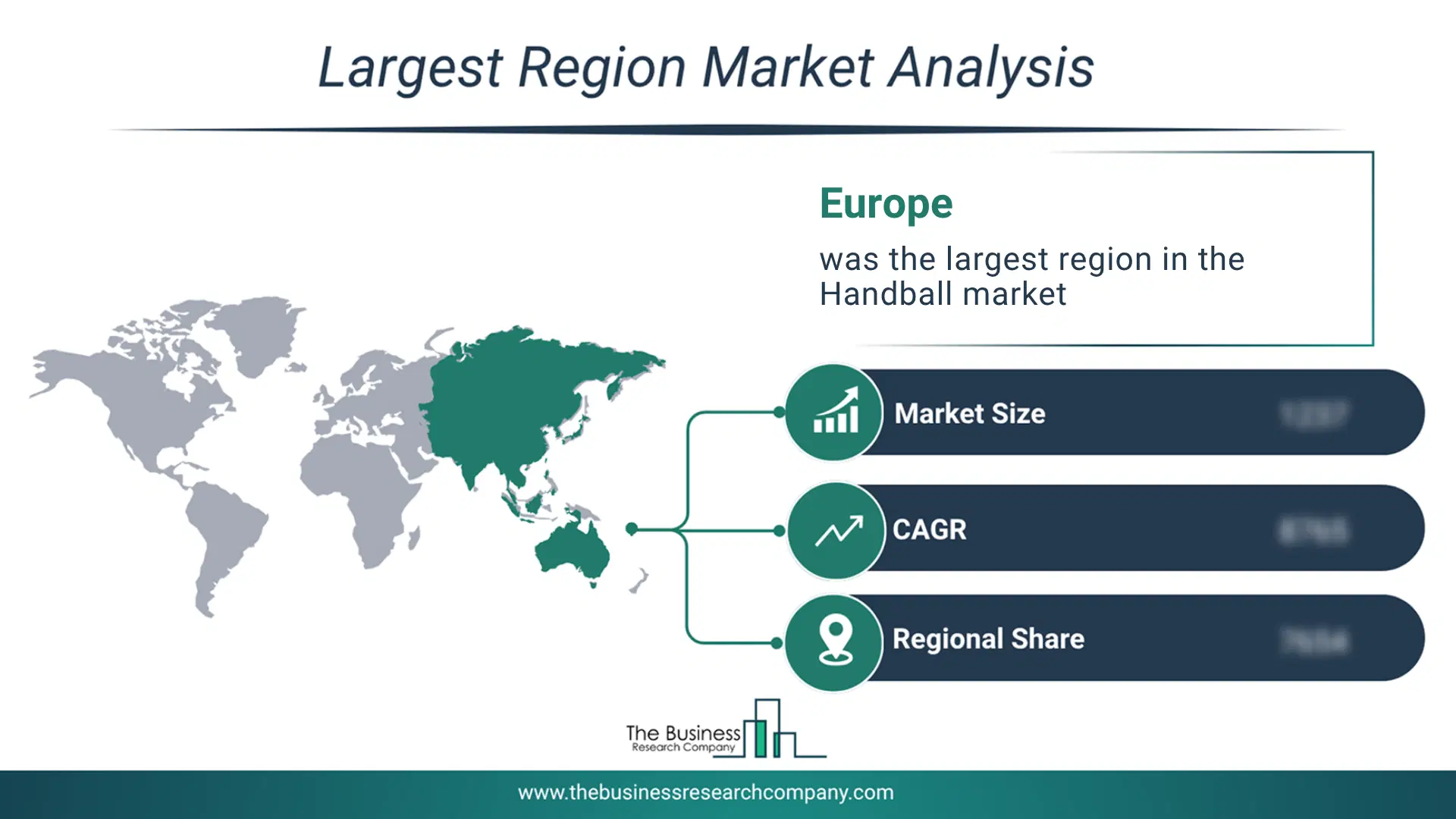
Regional Outlook
Europe was the largest region in the handball market in 2025. Asia-Pacific is expected to be the fastest-growing region in the forecast period. The regions covered in this market report are Asia-Pacific, South East Asia, Western Europe, Eastern Europe, North America, South America, Middle East, Africa The countries covered in this market report are Australia, Brazil, China, France, Germany, India, Indonesia, Japan, Taiwan, Russia, South Korea, UK, USA, Canada, Italy, Spain.What Defines the Handball Market?
The handball market consists of sales of handball training equipment, coaching accessories, goalkeeper gloves, player bags, water bottles, whistles, scoreboards, and court flooring systems. Values in this market are ‘factory gate’ values, that is the value of goods sold by the manufacturers or creators of the goods, whether to other entities (including downstream manufacturers, wholesalers, distributors and retailers) or directly to end customers. The value of goods in this market includes related services sold by the creators of the goods.How is Market Value Defined and Measured?
The market value is defined as the revenues that enterprises gain from the sale of goods and/or services within the specified market and geography through sales, grants, or donations in terms of the currency (in USD unless otherwise specified). The revenues for a specified geography are consumption values that are revenues generated by organizations in the specified geography within the market, irrespective of where they are produced. It does not include revenues from resales along the supply chain, either further along the supply chain or as part of other products.
This chart presents market attractiveness based on a quantitative evaluation of growth, competition, strategic alignment, and risk, offering a clear view of opportunity areas for decision-making. This chart is for illustrative purposes; the full report contains the complete analysis.

This chart highlights the Total Addressable Market (TAM) by estimating the maximum revenue opportunity using an assumption-driven approach, supporting strategic planning and opportunity sizing across markets. The chart is illustrative; the full report provides a more comprehensive analysis.
What Key Data and Analysis Are Included in the Handball Market Report 2026?
The handball market research report is one of a series of new reports from The Business Research Company that provides market statistics, including Market Report 2026?global market size, regional shares, competitors with the market share, detailed market segments, market trends and opportunities, and any further data you may need to thrive in the handball Market Report 2026? The market research report delivers a complete perspective of everything you need, with an in-depth analysis of the current and future state of the Market Report 2026?Handball Market Report Forecast Analysis
| Report Attribute | Details |
|---|---|
| Market Size Value In 2026 | $1.36 billion |
| Revenue Forecast In 2030 | $1.77 billion |
| Growth Rate | CAGR of 7.0% from 2026 to 2030 |
| Base Year For Estimation | 2025 |
| Actual Estimates/Historical Data | 2020-2025 |
| Forecast Period | 2026 - 2030 |
| Market Representation | Revenue in USD Billion and CAGR from 2026 to 2030 |
| Segments Covered | Type, Demographic, Revenue Source, Distribution Channel, End-User |
| Regional Scope | Asia-Pacific, Western Europe, Eastern Europe, North America, South America, Middle East, Africa |
| Country Scope | The countries covered in the report are Australia, Brazil, China, France, Germany, India, Indonesia, Japan, Taiwan, Russia, South Korea, UK, USA, Canada, Italy, Spain. |
| Key Companies Profiled | Kempa Sports, Hummel International, Molten Corporation, Select Sport, Erima GmbH, Joma Sport, Salming Sports AB, Mizuno Corporation, Asics Corporation, Adidas AG, Nike Inc., Puma SE, Jako AG, Errea, Givova, Stanno, Bison Inc., COSCO Sports Equipment, Mikasa Corporation, Macron S.p.A. |
| Customization Scope | Request for Customization |
| Pricing And Purchase Options | Explore Purchase Options |