
Haptic Internet Infrastructure Market Report 2026
Global Outlook – By Component (Hardware, Software, Services), By Technology Type (Tactile Communication, Force Feedback Systems, 5G Or 6G Network Infrastructure, Edge Computing Solutions), By Deployment Mode (On-premise, Cloud-based, Hybrid), By End-User Profile (Enterprise Customers, Technology Integrators And Solution Providers, Gaming Companies And Entertainment Studios, Automotive Manufacturers, Educational Institutions, Government And Defense Agencies, Consumer Electronics Manufacturers, Startups And Innovation Labs) – Market Size, Trends, Strategies, and Forecast to 2030
Haptic Internet Infrastructure Market Overview
• Haptic Internet Infrastructure market size has reached to $1.31 billion in 2025 • Expected to grow to $7.06 billion in 2030 at a compound annual growth rate (CAGR) of 40% • Growth Driver: 5G Network Adoption Fueling The Growth Of The Market Due To Ultra-Low Latency And High-Speed Connectivity • Market Trend: Advanced Haptic Technology Simulates Textures Without Physical Contact • North America was the largest region in 2025 and Asia-Pacific is the fastest growing region.What Is Covered Under Haptic Internet Infrastructure Market?
Haptic internet infrastructure refers to the technological framework that enables real-time transmission of touch-based sensations over digital networks. It integrates ultra-low-latency communication systems, sensors, actuators, and advanced networking protocols to deliver immediate tactile feedback. This infrastructure supports immersive interactions by synchronizing physical touch with virtual or remote environments. The main components in haptic internet infrastructure include hardware, software, and services. Hardware components are widely deployed, as they enable ultra-low-latency sensing, actuation, and real-time data transmission required for bidirectional tactile interactions over networks. Haptic internet infrastructure leverages technologies such as tactile communication, force feedback systems, 5G or 6G network infrastructure, and edge computing solutions and is deployed through on-premise, cloud-based, and hybrid models. These solutions serve a wide range of end-user profiles, including enterprise customers, technology integrators and solution providers, gaming companies and entertainment studios, automotive manufacturers, educational institutions, government and defense agencies, consumer electronics manufacturers, startups, and innovation labs.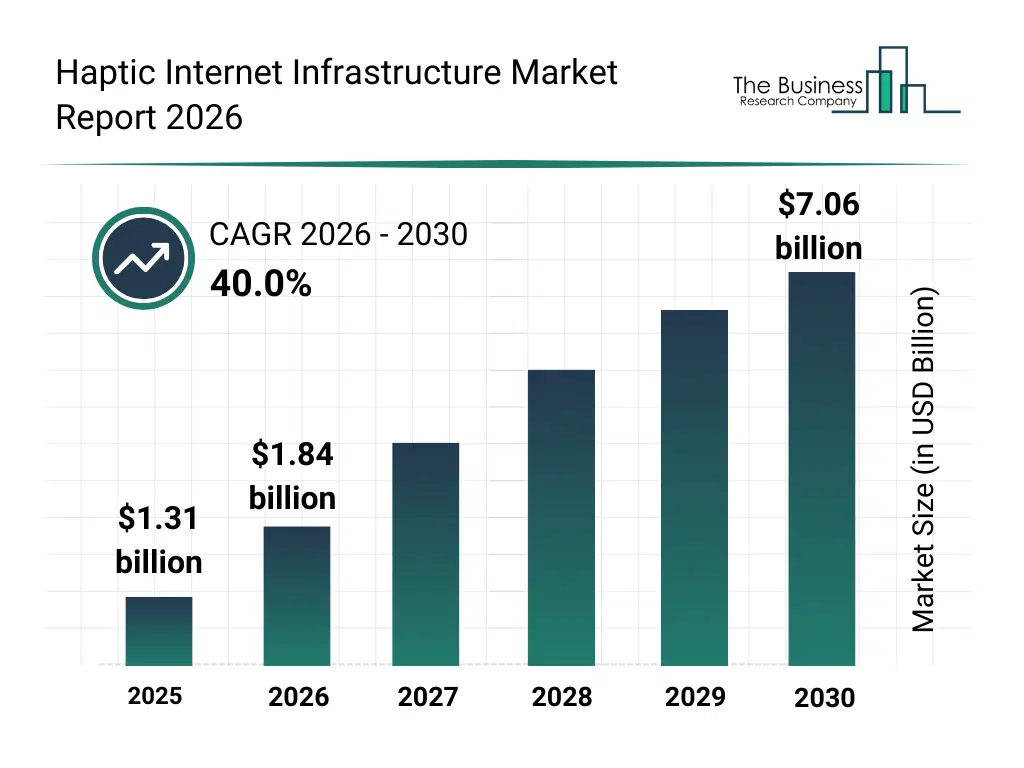
What Is The Haptic Internet Infrastructure Market Size and Share 2026?
The haptic internet infrastructure market size has grown exponentially in recent years. It will grow from $1.31 billion in 2025 to $1.84 billion in 2026 at a compound annual growth rate (CAGR) of 40.3%. The growth in the historic period can be attributed to increasing adoption of early haptic technologies, growing demand for immersive digital interactions, rising use of sensors and actuators in devices, expanding integration of haptics in gaming and VR, and rising investment in advanced communication networks.What Is The Haptic Internet Infrastructure Market Growth Forecast?
The haptic internet infrastructure market size is expected to see exponential growth in the next few years. It will grow to $7.06 billion in 2030 at a compound annual growth rate (CAGR) of 40.0%. The growth in the forecast period can be attributed to increasing deployment of 5G and edge computing, growing demand for real-time tactile communication, rising adoption of haptic systems in healthcare, expanding use of haptic interfaces in automation, and growing investment in ultra-low latency infrastructure. Major trends in the forecast period include technology advancements in tactile communication systems, innovations in high-precision haptic hardware, developments in ultra-low latency network protocols, research and development in immersive XR ecosystems, and innovations in AI-enhanced haptic feedback systems.
Global Haptic Internet Infrastructure Market Segmentation
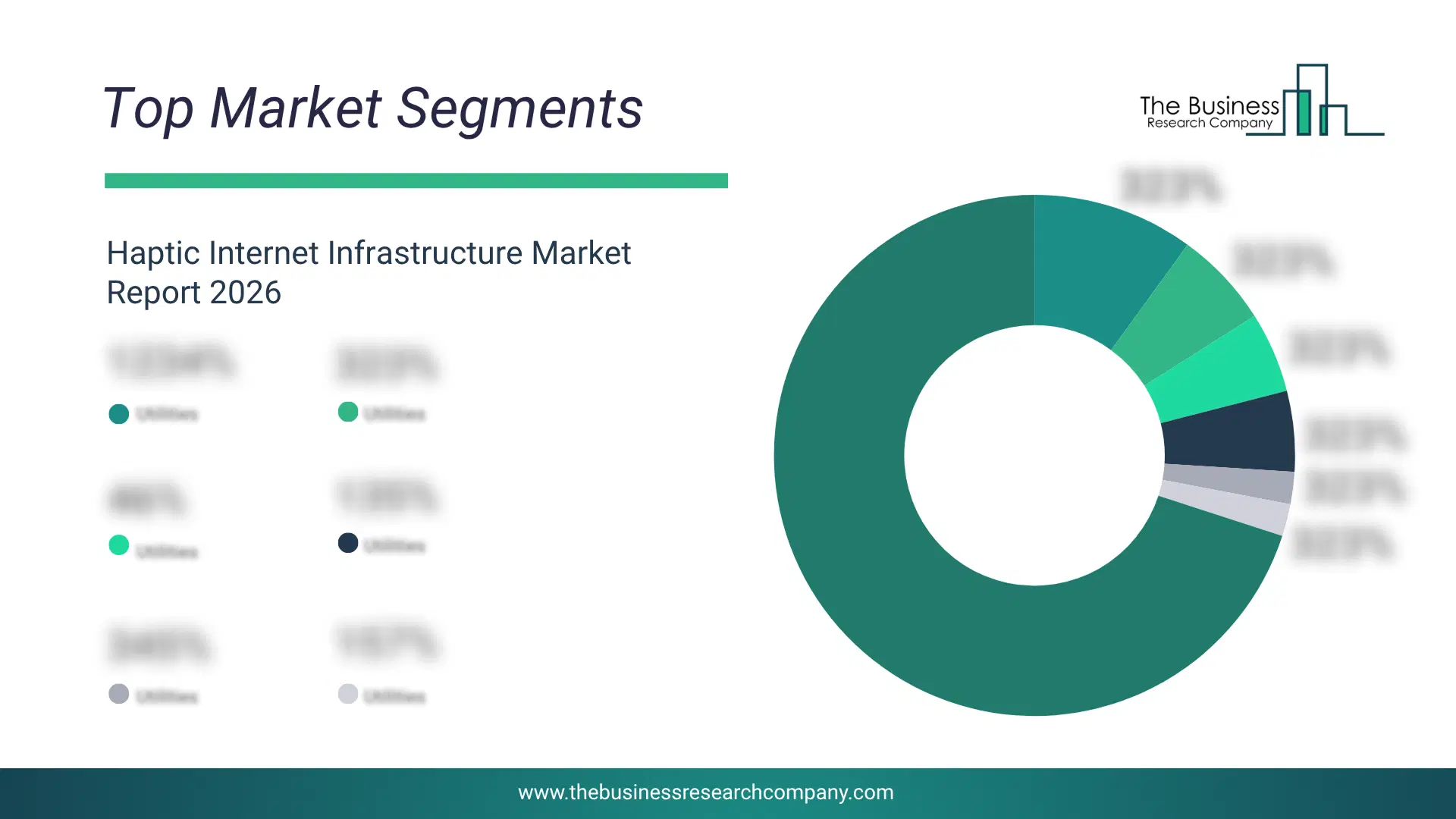
1) By Component: Hardware, Software, Services 2) By Technology Type: Tactile Communication, Force Feedback Systems, 5G Or 6G Network Infrastructure, Edge Computing Solutions 3) By Deployment Mode: On-premise, Cloud-based, Hybrid 4) By End-User Profile: Enterprise Customers, Technology Integrators And Solution Providers, Gaming Companies And Entertainment Studios, Automotive Manufacturers, Educational Institutions, Government And Defense Agencies, Consumer Electronics Manufacturers, Startups And Innovation Labs Subsegments: 1) By Hardware: Haptic Sensors, Haptic Actuators, Haptic Controllers, Communication Chipsets, Edge Computing Devices, Network Infrastructure Equipment 2) By Software: Haptic Feedback Software, Real-Time Control Software, Simulation Software, Tactile Communication Platforms, User Interface Integration Software 3) By Services: Integration Services, Deployment Services, Maintenance Services, Consulting Services, Training And Support ServicesWhat Are The Drivers Of The Haptic Internet Infrastructure Market?
The increasing adoption of 5G networks is expected to propel the growth of the haptic internet infrastructure market going forward. 5G networks are the latest generation of mobile connectivity, delivering high-speed data, ultra-low latency, and improved capacity to support advanced technologies such as immersive gaming and the internet of things. The rise in adoption of 5G networks is due to the increasing demand for high-speed, low-latency connectivity to support real-time digital applications. Adoption of 5G networks enhances haptic internet infrastructure by providing ultra-low latency, high bandwidth, and reliable connectivity. It enables real-time tactile interactions, remote operations, and advanced applications in fields such as industrial automation and telemedicine. For instance, in December 2023, according to the Office of Communications (Ofcom), a UK-based regulator and competition authority, in 2023, the level of outdoor 5G coverage provided by at least one mobile network operator rose to 85-93% in 2023, an increase from 67-78% in 2022. Therefore, the increasing adoption of 5G networks is driving the growth of the haptic internet infrastructure industry. The rising demand for industrial automation is expected to propel the growth of the haptic internet infrastructure market going forward. Industrial automation refers to the use of control systems, machinery, software, and robotics to operate and monitor industrial processes with minimal human intervention. The demand for industrial automation is rising due to the need for increased operational efficiency as businesses aim to reduce costs, minimize errors, and boost productivity. Haptic internet infrastructure enhances industrial automation by enabling real-time tactile feedback, remote control, and precise machine operation. It improves efficiency, safety, and accuracy in industrial processes. For instance, in September 2025, according to the International Federation of Robotics, a Germany-based non-profit organization, there were 4,664,000 robotic units operating in factories globally in 2024, marking a 9% increase from 4,281,585 units in 2023. Therefore, the rising demand for industrial automation is driving the growth of the haptic internet infrastructure industry.Key Players In The Global Haptic Internet Infrastructure Market
Major companies operating in the haptic internet infrastructure market are NVIDIA Corporation, Intel Corporation, Telefonaktiebolaget LM Ericsson, Nokia Corporation, Texas Instruments Incorporated, STMicroelectronics N.V., Nidec Corporation, TDK Corporation, Alps Alpine Co.Ltd., Johnson Electric Holdings Limited, AAC Technologies Holdings Inc., Cirrus Logic Inc., Synaptics Incorporated, Immersion Corporation, SynTouch Inc., Dexta Robotics Inc., HaptX Inc., SenseGlove B.V., Woojer Ltd., Actronika SAS, bHaptics Inc.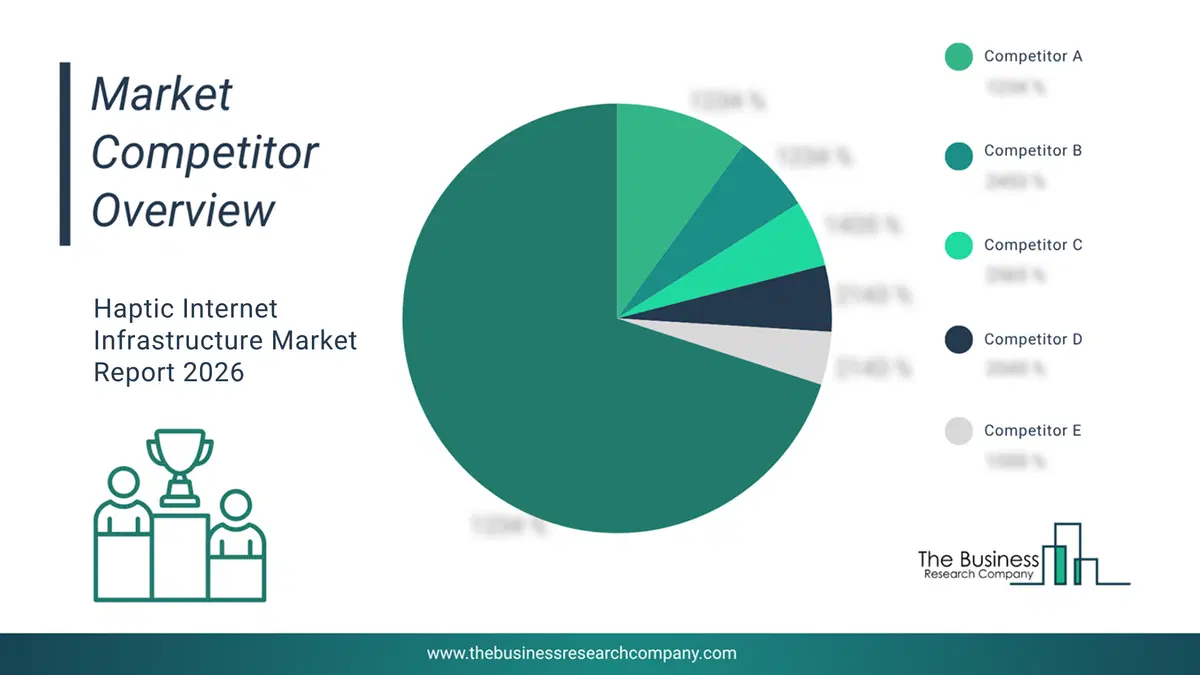
This chart is for illustrative purposes; the full report includes a detailed competitor analysis and comprehensive overview of the top 10 companies in the market.
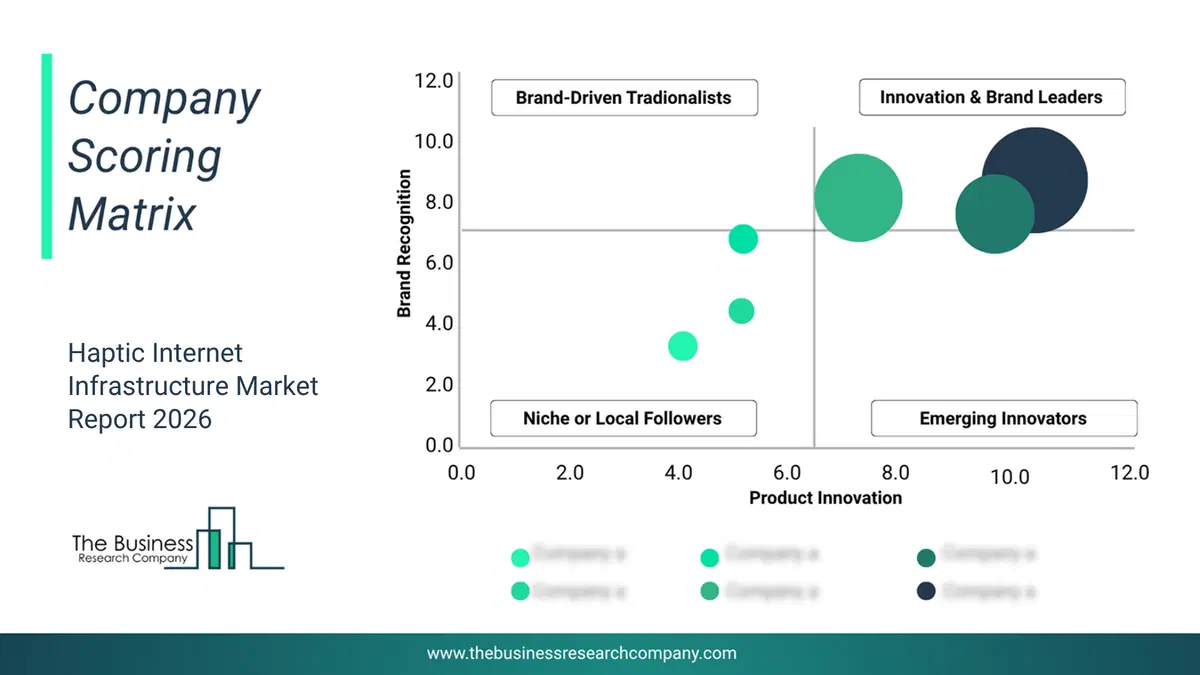
This chart maps companies by product innovation and brand strength, with bubble size indicating relative revenue, helping identify market leaders, challengers, and niche players. This is an illustrative chart; the full report provides a complete and accurate competitive analysis.
Global Haptic Internet Infrastructure Market Trends and Insights
Major companies operating in the haptic internet infrastructure market are focusing on developing advanced technologies, such as ultrasound touch feedback systems, to create immersive experiences, enhance digital communication, and enable new forms of remote interaction. Ultrasound touch feedback systems refer to technologies that use focused ultrasonic waves to create the sensation of touch or tactile feedback in mid-air, without requiring physical contact. For instance, in May 2025, Nippon Telegraph and Telephone Corporation, a Japan‑based telecommunications company, launched a new ultrasound technology. It is an advanced sensory system that recreates the feeling of touch by using different positions and frequencies of ultrasound waves, allowing users to feel varying textures such as smooth and rough surfaces where no physical object exists. This foundational haptic technology may be used in video games, video calls, and online shopping among other applications, contributing to the infrastructure for more interactive and experiential internet services.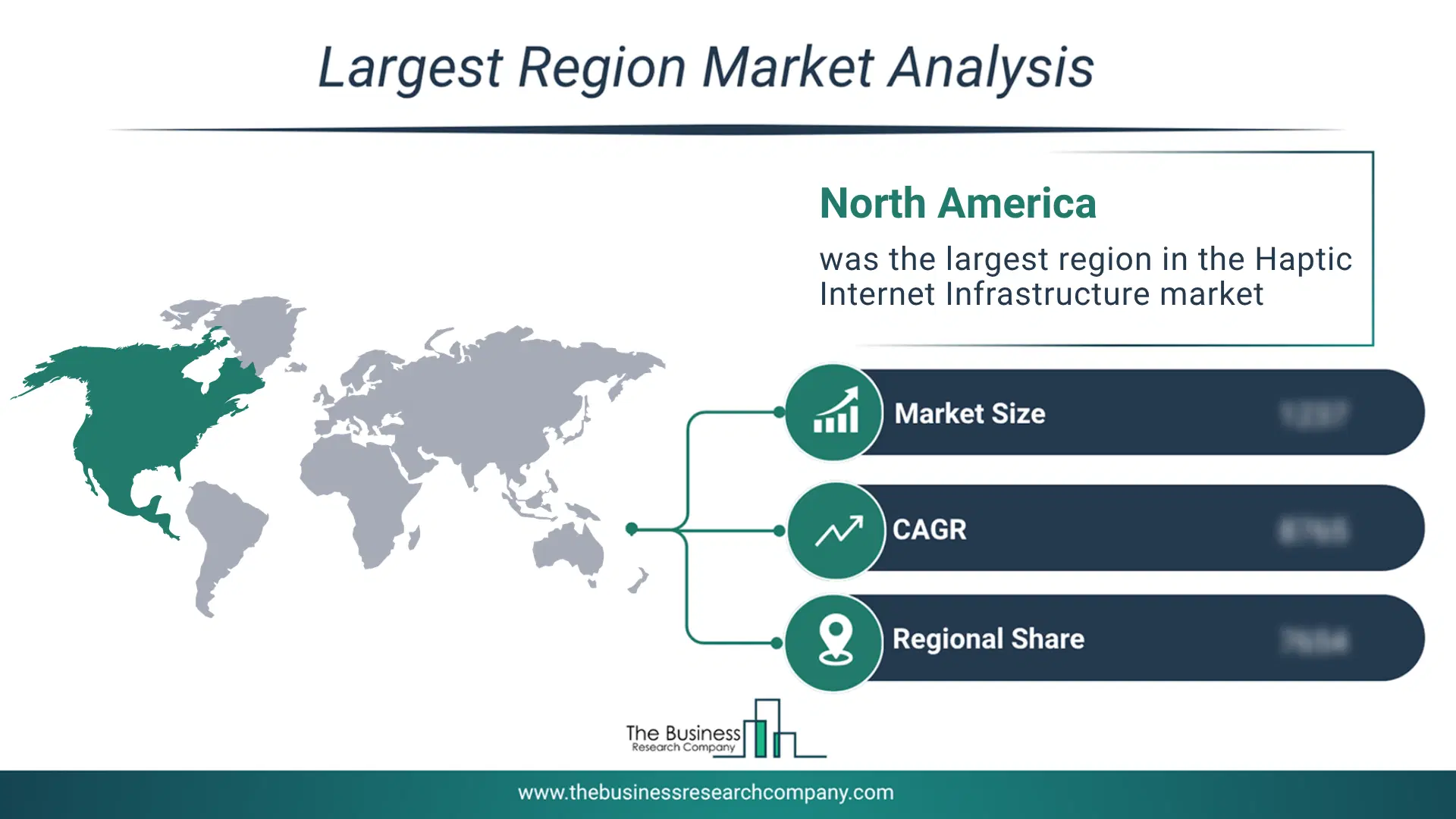
Regional Insights
North America was the largest region in the haptic internet infrastructure market in 2025. Asia-Pacific is expected to be the fastest-growing region in the forecast period. The regions covered in this market report are Asia-Pacific, South East Asia, Western Europe, Eastern Europe, North America, South America, Middle East, Africa. The countries covered in this market report are Australia, Brazil, China, France, Germany, India, Indonesia, Japan, Taiwan, Russia, South Korea, UK, USA, Canada, Italy, Spain.What Defines the Haptic Internet Infrastructure Market?
The haptic internet infrastructure market consists of revenues earned by entities by providing services such as low-latency network provisioning and quality-of-service guarantees for tactile applications, edge compute hosting and content delivery for haptic streams, haptic content orchestration and developer integration services, tactile data analytics and real-time monitoring, and managed deployment and maintenance of haptic application platforms. The market value includes the value of related goods sold by the service provider or included within the service offering. The haptic internet infrastructure market also includes sales of haptic feedback actuators and motors, tactile sensor arrays, edge servers and microdata-center appliances optimized for haptic compute, haptic-enabled wearable devices and controllers, and ultra-low-latency networking equipment and switches. Values in this market are ‘factory gate’ values, that is, the value of goods sold by the manufacturers or creators of the goods, whether to other entities (including downstream manufacturers, wholesalers, distributors, and retailers) or directly to end customers. The value of goods in this market includes related services sold by the creators of the goods.How is Market Value Defined and Measured?
The market value is defined as the revenues that enterprises gain from the sale of goods and/or services within the specified market and geography through sales, grants, or donations in terms of the currency (in USD unless otherwise specified). The revenues for a specified geography are consumption values that are revenues generated by organizations in the specified geography within the market, irrespective of where they are produced. It does not include revenues from resales along the supply chain, either further along the supply chain or as part of other products.
This chart presents market attractiveness based on a quantitative evaluation of growth, competition, strategic alignment, and risk, offering a clear view of opportunity areas for decision-making. This chart is for illustrative purposes; the full report contains the complete analysis.

This chart highlights the Total Addressable Market (TAM) by estimating the maximum revenue opportunity using an assumption-driven approach, supporting strategic planning and opportunity sizing across markets. The chart is illustrative; the full report provides a more comprehensive analysis.
What Key Data and Analysis Are Included in the Haptic Internet Infrastructure Market Report 2026?
The haptic internet infrastructure market research report is one of a series of new reports from The Business Research Company that provides market statistics, including industry global market size, regional shares, competitors with the market share, detailed market segments, market trends and opportunities, and any further data you may need to thrive in the haptic internet infrastructure industry. The market research report delivers a complete perspective of everything you need, with an in-depth analysis of the current and future state of the industry.Haptic Internet Infrastructure Market Report Forecast Analysis
| Report Attribute | Details |
|---|---|
| Market Size Value In 2026 | $1.84 billion |
| Revenue Forecast In 2030 | $7.06 billion |
| Growth Rate | CAGR of 40% from 2026 to 2030 |
| Base Year For Estimation | 2025 |
| Actual Estimates/Historical Data | 2020-2025 |
| Forecast Period | 2026 - 2030 |
| Market Representation | Revenue in USD Billion and CAGR from 2026 to 2030 |
| Segments Covered | Component, Technology Type, Deployment Mode, End-User Profile |
| Regional Scope | Asia-Pacific, Western Europe, Eastern Europe, North America, South America, Middle East, Africa |
| Country Scope | The Countries Covered In This Market Report Are Australia, Brazil, China, France, Germany, India, Indonesia, Japan, Taiwan, Russia, South Korea, Uk, Usa, Canada, Italy, Spain. |
| Key Companies Profiled | NVIDIA Corporation, Intel Corporation, Telefonaktiebolaget LM Ericsson, Nokia Corporation, Texas Instruments Incorporated, STMicroelectronics N.V., Nidec Corporation, TDK Corporation, Alps Alpine Co.Ltd., Johnson Electric Holdings Limited, AAC Technologies Holdings Inc., Cirrus Logic Inc., Synaptics Incorporated, Immersion Corporation, SynTouch Inc., Dexta Robotics Inc., HaptX Inc., SenseGlove B.V., Woojer Ltd., Actronika SAS, bHaptics Inc. |
| Customization Scope | Request for Customization |
| Pricing And Purchase Options | Explore Purchase Options |