
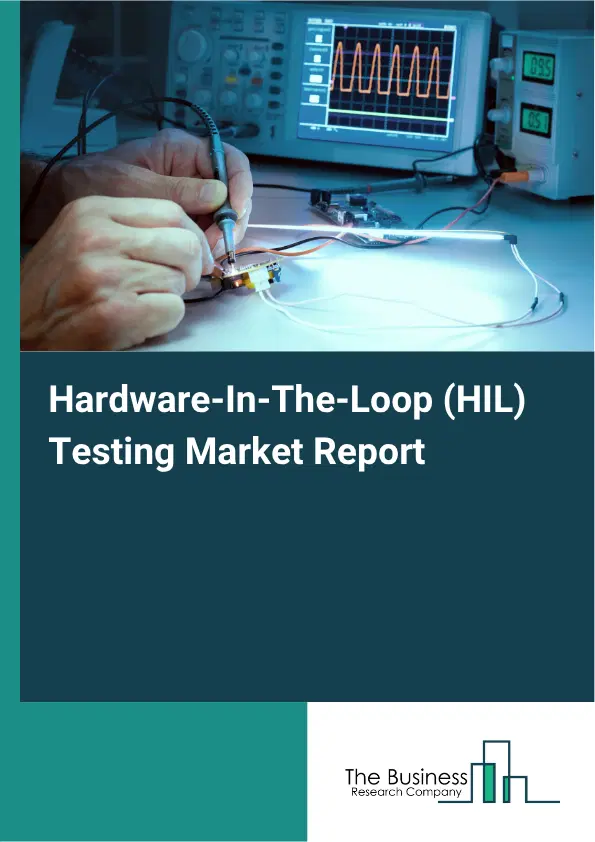
Hardware-In-The-Loop (HIL) Testing Market Report 2026
Global Outlook – By Component (Hardware, Software, Services), By Testing Phase (Design Validation, Integration Testing, Acceptance Testing, Manufacturing Testing, Performance Testing, Other Testing Phases), By Deployment Mode (On-Premises, Cloud-Based, Hybrid Deployment), By Application (Aerospace And Defense, Automotive, Industrial Automation, Consumer Electronics, Energy And Utilities, Healthcare), By End-User (Original Equipment Manufacturers, Research Institutions, Government Agencies, Independent Testing Labs) – Market Size, Trends, Strategies, and Forecast to 2035
Hardware-In-The-Loop (HIL) Testing Market Overview
• Hardware-In-The-Loop (HIL) Testing market size has reached to $1.12 billion in 2025 • Expected to grow to $1.86 billion in 2030 at a compound annual growth rate (CAGR) of 10.9% • Growth Driver: Rising Electric Vehicle Production Fueling The Growth Of The Market Due To Increasing Need For Real-Time Simulation And Validation Of Complex Vehicle Systems • Market Trend: Advancing Virtual Validation With Software-Driven Embedded Testing Solutions For Next-Generation Automotive And Industrial Systems • North America was the largest region in 2025 and Asia-Pacific is the fastest growing region.What Is Covered Under Hardware-In-The-Loop (HIL) Testing Market?
Hardware-in-the-loop (HIL) testing is a real-time simulation technique used to test and validate complex embedded systems by integrating actual hardware components with virtual models of the system environment. It enables engineers to evaluate system performance, control algorithms, and response behavior under simulated real-world operating conditions without requiring full physical prototypes. It enhances testing accuracy, reduces development risk, and accelerates product validation cycles across high-complexity engineering applications. The main components of hardware-in-the-loop (HIL) testing include hardware, software, and services. Hardware refers to physical test benches, real-time simulators, and interface modules used to replicate real-world operating conditions for embedded systems validation. These systems are categorized by testing phase including design validation, integration testing, acceptance testing, manufacturing testing, performance testing, and other testing phases and by deployment mode such as on-premises, cloud-based, and hybrid deployment. The various applications involved are aerospace and defense, automotive, industrial automation, consumer electronics, energy and utilities, and healthcare, and they are utilized by end users including original equipment manufacturers, research institutions, government agencies, and independent testing labs.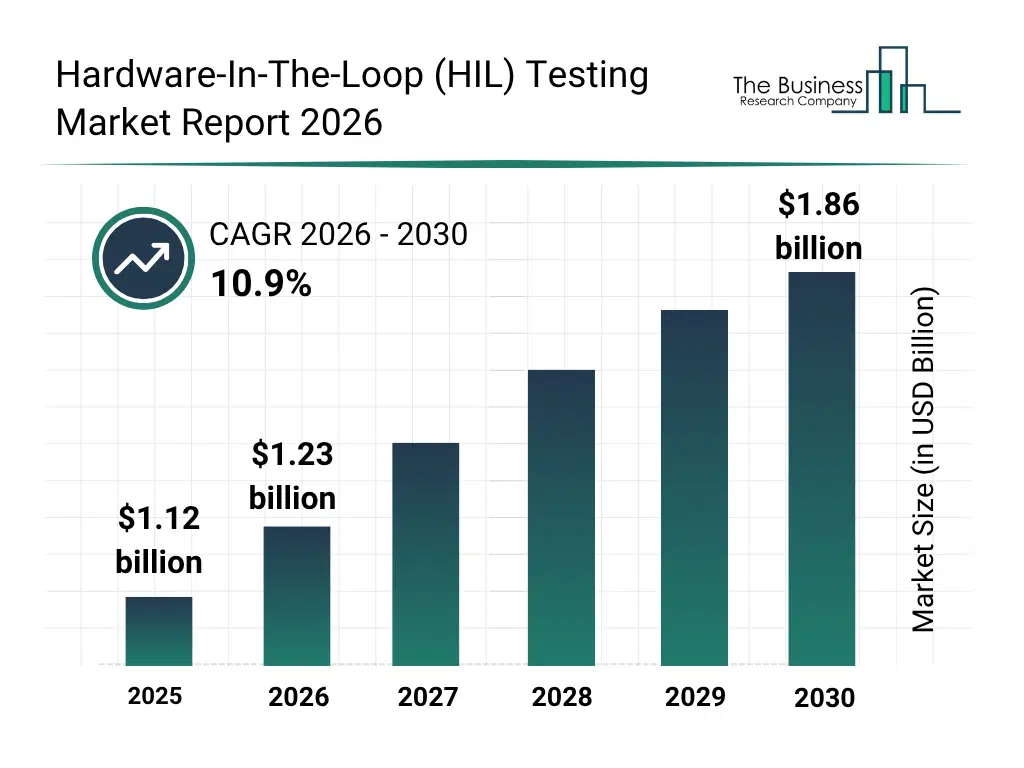
What Is The Hardware-In-The-Loop (HIL) Testing Market Size and Share 2026?
The hardware-in-the-loop (HIL) testing market size has grown rapidly in recent years. It will grow from $1.12 billion in 2025 to $1.23 billion in 2026 at a compound annual growth rate (CAGR) of 10.6%. The growth in the historic period can be attributed to legacy embedded system validation complexity, growth in automotive ecu testing requirements, increasing aerospace control system verification needs, expansion of defense simulation programs, rising adoption of semiconductor-based embedded systems.What Is The Hardware-In-The-Loop (HIL) Testing Market Growth Forecast?
The hardware-in-the-loop (HIL) testing market size is expected to see rapid growth in the next few years. It will grow to $1.86 billion in 2030 at a compound annual growth rate (CAGR) of 10.9%. The growth in the forecast period can be attributed to expansion of digital twin based validation ecosystems, growth in autonomous vehicle testing demand, increasing adoption of AI-driven simulation platforms, rising electrification of mobility systems, increasing shift toward cloud based real time testing environments. Major trends in the forecast period include model-based systems engineering driven validation of embedded control systems, shift-left testing adoption in embedded software development lifecycle, increasing demand for safety-critical system certification and compliance testing, expansion of real-time simulation for power electronics and control system validation, rising integration of hardware-software co-validation in early-stage prototyping.
Global Hardware-In-The-Loop (HIL) Testing Market Segmentation
1) By Component: Hardware, Software, Services 2) By Testing Phase: Design Validation, Integration Testing, Acceptance Testing, Manufacturing Testing, Performance Testing, Other Testing Phases 3) By Deployment Mode: On-Premises, Cloud-Based, Hybrid Deployment 4) By Application: Aerospace And Defense, Automotive, Industrial Automation, Consumer Electronics, Energy And Utilities, Healthcare 5) By End-User: Original Equipment Manufacturers, Research Institutions, Government Agencies, Independent Testing Labs Subsegments: 1) By Hardware: Real Time Simulators, Input Output Interfaces, Signal Conditioning Units, Power Amplifiers, Communication Interfaces, Data Acquisition Systems, Processor Units, Test Benches 2) By Software: Simulation Modeling Software, Real Time Execution Software, Test Automation Software, Data Analysis Software, Visualization Software, Scenario Generation Software, Integration Middleware Software, Debugging And Validation Tools 3) By Services: System Integration Services, Consulting Services, Maintenance And Support Services, Calibration Services, Training And Education Services, Deployment Services, Customization Services, Technical Support ServicesWhat Is The Driver Of The Hardware-In-The-Loop (HIL) Testing Market?
The increasing production of electric vehicles (EVs) is expected to propel the growth of the hardware-in-the-loop (HIL) testing market going forward. Electric vehicle production is rising due to strong global demand for cleaner transportation, supported by government regulations, advancements in battery technology, and increasing investments by automakers in electrification. Hardware-in-the-loop (HIL) testing is used in EV production for real-time simulation and validation of key systems such as battery management systems, power electronics, and control units before deployment, improving reliability, reducing development time, and enhancing safety. As EVs incorporate a higher number of electronic and software-driven components, the need for advanced validation tools such as HIL testing increases. For instance, in January 2025, according to the Cox Automotive, a US-based system software company, electric vehicle (EV) sales in the United States in 2023 were revised upward to 1.21 million units, representing a 49% increase compared to 2022, and continued to grow in 2024, rising by 7.3% to reach 1.30 million units. Therefore, the increasing electric vehicle production is driving the growth of the hardware-in-the-loop (HIL) testing industry.Key Players In The Global Hardware-In-The-Loop (HIL) Testing Market
Major companies operating in the hardware-in-the-loop (hil) testing market are Robert Bosch GmbH, Dassault Systèmes SE, Keysight Technologies Inc., AVL List GmbH, The MathWorks Inc., IPG Automotive GmbH, Acutronic Holding AG, OPAL-RT Technologies Inc., dSPACE SE & Co. KG, AB Dynamics plc, MicroNova AG, Testek Solutions Inc., Applied Intuition Inc., Foretellix Ltd., Speedgoat GmbH, Konrad Technologies GmbH, RTDS Technologies Inc., Vector Informatik GmbH, Plexim GmbH, Typhoon HIL Inc.Global Hardware-In-The-Loop (HIL) Testing Market Trends and Insights
Major companies operating in the hardware-in-the-loop (HIL) testing market are focusing on developing innovative solutions such as, model-based HIL simulation platforms to enable real-time virtual testing and reduce reliance on physical prototypes. Model-based HIL simulation platforms are software-driven testing systems that use virtual models of physical systems to test embedded controllers in real time, helping engineers validate performance early, reduce hardware costs, and speed up development cycles. For instance, in March 2025, Emerson Electric Co., a US–based automation and technology company, launched its Embedded Software HIL Test Suite. The solution is a modular, software-defined testing platform that integrates test, validation, and data analysis tools into a unified environment for real-time simulation of complex embedded systems. It enables reuse of modular components, supports integration with NI hardware for accurate edge-case detection, and allows engineers to customize and scale test systems efficiently. Key features include automated test execution, compatibility with model-based design tools, and advanced analytics for post-test evaluation, making it widely applicable in automotive, aerospace, and industrial automation sectors to reduce development time, improve test coverage, and lower overall validation costs.What Are Latest Mergers And Acquisitions In The Hardware-In-The-Loop (HIL) Testing Market?
In October 2023, Emerson Electric Co., a US-based technology and industrial automation company, acquired National Instruments Corporation for approximately $8.2 billion. With this acquisition, Emerson aimed to strengthen its position as a global automation leader by expanding its test and measurement capabilities, increasing exposure to high-growth discrete markets such as semiconductors and aerospace, and accelerating its transformation toward a more software-driven industrial portfolio. National Instruments Corporation is a US-based technology company that specializes in providing comprehensive hardware-in-the-loop (HIL) testing solutions.Regional Outlook/Insights
North America was the largest region in the hardware-in-the-loop (HIL) testing market in 2025. Asia-Pacific is expected to be the fastest-growing region in the forecast period. The regions covered in this market report are Asia-Pacific, South East Asia, Western Europe, Eastern Europe, North America, South America, Middle East, Africa. The countries covered in this market report are Australia, Brazil, China, France, Germany, India, Indonesia, Japan, Taiwan, Russia, South Korea, UK, USA, Canada, Italy, Spain.What Defines the Hardware-In-The-Loop (HIL) Testing Market?
The hardware-in-the-loop (HIL) testing market consists of revenues earned by entities by providing services such as real-time system simulation, embedded system validation, control system testing, model development, test automation, system integration, and engineering support. The market value includes the value of related goods sold by the service provider or included within the service offering. The hardware-in-the-loop (HIL) testing market also includes sales of HIL simulators, real-time processors, signal conditioning units, interface hardware, test benches, simulation software platforms, and data acquisition systems. Values in this market are ‘factory gate’ values, that is, the value of goods sold by the manufacturers or creators of the goods, whether to other entities (including downstream manufacturers, wholesalers, distributors, and retailers) or directly to end customers. The value of goods in this market includes related services sold by the creators of the goods.How is Market Value Defined and Measured?
The market value is defined as the revenues that enterprises gain from the sale of goods and/or services within the specified market and geography through sales, grants, or donations in terms of the currency (in USD unless otherwise specified). The revenues for a specified geography are consumption values that are revenues generated by organizations in the specified geography within the market, irrespective of where they are produced. It does not include revenues from resales along the supply chain, either further along the supply chain or as part of other products.What Key Data and Analysis Are Included in the Hardware-In-The-Loop (HIL) Testing Market Report 2026?
The hardware-in-the-loop (hil) testing market research report is one of a series of new reports from The Business Research Company that provides market statistics, including industry global market size, regional shares, competitors with the market share, detailed market segments, market trends and opportunities, and any further data you may need to thrive in the hardware-in-the-loop (hil) testing industry. The market research report delivers a complete perspective of everything you need, with an in-depth analysis of the current and future state of the industry.Hardware-In-The-Loop (HIL) Testing Market Report Forecast Analysis
| Report Attribute | Details |
|---|---|
| Market Size Value In 2026 | $1.23 billion |
| Revenue Forecast In 2035 | $1.86 billion |
| Growth Rate | CAGR of 10.9% from 2026 to 2035 |
| Base Year For Estimation | 2025 |
| Actual Estimates/Historical Data | 2020-2025 |
| Forecast Period | 2026 - 2030 - 2035 |
| Market Representation | Revenue in USD Billion and CAGR from 2026 to 2035 |
| Segments Covered | Component, Testing Phase, Deployment Mode, Application, End-User |
| Regional Scope | Asia-Pacific, Western Europe, Eastern Europe, North America, South America, Middle East, Africa |
| Country Scope | The countries covered in the report are Australia, Brazil, China, France, Germany, India, Indonesia, Japan, Taiwan, Russia, South Korea, UK, USA, Canada, Italy, Spain. |
| Key Companies Profiled | Robert Bosch GmbH, Dassault Systèmes SE, Keysight Technologies Inc., AVL List GmbH, The MathWorks Inc., IPG Automotive GmbH, Acutronic Holding AG, OPAL-RT Technologies Inc., dSPACE SE & Co. KG, AB Dynamics plc, MicroNova AG, Testek Solutions Inc., Applied Intuition Inc., Foretellix Ltd., Speedgoat GmbH, Konrad Technologies GmbH, RTDS Technologies Inc., Vector Informatik GmbH, Plexim GmbH, Typhoon HIL Inc. |
| Customization Scope | Request for Customization |
| Pricing And Purchase Options | Explore Purchase Options |