
Hardware Security Modules Market Report 2026
Global Outlook – By Type (LAN Based Or Network Attached, PCI-Based Or Embedded Plugins, USB Based Or Portable, Smart Cards), By Deployment Type (On-Premise, Cloud), By Application (Secure Sockets Layer (SSL), Transport Layer Security, Authentication, Payment Processing, Code And Document Signing, Application-Level Encryption, Database Encryption, Public Key Infrastructure (PKI), Credential Management), By End-User (Banking And Financial Services, Energy And Utilities, Retail And Consumer Products, Government Technology And Communication, Industrial And Manufacturing, Healthcare, Life Sciences) – Market Size, Trends, Strategies, and Forecast to 2030
Hardware Security Modules Market Overview
• Hardware Security Modules market size has reached to $1.9 billion in 2025 • Expected to grow to $4.01 billion in 2030 at a compound annual growth rate (CAGR) of 16.1% • Growth Driver: Rising Cybersecurity Threats Fueling Growth In The Hardware Security Module (HSM) Market • Market Trend: Innovative Product Developments Drive Advancements In The Hardware Security Module (HSM) Market • Europe was the largest region in 2025.What Is Covered Under Hardware Security Modules Market?
A hardware security module (HSM) is a specialized cryptographic processor that handles and protects digital keys. It is specially designed to secure the crypto key lifecycle by performing encryption and decryption tasks for strong authentication, digital signatures, and other cryptographic functions. The main types of hardware security modules are LAN-based or network-attached, PCI-based or embedded plugins, USB-based or portable and smart cards. A local area network (LAN) refers to a group of devices that are connected in a single physical place, such as a building, business, or house. The deployment type is on-premises and cloud, with different applications including SSL (Secure Sockets Layer), TSL (Transport Layer Security), authentication, payment processing, code and document signing, application-level encryption, database encryption, public key infrastructure (PKI) and credential management. It is used in banking and financial services, energy and utility, retail and consumer products, government technology and communication, industrial and manufacturing, healthcare, and life sciences.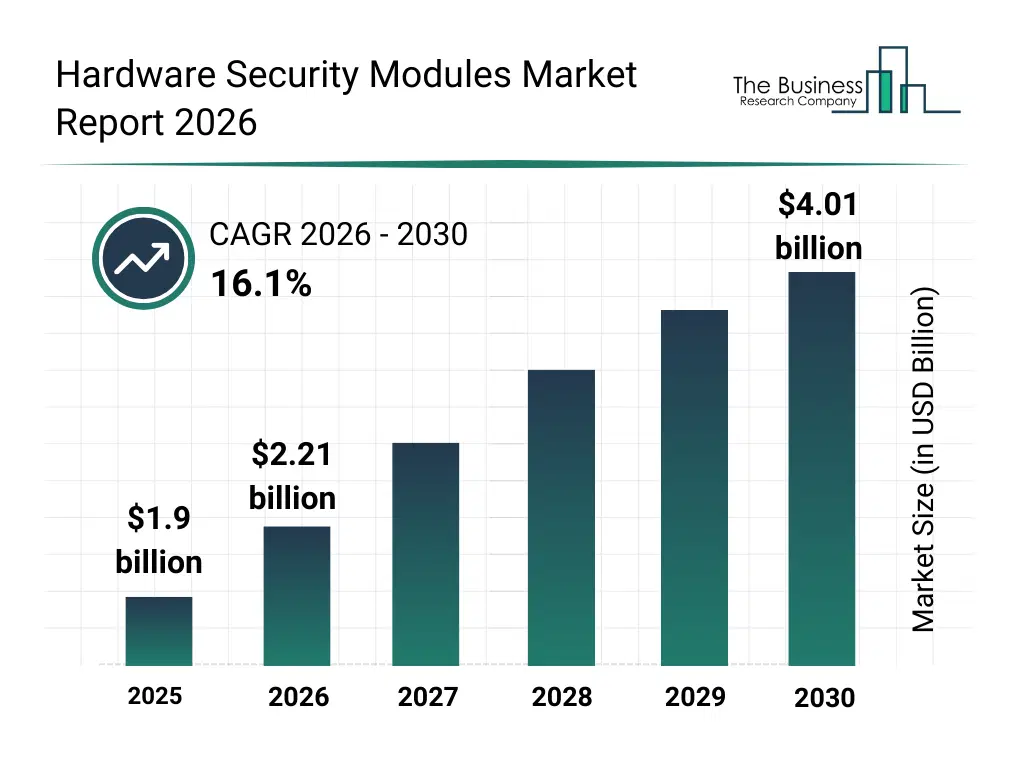
What Is The Hardware Security Modules Market Size and Share 2026?
The hardware security modules market size has grown rapidly in recent years. It will grow from $1.9 billion in 2025 to $2.21 billion in 2026 at a compound annual growth rate (CAGR) of 16.1%. The growth in the historic period can be attributed to growth of digital payment systems, increased use of encryption technologies, rising cybersecurity threats, expansion of online banking platforms, adoption of secure authentication frameworks.What Is The Hardware Security Modules Market Growth Forecast?
The hardware security modules market size is expected to see rapid growth in the next few years. It will grow to $4.01 billion in 2030 at a compound annual growth rate (CAGR) of 16.1%. The growth in the forecast period can be attributed to increasing adoption of cloud security architectures, rising regulatory requirements for data protection, growth of blockchain-based applications, expanding use of encryption in iot ecosystems, increasing demand for zero-trust security models. Major trends in the forecast period include increasing adoption of cloud-based hsms, rising demand for secure digital key management, growing use in payment and authentication systems, expansion of hsm deployment in pki environments, enhanced focus on regulatory compliance security.
Global Hardware Security Modules Market Segmentation
1) By Type: LAN Based Or Network Attached, PCI-Based Or Embedded Plugins, USB Based Or Portable, Smart Cards 2) By Deployment Type: On-Premise, Cloud 3) By Application: Secure Sockets Layer (SSL), Transport Layer Security, Authentication, Payment Processing, Code And Document Signing, Application-Level Encryption, Database Encryption, Public Key Infrastructure (PKI), Credential Management 4) By End-User: Banking And Financial Services, Energy And Utilities, Retail And Consumer Products, Government Technology And Communication, Industrial And Manufacturing, Healthcare, Life Sciences Subsegments: 1) By LAN Based Or Network Attached: Standalone HSMs, Clustered HSMs 2) By PCI-Based Or Embedded Plugins: Server-Side HSMs, PCI Express HSMs 3) By USB Based Or Portable: USB HSMs, Hardware Tokens 4) By Smart Cards: Contact Smart Cards, Contactless Smart CardsWhat Is The Driver Of The Hardware Security Modules Market?
An increase in data breaches and cyberattacks is expected to propel the growth of the hardware security module market going forward. A cyber attack is an attempt to illegally access a computer system or a computer network to cause damage, whereas a data breach occurs when data is stolen or extracted from a system without the owner's knowledge or authorization. The hardware security module (HSM) is a physical device that protects data against both logical and inherent security threats. It is meant to keep data and information safe and secure by providing built-in vulnerability protection. Furthermore, the growing acceptance of digital payments has favored an increase in cyberattacks and data-breaching activities, thus increasing demand for hardware security modules. For instance, in October 2024, according to Check Point Software Technologies Ltd., an Israel-based cybersecurity company, in the U.S., cyberattacks have risen by 56% year-over-year, with a weekly average of 1,300 attacks per organization, 10% higher than the previous quarter. Therefore, the increase in data breaches and cyber-attacks is driving the growth of the hardware security module industry.Key Players In The Global Hardware Security Modules Market
Major companies operating in the hardware security modules market are Thales e-Security Inc.; Utimaco GmbH; International Business Machines Corporation; FutureX LP; Yubico Inc.; SWIFT SCRL.; ATOS SE; Ultra Electronics Holdings plc; Entrust Corporation; Hewlett-Packard Enterprise Development LP; Securosys SA; Infineon Technologies AG; Ledger & Spyrus Inc.; Exceet Secure Solutions GmbH; Google LLC; Microchip Technology Inc.; Amazon Web Services Inc.; WIBU-SYSTEMS AG; Trustwave Holdings; Fortanix; Marvell Technology Group; Synopsys Inc.; Westone Information Industry Inc; Sansec Technology; Keyou; Beijing Dean Information Technology; Fortanix Data Security Manager
This chart is for illustrative purposes; the full report includes a detailed competitor analysis and comprehensive overview of the top 10 companies in the market.
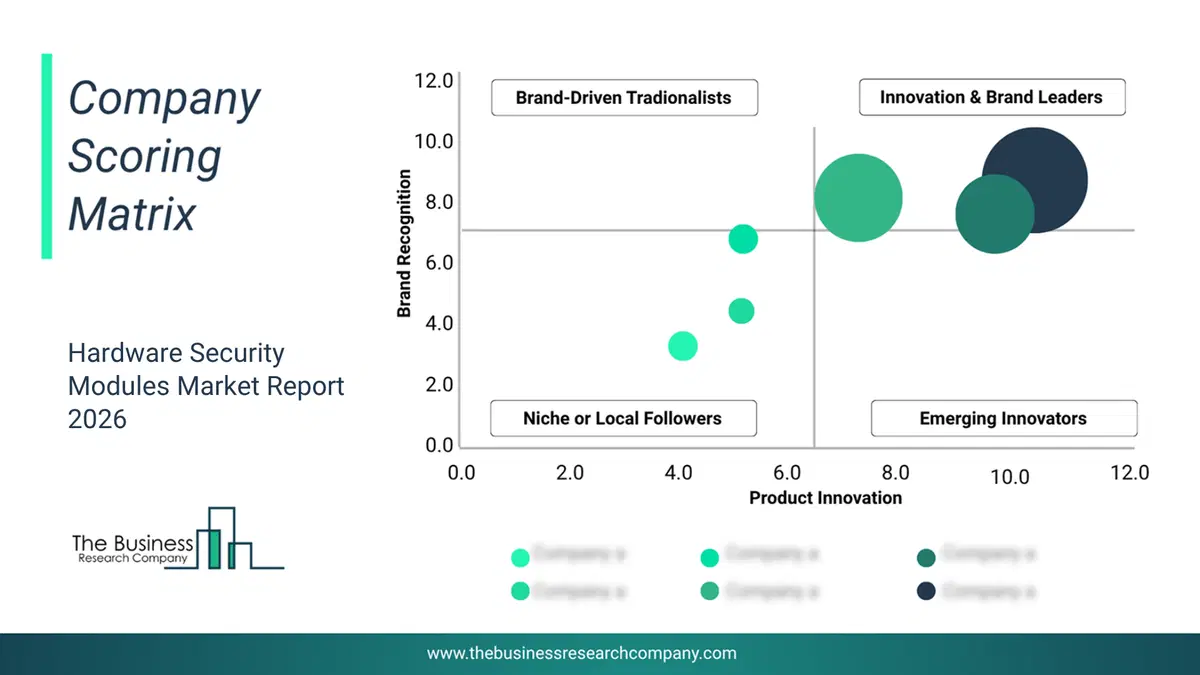
This chart maps companies by product innovation and brand strength, with bubble size indicating relative revenue, helping identify market leaders, challengers, and niche players. This is an illustrative chart; the full report provides a complete and accurate competitive analysis.
Global Hardware Security Modules Market Trends and Insights
Major companies operating in the hardware security module market are focusing on introducing advanced cloud-based solutions to provide secure, scalable, and compliant cryptographic services for the digital payments ecosystem. These solutions aim to simplify payment security management by offering flexible, subscription-based access to hardware-grade encryption capabilities through the cloud. For instance, in August 2023, Thales, a France-based technology company, launched payShield Cloud HSM, a subscription-based, cloud-native payment HSM service built on its market-leading payShield 10K payment HSM technology. The offering delivers rapid, cloud-ready deployment and multi-cloud integration with AWS, Microsoft Azure and Google Cloud Platform, supports hybrid deployments so customers can migrate at their own pace while maintaining compatibility with existing on-prem payShield HSMs and custom code, and is hosted across multiple US and EU data centres that meet critical payment security audit standards such as PCI PIN security, enabling scalable, low-latency, and compliant payment cryptography without requiring hardware replacement.What Are Latest Mergers And Acquisitions In The Hardware Security Modules Market?
In December 2023, Thales Group, a France-based IT company, acquired Imperva, Inc. for an undisclosed amount. With this acquisition, Thales aims to enhance its cybersecurity capabilities and expand its data and application security offerings, aiming to generate an expected revenue boost of around $500 million while positioning itself among the top global leaders in the cybersecurity market. Imperva, Inc., a US-based IT security company, provides hardware security modules that protect sensitive information.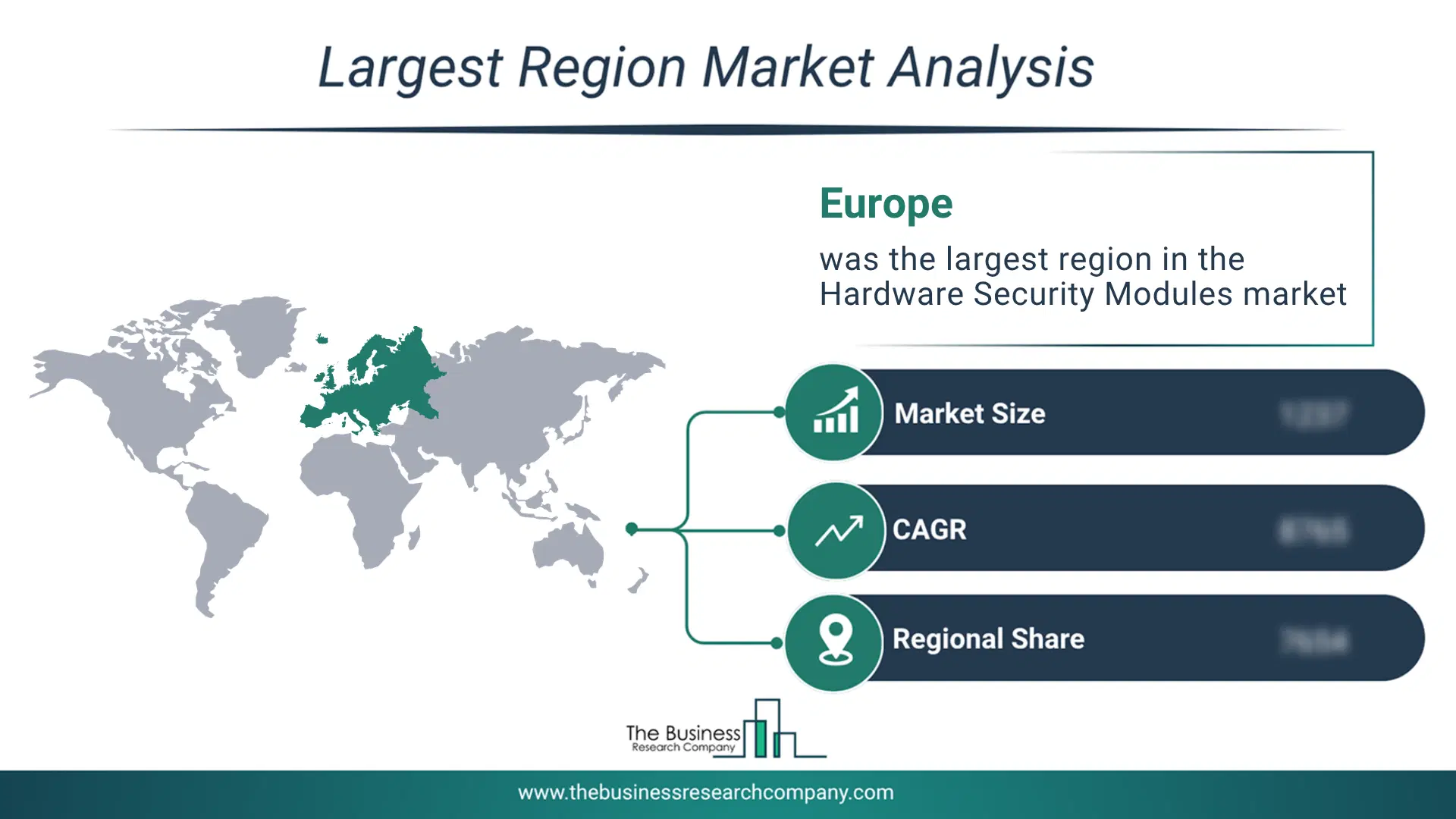
Regional Insights
Europe was the largest region in the hardware security module market in 2025. The regions covered in this market report are Asia-Pacific, South East Asia, Western Europe, Eastern Europe, North America, South America, Middle East, Africa. The countries covered in this market report are Australia, Brazil, China, France, Germany, India, Indonesia, Japan, Taiwan, Russia, South Korea, UK, USA, Canada, Italy, SpainWhat Defines the Hardware Security Modules Market?
The hardware security module market consists of revenues earned by entities by providing encryption and decryption services such as cryptographic key generation, authentication process, data integrity, transaction processing, and RSA operations. The market value includes the value of related goods sold by the service provider or included within the service offering. The hardware security module market also includes sales of general-purpose hardware security module, card payment system HSMs, payment and transaction HSMs that are used for providing hardware security module services. Values in this market are ‘factory gate’ values, that is the value of goods sold by the manufacturers or creators of the goods, whether to other entities (including downstream manufacturers, wholesalers, distributors and retailers) or directly to end customers. The value of goods in this market includes related services sold by the creators of the goods.How is Market Value Defined and Measured?
The market value is defined as the revenues that enterprises gain from the sale of goods and/or services within the specified market and geography through sales, grants, or donations in terms of the currency (in USD unless otherwise specified). The revenues for a specified geography are consumption values that are revenues generated by organizations in the specified geography within the market, irrespective of where they are produced. It does not include revenues from resales along the supply chain, either further along the supply chain or as part of other products.
This chart presents market attractiveness based on a quantitative evaluation of growth, competition, strategic alignment, and risk, offering a clear view of opportunity areas for decision-making. This chart is for illustrative purposes; the full report contains the complete analysis.

This chart highlights the Total Addressable Market (TAM) by estimating the maximum revenue opportunity using an assumption-driven approach, supporting strategic planning and opportunity sizing across markets. The chart is illustrative; the full report provides a more comprehensive analysis.
What Key Data and Analysis Are Included in the Hardware Security Modules Market Report 2026?
The hardware security modules market research report is one of a series of new reports from The Business Research Company that provides market statistics, including industry global market size, regional shares, competitors with the market share, detailed market segments, market trends and opportunities, and any further data you may need to thrive in the hardware security modules industry. The market research report delivers a complete perspective of everything you need, with an in-depth analysis of the current and future state of the industry.Hardware Security Modules Market Report Forecast Analysis
| Report Attribute | Details |
|---|---|
| Market Size Value In 2026 | $2.21 billion |
| Revenue Forecast In 2030 | $4.01 billion |
| Growth Rate | CAGR of 16.1% from 2026 to 2030 |
| Base Year For Estimation | 2025 |
| Actual Estimates/Historical Data | 2020-2025 |
| Forecast Period | 2026 - 2030 |
| Market Representation | Revenue in USD Billion and CAGR from 2026 to 2030 |
| Segments Covered | Type, Deployment Type, Application, End-User |
| Regional Scope | Asia-Pacific, Western Europe, Eastern Europe, North America, South America, Middle East, Africa |
| Country Scope | The Countries Covered In This Market Report Are Australia, Brazil, China, France, Germany, India, Indonesia, Japan, Taiwan, Russia, South Korea, Uk, Usa, Canada, Italy, Spain. |
| Key Companies Profiled | Thales e-Security Inc., Utimaco GmbH, International Business Machines Corporation, FutureX LP, Yubico Inc., SWIFT SCRL., ATOS SE, Ultra Electronics Holdings plc, Entrust Corporation, Hewlett-Packard Enterprise Development LP, Securosys SA, Infineon Technologies AG, Ledger & Spyrus Inc., Exceet Secure Solutions GmbH, Google LLC, Microchip Technology Inc., Amazon Web Services Inc., WIBU-SYSTEMS AG, Trustwave Holdings, Fortanix, Marvell Technology Group, Synopsys Inc., Westone Information Industry Inc, Sansec Technology, Keyou, Beijing Dean Information Technology, Fortanix Data Security Manager |
| Customization Scope | Request for Customization |
| Pricing And Purchase Options | Explore Purchase Options |