
Hazardous Drug Management Systems Market Report 2026
Global Outlook – By Product Type (Closed System Transfer Devices, Drug Compounding Systems, Drug Storage And Transport Systems, Personal Protective Equipment, Other Product Types), By Deployment Mode (On Premises, Cloud Based, Hybrid), By Drug Type (Antineoplastic Drugs, Non Antineoplastic Hazardous Drugs, Reproductive Risk Only Drugs), By Workflow Stage (Drug Procurement And Storage, Drug Preparation And Compounding, Drug Dispensing And Transportation, Drug Administration, Waste Handling And Disposal, Environmental Monitoring And Decontamination, Personnel Safety And Compliance Management), By End User (Healthcare Providers, Pharmaceutical Companies, Research Institutes, Other End Users) – Market Size, Trends, Strategies, and Forecast to 2030
Hazardous Drug Management Systems Market Overview
• Hazardous Drug Management Systems market size has reached to $1.38 billion in 2025 • Expected to grow to $2.09 billion in 2030 at a compound annual growth rate (CAGR) of 8.6% • Growth Driver: Expanding Personalized Medicine And Complex Infusion Protocols Due To Rising Use Of Targeted, High-Potency Therapies • North America was the largest region in 2025 and Asia-Pacific is the fastest growing region.What Is Covered Under Hazardous Drug Management Systems Market?
The hazardous drug management systems refer to the digital and automated solutions used to ensure the safe handling, storage, preparation, tracking, and disposal of hazardous medications across regulated environments. Its primary purpose is to minimize occupational exposure, prevent medication errors, and ensure compliance with safety and regulatory standards through controlled system workflows. It also supports real time monitoring, audit readiness, and risk reduction across hazardous medication management processes. The main types of hazardous drug management systems are closed system transfer devices, drug compounding systems, drug storage and transport systems, personal protective equipment, and others. Closed system transfer devices (CSTDs) refer to engineered systems that prevent the escape of hazardous drug vapors and liquids during drug preparation and administration, minimizing exposure risks to healthcare personnel. These systems can be deployed on-premises, via cloud-based platforms, or in hybrid models. The various drug types including antineoplastic drugs, non-antineoplastic hazardous drugs, and reproductive risk-only drugs. They support multiple workflow stages such as drug procurement and storage, drug preparation and compounding, drug dispensing and transportation, drug administration, waste handling and disposal, environmental monitoring and decontamination, and personnel safety and compliance management and the key end users including healthcare providers, pharmaceutical companies, research institutes, and others.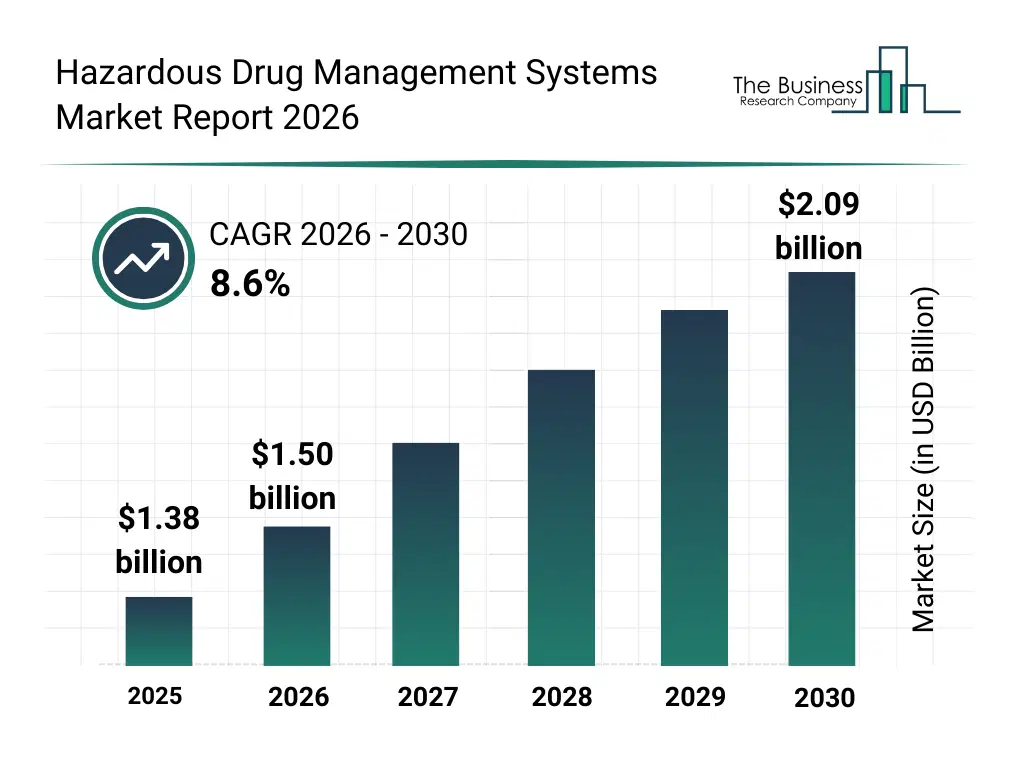
What Is The Hazardous Drug Management Systems Market Size and Share 2026?
The hazardous drug management systems market size has grown strongly in recent years. It will grow from $1.38 billion in 2025 to $1.50 billion in 2026 at a compound annual growth rate (CAGR) of 8.9%. The growth in the historic period can be attributed to growing focus on healthcare worker safety, increasing awareness of hazardous drug exposure risks, rising adoption of compliance-driven safety protocols, expansion of hospital and pharmacy automation, and growing enforcement of occupational safety guidelines.What Is The Hazardous Drug Management Systems Market Growth Forecast?
The hazardous drug management systems market size is expected to see strong growth in the next few years. It will grow to $2.09 billion in 2030 at a compound annual growth rate (CAGR) of 8.6%. The growth in the forecast period can be attributed to increasing implementation of closed system drug transfer technologies, growing demand for automated hazardous drug handling, rising investment in oncology safety infrastructure, expansion of regulatory compliance requirements across healthcare facilities, and a rise in focus on workplace contamination prevention. Major trends in the forecast period include technology-driven innovations in closed system transfer devices, advancements in robotic and automated compounding safety solutions, developments in real-time contamination monitoring systems, rising research and development in exposure prevention technologies, and innovation in integrated hazardous drug tracking and reporting systems.
Global Hazardous Drug Management Systems Market Segmentation
1) By Product Type: Closed System Transfer Devices, Drug Compounding Systems, Drug Storage And Transport Systems, Personal Protective Equipment, Other Product Types 2) By Deployment Mode: On Premises, Cloud Based, Hybrid 3) By Drug Type: Antineoplastic Drugs, Non Antineoplastic Hazardous Drugs, Reproductive Risk Only Drugs 4) By Workflow Stage: Drug Procurement And Storage, Drug Preparation And Compounding, Drug Dispensing And Transportation, Drug Administration, Waste Handling And Disposal, Environmental Monitoring And Decontamination, Personnel Safety And Compliance Management 5) By End User: Healthcare Providers, Pharmaceutical Companies, Research Institutes, Other End Users Subsegments: 1) By Closed System Transfer Devices: Needle Free Connectors, Bag Spike Systems, Luer Lock Adapters, Vial Adapters 2) By Drug Compounding Systems: Automated Compounding Devices, Manual Compounding Devices, Isolator Systems, Compounding Enclosures 3) By Drug Storage And Transport Systems: Refrigerated Storage Units, Temperature Controlled Transport Carts, Lockable Cabinets, Portable Containment Units 4) By Personal Protective Equipment:Gloves, Gowns, Respirators, Eye Protection 5) By Other Product Types: Spill Containment Kits, Decontamination Systems, Waste Disposal Containers, Cleaning SuppliesWhat Are The Drivers Of The Hazardous Drug Management Systems Market?
The expanding use of personalized medicine and complex infusion protocols is expected to propel the growth of the hazardous drug management systems market going forward. Personalized medicine is the approach of tailoring medical treatments, including drug selection and dosing, to individual patient characteristics such as genetics, biomarkers, and disease profiles. The expansion of personalized medicine is driven by the increasing approval and clinical adoption of targeted therapies that require highly customized intravenous dosing and preparation. Hazardous drug management systems support personalized medicine by ensuring the safe preparation, handling, and delivery of high potency and targeted therapies, protecting healthcare workers while enabling precise, patient-specific treatment. For instance, in November 2025, according to the Personalized Medicine Coalition, a US-based nonprofit organization, the US Food and Drug Administration approved 18 new personalized medicines in 2024, accounting for more than 25% of all new drug approvals, following 20 personalized medicine approvals in 2023, many of which require individualized IV preparation. Therefore, the expanding use of personalized medicine and complex infusion protocols is driving the growth of the hazardous drug management systems industry. The increasing number of pharmaceutical clinical trials is expected to propel the growth of the hazardous drug management systems market going forward. Pharmaceutical clinical trials are structured research studies conducted to evaluate the safety, efficacy, and optimal dosing of new drugs or therapies in human participants. The increasing number of pharmaceutical clinical trials is due to the growing demand for innovative treatments to address complex and emerging health conditions. Hazardous drug management systems support clinical trials by enabling safe, accurate, and compliant handling of investigational and high-potency drugs, ensuring both patient safety and regulatory adherence throughout the study. For instance, in December 2024, according to the Association of the British Pharmaceutical Industry (ABPI), a UK-based organization, the number of pharmaceutical industry trials launched in the UK increased for the second consecutive year, rising from 411 in 2022 to 426 in 2023. Therefore, the increasing number of pharmaceutical clinical trials drives the hazardous drug management systems industry.Key Players In The Global Hazardous Drug Management Systems Market
Major companies operating in the hazardous drug management systems market are Particle Measuring Systems Inc., Baker Hughes Company, Becton Dickinson and Company, Baxter International Inc., B. Braun Melsungen AG, Terumo Corporation, West Pharmaceutical Services Inc., ICU Medical Inc., Esco Healthcare, JMS Co. Ltd., Vygon SA, CODAN Medizinische Geräte GmbH & Co. KG, NuAire Inc., Equashield LLC, Labconco Corporation, Germfree Laboratories Inc., Sentry Air Systems Inc., Simplivia Healthcare Ltd., Mecart Cleanrooms, Corvida Medical Inc.
This chart is for illustrative purposes; the full report includes a detailed competitor analysis and comprehensive overview of the top 10 companies in the market.
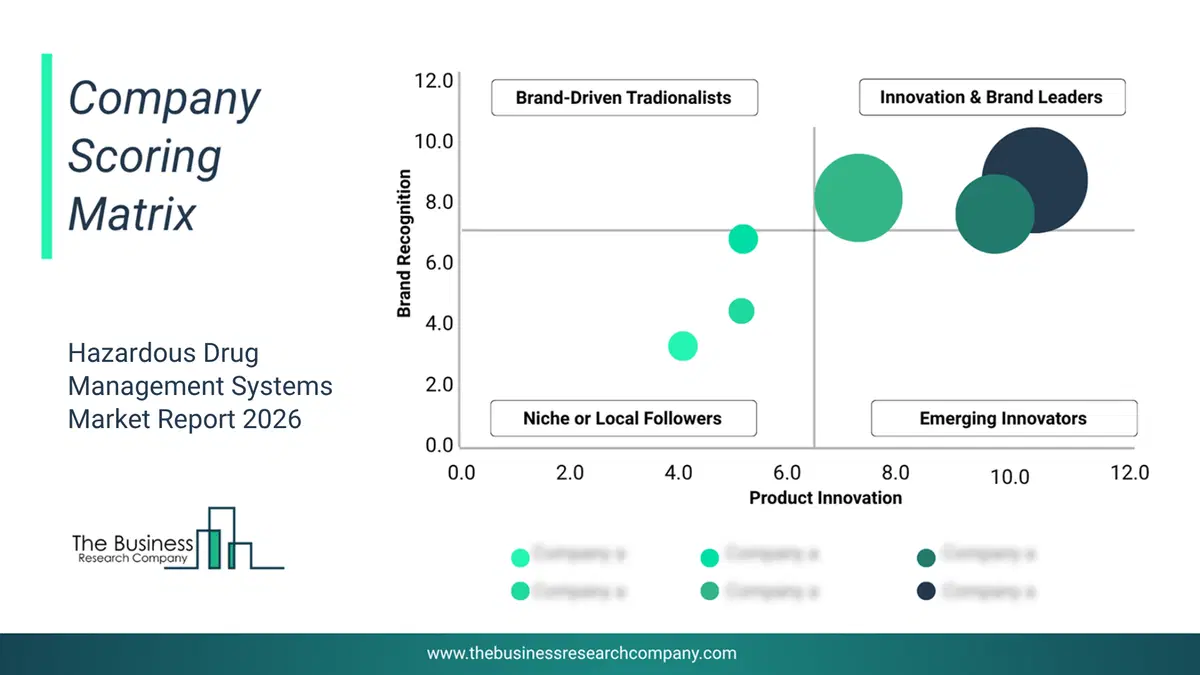
This chart maps companies by product innovation and brand strength, with bubble size indicating relative revenue, helping identify market leaders, challengers, and niche players. This is an illustrative chart; the full report provides a complete and accurate competitive analysis.
What Are Latest Mergers And Acquisitions In The Hazardous Drug Management Systems Market?
In October 2025, Ideagen PLC, a UK-based provider of software for regulated and high-compliance industries, acquired SafetyStratus Inc. for an undisclosed amount. Through this acquisition, Ideagen aims to enhance its enterprise environmental, health, and safety (EHS) offerings by integrating SafetyStratus’s chemical and hazardous management software, expanding its capabilities in hazardous drug and chemical tracking, compliance, and safety workflows. SafetyStratus Inc. is a US-based company that specializes in hazardous drug management systems, providing solutions to ensure safe handling, compliance, and tracking of hazardous medications in healthcare and laboratory settings.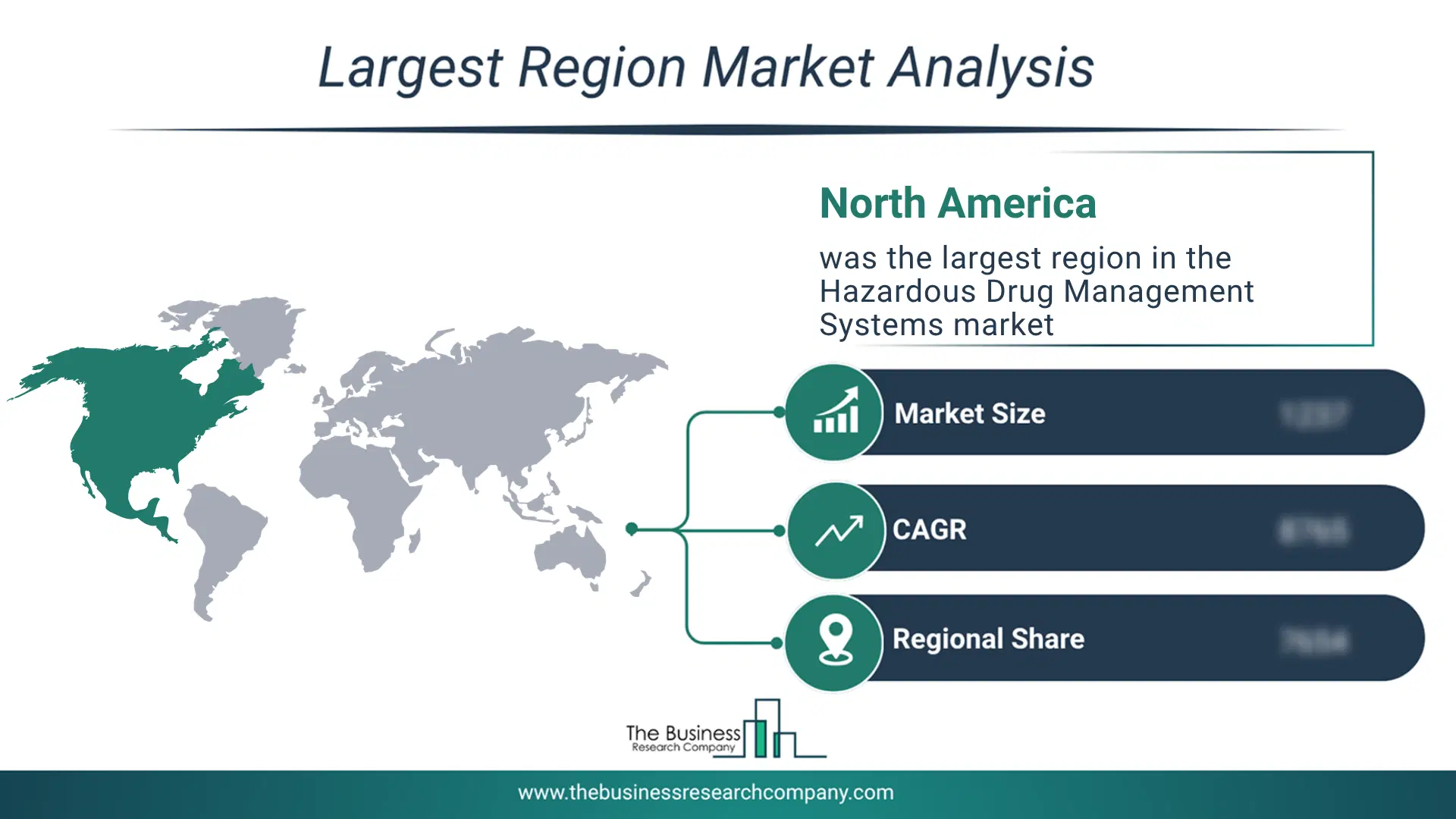
Regional Insights
North America was the largest region in the hazardous drug management systems market in 2025. Asia-Pacific is expected to be the fastest-growing region in the forecast period. The regions covered in this market report are Asia-Pacific, South East Asia, Western Europe, Eastern Europe, North America, South America, Middle East, Africa. The countries covered in this market report are Australia, Brazil, China, France, Germany, India, Indonesia, Japan, Taiwan, Russia, South Korea, UK, USA, Canada, Italy, Spain.What Defines the Hazardous Drug Management Systems Market?
The hazardous drug management systems market consists of revenues earned by entities by providing services such as hazardous drug tracking software, safety compliance management platforms, automated workflow control systems, exposure reporting tools, and inventory monitoring solutions. The market value includes the value of related goods sold by the service provider or included within the service offering. The hazardous drug management systems also includes sales of secured storage units, automated dispensing integration systems, barcode tracking hardware, and contamination monitoring devices. Values in this market are ‘factory gate’ values, that is, the value of goods sold by the manufacturers or creators of the goods, whether to other entities (including downstream manufacturers, wholesalers, distributors, and retailers) or directly to end customers. The value of goods in this market includes related services sold by the creators of the goods.How is Market Value Defined and Measured?
The market value is defined as the revenues that enterprises gain from the sale of goods and/or services within the specified market and geography through sales, grants, or donations in terms of the currency (in USD unless otherwise specified). The revenues for a specified geography are consumption values that are revenues generated by organizations in the specified geography within the market, irrespective of where they are produced. It does not include revenues from resales along the supply chain, either further along the supply chain or as part of other products.
This chart presents market attractiveness based on a quantitative evaluation of growth, competition, strategic alignment, and risk, offering a clear view of opportunity areas for decision-making. This chart is for illustrative purposes; the full report contains the complete analysis.

This chart highlights the Total Addressable Market (TAM) by estimating the maximum revenue opportunity using an assumption-driven approach, supporting strategic planning and opportunity sizing across markets. The chart is illustrative; the full report provides a more comprehensive analysis.
What Key Data and Analysis Are Included in the Hazardous Drug Management Systems Market Report 2026?
The hazardous drug management systems market research report is one of a series of new reports from The Business Research Company that provides market statistics, including industry global market size, regional shares, competitors with the market share, detailed market segments, market trends and opportunities, and any further data you may need to thrive in the hazardous drug management systems industry. The market research report delivers a complete perspective of everything you need, with an in-depth analysis of the current and future state of the industry.Hazardous Drug Management Systems Market Report Forecast Analysis
| Report Attribute | Details |
|---|---|
| Market Size Value In 2026 | $1.50 billion |
| Revenue Forecast In 2030 | $2.09 billion |
| Growth Rate | CAGR of 8.6% from 2026 to 2030 |
| Base Year For Estimation | 2025 |
| Actual Estimates/Historical Data | 2020-2025 |
| Forecast Period | 2026 - 2030 |
| Market Representation | Revenue in USD Billion and CAGR from 2026 to 2030 |
| Segments Covered | Product Type, Deployment Mode, Drug Type, Workflow Stage, End User |
| Regional Scope | Asia-Pacific, Western Europe, Eastern Europe, North America, South America, Middle East, Africa |
| Country Scope | The countries covered in the report are Australia, Brazil, China, France, Germany, India, Indonesia, Japan, Taiwan, Russia, South Korea, UK, USA, Canada, Italy, Spain. |
| Key Companies Profiled | Particle Measuring Systems Inc., Baker Hughes Company, Becton Dickinson and Company, Baxter International Inc., B. Braun Melsungen AG, Terumo Corporation, West Pharmaceutical Services Inc., ICU Medical Inc., Esco Healthcare, JMS Co. Ltd., Vygon SA, CODAN Medizinische Geräte GmbH & Co. KG, NuAire Inc., Equashield LLC, Labconco Corporation, Germfree Laboratories Inc., Sentry Air Systems Inc., Simplivia Healthcare Ltd., Mecart Cleanrooms, Corvida Medical Inc. |
| Customization Scope | Request for Customization |
| Pricing And Purchase Options | Explore Purchase Options |