
Hazardous Goods Logistics Market Report 2026
Global Outlook – By Product (Flammable; Explosive; Radioactive; Bio-Hazardous; Other Products), By Business Type (Transportation; Warehousing; Value-Added Services), By Operation (Seaways; Roadways; Railways; Airways; Storage And Services), By Application (Industrial; Healthcare; Agriculture; Other Applications) – Market Size, Trends, Strategies, and Forecast to 2030
Hazardous Goods Logistics Market Overview
• Hazardous Goods Logistics market size has reached to $251.13 billion in 2025 • Expected to grow to $367.18 billion in 2030 at a compound annual growth rate (CAGR) of 8.1% • Growth Driver: E-Commerce Boom Fuels Expansion Of Hazardous Goods Logistics Market • Market Trend: One-Stop Logistics Solutions Revolutionize Hazardous Goods Logistics For Efficiency And Cost Savings • North America was the largest region in 2025 and Asia-Pacific is the fastest growing region.Market Gains By 2030 – Top Opportunities By Segment
Market Gain identifies the most promising market opportunities by highlighting the segments or products expected to generate the highest incremental revenue growth over the next five years.
What Is Covered Under Hazardous Goods Logistics Market?
Hazardous goods logistics are specialized processes and procedures that involve the transportation, storage, handling and management of commodities that are considered hazardous or dangerous due to their potential to cause harm to individuals, property, or the environment. Hazardous goods logistics help ensure that materials are transported to production facilities safely and the waste products are managed and disposed of properly. The main products of hazardous goods logistics are flammable, explosive, radioactive, bio-hazardous and others. Flammable products refer to goods that ignite and combust rapidly when exposed to heat, sparks, or open flames. These logistics are used for various types of businesses including transportation, warehousing and value-added services by seaways, roadways, railways, airways, storage and services operations for industrial, healthcare, agriculture and other applications.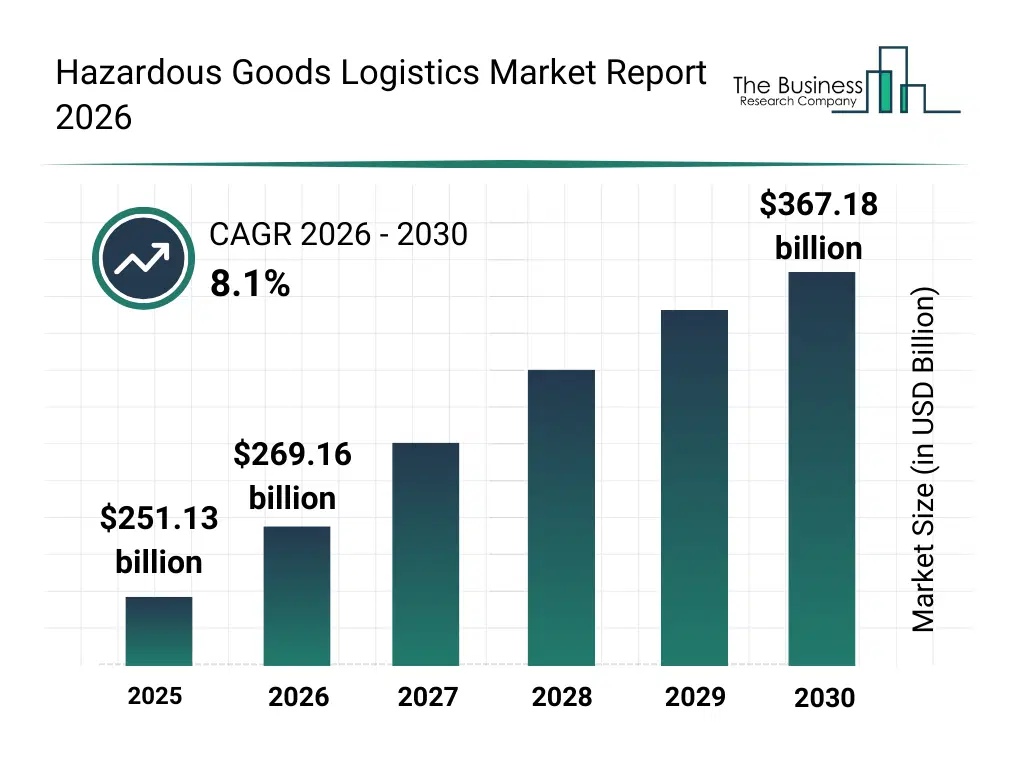
What Is The Hazardous Goods Logistics Market Size and Share 2026?
The hazardous goods logistics market size has grown strongly in recent years. It will grow from $251.13 billion in 2025 to $269.16 billion in 2026 at a compound annual growth rate (CAGR) of 7.2%. The growth in the historic period can be attributed to expansion of industrial chemical production, growth of pharmaceutical manufacturing, increasing regulatory oversight on hazardous transport, rising global trade of dangerous goods, development of specialized logistics infrastructure.What Is The Hazardous Goods Logistics Market Growth Forecast?
The hazardous goods logistics market size is expected to see strong growth in the next few years. It will grow to $367.18 billion in 2030 at a compound annual growth rate (CAGR) of 8.1%. The growth in the forecast period can be attributed to increasing adoption of smart hazardous logistics platforms, rising focus on environmental compliance, expansion of cold chain logistics for bio-hazardous materials, growing investments in secure transport solutions, increasing cross-border safety regulations. Major trends in the forecast period include increasing adoption of digitized hazard tracking systems, rising demand for compliance-focused logistics solutions, growing integration of real-time monitoring technologies, expansion of specialized hazardous storage services, enhanced focus on risk mitigation and safety protocols.
Global Hazardous Goods Logistics Market Segmentation
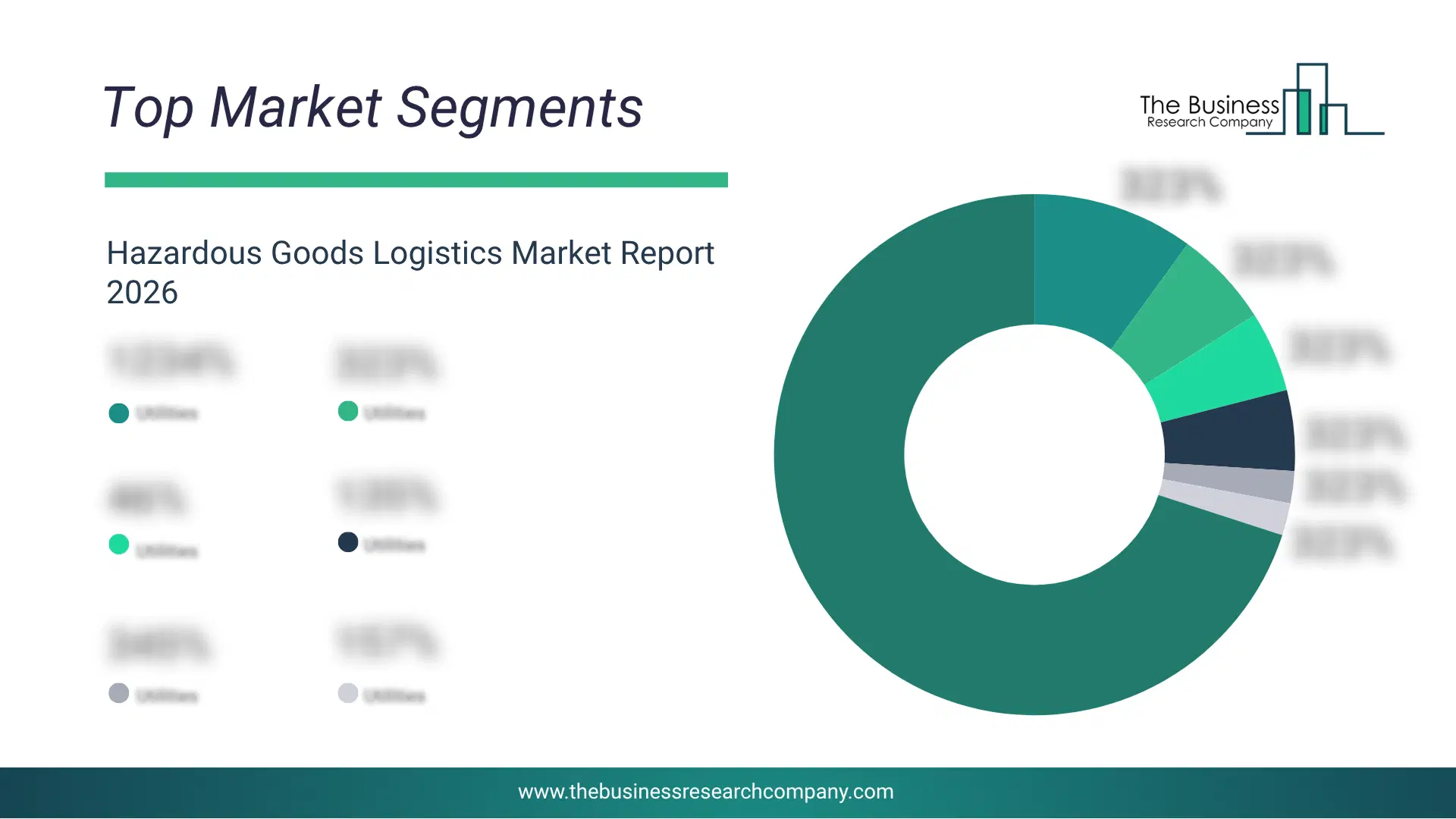
1) By Product: Flammable, Explosive, Radioactive, Bio-Hazardous, Other Products 2) By Business Type: Transportation, Warehousing, Value-Added Services 3) By Operation: Seaways, Roadways, Railways, Airways, Storage And Services 4) By Application: Industrial, Healthcare, Agriculture, Other Applications Subsegments: 1) By Flammable: Liquids, Solids, Gases 2) By Explosive: Detonators, Ammunition, Other Explosive Materials 3) By Radioactive: Medical Isotopes, Nuclear Fuel, Other Radioactives 4) By Bio-Hazardous: Medical Waste, Pathological Waste, Sharps Waste 5) By Other Products: Corrosive Materials, Toxic Substances, Compressed Gases The top segments in the hazardous goods logistics market will be: • Flammable will reach $154.57 Billion by 2030. • Other Products will reach $88.34 Billion by 2030. • Explosive will reach $55.98 Billion by 2030. • Bio-Hazardous will reach $43.3 Billion by 2030. • Radioactive will reach $22.92 Billion by 2030.What Is The Driver Of The Hazardous Goods Logistics Market?
The growing demand for e-commerce is expected to people the growth of the hazardous goods logistics market going forward. E-commerce refers to short for electronic commerce, involves buying and selling products and services online. E-commerce businesses use hazardous goods logistics to ensure the safe, compliant, and efficient transportation of hazardous or dangerous goods to their customers. For instance in In August 2024, the U.S. Census Bureau, a US-based government agency, reported that e-commerce sales represented 16.0 percent of total retail sales for the second quarter of 2024. On an unadjusted basis, U.S. retail e-commerce sales reached $282.3 billion in this period, marking a 5.3 percent increase (±0.7) compared to the first quarter of 2023. Therefore, the growing demand for e-commerce is driving the growth of the hazardous goods logistics industry.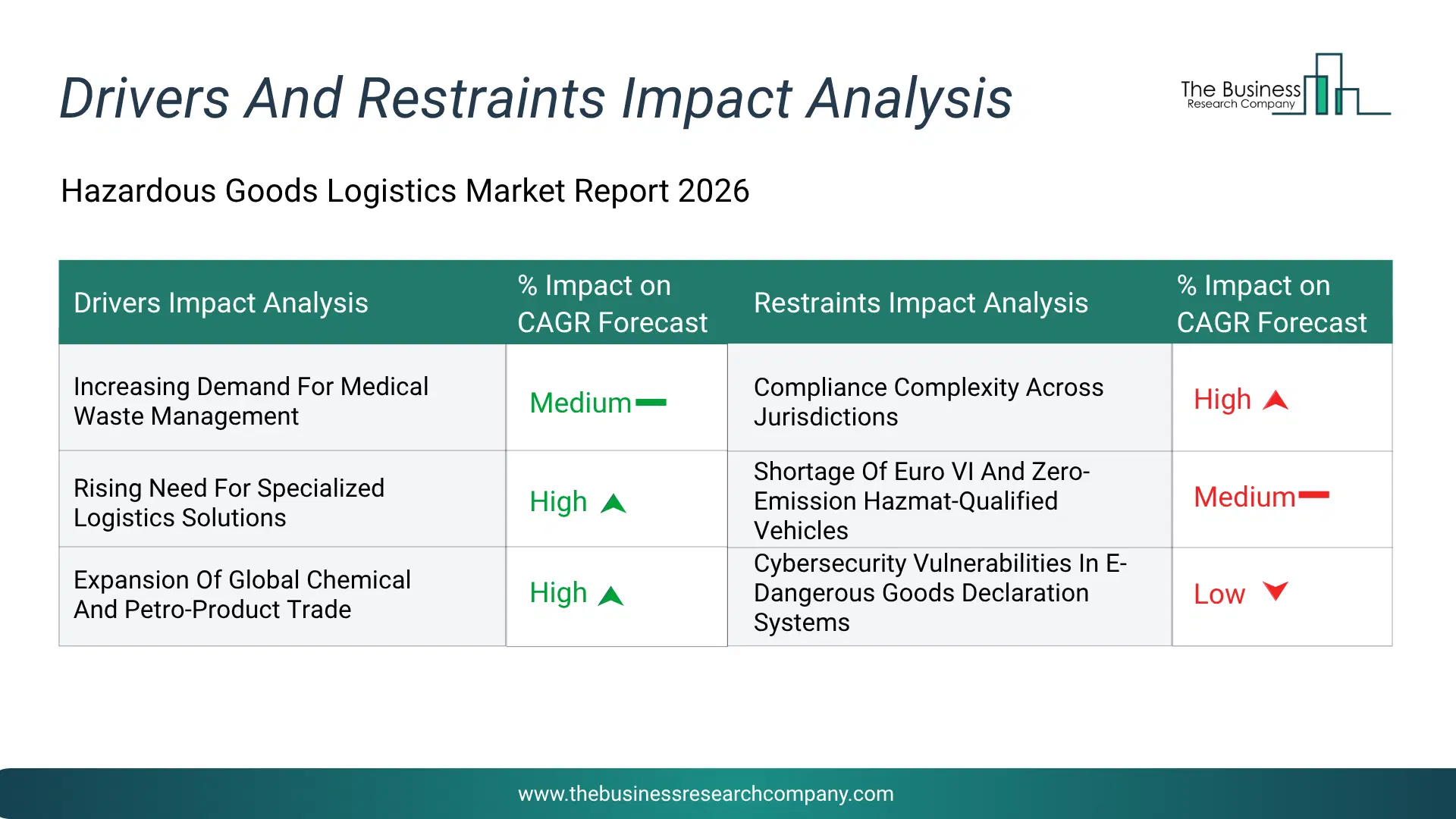
Infographic Chart Showing Key Market Drivers Analysis And Restraints For Hazardous Goods Logistics Market
The chart presents an impact analysis of key drivers and restraints, quantifying their relative influence on the market's growth rate and helping assess the balance between growth enablers and limiting factors. This chart offers a high-level perspective; the full report contains more detailed insights.
How Will The Drivers Impact Growth In The Global Hazardous Goods Logistics Market?
• Increasing Demand For Medical Waste Management (Medium) – During the forecast period, the increasing demand for medical waste management is expected to become a key growth driver for the hazardous goods logistics market by 2030. Growing healthcare activities, expanding pharmaceutical production, and rising volumes of infectious and hazardous medical waste are creating greater demand for secure collection, transportation, and disposal services. Logistics providers are enhancing their capabilities to handle bio-hazardous materials in accordance with stringent safety and environmental regulations. The need for specialized containment systems and traceable transportation processes is further strengthening market demand. • Rising Need For Specialized Logistics Solutions (High) – During the forecast period, the rising need for specialized logistics solutions is expected to emerge as a major factor driving the expansion of the hazardous goods logistics market by 2030. Industries handling dangerous materials increasingly require customized transportation, storage, packaging, and monitoring services to ensure operational safety and regulatory compliance. Logistics providers are investing in dedicated fleets, advanced tracking technologies, and trained personnel to manage complex hazardous cargo requirements. The growing focus on minimizing transportation risks and maintaining product integrity is accelerating the adoption of specialized logistics services. • Expansion Of Global Chemical And Petro-Product Trade (High) – During the forecast period, the expansion of global chemical and petro-product trade is expected to act as a key growth catalyst for the hazardous goods logistics market by 2030. Increasing cross-border movement of chemicals, fuels, industrial gases, and petrochemical derivatives is generating higher demand for compliant logistics operations. The development of international trade corridors, port infrastructure, and bulk transportation networks is supporting the efficient movement of hazardous materials across regions. Additionally, rising industrialization and manufacturing activities are increasing the volume of dangerous goods transported worldwide.How Will The Restraints Impact Growth In The Global Hazardous Goods Logistics Market?
• Compliance Complexity Across Jurisdictions (Medium) – During the forecast period, the compliance complexity across jurisdictions is restraining the hazardous goods logistics market by creating operational challenges for companies managing cross-border transportation. Different countries enforce varying regulations, documentation standards, and safety protocols for hazardous materials. This lack of uniformity increases administrative burden and raises the risk of non-compliance penalties. Logistics providers must invest heavily in regulatory expertise, training, and compliance systems to operate efficiently. Frequent updates to laws further complicate planning and execution. Smaller firms, in particular, struggle to manage these complexities, limiting their market participation. Consequently, regulatory fragmentation slows down operations and acts as a significant barrier to market growth. • Shortage Of Euro VI And Zero-Emission Hazmat-Qualified Vehicles (High) – During the forecast period, the shortage of Euro VI and zero-emission hazmat-qualified vehicles is restraining the hazardous goods logistics market by limiting the availability of compliant and environmentally friendly transportation options. Strict emission norms and sustainability goals are pushing logistics companies to upgrade their fleets. However, the high cost and limited supply of such specialized vehicles create financial and operational constraints. Many regions are enforcing low-emission zones, further restricting the use of older vehicles. This leads to reduced fleet flexibility and increased logistics costs. Additionally, the transition to cleaner technologies requires infrastructure and technical expertise. As a result, this shortage slows market expansion and hinders the adoption of sustainable logistics practices. • Cybersecurity Vulnerabilities In E-Dangerous Goods Declaration Systems (High) – During the forecast period, the cybersecurity vulnerabilities in e-Dangerous Goods Declaration systems are restraining the hazardous goods logistics market by exposing critical data and operations to digital threats. These systems are essential for documenting, tracking, and ensuring compliance in hazardous material transportation. However, increasing reliance on digital platforms makes them susceptible to hacking, data breaches, and system disruptions. Such incidents can compromise sensitive shipment information and lead to regulatory violations. Companies must invest significantly in cybersecurity infrastructure and risk management strategies. This increases operational costs and creates hesitation in adopting digital solutions. Consequently, cybersecurity risks act as a barrier by affecting trust, efficiency, and the overall reliability of logistics operations.Key Players In The Global Hazardous Goods Logistics Market
Major companies operating in the hazardous goods logistics market are Deutsche Post DHL Group, YRC Worldwide Inc., FedEx Corporation, A.P. Moller - Maersk, Kühne + Nagel International AG, DSV A/S, United Parcel Service Inc. (UPS), DB Schenker, C.H. Robinson Worldwide Inc., Nippon Express Co.Ltd., Expeditors International of Washington Inc., Panalpina Welttransport Holding AG, Geodis Logistics LLC, Kerry Logistics Network Limited, Bollore Logistics, XPO Logistics Inc., Kawasaki Kisen Kaisha Ltd., Hitachi Transport System Ltd., Hellmann Worldwide Logistics SE & Co. KG, Yusen Logistics Inc., Nishi-Nippon Railroad Co. Ltd., MOL Logistics Co. Ltd., Agility Public Warehousing Company K.S.C.P., Ceva Logistics, Toll Group, Rhenus Logistics S.A., DGD Transport LLC, Sagawa Express Co. Ltd.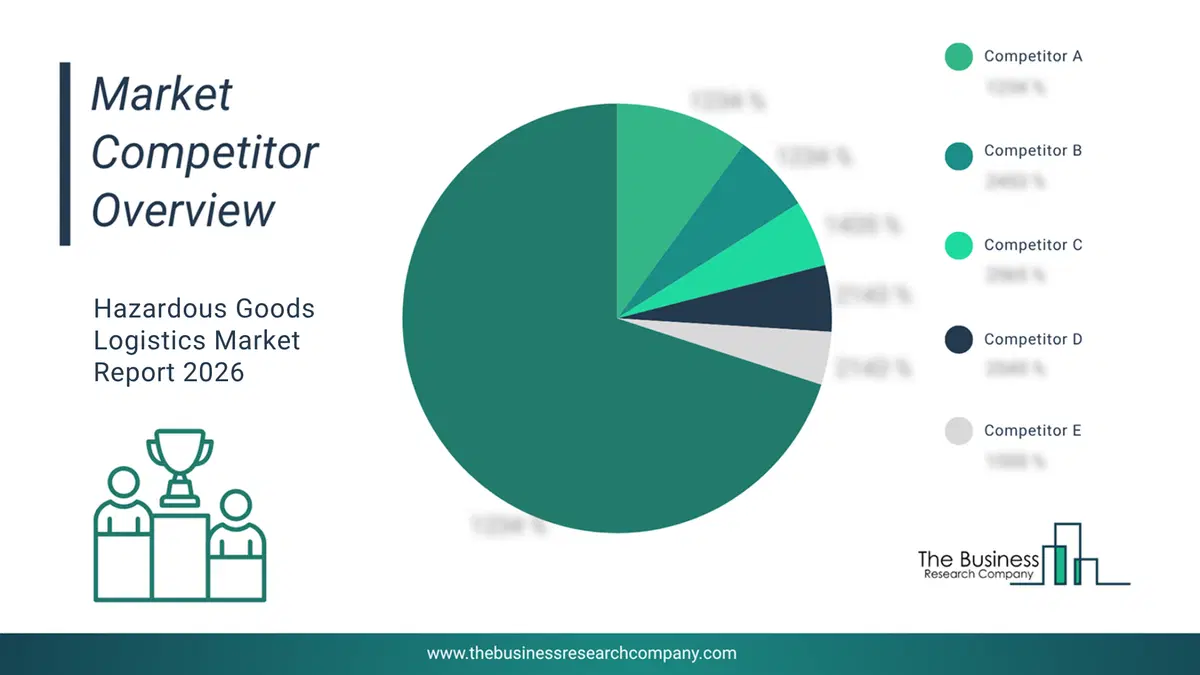
This chart is for illustrative purposes; the full report includes a detailed competitor analysis and comprehensive overview of the top 10 companies in the market.
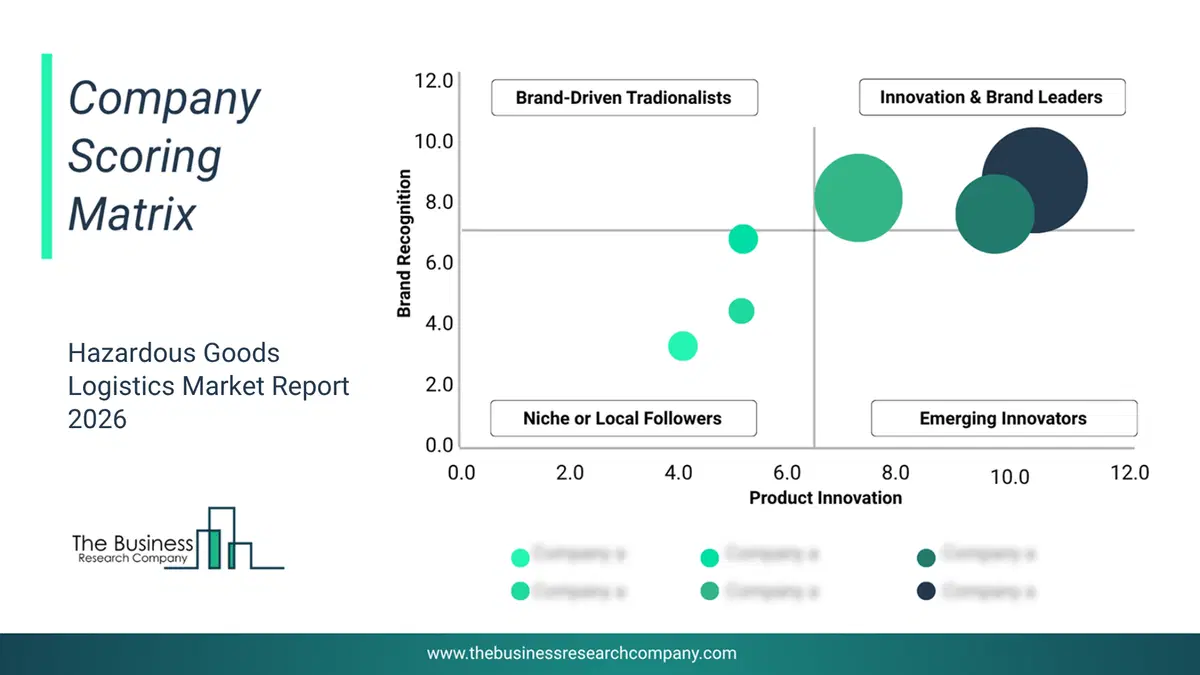
This chart maps companies by product innovation and brand strength, with bubble size indicating relative revenue, helping identify market leaders, challengers, and niche players. This is an illustrative chart; the full report provides a complete and accurate competitive analysis.
Global Hazardous Goods Logistics Market Trends and Insights
Major companies operating in the hazardous goods logistics market are developing innovative new logistic solutions, such as one-stop-shop logistics solutions, to increase their profitability in the market. A one-stop-shop logistics solution refers to a business or service provider that offers a complete portfolio of logistics services under the same denominator, providing convenience and efficiency to clients. For instance, in May 2023, FedEx Corporation, a US-based transportation company, launched a one-stop-shop logistics solution for hazardous commodities for local Cebu firms. One-stop-shop logistics solutions may save time and money by offering a lone point of contact for all logistical requirements. This solution enables local companies in Cebu to export all nine kinds of risky commodities.What Are Latest Mergers And Acquisitions In The Hazardous Goods Logistics Market?
In February 2024, CMA CGM Group, a France-based shipping and logistics company, acquired Bolloré Logistics for about $5.25 billion (€4.85 billion). With this acquisition, CMA CGM aimed to strengthen its global logistics capabilities, expand its end-to-end supply chain service portfolio, and enhance its presence across key trade corridors by integrating Bolloré Logistics into its logistics operations alongside CEVA Logistics. Bolloré Logistics is a France-based logistics company that specializes in international freight forwarding, contract logistics, supply chain management, and value-added logistics services across sectors such as aerospace, energy, healthcare, and industrial goods.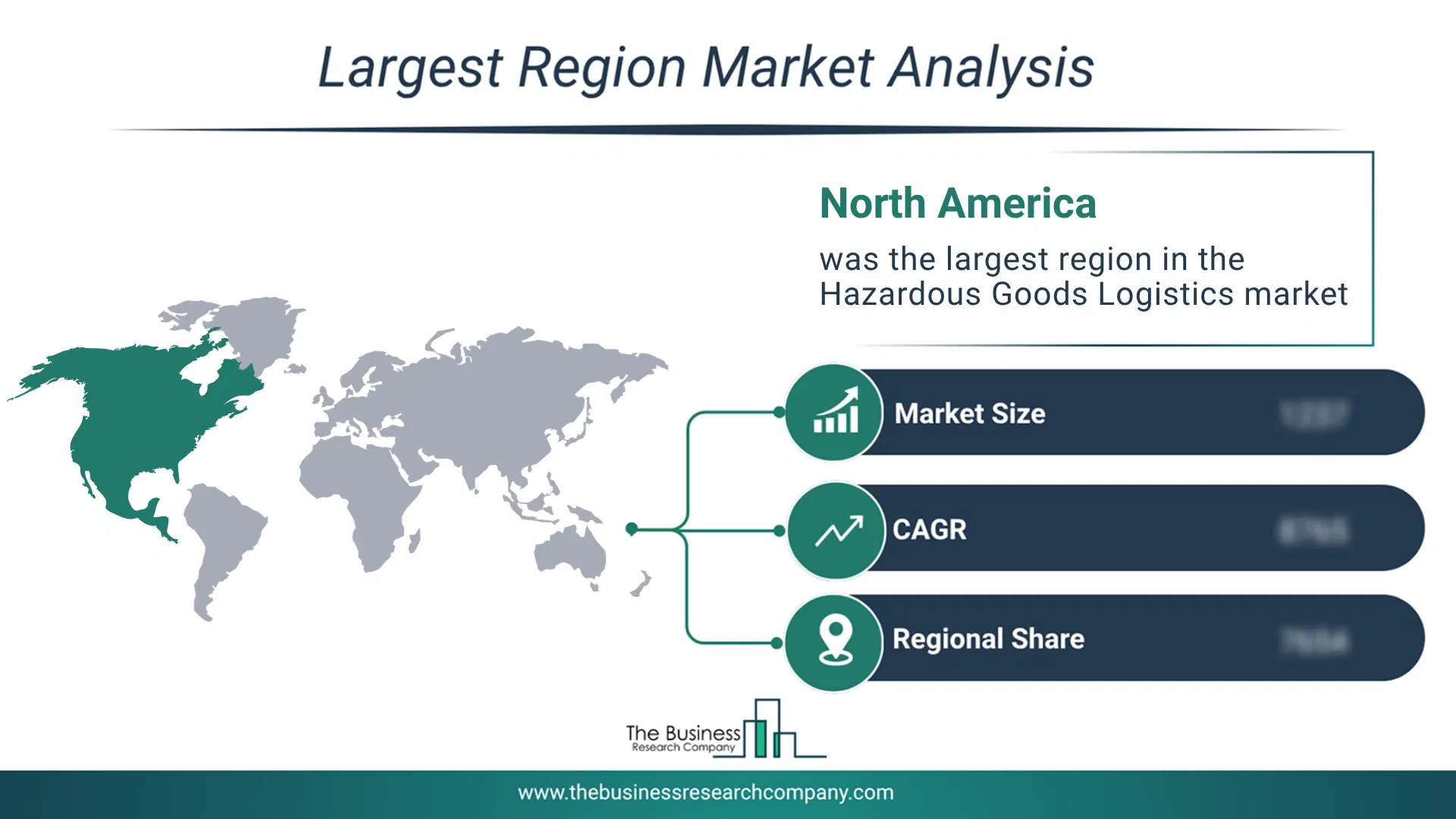
Regional Outlook
North America was the largest region in the hazardous goods logistics market in 2025. Asia-Pacific is expected to be the fastest-growing region in the forecast period. The regions covered in this market report are Asia-Pacific, South East Asia, Western Europe, Eastern Europe, North America, South America, Middle East, Africa. The countries covered in this market report are Australia; Brazil; China; France; Germany; India; Indonesia; Japan; Taiwan; Russia; South Korea; UK; USA; Canada; Italy; Spain.What Defines the Hazardous Goods Logistics Market?
The hazardous goods logistics market consists of revenues earned by entities by providing services such as risk assessment and management services, regulatory compliance services, emergency response planning services and packaging and labeling services. The market value includes the value of related goods sold by the service provider or included within the service offering. The hazardous goods logistics market also includes sales of products such as corrosive materials, oxidizing agents, toxic substances, compressed gases and sensitive electronics. Values in this market are ‘factory gate’ values, that is the value of goods sold by the manufacturers or creators of the goods, whether to other entities (including downstream manufacturers, wholesalers, distributors and retailers) or directly to end customers. The value of goods in this market includes related services sold by the creators of the goods.How is Market Value Defined and Measured?
The market value is defined as the revenues that enterprises gain from the sale of goods and/or services within the specified market and geography through sales, grants, or donations in terms of the currency (in USD unless otherwise specified). The revenues for a specified geography are consumption values that are revenues generated by organizations in the specified geography within the market, irrespective of where they are produced. It does not include revenues from resales along the supply chain, either further along the supply chain or as part of other products.
This chart presents market attractiveness based on a quantitative evaluation of growth, competition, strategic alignment, and risk, offering a clear view of opportunity areas for decision-making. This chart is for illustrative purposes; the full report contains the complete analysis.

This chart highlights the Total Addressable Market (TAM) by estimating the maximum revenue opportunity using an assumption-driven approach, supporting strategic planning and opportunity sizing across markets. The chart is illustrative; the full report provides a more comprehensive analysis.
What Key Data and Analysis Are Included in the Hazardous Goods Logistics Market Report 2026?
The hazardous goods logistics market research report is one of a series of new reports from The Business Research Company that provides market statistics, including Market Report 2026?global market size, regional shares, competitors with the market share, detailed market segments, market trends and opportunities, and any further data you may need to thrive in the hazardous goods logistics Market Report 2026? The market research report delivers a complete perspective of everything you need, with an in-depth analysis of the current and future state of the Market Report 2026?Hazardous Goods Logistics Market Report Forecast Analysis
| Report Attribute | Details |
|---|---|
| Market Size Value In 2026 | $269.16 billion |
| Revenue Forecast In 2030 | $367.18 billion |
| Growth Rate | CAGR of 7.2% from 2026 to 2030 |
| Base Year For Estimation | 2025 |
| Actual Estimates/Historical Data | 2020-2025 |
| Forecast Period | 2026 - 2030 |
| Market Representation | Revenue in USD Billion and CAGR from 2026 to 2030 |
| Segments Covered | Product, Business Type, Operation, Application |
| Regional Scope | Asia-Pacific, Western Europe, Eastern Europe, North America, South America, Middle East, Africa |
| Country Scope | The countries covered in the report are Australia, Brazil, China, France, Germany, India, Indonesia, Japan, Taiwan, Russia, South Korea, UK, USA, Canada, Italy, Spain. |
| Key Companies Profiled | Deutsche Post DHL Group, YRC Worldwide Inc., FedEx Corporation, A.P. Moller - Maersk, Kühne + Nagel International AG, DSV A/S, United Parcel Service Inc. (UPS), DB Schenker, C.H. Robinson Worldwide Inc., Nippon Express Co.Ltd., Expeditors International of Washington Inc., Panalpina Welttransport Holding AG, Geodis Logistics LLC, Kerry Logistics Network Limited, Bollore Logistics, XPO Logistics Inc., Kawasaki Kisen Kaisha Ltd., Hitachi Transport System Ltd., Hellmann Worldwide Logistics SE & Co. KG, Yusen Logistics Inc., Nishi-Nippon Railroad Co. Ltd., MOL Logistics Co. Ltd., Agility Public Warehousing Company K.S.C.P., Ceva Logistics, Toll Group, Rhenus Logistics S.A., DGD Transport LLC, Sagawa Express Co. Ltd. |
| Customization Scope | Request for Customization |
| Pricing And Purchase Options | Explore Purchase Options |