
Hazardous Waste Handling Automation Market Report 2026
Global Outlook – By Type (Manipulator Arms, Telescoping Masts, Cranes, Trusses, Size Reduction Systems), By Waste (Listed Wastes, Characteristic Waste, Universal Wastes, Mixed Wastes), By End-User Industry (Manufacturing, Chemical, Energy, Consumer Care, Government, Other End Users) – Market Size, Trends, Strategies, and Forecast to 2030
Hazardous Waste Handling Automation Market Overview
• Hazardous Waste Handling Automation market size has reached to $34.73 billion in 2025 • Expected to grow to $56.68 billion in 2030 at a compound annual growth rate (CAGR) of 10.3% • Growth Driver: Rising Waste Levels Propel Growth In Hazardous Waste Handling Automation Market • Market Trend: Adoption of Telerobotic Systems to Automate Hazardous Waste Handling • North America was the largest region in 2025 and Asia-Pacific is the fastest growing region.What Is Covered Under Hazardous Waste Handling Automation Market?
Hazardous waste handling automation is the process of using technology and automation systems to enhance the management, handling, and disposal of hazardous waste materials. It involves the application of various technologies, including robotics, artificial intelligence (AI), machine learning, sensors, and automation software, to automate and streamline hazardous waste management processes. The main types of hazardous waste handling automation include manipulator arms, telescoping masts, cranes, trusses and size reduction systems. Manipulator arms are programmable, multipurpose mechanical devices used to move tools, components, or materials according to predetermined movements in order to carry out numerous operations. They are used to treat different kinds of waste including listed wastes, characteristic waste, universal wastes and mixed wastes for use in various end-user industries such as manufacturing, chemical, energy, consumer care, government and others.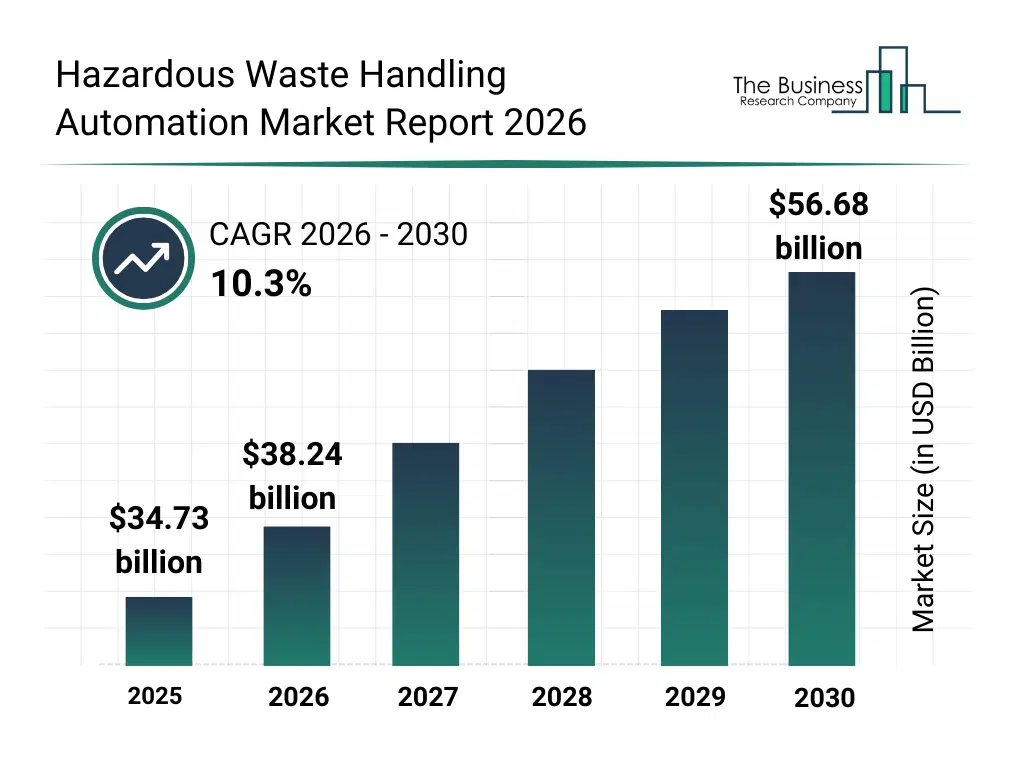
What Is The Hazardous Waste Handling Automation Market Size and Share 2026?
The hazardous waste handling automation market size has grown rapidly in recent years. It will grow from $34.73 billion in 2025 to $38.24 billion in 2026 at a compound annual growth rate (CAGR) of 10.1%. The growth in the historic period can be attributed to strict environmental regulations, increasing industrial waste generation, need to reduce human exposure risks, demand for operational efficiency, growth of chemical manufacturing activities.What Is The Hazardous Waste Handling Automation Market Growth Forecast?
The hazardous waste handling automation market size is expected to see rapid growth in the next few years. It will grow to $56.68 billion in 2030 at a compound annual growth rate (CAGR) of 10.3%. The growth in the forecast period can be attributed to tightening environmental compliance norms, adoption of automation in waste facilities, growth of hazardous waste recycling initiatives, increasing focus on worker safety, expansion of smart industrial infrastructure. Major trends in the forecast period include robotic waste handling systems, automated hazardous material sorting, remote controlled waste management equipment, AI based waste identification, sensor enabled safety monitoring.
Global Hazardous Waste Handling Automation Market Segmentation
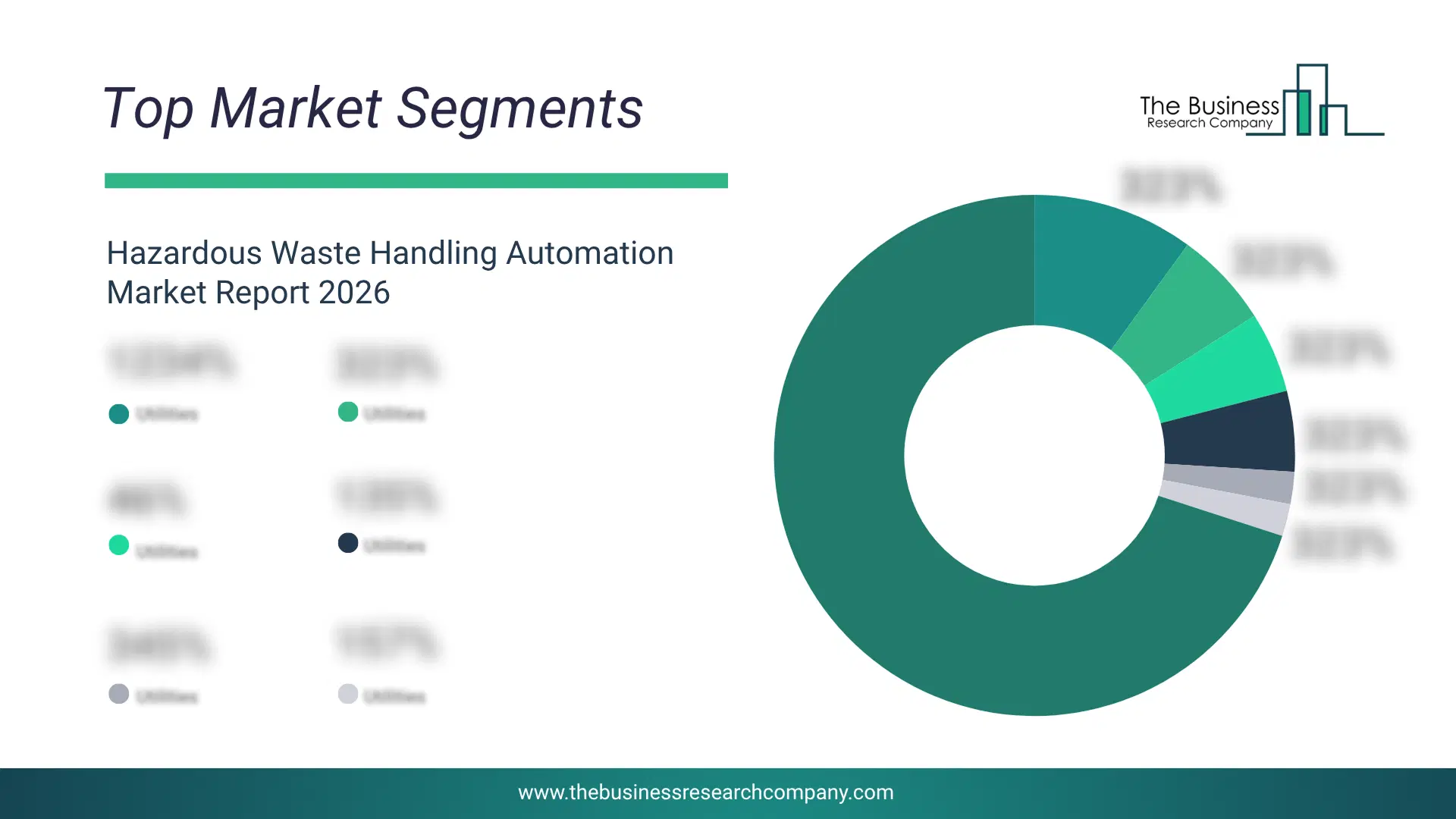
1) By Type: Manipulator Arms, Telescoping Masts, Cranes, Trusses, Size Reduction Systems 2) By Waste: Listed Wastes, Characteristic Waste, Universal Wastes, Mixed Wastes 3) By End-User Industry: Manufacturing, Chemical, Energy, Consumer Care, Government, Other End Users Subsegments: 1) By Manipulator Arms: Robotic Arms, Articulated Manipulators, Linear Manipulators 2) By Telescoping Masts: Fixed Telescoping Masts, Adjustable Telescoping Masts, Pneumatic Telescoping Masts 3) By Cranes: Overhead Cranes, Gantry Cranes, Mobile Cranes 4) By Trusses: Modular Trusses, Fixed Trusses, Adjustable Trusses 5) By Size Reduction Systems: Shredders, Crushers, GranulatorsWhat Is The Driver Of The Hazardous Waste Handling Automation Market?
The increasing amount of waste is expected to boost the growth of the hazardous waste handling automation market going forward. The rapid rise in population and urbanization has led to an increase in the amount of waste, which includes both hazardous and non-hazardous waste. While non-hazardous waste is comparatively easier to dispose of, hazardous waste disposal requires immediate attention. Hazardous waste handling automation ensures the safe disposal of this waste, which otherwise could pose a risk to the manual handlers and the environment. For instance, in February 2024, according to reports published by the UN Environment Programme, a Kenya-based organization, the report indicates that municipal solid waste generation is expected to increase from 2.3 billion tonnes in 2023 to 3.8 billion tonnes by 2050. Therefore, the increasing amount of waste is driving the growth of the hazardous waste handling automation industry.Key Players In The Global Hazardous Waste Handling Automation Market
Major companies operating in the hazardous waste handling automation market are Clean Harbors Inc.; Konecranes Oyj; Penz Crane GmbH; PaR Systems Inc; Pallmann; Hosokawa Micron Powder Systems; Terex MHPS GmbH; Cargotec Corp.; Fritz Schäfer GmbH; Vecoplan AG; BHS-Sonthofen GmbH; Bühler Group; ANDRITZ AG; Komptech Group; Ecolab Inc.; Veolia Environnement S.A.; SUEZ India Private Limited; Stericycle Inc.; Cleanaway Waste Management Limited; Remondis SE & Co. KG; Republic Services Inc.; Advanced Disposal Services Inc.; Casella Waste Systems Inc.; Fomento de Construcciones y Contratas Environment Limited; Green For Life Environmental Inc.; Meridian Waste; Progressive Waste Solutions Ltd.; Recology; Rumpke Consolidated Companies Inc.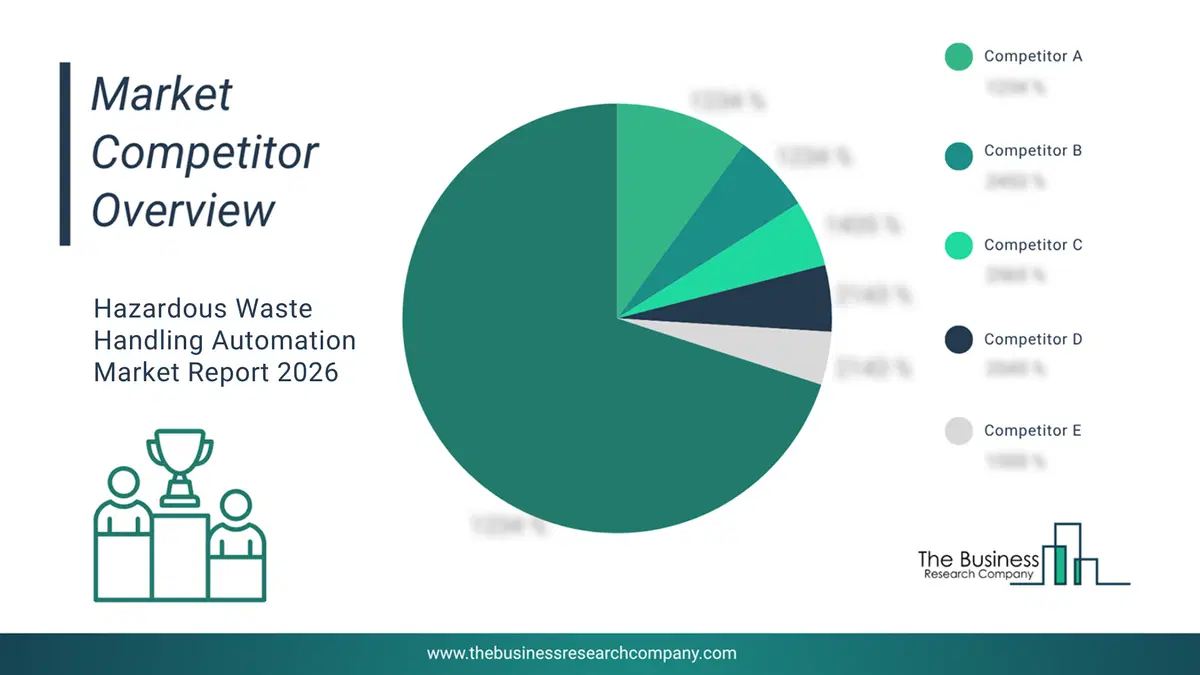
This chart is for illustrative purposes; the full report includes a detailed competitor analysis and comprehensive overview of the top 10 companies in the market.
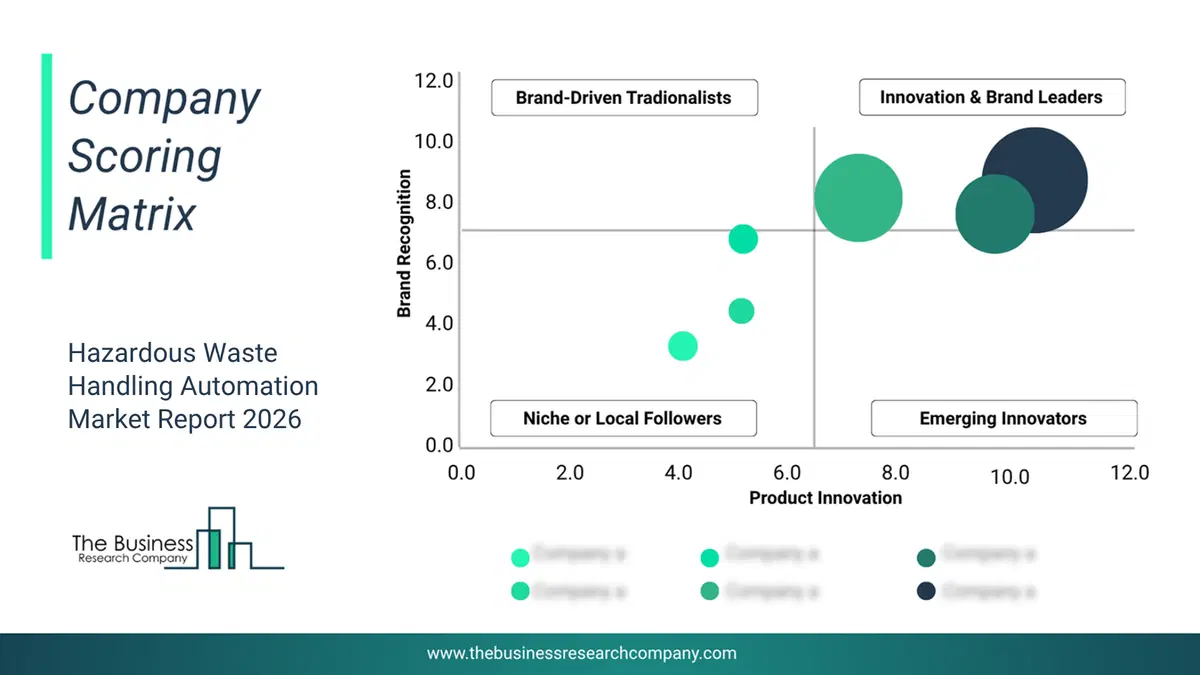
This chart maps companies by product innovation and brand strength, with bubble size indicating relative revenue, helping identify market leaders, challengers, and niche players. This is an illustrative chart; the full report provides a complete and accurate competitive analysis.
Global Hazardous Waste Handling Automation Market Trends and Insights
Major companies are operating in the hazardous waste handling automation market, focusing on developing technological advancements such as dual-armed telerobotic systems for high-risk waste management to enhance safety, improve operational precision, and reduce human exposure to hazardous environments. A dual-armed telerobotic system uses two dexterous robotic arms controlled remotely via VR and haptic interfaces similar to a human operator’s movement allowing precise handling of hazardous materials, safer interaction with confined or high-radiation spaces, and reduced risk of contamination or accidents. For instance, in March 2024, Argonne National Laboratory, a U.S.-based research organization, successfully demonstrated its Dual-Armed Telerobotic System for Hazardous Waste Cleanup. The system features two robotic arms with multi-fingered end-effectors, VR-based digital twin control, and adaptable manipulation capabilities for drums, containers, and mixed hazardous materials. It improves worker safety by minimizing direct exposure, increases operational efficiency through precise remote handling, and can be deployed in nuclear, chemical, and other high-risk waste sites.What Are Latest Mergers And Acquisitions In The Hazardous Waste Handling Automation Market?
In March 2024, Blue Planet Environmental Solutions Pte Ltd, a Singapore-based provider of technology-driven end-to-end waste management and upcycling solutions, acquired Vac Tech Engineering Pte Ltd for an undisclosed amount. Through this acquisition, Blue Planet aims to strengthen its hazardous waste management and treatment capabilities by integrating Vac Tech’s automated dewatering and centrifuge systems and enhancing its technology-driven waste handling solutions. Vac Tech Engineering Pte Ltd is a Singapore-based company that provides hazardous waste treatment systems, including automated dewatering and centrifuge technologies, along with hazardous waste transportation services.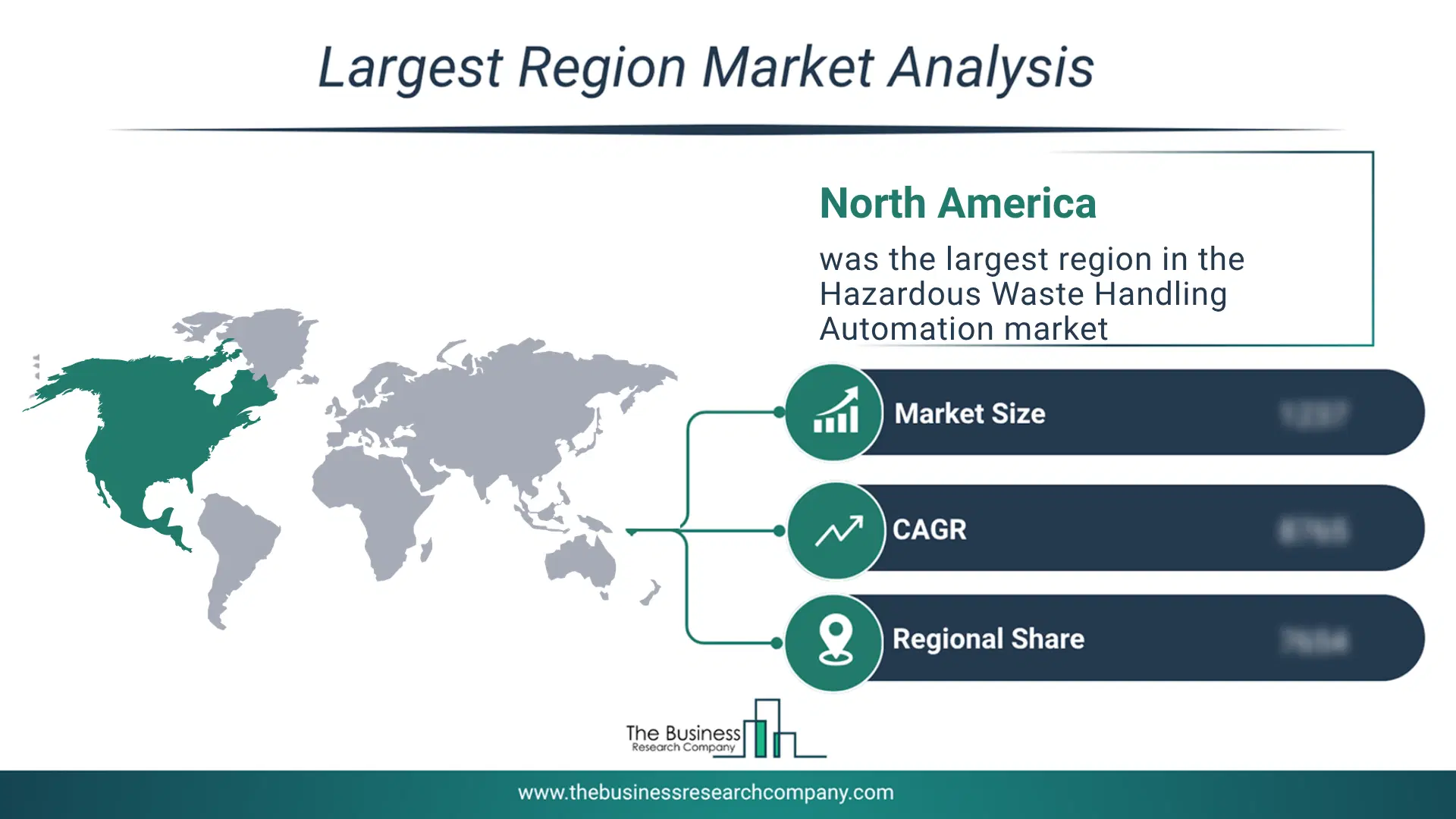
Regional Insights
North America was the largest region in the global hazardous waste handling automation market in 2025.Asia-Pacific is expected to be the fastest-growing region in the forecast period. The regions covered in this market report are Asia-Pacific, South East Asia, Western Europe, Eastern Europe, North America, South America, Middle East, Africa. The countries covered in this market report are Australia, Brazil, China, France, Germany, India, Indonesia, Japan, Taiwan, Russia, South Korea, UK, USA, Canada, Italy, SpainWhat Defines the Hazardous Waste Handling Automation Market?
The hazardous waste handling automation market includes revenues earned by entities by providing services that include consulting and assessment of waste generation, and training and support. The market value includes the value of related goods sold by the service provider or included within the service offering. Only goods and services traded between entities or sold to end consumers are included. The hazardous waste handling automation market consists of sales of robotic systems, automation software and sensor technologies. Values in this market are ‘factory gate’ values, that is, the value of goods sold by the manufacturers or creators of the goods, whether to other entities (including downstream manufacturers, wholesalers, distributors and retailers) or directly to end customers. The value of goods in this market includes related services sold by the creators of the goods.How is Market Value Defined and Measured?
The market value is defined as the revenues that enterprises gain from the sale of goods and/or services within the specified market and geography through sales, grants, or donations in terms of the currency (in USD unless otherwise specified). The revenues for a specified geography are consumption values that are revenues generated by organizations in the specified geography within the market, irrespective of where they are produced. It does not include revenues from resales along the supply chain, either further along the supply chain or as part of other products.
This chart presents market attractiveness based on a quantitative evaluation of growth, competition, strategic alignment, and risk, offering a clear view of opportunity areas for decision-making. This chart is for illustrative purposes; the full report contains the complete analysis.

This chart highlights the Total Addressable Market (TAM) by estimating the maximum revenue opportunity using an assumption-driven approach, supporting strategic planning and opportunity sizing across markets. The chart is illustrative; the full report provides a more comprehensive analysis.
What Key Data and Analysis Are Included in the Hazardous Waste Handling Automation Market Report 2026?
The hazardous waste handling automation market research report is one of a series of new reports from The Business Research Company that provides market statistics, including industry global market size, regional shares, competitors with the market share, detailed market segments, market trends and opportunities, and any further data you may need to thrive in the hazardous waste handling automation industry. The market research report delivers a complete perspective of everything you need, with an in-depth analysis of the current and future state of the industry.Hazardous Waste Handling Automation Market Report Forecast Analysis
| Report Attribute | Details |
|---|---|
| Market Size Value In 2026 | $38.24 billion |
| Revenue Forecast In 2030 | $56.68 billion |
| Growth Rate | CAGR of 10.3% from 2026 to 2030 |
| Base Year For Estimation | 2025 |
| Actual Estimates/Historical Data | 2020-2025 |
| Forecast Period | 2026 - 2030 |
| Market Representation | Revenue in USD Billion and CAGR from 2026 to 2030 |
| Segments Covered | Type, Waste, End-User Industry |
| Regional Scope | Asia-Pacific, Western Europe, Eastern Europe, North America, South America, Middle East, Africa |
| Country Scope | The Countries Covered In This Market Report Are Australia, Brazil, China, France, Germany, India, Indonesia, Japan, Taiwan, Russia, South Korea, Uk, Usa, Canada, Italy, Spain. |
| Key Companies Profiled | Clean Harbors Inc., Konecranes Oyj, Penz Crane GmbH, PaR Systems Inc, Pallmann, Hosokawa Micron Powder Systems, Terex MHPS GmbH, Cargotec Corp., Fritz Schäfer GmbH, Vecoplan AG, BHS-Sonthofen GmbH, Bühler Group, ANDRITZ AG, Komptech Group, Ecolab Inc., Veolia Environnement S.A., SUEZ India Private Limited, Stericycle Inc., Cleanaway Waste Management Limited, Remondis SE & Co. KG, Republic Services Inc., Advanced Disposal Services Inc., Casella Waste Systems Inc., Fomento de Construcciones y Contratas Environment Limited, Green For Life Environmental Inc., Meridian Waste, Progressive Waste Solutions Ltd., Recology, Rumpke Consolidated Companies Inc. |
| Customization Scope | Request for Customization |
| Pricing And Purchase Options | Explore Purchase Options |