

Head-Up Display (HUD) Waveguide Combiner Market Report 2026
Global Outlook – By Product Type (Reflective Waveguide Combiner, Diffractive Waveguide Combiner, Holographic Waveguide Combiner, Other Product Types), By Technology (Augmented Reality Head-Up Display (HUD), Conventional Head-Up Display (HUD)), By Application (Automotive, Aviation, Consumer Electronics, Military And Defense, Other Applications), By End-User (Original Equipment Manufacturers (OEMs), Aftermarket) – Market Size, Trends, Strategies, and Forecast to 2030
Head-Up Display (HUD) Waveguide Combiner Market Overview
• Head-Up Display (HUD) Waveguide Combiner market size has reached to $1.23 billion in 2025 • Expected to grow to $2.85 billion in 2030 at a compound annual growth rate (CAGR) of 18.3% • Growth Driver: Rising Electric Vehicle Adoption Driving Demand For The Market Due To Environmental Awareness And Advanced Driver Interface Needs • Market Trend: Innovative Optical Solutions Improve Vehicle Windshield Projections • North America was the largest region in 2025 and Asia-Pacific is the fastest growing region.What Is Covered Under Head-Up Display (HUD) Waveguide Combiner Market?
A head-up display (HUD) waveguide combiner is an optical component used in automotive and aviation HUD systems to project critical information such as speed, navigation, or alerts directly into the driver’s line of sight. It works by guiding and combining light from a display source through a transparent waveguide that overlays the real-world view, allowing virtual images to appear as if they are floating ahead of the viewer. The main product types of head-up display (HUD) waveguide combiners are reflective waveguide combiners, diffractive waveguide combiners, holographic waveguide combiners, and others. A reflective waveguide combiner is an optical HUD component that utilizes reflective surfaces to direct and project images into the user’s line of sight. These combiners support technologies including augmented reality head-up display (HUD) and conventional head-up display (HUD). They find applications in automotive, aviation, consumer electronics, military and defense, and others, serving end-users including original equipment manufacturers (OEMs) and aftermarket.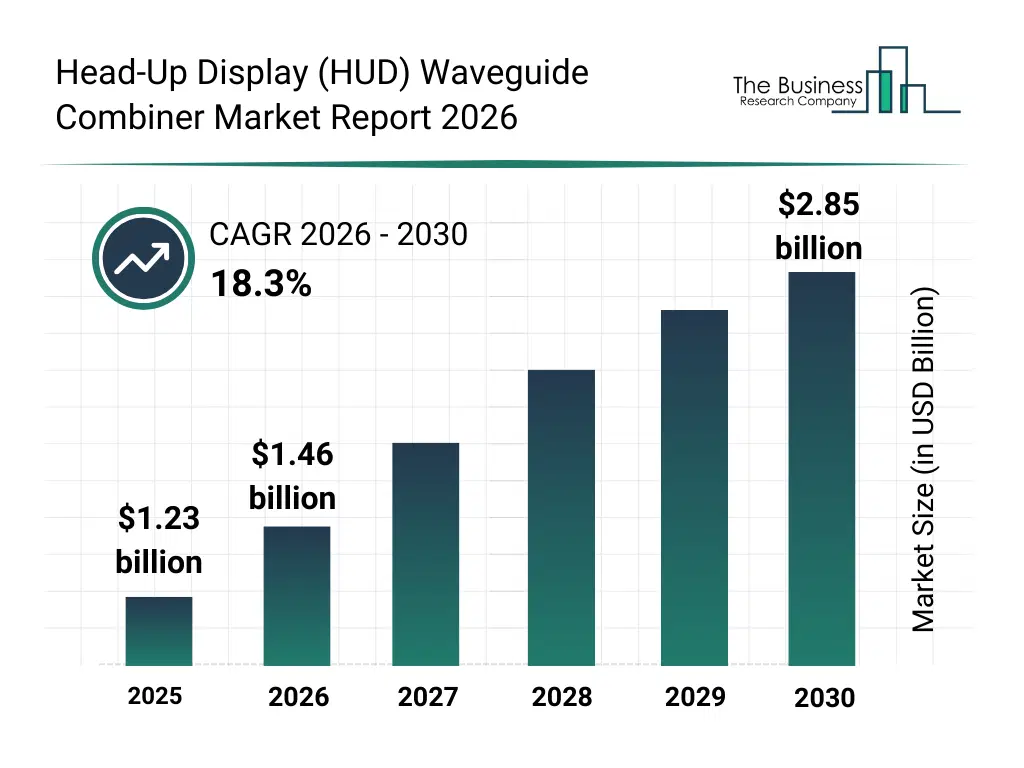
What Is The Head-Up Display (HUD) Waveguide Combiner Market Size and Share 2026?
The head-up display (hud) waveguide combiner market size has grown rapidly in recent years. It will grow from $1.23 billion in 2025 to $1.46 billion in 2026 at a compound annual growth rate (CAGR) of 18.6%. The growth in the historic period can be attributed to advancement in optical technologies, automotive hud adoption, need for driver safety information, premium vehicle demand, aviation display usage.What Is The Head-Up Display (HUD) Waveguide Combiner Market Growth Forecast?
The head-up display (hud) waveguide combiner market size is expected to see rapid growth in the next few years. It will grow to $2.85 billion in 2030 at a compound annual growth rate (CAGR) of 18.3%. The growth in the forecast period can be attributed to integration of ar-based huds, autonomous vehicle development, smart cockpit demand, growth in electric vehicles, advances in waveguide optics. Major trends in the forecast period include adoption of augmented reality huds, demand for enhanced driver assistance displays, miniaturization of optical components, growth of advanced cockpit systems, expansion into aviation applications.
Global Head-Up Display (HUD) Waveguide Combiner Market Segmentation
1) By Product Type: Reflective Waveguide Combiner, Diffractive Waveguide Combiner, Holographic Waveguide Combiner, Other Product Types 2) By Technology: Augmented Reality Head-Up Display (HUD), Conventional Head-Up Display (HUD) 3) By Application: Automotive, Aviation, Consumer Electronics, Military And Defense, Other Applications 4) By End-User: Original Equipment Manufacturers (OEMs), Aftermarket Subsegments: 1) By Reflective Waveguide Combiner: Surface-Relief Reflective Waveguide, Prism-Based Reflective Waveguide 2) By Diffractive Waveguide Combiner: Holographic Optical Element (HOE) Diffractive Waveguide, Grating-Based Diffractive Waveguide 3) By Holographic Waveguide Combiner: Volume Holographic Waveguide, Surface Holographic Waveguide 4) By Other Product Types: Polarization-Based Waveguide, Hybrid WaveguideWhat Is The Driver Of The Head-Up Display (HUD) Waveguide Combiner Market?
The growing popularity of electric vehicles is expected to propel the growth of the head-up display (HUD) waveguide combiner market going forward. Electric vehicles (EVs) are vehicles powered by electric motors using battery-stored energy, replacing or supplementing conventional internal combustion engines. Electric vehicles are increasing due to environmental concerns, as they produce little to no tailpipe emissions, reducing air pollution and greenhouse gas impact. Head up display waveguide combiners help electric vehicles by improving driver awareness through real time projection of essential information such as speed and navigation data directly onto the windshield, allowing drivers to stay focused on the road and enhancing overall safety. For instance, in March 2024, according to the International Energy Agency (IEA), a France-based autonomous intergovernmental organization, sales of electric cars in 2023 were 3.5 million higher than in 2022, a 35% year-on-year increase. Therefore, the growing popularity of electric vehicles is driving the growth of the head-up display (HUD) waveguide combiner industry.Key Players In The Global Head-Up Display (HUD) Waveguide Combiner Market
Major companies operating in the head-up display (hud) waveguide combiner market report include Hyundai Mobis Co. Ltd., Continental AG, BAE Systems Plc, Thales S.A., Elbit Systems Ltd., Garmin Ltd., G&H Diversified Manufacturing LP, UniMax Electronics, Dispelix Oy, Envisics Ltd., DigiLens Inc., Panasonic Automotive Systems GmbH, Foryou Multimedia Electronics Co. Ltd., Luminit-Holoptic LLC, Optinvent S.A., LetinAR Inc., Rockwell Collins Inc., SVG Tech Inc., Vuzix Corporation, AUMOVIO Engineering Solutions, Lochn Optics, Tripole Optoelectronics
This chart is for illustrative purposes; the full report includes a detailed competitor analysis and comprehensive overview of the top 10 companies in the market.
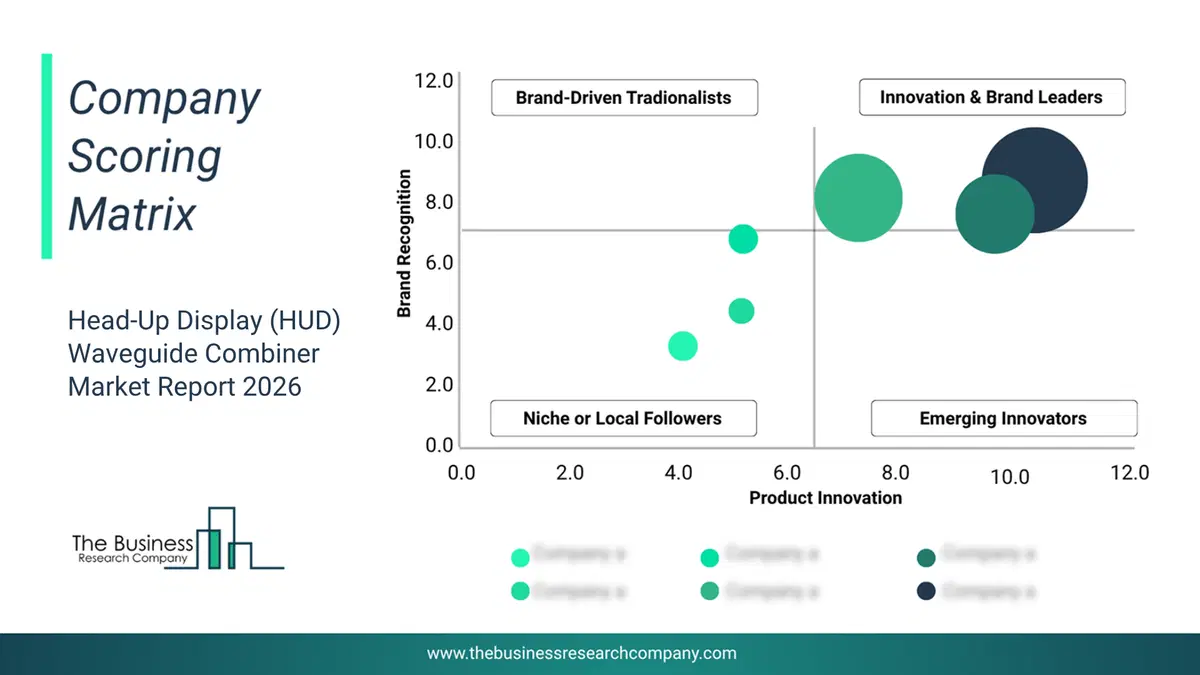
This chart maps companies by product innovation and brand strength, with bubble size indicating relative revenue, helping identify market leaders, challengers, and niche players. This is an illustrative chart; the full report provides a complete and accurate competitive analysis.
Global Head-Up Display (HUD) Waveguide Combiner Market Trends and Insights
Major companies operating in the head-up display (HUD) waveguide combiner market are focusing on developing advanced solutions, such as mirror-array vision extenders, to enhance projection clarity, reduce system size, and improve augmented-reality integration in vehicles. Mirror-array vision extenders refer to an optical technology that uses arrays of small mirrors in combination with angled and concave mirrors to project high-resolution images onto windshields, enabling compact, ghost-free AR displays compatible with standard automotive glass. For instance, in March 2024, UniMax, a Taiwan-based automotive electronics design company, introduced the world’s first augmented-reality HUD utilizing mirror-array vision extender (MAVE) technology. Designed for seamless vehicle integration, this solution reduces overall unit volume by at least 30%, eliminates the need for wedge glass to prevent ghosting, and delivers clear, real-time driver information, making AR HUDs more accessible for smaller and lower-cost vehicles.What Are Latest Mergers And Acquisitions In The Head-Up Display (HUD) Waveguide Combiner Market?
In June 2023, Saab AB, a Sweden-based aerospace company, partnered with Honeywell International Inc. to transform its advanced head-up display (HUD) technology. This collaboration aims to integrate Saab’s head-up display technology with Honeywell’s avionics expertise to provide improved flight safety and cockpit situational awareness through innovative, lightweight display solutions. Honeywell International Inc. is a US-based conglomerate that offers head-up display (HUD) waveguide combiners.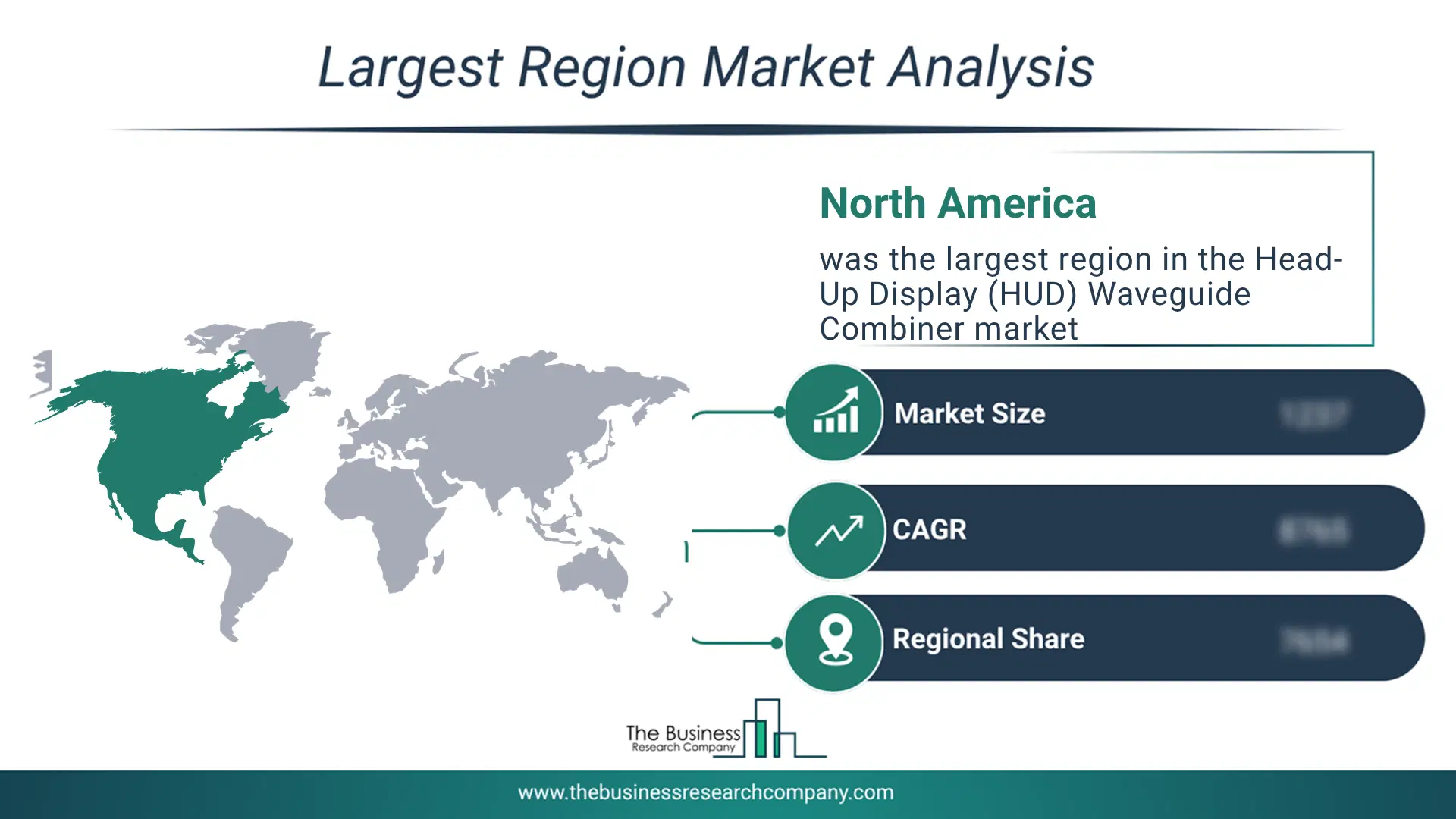
Regional Outlook
North America was the largest region in the head-up display (HUD) waveguide combiner market in 2025. Asia-Pacific is expected to be the fastest-growing region in the forecast period. The regions covered in this market report include Asia-Pacific, South East Asia, Western Europe, Eastern Europe, North America, South America, Middle East, Africa. The countries covered in this market report include Australia, Brazil, China, France, Germany, India, Indonesia, Japan, Taiwan, Russia, South Korea, UK, USA, Canada, Italy, SpainWhat Defines the Head-Up Display (HUD) Waveguide Combiner Market?
The head-up display (HUD) waveguide combiner market consists of sales of automotive head-up displays, windshield-integrated head-up display modules, and combiner glass. Values in this market are ‘factory gate’ values; that is, the value of goods sold by the manufacturers or creators of the goods, whether to other entities (including downstream manufacturers, wholesalers, distributors, and retailers) or directly to end customers. The value of goods in this market includes related services sold by the creators of the goods.How is Market Value Defined and Measured?
The market value is defined as the revenues that enterprises gain from the sale of goods and/or services within the specified market and geography through sales, grants, or donations in terms of the currency (in USD unless otherwise specified). The revenues for a specified geography are consumption values that are revenues generated by organizations in the specified geography within the market, irrespective of where they are produced. It does not include revenues from resales along the supply chain, either further along the supply chain or as part of other products.
This chart presents market attractiveness based on a quantitative evaluation of growth, competition, strategic alignment, and risk, offering a clear view of opportunity areas for decision-making. This chart is for illustrative purposes; the full report contains the complete analysis.

This chart highlights the Total Addressable Market (TAM) by estimating the maximum revenue opportunity using an assumption-driven approach, supporting strategic planning and opportunity sizing across markets. The chart is illustrative; the full report provides a more comprehensive analysis.
What Key Data and Analysis Are Included in the Head-Up Display (HUD) Waveguide Combiner Market Report 2026?
The head-up display (hud) waveguide combiner market research report is one of a series of new reports from The Business Research Company that provides market statistics, including industry global market size, regional shares, competitors with the market share, detailed market segments, market trends and opportunities, and any further data you may need to thrive in the head-up display (hud) waveguide combiner industry. The market research report delivers a complete perspective of everything you need, with an in-depth analysis of the current and future state of the industry.Head-Up Display (HUD) Waveguide Combiner Market Report Forecast Analysis
| Report Attribute | Details |
|---|---|
| Market Size Value In 2026 | $1.46 billion |
| Revenue Forecast In 2030 | $2.85 billion |
| Growth Rate | CAGR of 18.6% from 2026 to 2030 |
| Base Year For Estimation | 2025 |
| Actual Estimates/Historical Data | 2020-2025 |
| Forecast Period | 2026 - 2030 - 2030 |
| Market Representation | Revenue in USD Billion and CAGR from 2026 to 2030 |
| Segments Covered | Product Type, Technology, Application, End-User |
| Regional Scope | Asia-Pacific, Western Europe, Eastern Europe, North America, South America, Middle East, Africa |
| Country Scope | The countries covered in the report are Australia, Brazil, China, France, Germany, India, Indonesia, Japan, Taiwan, Russia, South Korea, UK, USA, Canada, Italy, Spain. |
| Key Companies Profiled | Hyundai Mobis Co. Ltd., Continental AG, BAE Systems Plc, Thales S.A., Elbit Systems Ltd., Garmin Ltd., G&H Diversified Manufacturing LP, UniMax Electronics, Dispelix Oy, Envisics Ltd., DigiLens Inc., Panasonic Automotive Systems GmbH, Foryou Multimedia Electronics Co. Ltd., Luminit-Holoptic LLC, Optinvent S.A., LetinAR Inc., Rockwell Collins Inc., SVG Tech Inc., Vuzix Corporation, AUMOVIO Engineering Solutions, Lochn Optics, Tripole Optoelectronics |
| Customization Scope | Request for Customization |
| Pricing And Purchase Options | Explore Purchase Options |