

Healthcare Assistive Robot Market Report 2026
Global Outlook – By Type (Care Robot, Surgical Assistive Robot), By Portability (Fixed Base, Mobile), By End User (Hospitals, Clinics, Ambulatory Surgical Centers, Other End Users) - Market Size, Trends, Strategies, and Forecast to 2030
Healthcare Assistive Robot Market Overview
• Healthcare Assistive Robot market size has reached to $1.58 billion in 2025 • Expected to grow to $3.97 billion in 2030 at a compound annual growth rate (CAGR) of 20.2% • Growth Driver: Navigating The Surge In Orthopedic Disorders With Robotics In Healthcare • Market Trend: Introduction To Technological Advancements Of Rehab Robotics In The Healthcare Assistive Robots Market • North America was the largest region in 2025.What Is Covered Under Healthcare Assistive Robot Market?
Healthcare assistive robots are intelligent machines designed to help individuals with disabilities, the elderly, or those requiring care by performing mobility support, patient monitoring, and rehabilitation exercises. They enhance healthcare delivery by assisting with physical tasks, providing companionship, and enabling remote health monitoring and communication. These robots improve quality of life, foster greater independence, and reduce the workload on healthcare professionals. The main types of healthcare assistive robots are care robots and surgical assistive robots. Care robots are designed to assist in the care of patients, providing support with daily activities, emotional interaction, or monitoring health conditions. The types of portability include fixed base and mobile. These are used by various end users, such as hospitals, clinics, ambulatory surgical centers, and others.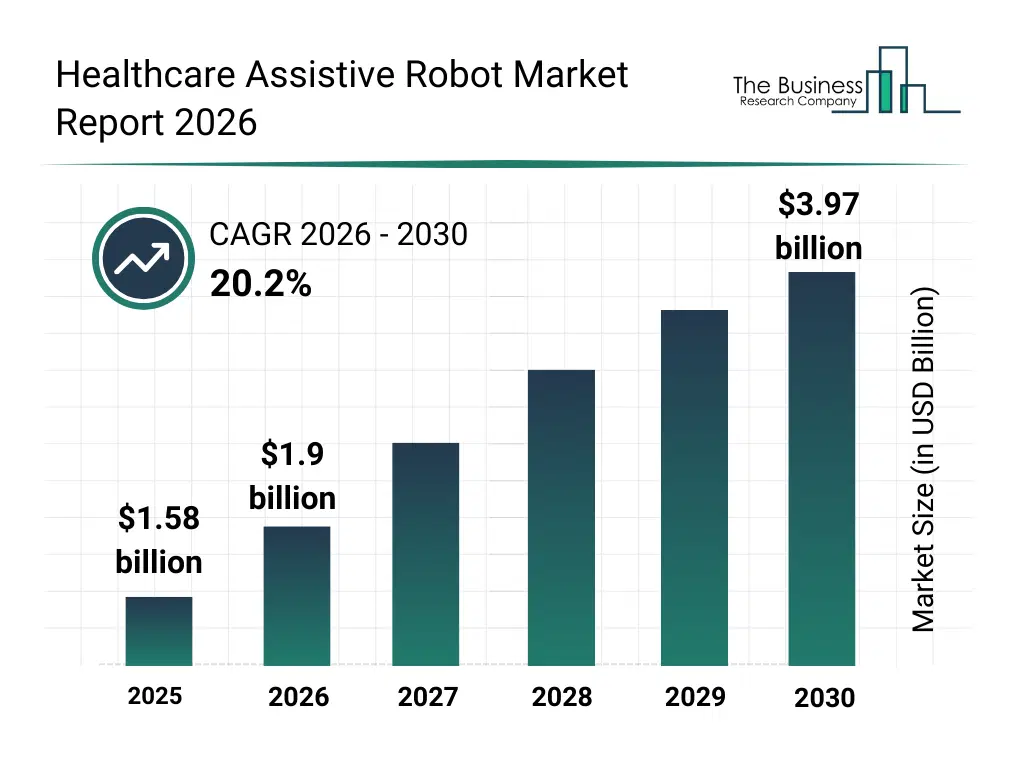
What Is The Healthcare Assistive Robot Market Size and Share 2026?
The healthcare assistive robot market size has grown exponentially in recent years. It will grow from $1.58 billion in 2025 to $1.9 billion in 2026 at a compound annual growth rate (CAGR) of 20.1%. The growth in the historic period can be attributed to rising elderly population requiring assisted care, increasing burden on healthcare workforce, early adoption of rehabilitation robotics, expansion of hospital automation initiatives, growing acceptance of robotic assistance in care settings.What Is The Healthcare Assistive Robot Market Growth Forecast?
The healthcare assistive robot market size is expected to see exponential growth in the next few years. It will grow to $3.97 billion in 2030 at a compound annual growth rate (CAGR) of 20.2%. The growth in the forecast period can be attributed to increasing demand for home-based healthcare solutions, rising investments in intelligent care technologies, expansion of remote and virtual care models, growing focus on patient independence and quality of life, technological advancements in robotics and ai. Major trends in the forecast period include increasing adoption of companion and socially assistive robots, rising deployment of mobility assistance and rehabilitation robots, growing integration of remote patient monitoring capabilities, expansion of telepresence robots in clinical settings, enhanced focus on human-robot interaction design.
Global Healthcare Assistive Robot Market Segmentation
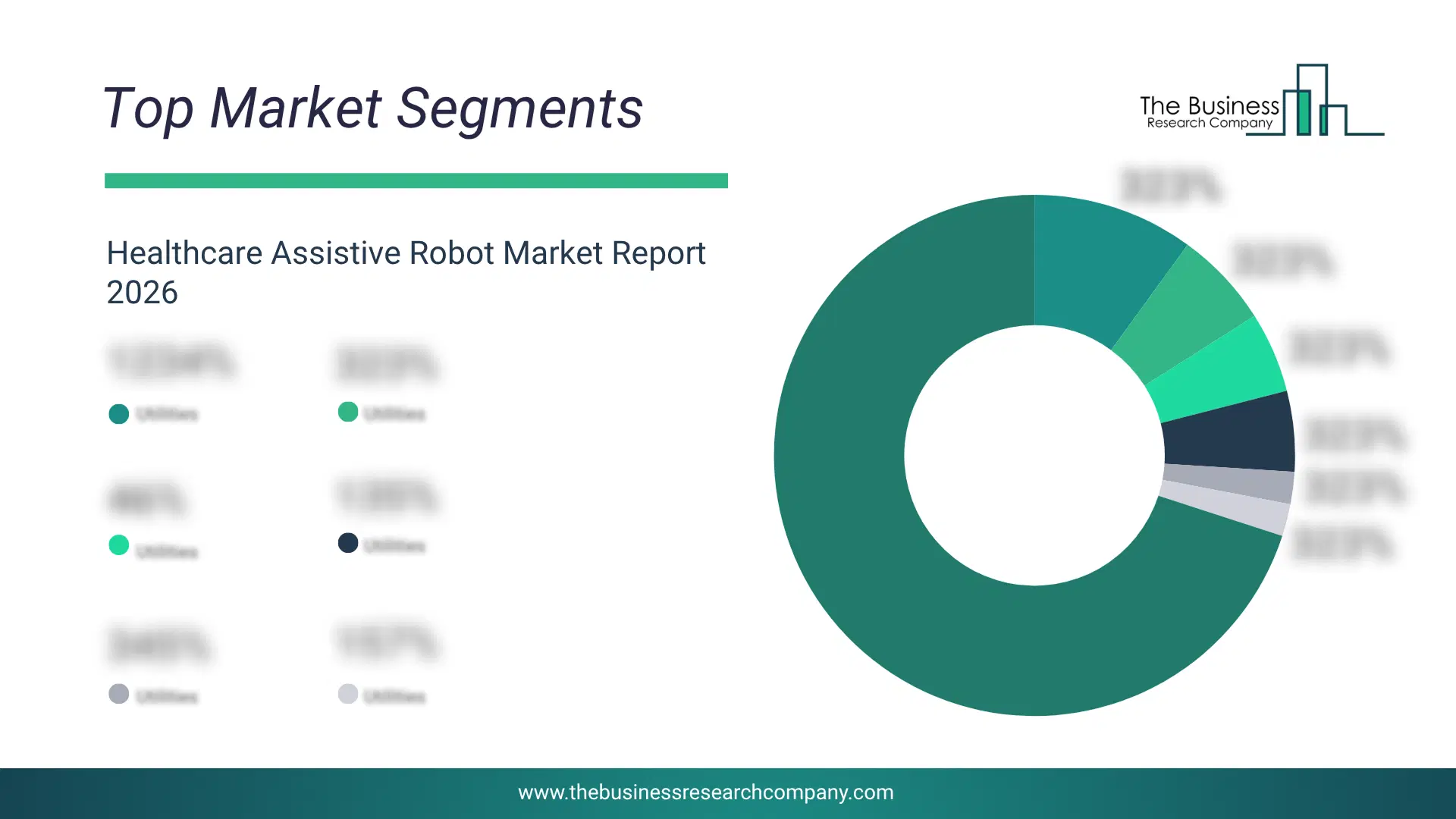
1) By Type: Care Robot, Surgical Assistive Robot 2) By Portability: Fixed Base, Mobile 3) By End User: Hospitals, Clinics, Ambulatory Surgical Centers, Other End Users Subsegments: 1) By Care Robot: Companion Robots, Rehabilitation Robots, Mobility Assistance Robots, Telepresence Robots, Hygiene And Sanitation Robots 2) By Surgical Assistive Robot: Robotic Surgical Systems, Robotic Endoscopic Systems, Robotic Orthopedic Systems, Robotic Assistance For Minimally Invasive SurgeriesWhat Is The Driver Of The Healthcare Assistive Robot Market?
The increasing incidence of orthopedic disorders is expected to propel the growth of the healthcare assistive robot market going forward. Orthopedic disorders refer to a broad category of conditions that affect the musculoskeletal system, which includes bones, joints, ligaments, tendons, muscles, and nerves. Healthcare assistive robots for orthopedic disorders help support mobility and rehabilitation and perform precise surgical procedures, thereby enhancing patient care and recovery. For instance, in August 2023, according to the Institute for Health Metrics and Evaluation (IHME), a US-based research institution, nearly 1 billion people will experience osteoarthritis, with knee cases increasing by 75% and hand cases by 50% by 2050. Therefore, the increasing incidence of orthopedic disorders is driving the growth of the healthcare assistive robot industry.Key Players In The Global Healthcare Assistive Robot Market
Major companies operating in the healthcare assistive robot market are HONDA Motor Co. Ltd., Johnson & Johnson, Medtronic PLC, ABB Ltd., Stryker Corporation, Zimmer Biomet Holdings Inc., Intuitive Surgical Inc., OmniCell Inc., Globus Medical Inc., SoftBank Robotics Group Corp., Kinova Inc., CMR Surgical Ltd., Diligent Robotics Inc., Cyberdyne Inc., Ekso Bionics Holdings Inc., Titan Medical Inc., ReWalk Robotics Ltd., Focal Meditech BV, Barrett Technology, Rex Bionics Ltd., Bionik Laboratories Corp.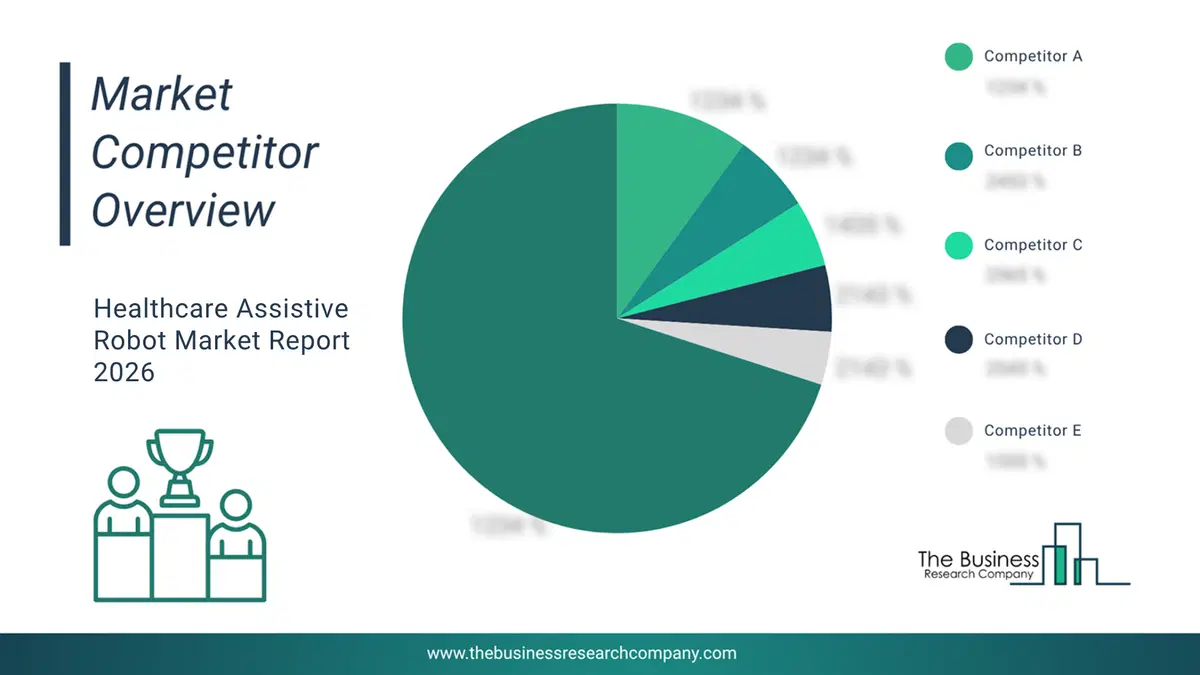
This chart is for illustrative purposes; the full report includes a detailed competitor analysis and comprehensive overview of the top 10 companies in the market.
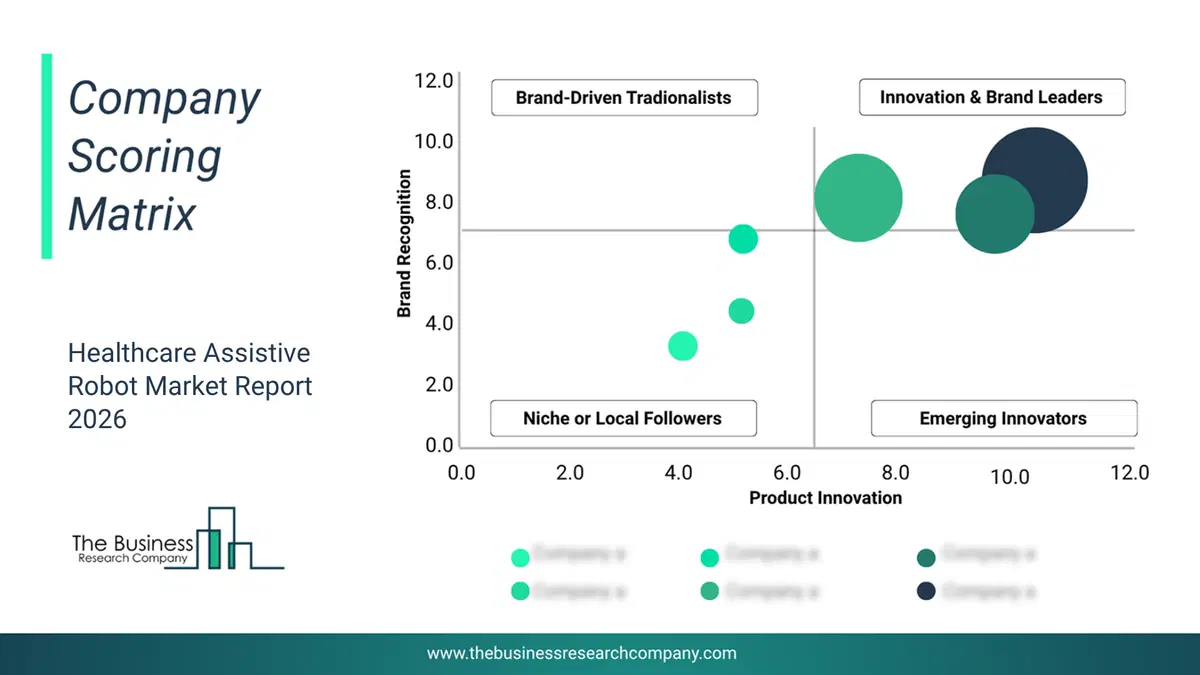
This chart maps companies by product innovation and brand strength, with bubble size indicating relative revenue, helping identify market leaders, challengers, and niche players. This is an illustrative chart; the full report provides a complete and accurate competitive analysis.
Global Healthcare Assistive Robot Market Trends and Insights
Major companies operating in the healthcare assistive robot market are developing innovative technologies, such as gait therapy software, to increase their profitability in the market. Gait therapy software refers to specialized programs that guide robots in assisting patients with walking exercises, aiming to improve mobility and rehabilitation outcomes. For instance, in January 2024, Ekso Bionics Holdings Inc., a US-based robotic exoskeleton manufacturer, launched GaitCoach Software for EksoNR, a clinical rehabilitation wearable robot designed for exoskeletal assistance. This revolutionized gait therapy with its capability to tailor sessions to individual patient needs, provide real-time, dynamic feedback, and deliver precise guidance akin to that of an additional clinical observer. This innovative software, which succeeds SmartAssist, enhances the integration of robotics in rehabilitation, as evidenced by 96% of experienced EksoNR users finding it highly intuitive and 93% valuing its guidance for simplifying usage.What Are Latest Mergers And Acquisitions In The Healthcare Assistive Robot Market?
In January 2025, 1X Technologies, a US-based provider of humanoid and general-purpose robots, acquired Kind Humanoid Inc. for an undisclosed amount. With this acquisition, 1X accelerated its roadmap for intelligent household and healthcare-assistive robots by combining its robotics platform with Kind Humanoid’s bio-inspired design and AI-driven interaction capabilities. Kind Humanoid is a US-based company that develops bipedal, consumer-friendly humanoid robots aimed at caregiving, companionship, and assistance in home environments.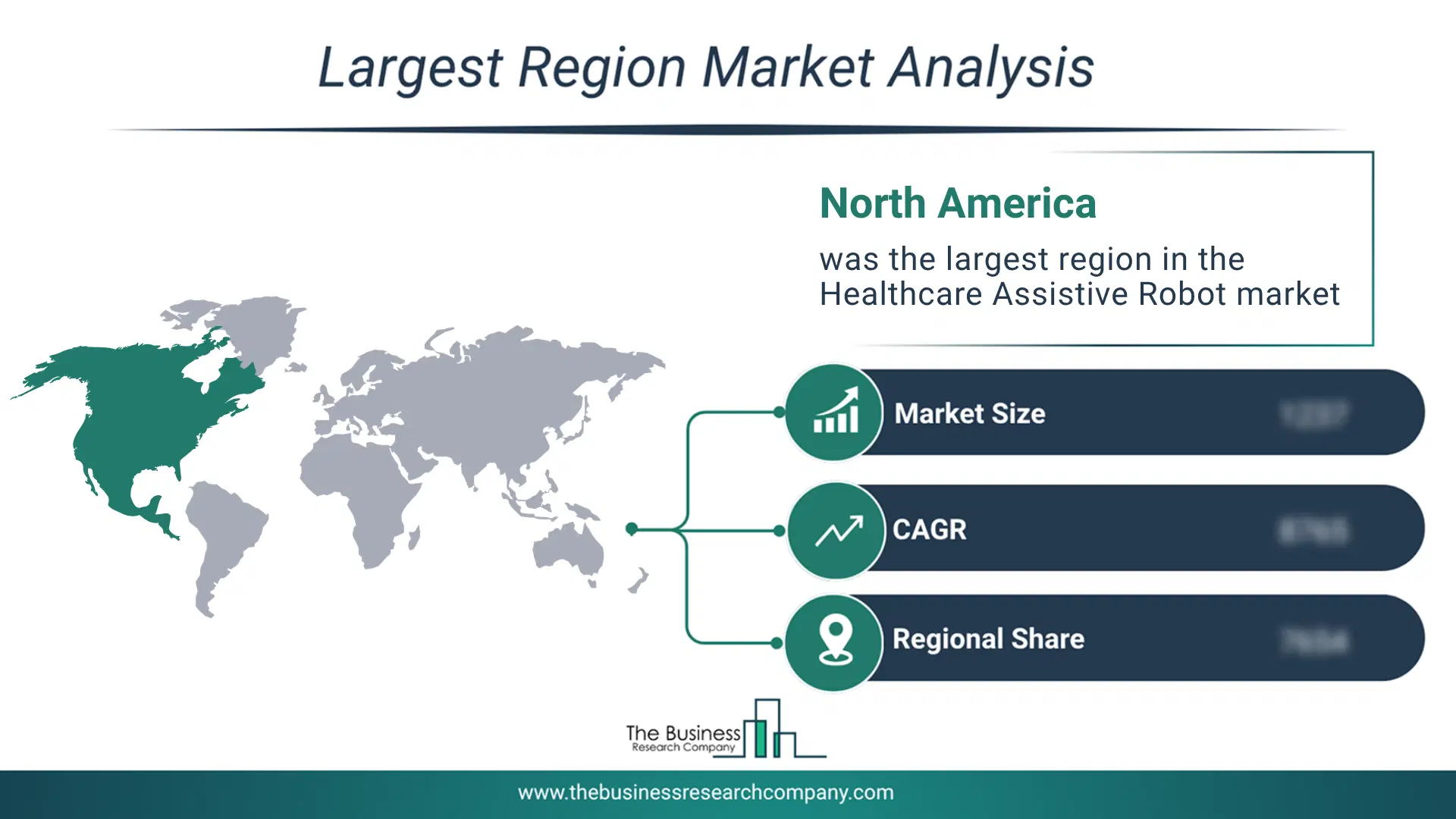
Regional Outlook
North America was the largest region in the healthcare assistive robot market in 2025. The regions covered in this market report are Asia-Pacific, South East Asia, Western Europe, Eastern Europe, North America, South America, Middle East, Africa. The countries covered in this market report are Australia, Brazil, China, France, Germany, India, Indonesia, Japan, Taiwan, Russia, South Korea, UK, USA, Canada, Italy, Spain.What Defines the Healthcare Assistive Robot Market?
The healthcare assistive robot market consists of revenues earned by entities by providing services such as patient care and monitoring, assistance with daily activities, surgical assistance, telepresence and remote care, disinfection and sanitation, physical therapy, and rehabilitation. The market value includes the value of related goods sold by the service provider or included within the service offering. The healthcare assistive robot market also includes sales of mobility assistance robots, patient transfer robots, prosthetic and orthotic robots, telepresence robots, surgical robots, rehabilitation robots, social assistance robots, disinfection robots, medication dispensing robots, and diagnostic robots. Values in this market are ‘factory gate’ values, that is, the value of goods sold by the manufacturers or creators of the goods, whether to other entities (including downstream manufacturers, wholesalers, distributors, and retailers) or directly to end customers. The value of goods in this market includes related services sold by the creators of the goods.How is Market Value Defined and Measured?
The market value is defined as the revenues that enterprises gain from the sale of goods and/or services within the specified market and geography through sales, grants, or donations in terms of the currency (in USD unless otherwise specified). The revenues for a specified geography are consumption values that are revenues generated by organizations in the specified geography within the market, irrespective of where they are produced. It does not include revenues from resales along the supply chain, either further along the supply chain or as part of other products.
This chart presents market attractiveness based on a quantitative evaluation of growth, competition, strategic alignment, and risk, offering a clear view of opportunity areas for decision-making. This chart is for illustrative purposes; the full report contains the complete analysis.

This chart highlights the Total Addressable Market (TAM) by estimating the maximum revenue opportunity using an assumption-driven approach, supporting strategic planning and opportunity sizing across markets. The chart is illustrative; the full report provides a more comprehensive analysis.
What Key Data and Analysis Are Included in the Healthcare Assistive Robot Market Report 2026?
The healthcare assistive robot market research report is one of a series of new reports from The Business Research Company that provides market statistics, including industry global market size, regional shares, competitors with the market share, detailed market segments, market trends and opportunities, and any further data you may need to thrive in the healthcare assistive robot industry. The market research report delivers a complete perspective of everything you need, with an in-depth analysis of the current and future state of the industry.Healthcare Assistive Robot Market Report Forecast Analysis
| Report Attribute | Details |
|---|---|
| Market Size Value In 2026 | $1.9 billion |
| Revenue Forecast In 2030 | $3.97 billion |
| Growth Rate | CAGR of 20.2% from 2026 to 2030 |
| Base Year For Estimation | 2025 |
| Actual Estimates/Historical Data | 2020-2025 |
| Forecast Period | 2026 - 2030 |
| Market Representation | Revenue in USD Billion and CAGR from 2026 to 2030 |
| Segments Covered | Type, Portability, End User |
| Regional Scope | Asia-Pacific, Western Europe, Eastern Europe, North America, South America, Middle East, Africa |
| Country Scope | The countries covered in the report are Australia, Brazil, China, France, Germany, India, Indonesia, Japan, Taiwan, Russia, South Korea, UK, USA, Canada, Italy, Spain |
| Key Companies Profiled | HONDA Motor Co. Ltd., Johnson & Johnson, Medtronic PLC, ABB Ltd., Stryker Corporation, Zimmer Biomet Holdings Inc., Intuitive Surgical Inc., OmniCell Inc., Globus Medical Inc., SoftBank Robotics Group Corp., Kinova Inc., CMR Surgical Ltd., Diligent Robotics Inc., Cyberdyne Inc., Ekso Bionics Holdings Inc., Titan Medical Inc., ReWalk Robotics Ltd., Focal Meditech BV, Barrett Technology, Rex Bionics Ltd., Bionik Laboratories Corp. |
| Customization Scope | Request for Customization |
| Pricing And Purchase Options | Explore Purchase Options |