
Healthcare Cybersecurity Market Report 2026
Global Outlook – By Solution (Identity And Access Management, Risk And Compliance Management, Antivirus And Antimalware, Distributed Denial Of Service (DDoS) Mitigation, Security Information And Event Management, Intrusion Detection System/ Intrusion Prevention System, Other Solutions), By Security (Network Security, Endpoint Security, Application Security, Content Security), By Threat (Malware, Distributed Denial Of Service (DDoS) Threats, Advanced Persistent Threat, Spyware, Lost Or Stolen Devices, Other Threats), By End User (Pharma And Chemicals, Medical Devices, Health Insurance, Hospitals, Other End Users) - Market Size, Trends, Strategies, and Forecast to 2030
Healthcare Cybersecurity Market Overview
• Healthcare Cybersecurity market size has reached to $27.52 billion in 2025 • Expected to grow to $56.69 billion in 2030 at a compound annual growth rate (CAGR) of 15.6% • Growth Driver: Rise Of Cybersecurity Needs In Healthcare Due To Increasing Cyber Threats • Market Trend: Advanced Threat Intelligence Solutions Strengthen Digital Defense For Hospitals • North America was the largest region in 2025 and Asia-Pacific is the fastest growing region.What Is Covered Under Healthcare Cybersecurity Market?
Healthcare cybersecurity refers to the practice of protecting electronic information and assets from unauthorized access, use, disclosure, disruption, modification, or destruction within the healthcare sector. It involves implementing a variety of security measures, technologies, and policies to safeguard patient data, hospital systems, and medical devices against cyber threats and breaches. This is essential for maintaining patient privacy, ensuring the integrity of medical records, and supporting the continuity of healthcare services. The main solutions to healthcare cybersecurity are identity and access management, risk and compliance management, antivirus and antimalware, distributed denial of service (DDoS) mitigation, security information and event management, intrusion detection systems/ intrusion prevention systems, and others. Identity and access management (IAM) is the process of managing and controlling access to sensitive information and systems within an organization. The types of security systems are network security, endpoint security, application security, and content security, that are used to control cybersecurity threats such as malware, distributed denial of service (DDoS) threats, advanced persistent threats, spyware, lost or stolen devices, and others. These are used by various end users, such as pharmaceuticals and chemicals, medical devices, health insurance, hospitals, and others.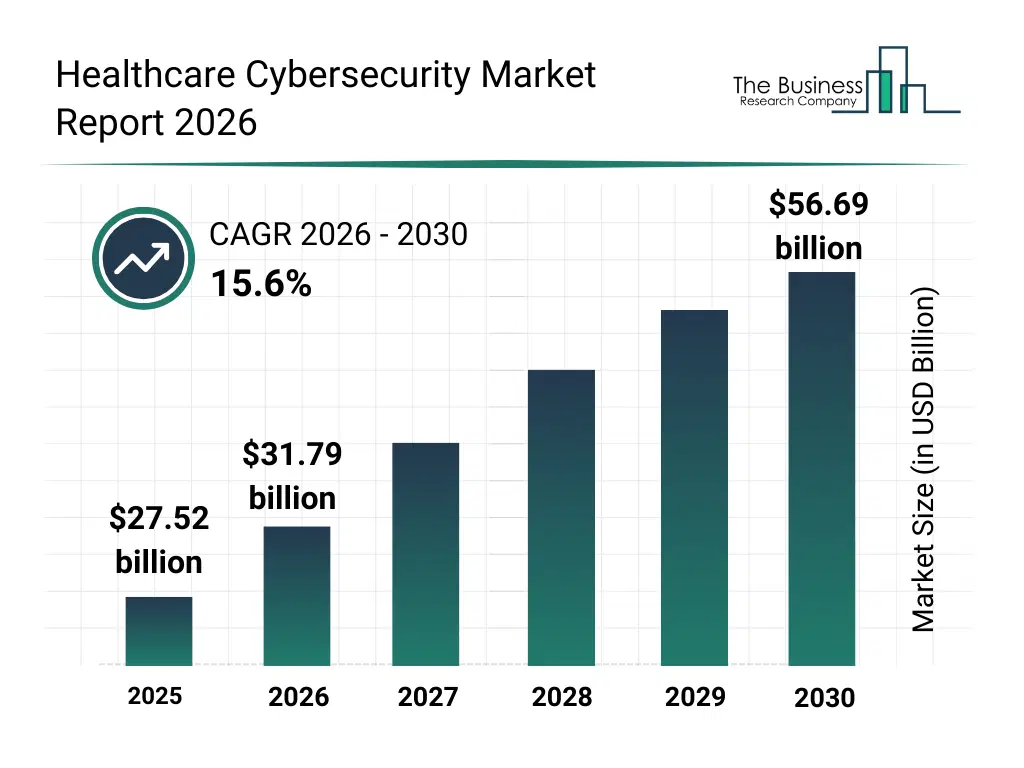
What Is The Healthcare Cybersecurity Market Size and Share 2026?
The healthcare cybersecurity market size has grown rapidly in recent years. It will grow from $27.52 billion in 2025 to $31.79 billion in 2026 at a compound annual growth rate (CAGR) of 15.5%. The growth in the historic period can be attributed to increasing digitization of healthcare records, rising cyberattack incidents on hospitals, adoption of electronic health records, expansion of connected medical devices, growing regulatory focus on patient data protection.What Is The Healthcare Cybersecurity Market Growth Forecast?
The healthcare cybersecurity market size is expected to see rapid growth in the next few years. It will grow to $56.69 billion in 2030 at a compound annual growth rate (CAGR) of 15.6%. The growth in the forecast period can be attributed to increasing investments in healthcare IT security, rising demand for real-time threat monitoring, expansion of cloud-based healthcare platforms, growing focus on ransomware prevention, increasing integration of cybersecurity in medical device design. Major trends in the forecast period include increasing deployment of advanced threat detection systems, rising adoption of zero-trust security frameworks, growing integration of AI-based security analytics, expansion of medical device cybersecurity solutions, enhanced focus on regulatory compliance and data privacy.
Global Healthcare Cybersecurity Market Segmentation
1) By Solution: Identity And Access Management, Risk And Compliance Management, Antivirus And Antimalware, Distributed Denial Of Service (DDoS) Mitigation, Security Information And Event Management, Intrusion Detection System/ Intrusion Prevention System, Other Solutions 2) By Security: Network Security, Endpoint Security, Application Security, Content Security 3) By Threat: Malware, Distributed Denial Of Service (DDoS) Threats, Advanced Persistent Threat, Spyware, Lost Or Stolen Devices, Other Threats 4) By End User: Pharma And Chemicals, Medical Devices, Health Insurance, Hospitals, Other End Users Subsegments: 1) By Identity And Access Management: User Authentication, Role-Based Access Control, Single Sign-On 2) By Risk And Compliance Management: Risk Assessment Tools, Compliance Management Solutions, Policy Management Software 3) By Antivirus And Antimalware: Antivirus Software, Antimalware Solutions, Endpoint Protection 4) By Distributed Denial Of Service (Ddos) Mitigation: Traffic Filtering, Rate Limiting, Ddos Protection Services 5) By Security Information And Event Management (SIEM): Log Management, Security Monitoring, Incident Response 6) By Intrusion Detection System Or Intrusion Prevention System (IDS Or IPS): Network-Based IDS Or IPS, Host-Based IDS Or IPS, Hybrid IDS Or IPS 7) By Other Solutions: Data Encryption Solutions, Threat Intelligence Services, Security Training And Awareness ProgramsWhat Is The Driver Of The Healthcare Cybersecurity Market?
The increasing number of cyberattacks is expected to propel the growth of the healthcare cybersecurity market going forward. Cyberattacks are malicious attempts to disrupt, damage, or gain unauthorized access to computer systems, networks, or devices. Cyberattacks are increasing because financially motivated threat actors are targeting organizations to steal sensitive data, execute ransomware operations, and exploit vulnerabilities for monetary gain. The healthcare cybersecurity supports this driver by providing advanced security tools that safeguard patient information, protect clinical operations, and prevent data breaches that could disrupt care delivery. For instance, in October 2025, according to the Australian Signals Directorate, a Australia-based government agency, in FY2024–25, the Australian Signals Directorate’s (ASD) Australian Cyber Security Centre (ACSC) received over 42,500 calls to the Australian Cyber Security Hotline, marking a 16% rise from the previous year. Therefore, the increasing number of cyberattacks is driving the growth of the healthcare cybersecurity industry.Key Players In The Global Healthcare Cybersecurity Market
Major companies operating in the healthcare cybersecurity market are Microsoft Corporation, Intel Corporation, International Business Machines Corporation, Cisco Systems Inc., Broadcom Inc., Thales Group, Palo Alto Networks Inc., Juniper Networks Inc., Fortinet Inc., Gen Digital Inc., Splunk Inc., Checkpoint Software Technologies Ltd., Trend Micro Inc., Crowdstrike Holdings Inc., Fortra LLC, Tenable Inc., Rapid7 Inc., Qualys Inc., McAfee Corp., Forescout Technologies Inc., LogRhythm Inc., Claroty Ltd., Sophos Ltd., Fortified Health Security, Sensato Cybersecurity Solutions
This chart is for illustrative purposes; the full report includes a detailed competitor analysis and comprehensive overview of the top 10 companies in the market.
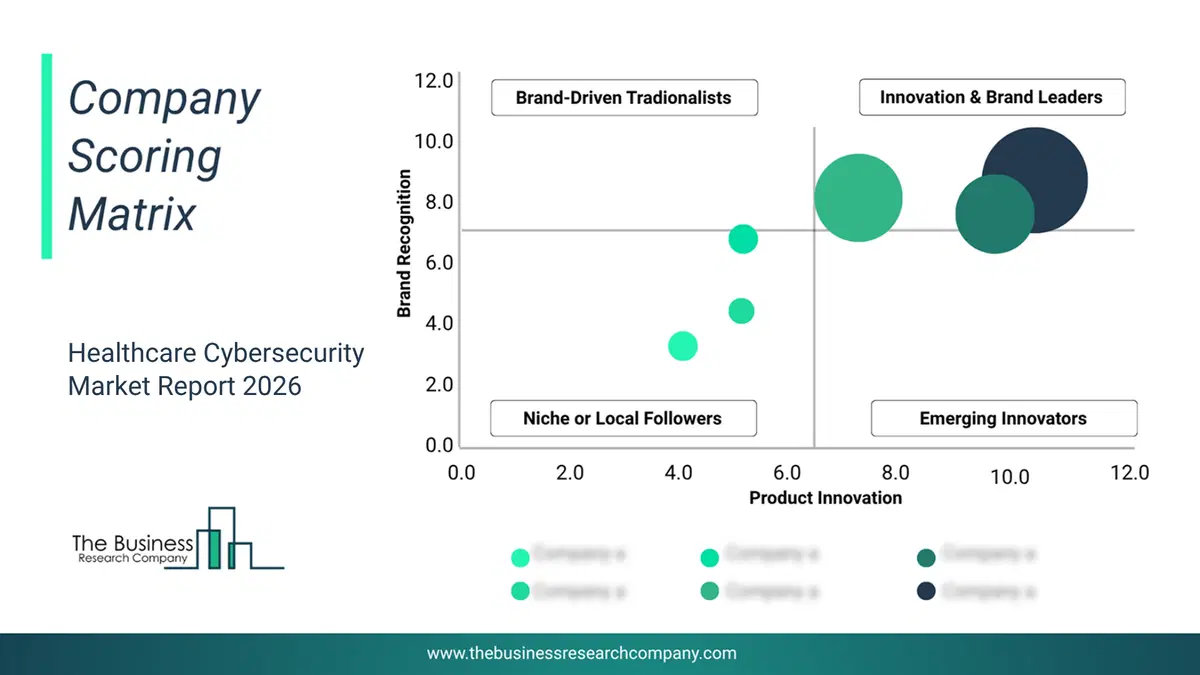
This chart maps companies by product innovation and brand strength, with bubble size indicating relative revenue, helping identify market leaders, challengers, and niche players. This is an illustrative chart; the full report provides a complete and accurate competitive analysis.
Global Healthcare Cybersecurity Market Trends and Insights
Major companies operating in the healthcare cybersecurity market are focusing on developing advanced solutions, such as healthcare-specific threat intelligence platforms, to strengthen protection of electronic health records, connected medical devices, and critical clinical systems against increasingly sophisticated cyberattacks. Healthcare-specific threat intelligence platforms refer to cybersecurity systems tailored for hospitals and health systems that aggregate sector-focused threat feeds, correlate indicators of compromise, and automate response workflows to help security teams detect, prioritize, and mitigate attacks targeting healthcare infrastructure. For instance, in December 2024, Cyware Labs Inc., a US-based cybersecurity software company, launched its Healthcare Tuned Threat Intelligence Platform (HC-TIP) to deliver curated, sector-specific threat intelligence to hospitals and clinical networks. The platform provides real-time visibility into ransomware attacks, medical-device vulnerabilities, and other healthcare-focused cyber risks. It also enhances incident response by offering pre-built workflows and automated threat-sharing capabilities tailored to the unique security needs of the healthcare sector.What Are Latest Mergers And Acquisitions In The Healthcare Cybersecurity Market?
In July 2025, Axonius Inc., a US-based cyber asset intelligence company, acquired Cynerio for $100 million. Through this acquisition, Axonius aims to strengthen its healthcare cybersecurity capabilities by integrating Cynerio’s medical device and healthcare IoT security platform to help hospitals secure connected medical devices and reduce cyber risks to patient care. Cynerio Israel Ltd is a Israel-based healthcare cybersecurity company specializing in protecting connected medical devices and clinical networks in hospital environments.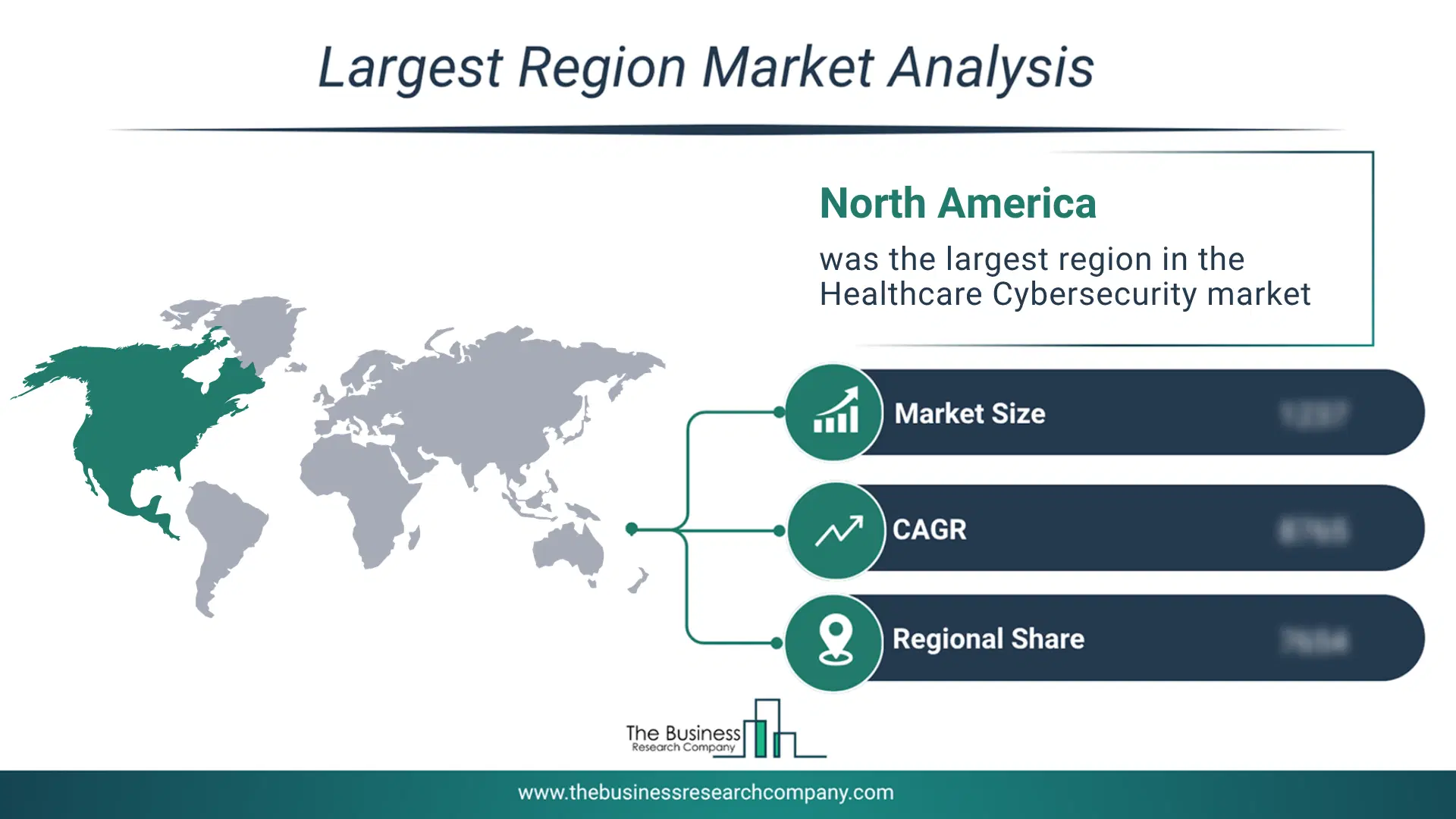
Regional Outlook
North America was the largest region in the healthcare cybersecurity market in 2025. Asia-Pacific is expected to be the fastest-growing region in the forecast period. The regions covered in this market report are Asia-Pacific, South East Asia, Western Europe, Eastern Europe, North America, South America, Middle East, Africa. The countries covered in this market report are Australia, Brazil, China, France, Germany, India, Indonesia, Japan, Taiwan, Russia, South Korea, UK, USA, Canada, Italy, Spain.What Defines the Healthcare Cybersecurity Market?
The healthcare cybersecurity market consists of revenues earned by entities by providing services such as risk assessment and management, data protection and encryption, firewall management, anti-malware and antivirus solutions, disaster recovery and business continuity planning, mobile and IoT security, and endpoint security. The market value includes the value of related goods sold by the service provider or included within the service offering. The healthcare cybersecurity market also includes sales of antivirus and anti-malware software, encryption tools, data loss prevention (DLP) software, patch management software, and phishing simulation tools that are used in providing services. Values in this market are ‘factory gate’ values, that is, the value of goods sold by the manufacturers or creators of the goods, whether to other entities (including downstream manufacturers, wholesalers, distributors, and retailers) or directly to end customers. The value of goods in this market includes related services sold by the creators of the goods.How is Market Value Defined and Measured?
The market value is defined as the revenues that enterprises gain from the sale of goods and/or services within the specified market and geography through sales, grants, or donations in terms of the currency (in USD unless otherwise specified). The revenues for a specified geography are consumption values that are revenues generated by organizations in the specified geography within the market, irrespective of where they are produced. It does not include revenues from resales along the supply chain, either further along the supply chain or as part of other products.
This chart presents market attractiveness based on a quantitative evaluation of growth, competition, strategic alignment, and risk, offering a clear view of opportunity areas for decision-making. This chart is for illustrative purposes; the full report contains the complete analysis.

This chart highlights the Total Addressable Market (TAM) by estimating the maximum revenue opportunity using an assumption-driven approach, supporting strategic planning and opportunity sizing across markets. The chart is illustrative; the full report provides a more comprehensive analysis.
What Key Data and Analysis Are Included in the Healthcare Cybersecurity Market Report 2026?
The healthcare cybersecurity market research report is one of a series of new reports from The Business Research Company that provides market statistics, including industry global market size, regional shares, competitors with the market share, detailed market segments, market trends and opportunities, and any further data you may need to thrive in the healthcare cybersecurity industry. The market research report delivers a complete perspective of everything you need, with an in-depth analysis of the current and future state of the industry.Healthcare Cybersecurity Market Report Forecast Analysis
| Report Attribute | Details |
|---|---|
| Market Size Value In 2026 | $31.79 billion |
| Revenue Forecast In 2030 | $56.69 billion |
| Growth Rate | CAGR of 15.6% from 2026 to 2030 |
| Base Year For Estimation | 2025 |
| Actual Estimates/Historical Data | 2020-2025 |
| Forecast Period | 2026 - 2030 |
| Market Representation | Revenue in USD Billion and CAGR from 2026 to 2030 |
| Segments Covered | Solution, Security, Threat, End User |
| Regional Scope | Asia-Pacific, Western Europe, Eastern Europe, North America, South America, Middle East, Africa |
| Country Scope | The countries covered in the report are Australia, Brazil, China, France, Germany, India, Indonesia, Japan, Taiwan, Russia, South Korea, UK, USA, Canada, Italy, Spain |
| Key Companies Profiled | Microsoft Corporation, Intel Corporation, International Business Machines Corporation, Cisco Systems Inc., Broadcom Inc., Thales Group, Palo Alto Networks Inc., Juniper Networks Inc., Fortinet Inc., Gen Digital Inc., Splunk Inc., Checkpoint Software Technologies Ltd., Trend Micro Inc., Crowdstrike Holdings Inc., Fortra LLC, Tenable Inc., Rapid7 Inc., Qualys Inc., McAfee Corp., Forescout Technologies Inc., LogRhythm Inc., Claroty Ltd., Sophos Ltd., Fortified Health Security, Sensato Cybersecurity Solutions |
| Customization Scope | Request for Customization |
| Pricing And Purchase Options | Explore Purchase Options |